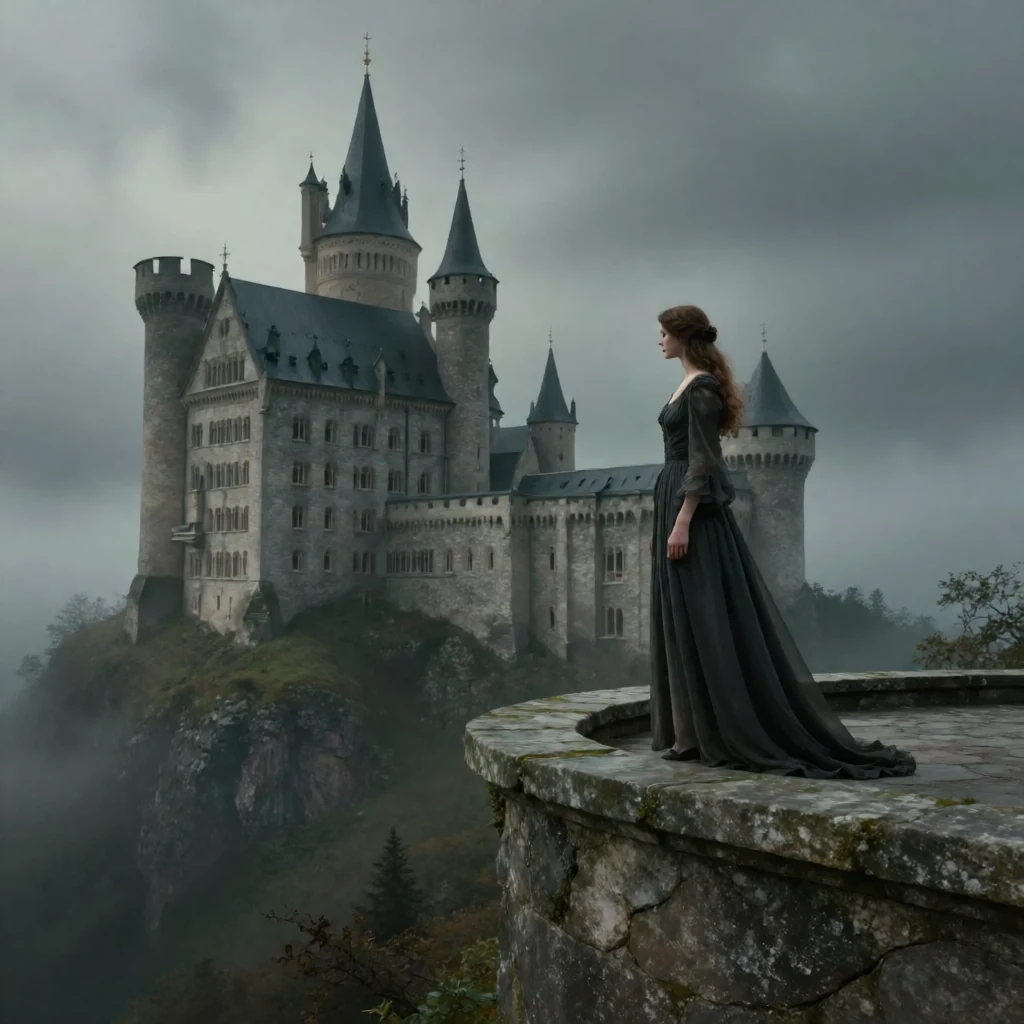
Verezzi’s Reckless Accusation
When Morano’s name is mentioned again, the wine-heated Verezzi ignores Cavigni’s warning looks and reveals Morano’s suggestion that the castle does not lawfully belong to Montoni, and that he would not willingly leave another murder on his conscience. Enraged, Montoni accuses his friends of insulting him, but Verezzi, confused, clarifies that they believe nothing against him. After a tense moment, Montoni recovers his composure and proposes a toast to Verezzi’s first exploit.
Montoni’s Story of the Lady Laurentini
To explain how the castle came into his possession, Montoni begins the story of the Lady Laurentini, his predecessor through the female line. Twenty years prior, he courted the beautiful and rich lady, who rejected him for another. After she was herself rejected, a deep melancholy seized her, and Montoni believes she ended her own life. On a night in October, she retired alone to the chamber at the end of the corridor—the very site of the previous night’s affray—and was never seen again.
The Mysterious Voice
Twice during Montoni’s telling, an unseen voice in the room startles the company. First, when Montoni promises to repeat the singular circumstances of the Lady Laurentini’s death, a voice says “Repeat them!” Later, as he tells them to listen, the same voice says “Listen!” The company is bewildered, as each guest looks to the others to identify the speaker, and no person is seen in the chamber.
The Disrupted Gathering
A search of the chamber by the summoned servants reveals no one, deepening the company’s surprise and consternation. Montoni, visibly discomposed, declares the subject too solemn and prepares to leave. When Verezzi jeeringly asks if he is superstitious, Montoni coldly replies that he knows how to despise commonplace platitudes. He leaves the room to investigate, and his unsettled guests retire to their own apartments for the night.
CHAPITRE VIII.
After Emily’s departure from Thoulouse, Valancourt lingers in the town, unable to tear himself from the places associated with her memory, particularly the terrace and pavilion where they took leave of each other. He blames himself for not having more forcefully opposed her journey to Italy and for allowing “an absurd and criminal delicacy” to overcome his reasonable arguments against it. When summoned to join his regiment, he accompanies a battalion to Paris, where the novelty and gaiety of the capital initially engage but eventually fatigue his grieving mind. His brother officers ridicule his reserved and thoughtful manners, and their schemes gradually draw him into their dissipations. Seeking relief from both solitude and company, Valancourt frequents the fashionable circles of Paris, including the assemblies of Countess Lacleur, who hosts elegant gatherings with gambling, and the Marchioness Champfort, a beautiful but artful widow. Though his brother’s relations receive him with kindness, they offer no real friendship, leaving him without guidance in a dangerous milieu. As time passes, habit and amusement gradually weaken his mourning for Emily, whose image, when recalled, now brings only mild reproach and unmixed misery rather than the tender melancholy of before, causing him to seek her memory less and less.
Opening Shakespeare Quote
The chapter opens with a Shakespeare quote: “He wears the rose of youth upon his cheek.” This sets the thematic tone for the chapter, which follows the youthful Valancourt as he navigates the temptations of Parisian society.
Valancourt Lingers at Thoulouse
After Emily’s departure from Thoulouse, Valancourt remains behind, unable to tear himself away from the scenes of their former happiness. He frequently visits the gardens of Madame Montoni’s château, spending hours wandering the terrace and pavilion where he last took leave of Emily. In these familiar places, he endeavors to recall her exact words, the tones of her voice, and the expression of her countenance. The memory of her face comes to him “like a vision,” awakening all his tenderness and telling him he has lost her forever. He blames himself for not having urged their marriage more forcefully and laments his “absurd and criminal delicacy” in failing to convince her to stay. His only restraint from following her to Italy is his military duty.
The original text of this work is in the public domain. This page focuses on a guided summary article, reading notes, selected quotes, and visual learning materials for educational purposes.