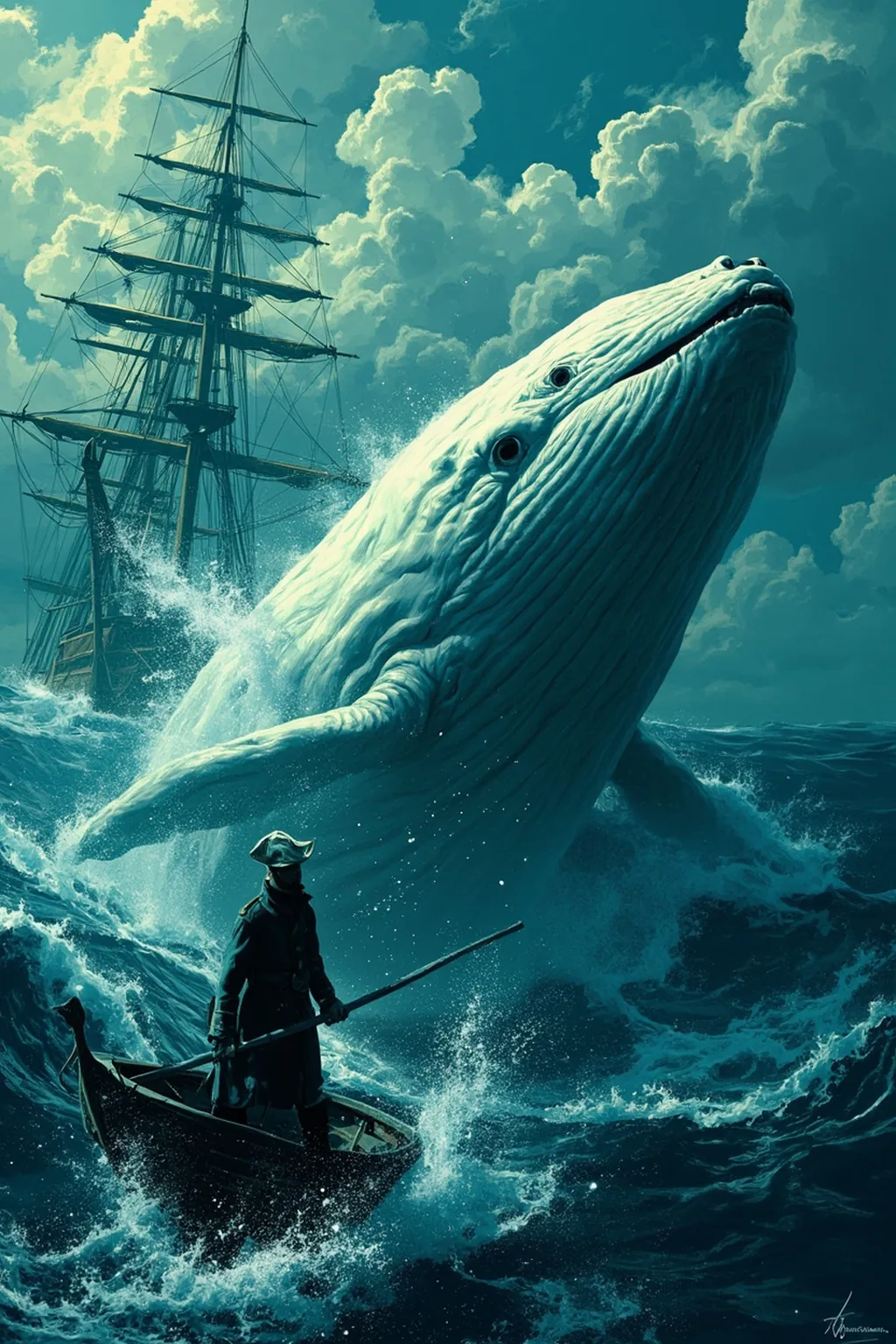
Ishmael Inspects Available Whaling Ships
Ishmael Inspects Available Whaling Ships After sauntering about the harbor and making various inquiries, Ishmael learns that three ships are fitted out for three-year whaling voyages: the Devil-dam, the Tit-bit, and the Pequod. He notes the likely origins of the first two names—the Devil-dam’s origin is unknown, while Tit-bit is self-explanatory—and recognizes Pequod as the name of a celebrated but now-extinct Massachusetts Indian tribe, comparable to the ancient Medes. Ishmael peers and pries about the Devil-dam, hops over to the Tit-bit, and finally goes aboard the Pequod. After looking around her briefly, he decides that the Pequod is the ship for them.
Ishmael Chooses the Pequod
Ishmael Chooses the Pequod After a moment’s inspection of the Pequod’s deck and appearance, Ishmael makes his decision to sail on this vessel. He judges her to be the right craft for his and Queequeg’s purposes, concluding the process of selection that Queequeg had entrusted to him in place of their original plan to choose a ship together.
Description of the Pequod
Description of the Pequod The Pequod is a ship of striking, antique character. Ishmael, who has seen many queer vessels, declares that nothing compares to this rare old craft. She is a small ship of the old school, with an old-fashioned claw-footed look, her hull long seasoned and weather-stained by typhoons and calms in all four oceans, her complexion darkened like a French grenadier who has fought in Egypt and Siberia. Her venerable bows appear bearded, and her masts—cut in Japan to replace originals lost overboard in a gale—stand stiffly like the spines of the three old kings of Cologne. Her ancient decks are worn and wrinkled like the pilgrim-worshipped flagstone in Canterbury Cathedral where Becket bled. To this antique foundation, half a century of whaling has added wild and marvelous features. Old Captain Peleg, her former chief-mate and now a part-owner, had built upon her original grotesqueness with quaint inlaid work of material and device unmatched except by Thorkill-Hake’s carved buckler or bedstead. She is apparelled like a barbaric Ethiopian emperor, with polished ivory pendants, and is a thing of trophies—a cannibal craft tricking herself forth in the chased bones of her enemies. Her open bulwarks are garnished with the long sharp teeth of the sperm whale, used as pins to fasten tendons of sea-ivory. Her tiller is carved from the long narrow lower jaw of the sperm whale, her hereditary foe, making the helmsman at her reverend helm feel like a Tartar holding back a fiery steed. She is a noble craft, but touched with melancholy, for all noble things share that quality. On the quarter-deck, Ishmael notices a strange conical tent or wigwam of limber black bone slabs taken from the right whale’s jaw, laced together and sloping toward a tufted apex, with a triangular opening facing the bow to command a view forward. This structure is being used as a temporary seat of authority while the ship is in port.
The original text of this work is in the public domain. This page focuses on a guided summary article, reading notes, selected quotes, and visual learning materials for educational purposes.