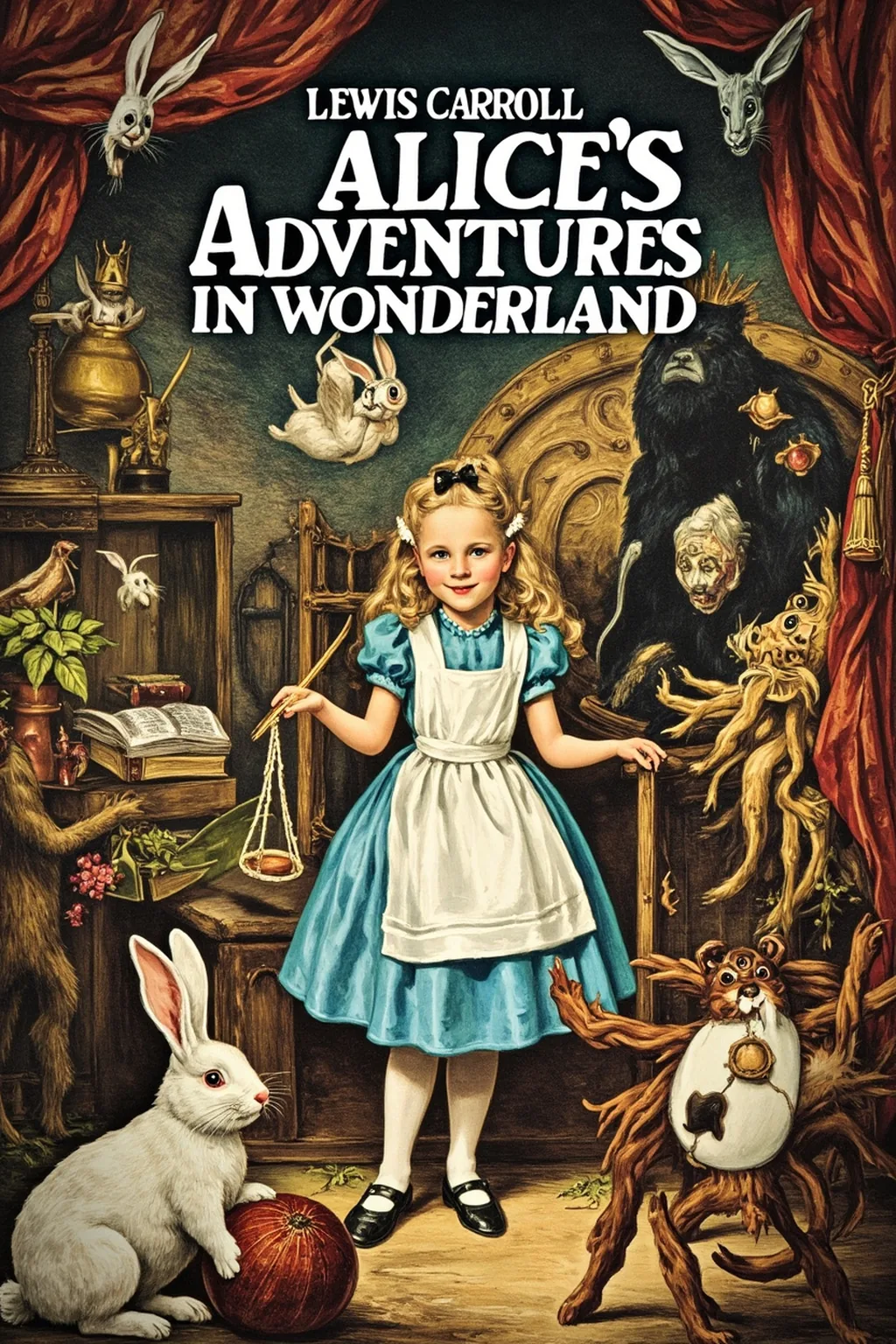
Alice Departs and Reaches the Beautiful Garden
Alice cannot bear the Hatter’s rudeness and departs in disgust, leaving the Dormouse to fall asleep instantly and the other two to place the Dormouse into the teapot. As she navigates through the wood, she notices a door in a tree and enters, finding herself back in the long hall with the glass table. She retrieves the golden key, unlocks the garden door, nibbles the mushroom to grow to approximately a foot tall, and walks down the passage into the beautiful garden with its flower-beds and cool fountains, escaping the maddening tea-party at last.
CHAPTER VIII. The Queen’s Croquet-Ground
A large rose-tree stood near the entrance of the garden, but the roses growing on it were white. This posed a problem for three gardeners—Two, Five, and Seven—who were busily painting them red. Their bickering was interrupted by Five’s panicked cry: “The Queen! The Queen!” The three men threw themselves flat upon their faces just as a grand procession approached: ten soldiers carrying clubs, ten courtiers ornamented with diamonds, ten royal children ornamented with hearts, the White Rabbit, the Knave of Hearts bearing the King’s crown, and finally the King and Queen of Hearts themselves.
Alice stood her ground when the Queen demanded to know who she was. “My name is Alice, so please your Majesty,” she said politely, though she reminded herself they were only a pack of cards. When the Queen screamed “Off with her head!” Alice replied “Nonsense!” so loudly that the Queen was silenced. The King, timid as ever, suggested the Queen consider that Alice was only a child.
The three gardeners, however, were not so lucky. The Queen spotted their white roses and ordered their execution. Three soldiers were left behind to carry out the sentence, but Alice hid the gardeners in a large flower-pot. When the Queen shouted to know if their heads were off, the soldiers reported they were gone. Pleased, the Queen asked if Alice could play croquet.
Alice joined the procession, walking beside the White Rabbit, who whispered that the Duchess was under sentence of execution for boxing the Queen’s ears. The croquet ground was a strange affair: ridges and furrows everywhere, the balls were live hedgehogs, the mallets live flamingoes, and the soldiers doubled themselves up to serve as arches. Alice struggled to manage her uncooperative flamingo, who kept twisting its neck to look at her, and her hedgehog kept unrolling itself and crawling away. The players all moved at once, quarrelling and fighting over the hedgehogs. Within minutes, the Queen was stamping about in a furious passion, shouting “Off with his head!” or “Off with her head!” about once a minute.
Seeking an ally, Alice noticed a curious grin floating in the air—it was the Cheshire Cat, appearing piece by piece. Alice complained about the game’s unfairness, and when the Queen asked how Alice liked her, Alice hastily added that the Queen was “likely to win.” The King, however, demanded the Cat’s removal, and the Queen promptly ordered its execution. A dispute erupted among the executioner, the King, and the Queen: you couldn’t cut off a head without a body, the executioner protested. Alice suggested they ask the Duchess, who was in prison, but by the time the executioner returned with her, the Cat had entirely faded away.
CHAPTER IX. The Mock Turtle’s Story
The Duchess appeared in a remarkably pleasant temper, tucking her arm into Alice’s as they walked. Alice reflected that perhaps the pepper in the kitchen had made her so savage before. She decided, when she became a Duchess, to banish pepper entirely from her kitchen—she theorized that pepper made people hot-tempered, vinegar made them sour, and barley-sugar made children sweet-tempered. The Duchess, however, was determined to find a moral in everything. When Alice said the game was going better, the Duchess replied that “’tis love, ’tis love, that makes the world go round!” When Alice whispered that it was done by everybody minding their own business, the Duchess offered another moral: “Take care of the sense, and the sounds will take care of themselves.”
The Duchess grew curious about Alice’s flamingo, though Alice doubted the wisdom of letting her try to put her arm around her waist. Their conversation was interrupted by the Queen, who appeared with her arms folded and frowning like a thunderstorm. “Either you or your head must be off,” she warned, “and that in about half no time!” The Duchess chose to vanish instantly.
The game resumed, and by the end of half an hour, every player except the King, the Queen, and Alice had been sentenced to execution. The Queen then asked whether Alice had seen the Mock Turtle. “It’s the thing Mock Turtle Soup is made from,” she explained. They walked off together, the King quietly pardoning everyone behind them, leaving Alice relieved.
They came upon a Gryphon lying fast asleep, whom the Queen ordered to take Alice to see the Mock Turtle. The Gryphon chuckled once the Queen was out of sight. “What fun!” it said. “It’s all her fancy, that: they never executes nobody, you know.” They found the Mock Turtle sitting sad and lonely on a ledge of rock, sighing as if his heart would break. Alice pitied him deeply.
“Once,” said the Mock Turtle at last, with a deep sigh, “I was a real Turtle.” He went on to tell of his schooldays in the sea. Their master was an old Turtle they called Tortoise “because he taught us,” which earned Alice a stern rebuke for being dull. Their education included Reeling and Writhing, the branches of Arithmetic—Ambition, Distraction, Uglification, and Derision—Mystery ancient and modern, Seaography, Drawling, Stretching, and Fainting in Coils. The Classics master was an old crab who taught Laughing and Grief, which made both creatures hide their faces in their paws. Lessons, the Gryphon explained, were so named because they lessened from day to day: ten hours the first day, nine the next, and so on.
The original text of this work is in the public domain. This page offers a compressed quick-read summary for educational purposes.