Summary
From this day, natural philosophy—and chemistry in its most comprehensive sense—became nearly my sole occupation. I read with ardour the works of modern inquirers, attended lectures, and cultivated the acquaintance of the men of science at the university. Even in M. Krempe I found sound sense and real information, though his manners were repulsive. In M. Waldman I found a true friend—his gentleness was never tinged by dogmatism, his instructions frank and free of pedantry. In a thousand ways he smoothed for me the path of knowledge, and my application soon became so ardent that the stars often disappeared in the light of morning whilst I was yet in my laboratory.
Two years passed thus, during which I paid no visit to Geneva. None but those who have experienced them can conceive the enticements of science: in other studies you go as far as others have gone, and there is nothing more to know; but in a scientific pursuit there is continual food for discovery and wonder. I improved so rapidly that I made discoveries in chemical instruments which procured me great esteem at the university. My ardour was the astonishment of the students, and my proficiency that of the masters.
I then turned my attention to the structure of the human frame and the principle of life—a bold question, ever considered a mystery. My father had taken care that my mind should be impressed with no supernatural horrors; darkness had no effect upon my fancy. But now I was forced to spend days and nights in vaults and charnel-houses, examining the minutiae of causation as exemplified in the change from life to death. At length, from the midst of this darkness, a sudden light broke in upon me—a light so brilliant and wondrous, yet so simple.
After days and nights of incredible labour, I succeeded in discovering the cause of generation and life; nay, more, I became myself capable of bestowing animation upon lifeless matter.
I hesitated long concerning the manner in which I should employ so astonishing a power. To prepare a frame for the reception of life—with all its intricacies of fibres, muscles, and veins—remained a work of inconceivable difficulty. But my imagination was too much exalted by my first success to permit me to doubt of my ability to give life to an animal as complex and wonderful as man. Resolved to make the being of a gigantic stature—about eight feet in height—I began the creation of a human being.
Life and death appeared to me ideal bounds which I should first break through. A new species would bless me as its creator; many happy and excellent natures would owe their being to me. I collected bones from charnel-houses and kept my workshop of filthy creation in a solitary cell at the top of the house. The dissecting room and the slaughter-house furnished many of my materials; often did my human nature turn with loathing from my occupation, whilst, still urged on by an eagerness which perpetually increased, I brought my work near to a conclusion.
The summer months passed while I was thus engaged, heart and soul. My eyes were insensible to the charms of nature, and the same feelings caused me to forget my friends, so many miles absent. I knew my silence disquieted them, and I well remembered my father’s words: that he would regard any interruption in my correspondence as a proof that my other duties were equally neglected. But I could not tear my thoughts from my employment.
I am now convinced that he was justified in conceiving that I should not be altogether free from blame. A human being ought always to preserve a calm and peaceful mind. If the study to which you apply yourself has a tendency to weaken your affections and destroy your taste for those simple pleasures in which no alloy can possibly mix, then that study is certainly unlawful. If this rule were always observed, Greece had not been enslaved, Cæsar would have spared his country, America would have been discovered more gradually, and the empires of Mexico and Peru had not been destroyed.
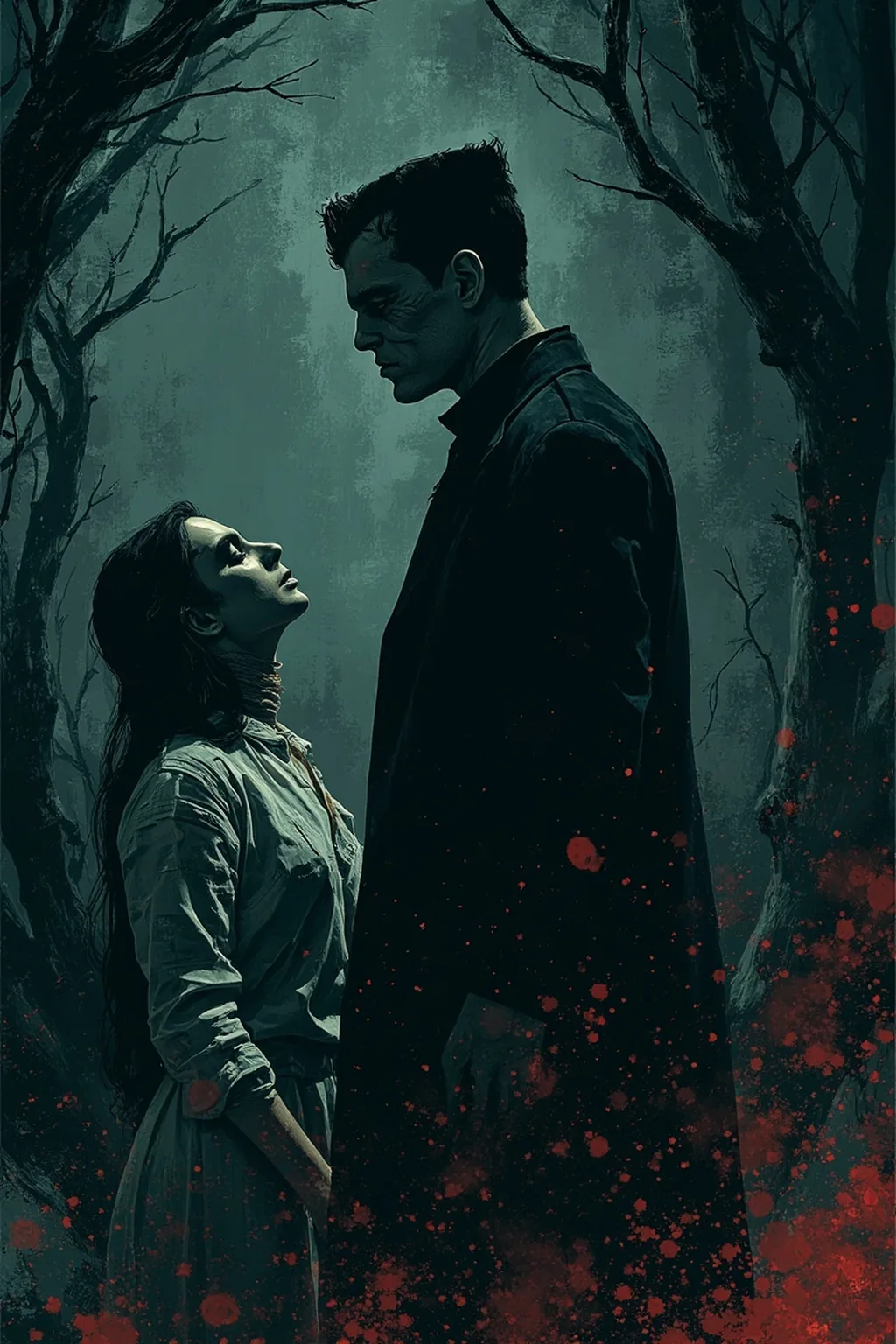
It was on a dreary night of November that I beheld the accomplishment of my toils. By the glimmer of the half-extinguished light, I saw the dull yellow eye of the creature open; it breathed hard, and a convulsive motion agitated its limbs.
His limbs were in proportion, and I had selected his features as beautiful. Beautiful! His yellow skin scarcely covered the work of muscles and arteries beneath; his hair was of a lustrous black, his teeth of a pearly whiteness; but these luxuriances only formed a more horrid contrast with his watery eyes, his shrivelled complexion, and straight black lips.
I rushed out of the room, unable to endure the aspect of the being I had created. At length lassitude succeeded, and I threw myself on the bed, endeavouring to seek a few moments of forgetfulness. I slept, indeed—but I was disturbed by the wildest dreams. I thought I saw Elizabeth, in the bloom of health; but as I imprinted the first kiss on her lips, they became livid with the hue of death; her features appeared to change, and I thought that I held the corpse of my dead mother in my arms. I started from my sleep with horror, and, by the dim and yellow light of the moon, I beheld the wretch—the miserable monster whom I had created. He held up the curtain of the bed; his jaws opened, and he muttered some inarticulate sounds. I escaped and rushed downstairs.
Morning, dismal and wet, at length dawned. I continued walking, endeavouring by bodily exercise to ease the load upon my mind:
Like one who, on a lonely road, Doth walk in fear and dread, And, having once turned round, walks on, And turns no more his head; Because he knows a frightful fiend Doth close behind him tread.
[Coleridge’s Ancient Mariner.]
At length I paused opposite to the inn at which the diligences stopped, and on the door being opened, I perceived Henry Clerval, who instantly sprung out. “My dear Frankenstein, how glad I am to see you! How fortunate that you should be here at the very moment of my alighting!”
Nothing could equal my delight on seeing Clerval. I grasped his hand, and in a moment forgot my horror and misfortune. He told me how he had persuaded his father to let him undertake a voyage of discovery to the land of knowledge, his father at last replying only with the words of the Dutch schoolmaster in The Vicar of Wakefield: “I have ten thousand florins a year without Greek, I eat heartily without Greek.”
We walked to my college. I dreaded to behold the monster, but I feared still more that Henry should see him. I threw the door of my apartment forcibly open—but nothing appeared. The monster had fled. I clapped my hands for joy.
The original text of this work is in the public domain. This page offers a compressed quick-read summary for educational purposes.