Whale-boat Design
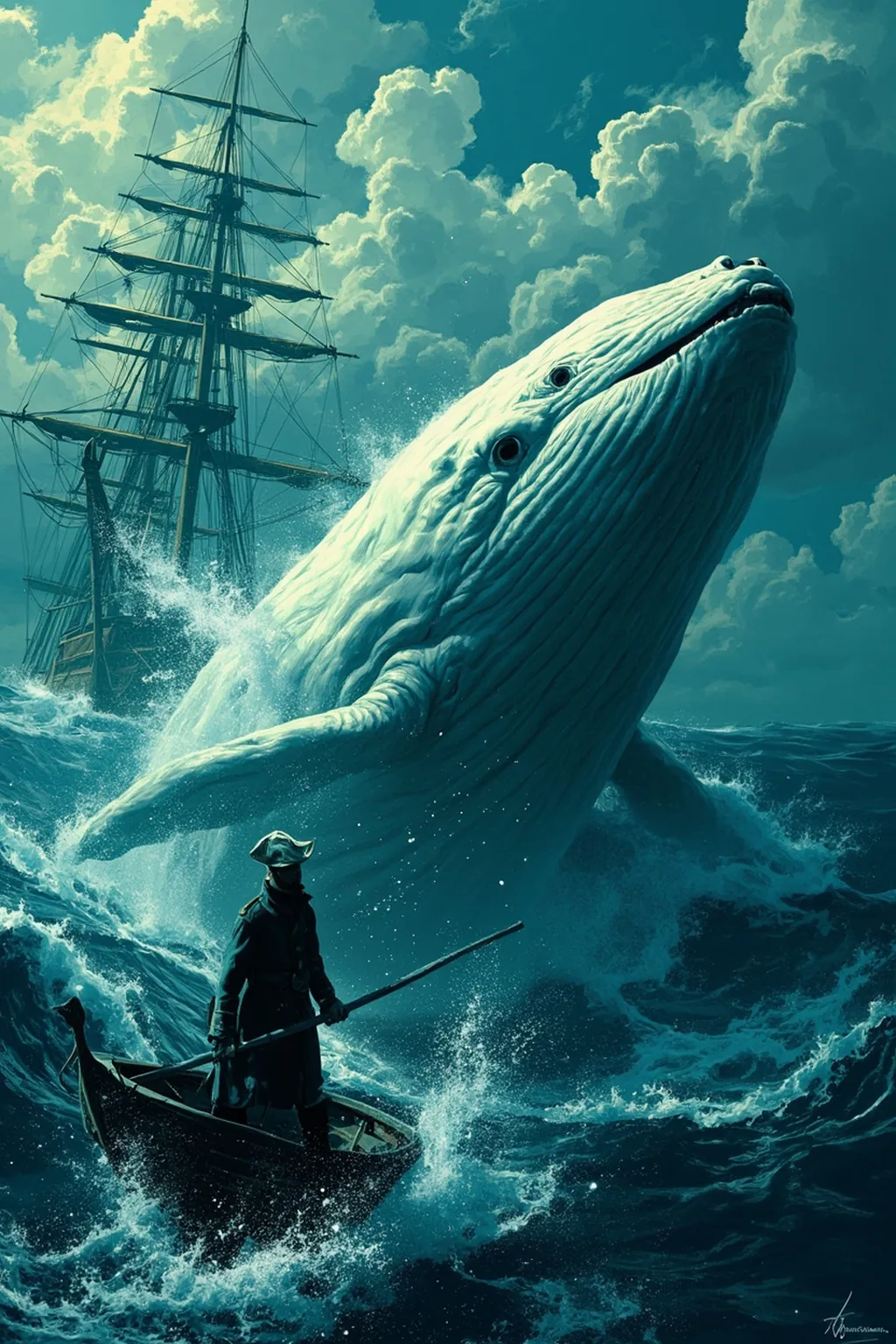
The design of the whale-boat differs markedly from boats used on pirate, man-of-war, or slave ships. While other vessels provide captains with comfortable, sometimes cushioned seats in the stern sheets and allow them to steer with decorated tillers, the whale-boat has no rear seat whatsoever and admits no tiller. This stark simplicity reflects the practical and unostentatious nature of whalemen, who would find it undignified to be wheeled about the water like gouty aldermen in patent chairs.
Captain’s Standing Dignity
In the whale-boat, when a gam is arranged, the captain must stand during the entire trip to the visiting vessel. He has no place to sit and must be “pulled off to his visit all standing like a pine tree.” Convinced of the eyes of the whole visible world resting upon him from both ships, the standing captain is acutely aware of the need to sustain his dignity by maintaining his balance and composure. This proves no easy task given the boat’s motion and his precarious position.
Boat Steering Customs
The whale-boat’s steering oar projects behind the standing captain, repeatedly striking him in the small of his back, while the after-oar raps his knees in front. He becomes wedged between these constraints and can only expand sideways by settling down on his stretched legs. Yet a sudden pitch threatens to topple him, since a narrow foundation offers little stability. Additionally, he must not be seen steadying himself by holding anything – he typically carries his hands in his pockets as a token of self-command, though Melville admits that well-authenticated instances exist where a captain, in sudden squalls, has seized an oarsman’s hair and held on like grim death.
CHAPITRE 54. The Town-Ho’s Story.
The chapter is framed as a story told at Lima’s Golden Inn to Spanish friends, recounting the Town-Ho’s encounter with Moby Dick and the resulting tragedy between the mate Radney and the Lakeman Steelkilt. The Town-Ho’s Story, told through a nested narrative by the Lakeman, recounts a mutiny aboard the whaling ship Town-Ho, where Steelkilt, a Canaller boatswain, leads a rebellion against the captain’s cruelty. After his allies betray him, Steelkilt is locked in the hold, but ultimately engineers a patient, vengeful plot against Chief Mate Radney, who had earlier violently struck him. The chapter weaves together commentary on the corrupt, picturesque life of the Canallers, a sharp satirical exchange with Lima gentlemen about corruption, and a slow-building tragedy of betrayal, punishment, and retribution at sea. This is the full account of the whaling ship Town-Ho’s voyage, centered on the conflict between crew member Steelkilt and the ship’s first mate Radney, the appearance and attack of the white whale Moby Dick, the crew’s desertion at a remote island, and the subsequent questioning of the story’s truth.
CHAPITRE 54. The Town-Ho’s Story.
The chapter is framed as a story told at Lima’s Golden Inn to Spanish friends, recounting the Town-Ho’s encounter with Moby Dick and the resulting tragedy between the mate Radney and the Lakeman Steelkilt.
The Golden Inn
The chapter opens with a reference to the Golden Inn, establishing the storytelling setting on a saint’s eve, with young Dons Pedro and Sebastian as the interlocutors who ask clarifying questions throughout the tale.
Encountering the Town-Ho
Shortly after speaking the Goney, a homeward-bound whaleman called the Town-Ho, manned almost entirely by Polynesians, is encountered. During a brief gam, she brings strong news of the White Whale.
The Secret Part of the Story
The narrator explains that the story contains a secret portion involving a mysterious judgment of God connected to the whale. This secret was known only to three white seamen of the Town-Ho, eventually leaked through Tashtego’s sleep-talking, but was kept hidden from Captain Ahab and the rest of the Pequod’s crew.
A Leak in the Hold
About two years before, the Town-Ho was cruising in the Pacific north of the Line when the crew discovered she was making more water than usual in her hold. They suspected a swordfish stab, but the captain, believing good luck awaited him in those latitudes, chose to continue cruising while the crew pumped at regular intervals. The leak, however, steadily worsened.
The original text of this work is in the public domain. This page focuses on a guided summary article, reading notes, selected quotes, and visual learning materials for educational purposes.