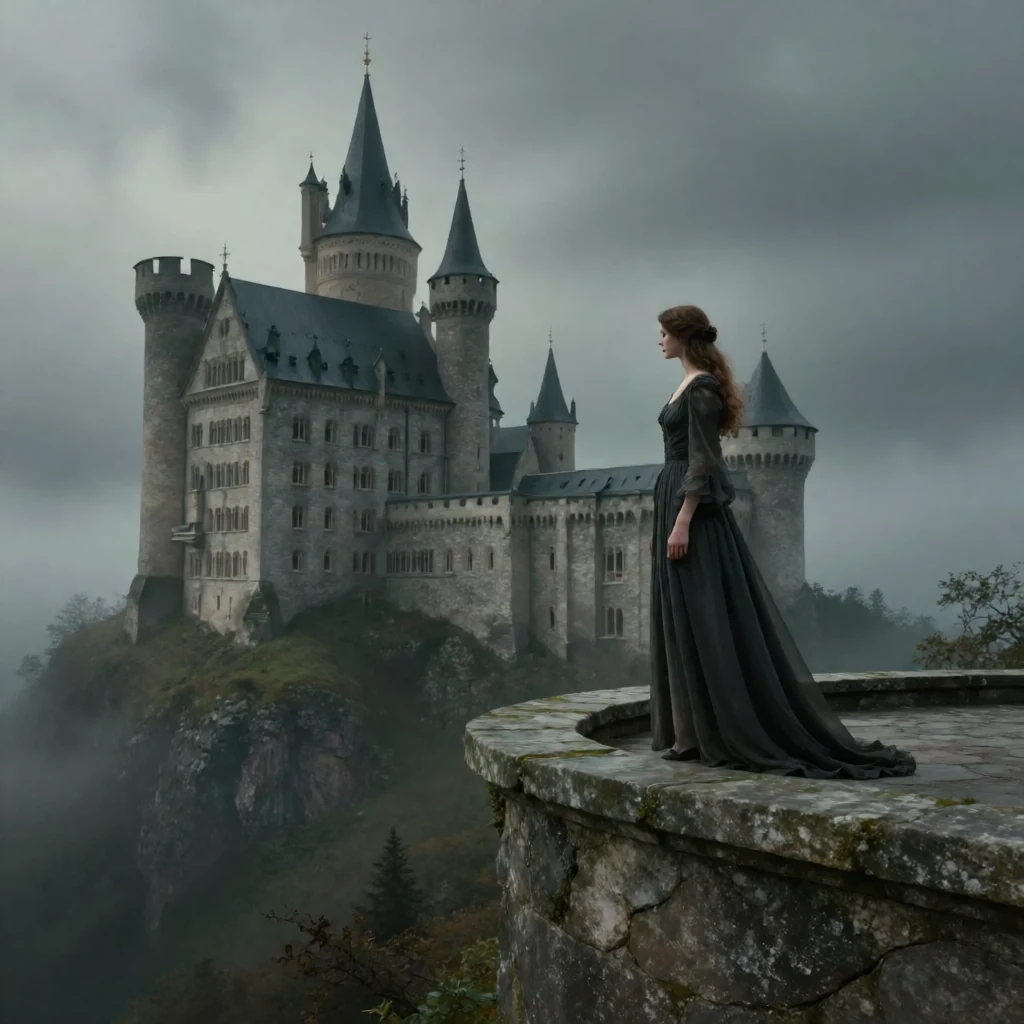
Shepherd’s Cabin and Grazing Herds
As they advance, the valley opens and its savage features soften. By evening they are among heathy mountains, hearing the solitary sheep-bell and the shepherd’s call. His cabin, partly shaded by cork-tree and ilex, is the only human habitation visible. Verdant bottom-lands and hollow recesses shelter grazing herds of cattle, some reposing by or laving in the cool stream.
Twilight Journey and Mysterious Horn
The setting sun gleams on the water and heightens the rich tints of heath and broom. As twilight falls and no cottages appear, Michael attempts to keep up his courage by singing a dismal vesper-hymn to his favourite saint. Travellers are roused by the sound of fire-arms, then a rustling in the brakes; St. Aubert draws a pistol and orders Michael forward. A horn echoes through the mountains.
Encounter with the Hunter Stranger
A young man in hunter’s dress, with a gun, horn, dogs, and a small pike, springs from the bushes onto the road. After a moment’s hesitation, St. Aubert stops to enquire about the hamlet. The stranger offers to guide them, and when invited to ride in the carriage, politely declines and keeps pace with the mules. He warns them that the mountain inhabitants lack even the necessaries of life. In the increasing dusk, Emily asks about a bright cloud on a distant peak, which St. Aubert identifies as a snowy summit still catching the sun’s rays. Village lights soon twinkle through the dusk.
Search for Hamlet Lodging
The stranger informs St. Aubert that there is no inn or public lodging in the village. The two men search together while Emily follows slowly in the carriage. The cottages they enter reek of ignorance, poverty, and mirth; owners eye St. Aubert with curious timidity. Nothing like a bed can be found. When Emily joins them, she observes her father’s pallor and laments the chosen road. Other cottages are scarcely less savage, housing mules and pigs with families of six to eight children on beds of skins and dried beech leaves, with a scent of spirits betraying the influence of Pyrenean smugglers.
Stranger’s Offer of His Bed
The young stranger draws St. Aubert aside and offers his own bed, describing it as decent only by comparison. St. Aubert refuses, but the stranger insists, urging that an invalid should not lie on hard skins while a younger man sleeps comfortably, and that refusal wounds his pride. St. Aubert consents on the condition that Emily can also be accommodated. He privately marvels that the stranger prioritized an infirm man over a young woman, but Emily is too grateful for her father’s comfort to consider herself.
CHAPTER III
CHAPTER III continues the journey, centering on the hospitality received at a superior cottage where St. Aubert and Emily are joined by the stranger Valancourt. The chapter depicts a homely evening meal, an intelligent conversation between St. Aubert and Valancourt that reveals the young man’s admirable qualities, a noisy quarrel between the muleteer Michael and the hostess over the lodging of his mules, Valancourt’s gentlemanly resolution of the dispute, and the discovery that Valancourt is a man of literary taste.
Cottage Hospitality and Conversation with Valancourt
On the road, the stranger, whose name is Valancourt, speaks first to the hostess of a cottage and welcomes St. Aubert inside. The cottage is much superior to others he has seen, and although it offers only eggs and milk, St. Aubert supplements the meal from his own provisions and invites Valancourt to share. The two men pass an hour in intelligent conversation, and St. Aubert is impressed by Valancourt’s manly frankness, simplicity, and keen susceptibility to the grandeur of nature—a sensibility St. Aubert has often said cannot exist strongly without a certain simplicity of heart.
Muleteer’s Quarrel Over Mule Lodging
The conversation is interrupted by a violent uproar outside, in which the muleteer Michael’s voice rises above all others. When St. Aubert goes to investigate, he finds Michael quarrelling with the hostess because she has refused to let his mules lie in the small room where he and her three sons are meant to sleep. The place is wretched, but there is no other for the family. With more delicacy than usual among the people of that wild region, she persists in refusing to let the animals share a bed-chamber with her children. Michael takes this as a wound to his honour, declaring his mules as honest and as good as any in the province, entitled to good treatment wherever they go. He defends them as harmless as lambs unless affronted, recounts a single past incident in which they broke a sleeping boy’s leg but were corrected and never misbehaved again, and concludes by vowing that the beasts shall share with him wherever he goes.
The original text of this work is in the public domain. This page offers a compressed quick-read summary for educational purposes.