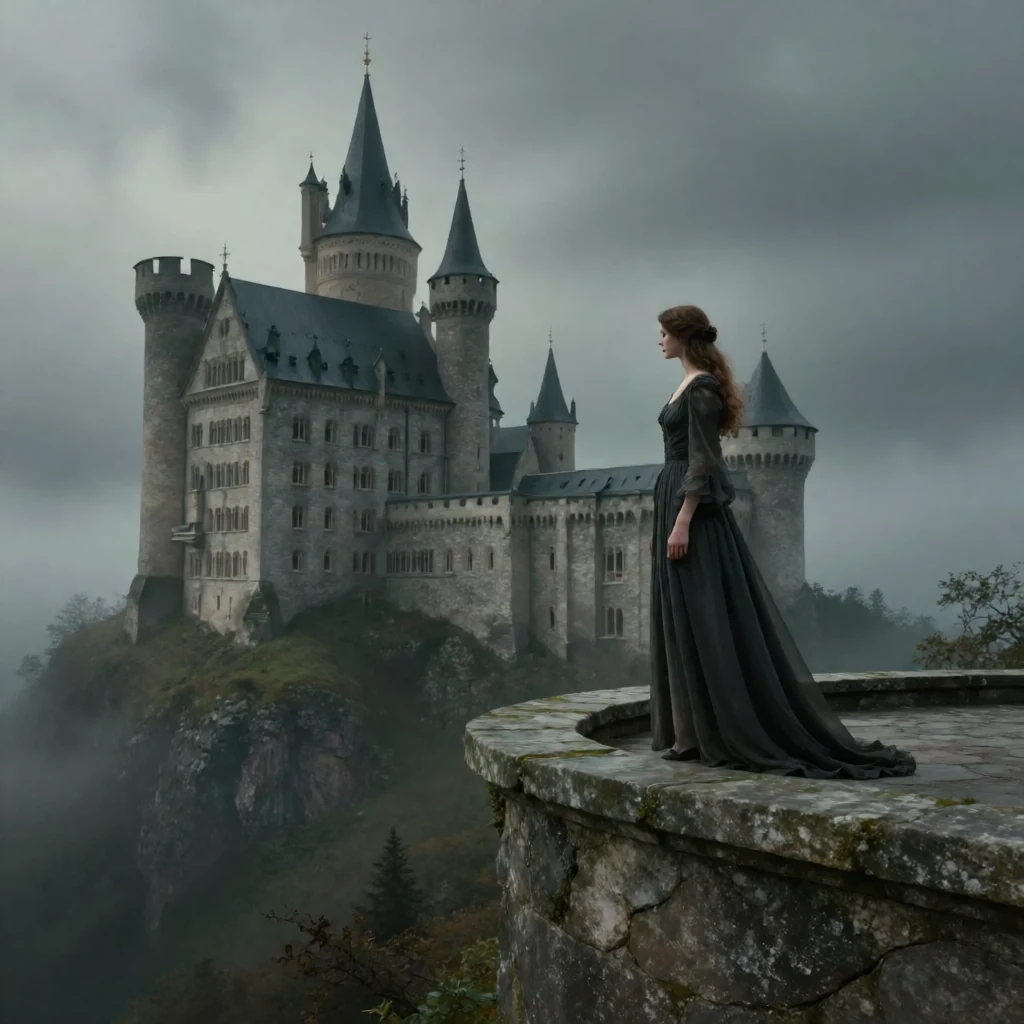
Dinner among the Cedars
The travelers stop to eat their midday meal in a pleasant open valley spot, shaded by tall cedar trees, before continuing their journey toward Beaujeu.
The Descent to Beaujeu
The road begins to wind down from the highlands, leaving the pine forests behind as it twists through rocky precipices. As evening twilight falls, the party loses sight of the surrounding landscape, and St. Aubert guesses they are not far from Beaujeu, looking forward to a safer, more populated road and an inn for the night.
The Fire by Night
In the dark, the party spots a large fire burning in the distance, illuminating the rocks and horizon. St. Aubert fears it may be lit by banditti who infest the Pyrenees, and grows anxious as they draw closer, wondering if the road passes near the fire.
The Banditti
As the party approaches the fire, a man on horseback rides up and orders their muleteer to stop. St. Aubert prepares a pistol for defense, but the man staggers on his horse, a shot rings out, and St. Aubert is horrified to hear what sounds like Valancourt’s faint voice calling out. He stops the carriage, alights, and finds Valancourt bleeding from a gunshot wound to his arm, still mounted on his horse. The party then passes the banditti’s camp without being attacked, as the group is too busy with their supper to notice the travelers at first.
Arrival at Beaujeu
After binding Valancourt’s wound with makeshift bandages and helping him into the carriage, the party proceeds slowly the remaining distance to Beaujeu. Valancourt explains he had followed them after their parting, drawn by his enjoyment of their company and his desire to see more of the scenic mountain route, and had hoped to catch up to them. The party arrives at Beaujeu’s only inn late at night.
The Surgeon
The town’s sole medical practitioner, who also treats horses and shaves faces, is called to attend to Valancourt. He examines the wound, confirms the bullet passed through the arm flesh without breaking bone, dresses it, and orders Valancourt to rest quietly.
Valancourt’s Wound
Though the wound is not life-threatening, Valancourt is initially in great pain, but his spirits lift once the pain subsides, and he wishes to join St. Aubert and Emily in conversation. St. Aubert must leave to purchase meat for supper, leaving Emily alone with Valancourt for a short time; they discuss the landscapes they have traveled, the region’s natural history, poetry, and St. Aubert, a topic Emily engages with particular enthusiasm.
Evening at the Inn
The travelers enjoy a pleasant evening together, though St. Aubert is fatigued from the journey and Valancourt begins to feel pain from his wound again, so the group separates soon after supper.
Morning Recovery
The next morning, St. Aubert finds Valancourt has had a restless, feverish night, with his wound still painful. The surgeon advises him to stay at Beaujeu to rest, and St. Aubert, dissatisfied with the local surgeon’s skill, initially plans to move Valancourt to a larger town for better care, but learns no suitable town is nearby, so he decides to remain at Beaujeu until Valancourt recovers.
The Environs of Beaujeu
While Valancourt rests indoors per the surgeon’s orders, St. Aubert and Emily explore the area around Beaujeu, which sits at the foot of the Pyrenean Alps. They admire the landscape of abrupt precipices, dense cedar, fir and cypress forests, bright beech and mountain-ash groves peeking through the dark woodland, and sparkling mountain torrents.
Valancourt’s Character
During their stay, St. Aubert observes Valancourt’s disposition and talents closely, and finds him to be frank, generous, full of ardour, deeply sensitive to grand and beautiful things, but also impetuous, wild, and somewhat romantic. Valancourt has had little exposure to the wider world, expresses his strong emotions (both admiration and indignation) with equal vehemence, and impresses St. Aubert with his unspoiled, genuine nature. St. Aubert repeats his earlier thought that Valancourt has never been to Paris, with a faint sigh.
The original text of this work is in the public domain. This page offers a compressed quick-read summary for educational purposes.