Annette’s Revelations at Dinner
Emily continues to play until Annette brings dinner into her chamber, which surprises her, as she enquires whose order has been followed. Annette explains that Montoni ordered her lady’s dinner to her own apartment and that the Signora has done the same for Emily, since there have been worse quarrels than ever between them. While waiting, Annette describes the strange armed men Emily had seen on the ramparts, their unsettling appearance, and how Montoni has ordered old Carlo to provide for them; she admits she is frightened by them. She also reports that Count Morano, lodged in a cottage in the wood below, is said by all to be dying, a piece of news that visibly discomposes Emily. Annette teases her for caring despite her professed dislike.
The Aunt’s Past Betrayals
Pressed to continue, Annette declares she must speak for Emily’s own good, even though she has little reason to love her mistress. She confesses that, long before, at Venice, she had overheard Montoni and her lady discussing Emily’s marriage to the Count, with Madame Montoni urging her husband never to yield to Emily’s “foolish whims” but to compel her obedience. Annette further reveals that, even earlier at Toulouse, she had heard Madame Montoni speaking of Emily and Valancourt in the most uncharitable terms to Madame Merveille and Madame Vaison: lamenting the trouble of keeping Emily in order, calling her a distress, declaring she would run away with Valancourt, and accusing her of conniving at his nocturnal visits. Emily blushes deeply and exclaims that it is impossible her aunt could thus have represented her.
CHAPTER VII
Chapter VII moves between Emily’s private distress over her aunt’s slander and the evening’s uneasy revelry in Montoni’s castle. Emily, hurt by her aunt’s gossip, retreats to the ramparts where she encounters the three ominous strangers. That night, Montoni’s carouse in the cedar chamber is disrupted by Verezzi’s reckless accusations about the castle’s true ownership, Montoni’s tale of the vanished Lady Laurentini, and a disembodied voice that twice interrupts the company, shattering the gathering.
Annette’s Indiscretion
Annette, the servant, informs Emily that her aunt (Madame Montoni) had spoken ill of her niece in Emily’s absence. Annette, attempting to console Emily, expresses that she did not believe the accusations herself. Emily, recovering her composure, rebukes Annette for speaking of her aunt’s faults, telling her to say no more and announcing she has finished dining.
Emily’s Reflections on Her Aunt
Alone, Emily laments that this is the reward she receives from a relation who should have been the guardian of her reputation. She bitterly reflects on the depravity of her aunt’s character, contrasting it with the benevolence and philosophic wisdom of her beloved late father. Emily then resolves, if possible, to remember only that her aunt is unfortunate.
A Walk on the Ramparts
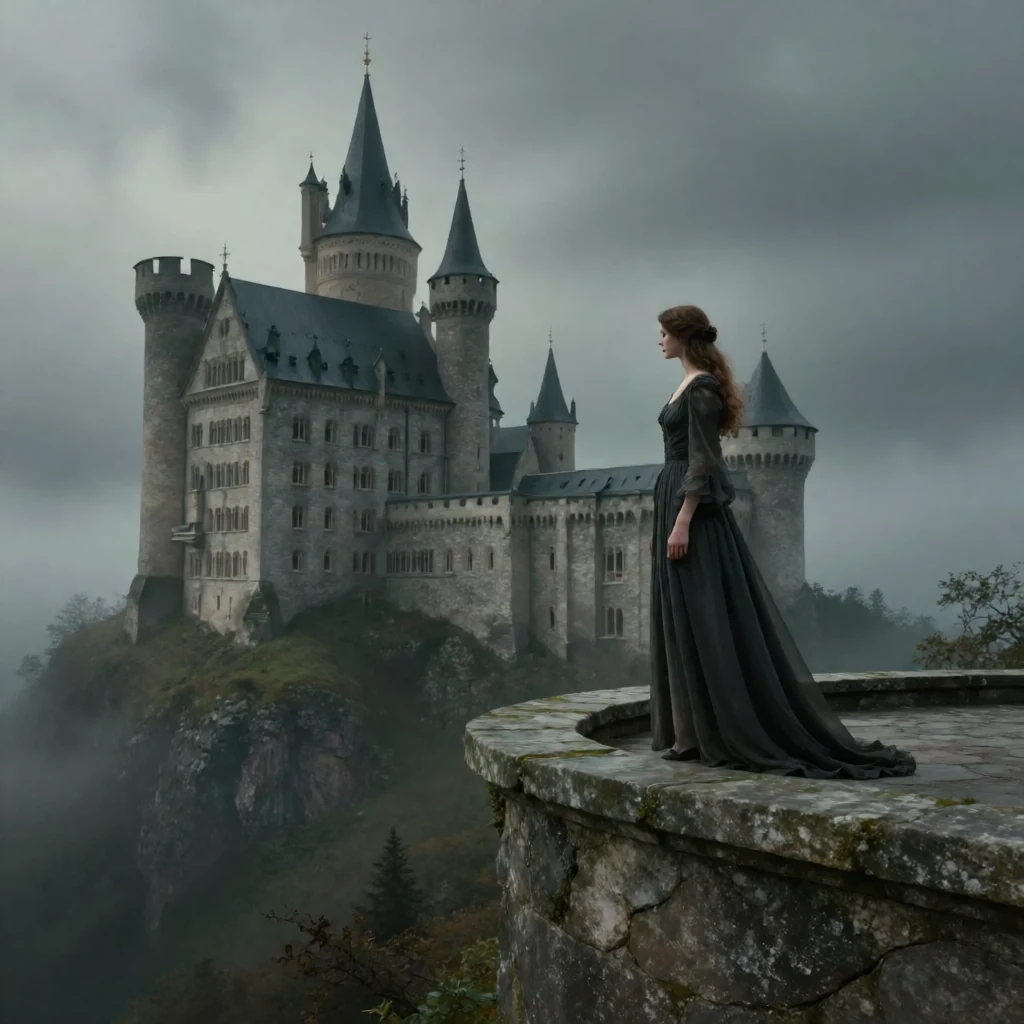
Emily throws on her veil and descends to walk upon the ramparts, the only walk open to her, as Montoni refuses to let her pass the castle gates. The peasants have finished their work, leaving the ramparts silent and solitary. The lowering sky and lonely setting suit her melancholy mood, and a sudden burst of sunlight streaming onto the west towers catches her attention.
The Three Strangers
Through a gothic arch lit by the sun, Emily perceives the three strangers she had noticed that morning. As she cannot avoid passing them on the narrow terrace, she hastily veils her face. The men, who speak in poor Italian, fix her with a fierce gaze, and the central figure’s sullen, villainous countenance fills her with horror. After she hurries past, she sees them gazing after her from a turret’s shadow before retreating to her apartment.
Montoni’s Feast in the Cedar Chamber
In the evening, Montoni carouses late with his guests in the cedar chamber, his spirits elevated by his recent triumph over Count Morano. The conversation turns to Emily, and the guests praise her profusely, though Montoni silences the subject. Once the servants withdraw, Montoni and his friends, including the anxious Cavigni and the choleric Verezzi, engage in close conversation in which Montoni displays a conscious superiority.
The original text of this work is in the public domain. This page focuses on a guided summary article, reading notes, selected quotes, and visual learning materials for educational purposes.