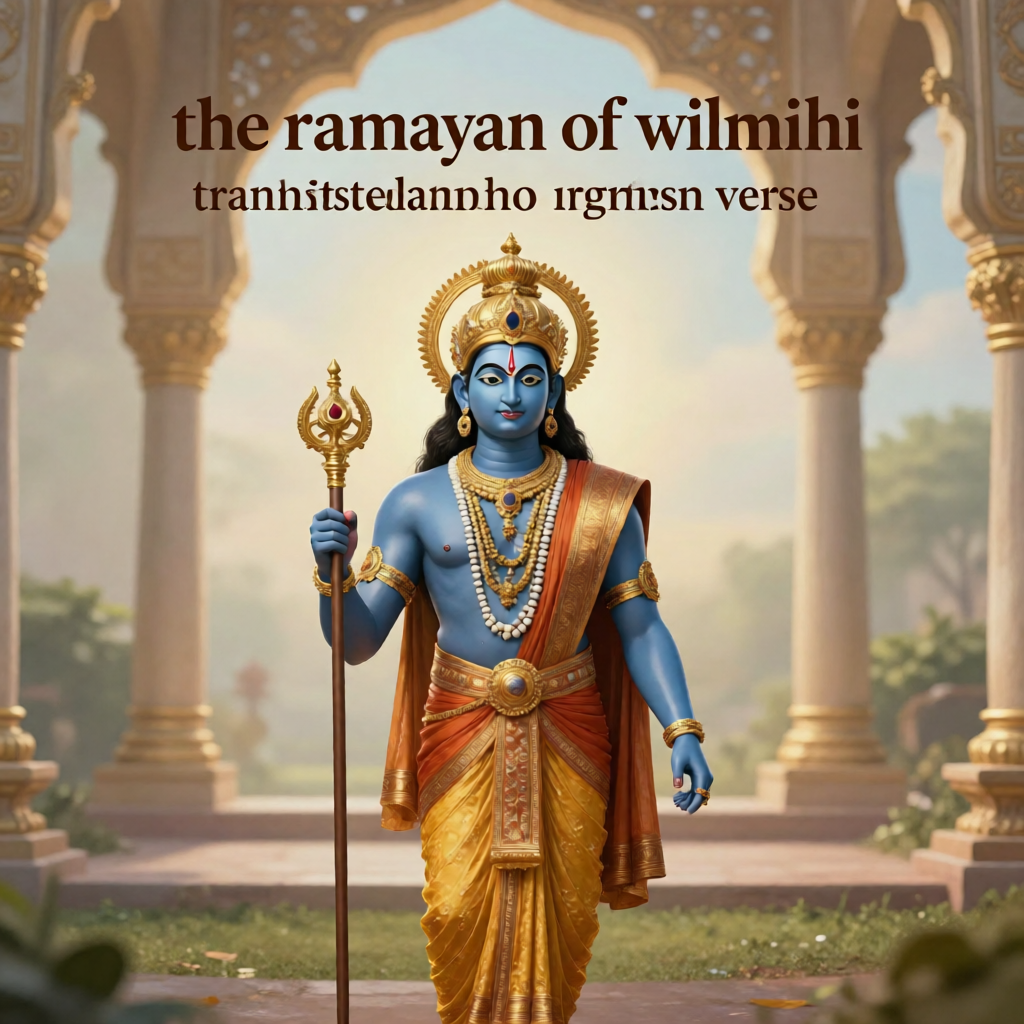
The Rámáyan of Válmíki: Reading Notes
The Shape of the Epic
Válmíki’s Rámáyan unfolds across nine great books, each a kāṇḍa — a movement in the larger symphony of exile, separation, war, and homecoming. The verse translation preserves the formal architecture of the original Sanskrit śloka, rendering each canto as a contained world of imagery, dialogue, and ritual weight. The books are themselves named for their emotional and geographic centers: the Bāla-kāṇḍa of childhood and origin, the Ayodhyā-kāṇḍa of the city left behind, the Araṇya-kāṇḍa of the forest, the Kiṣkindhā-kāṇḍa of the monkey kingdom, the Sundara-kāṇḍa of beauty and searching, the Yuddha-kāṇḍa of war, and the Uttara-kāṇḍa of aftermath.
Books I–II: The Gathering of Fate
The opening cantos arrive like incense smoke — first the sage Nārad’s revelation to Brahmā, then the descent into the mortal court of King Daśaratha at Ayodhyā. The city is described as a perfect wheel of dharma, its citizens contented, its castes fulfilling their ordained stations without discord. From this luminous stillness, the epic gathers its necessary sorrows: the childlessness of the aged king, the great horse-sacrifice under the hermit Rishyaśriṅga, the miraculous birth of the four princes.
Rāma emerges as the embodied ideal — lotus-eyed, long-armed, gentle in speech, terrible in battle. His marriage to Sītā follows the breaking of Śiva’s bow at King Janak’s court, a feat that none of earth’s warriors could accomplish. The nuptial fires burn bright. The twin royal houses of Ayodhyā and Videha are joined.
But the poetry of the Ayodhyā-kāṇḍa is the poetry of reversal. Queen Kaikeyī, stirred by the hunchbacked Mantharā, recalls two ancient boons: Rāma’s fourteen-year exile and the coronation of her own son Bharata. The king, bound by his word, crumbles. The city, which had blazed with white umbrellas and flower-strewn streets, falls into collective mourning. Sītā refuses to be left behind — her speech to Rāma burns with the logic of wifely dharma and the heat of a heart that cannot bear separation. Lakshmaṇa, equally devoted, wins permission to accompany his brother. The three walk from Ayodhyā in bark garments and matted hair, and the dust of their chariot becomes the dust of the world’s grief.
Book III: The Forest of Longing
The Araṇya-kāṇḍa breathes a different air — wilder, more haunted, more various. The exiles build leaf-thatched hermitages, receive divine weapons from sages, and protect the holy from the rākṣasas who devour ascetics and defile sacrifices. The imagery here is dense with the textures of Indian forest: the Godāvarī’s lotus-bright flood, the Mārkaṇḍeya’s penance grove, the Panchavaṭī clearing where the seasons turn like pages.
The demoness Śūrpaṇakhā arrives to shatter this fragile peace. Her desire for Rāma, her humiliation by Lakshmaṇa, her flight to her brother Khara — all become the fuse for catastrophe. The battle with Khara’s demon army is rendered with the thunderous imagery of a single hero standing against fourteen thousand, his arrows falling like sunbright rain upon the doomed. But the true horror of this book arrives through the golden deer: Mārīcha’s disguise that lures Rāma from Sītā’s side, Marīcha’s dying cry in Rāma’s voice that sends Lakshmaṇa away, and then the moment in the empty hermitage when Rāma understands that Sītā is gone.
The lamentations that follow are among the epic’s most piercing verses. Rāma roams the forest calling to trees, to rivers, to birds, to the air itself. He confuses the wind-stirred leaves for her hair, the lotus stems for her arms. His grief is not the private grief of a husband but the cosmic grief of dharma itself wounded. The encounter with the dying vulture Jaṭāyu, who fell defending Sītā, provides the first terrible confirmation of her abduction by Rāvaṇa.
Book IV: The Burning Search
The Kiṣkindhā-kāṇḍa and Sundara-kāṇḍa together form the epic’s middle movement, and the verse translation gives them the weight of a great river widening toward the sea. The arrival at the Pampā lake, where Rāma’s lament transforms the spring’s beauty into an instrument of his anguish, opens the book. The alliance with the exiled monkey-king Sugrīva — sealed by fire, witnessed by the gods — brings hope back into the poem’s breath. The slaying of the mighty Vālin, though stained with the shame of an unseen arrow, restores Sugrīva to his throne and the vānara host to mobilization.
Hanumān’s leap across the ocean is the epic’s most celebrated image: the son of the Wind God grown mountain-tall on the peak of Mahendra, his leap darkening the sun, the ocean deity offering him rest, the demoness Surasā demanding he pass through her maw, the shadow-grabbing Sinhikā torn apart from within. His arrival at Laṅkā begins the Sundara-kāṇḍa proper, and the poetry turns intimate again. Hanumān shrinks to cat-size to pass the city’s guardian goddess, slips through the demon queen’s bower, finds the sleeping Rāvaṇa with his wounds from Indra’s thunderbolt, and at last locates Sītā in the Aśoka grove.
The encounter between Hanumān and Sītā is rendered with extraordinary tenderness. She is pale, thin, her braid in mourning, her ornaments stripped away. The ring he bears, the message he carries, the tale of Rāma’s searching — all restore the thread of devotion across the dark ocean. Hanumān’s destruction of the grove, his capture, the burning of his tail, and his setting of Laṅkā ablaze become the poem’s first great act of divine wrath.
Books V–VI: The War of Laṅkā
The Yuddha-kāṇḍa is the epic’s longest and most structurally complex book, and the translation handles its many battles and councils with sustained force. The bridge of Nala across the ocean, built by the vānara engineers, spans a hundred leagues in five days. The omens darken. The spies are exchanged. Indrajīt’s magic serpent-noose brings both Rāma and Lakshmaṇa low in a single stroke, and only the descent of Garuḍa, lord of birds, breaks the spell. The duels follow one upon another like monsoon waves: the death of Dhūmrākṣa, the death of Vajradanṣṭra, the death of Kumbhakarṇa — that great sleeper who wakes once every six months to devour the world — and finally, across the central cantos, the death of Indrajīt by Lakshmaṇa’s hand.
The final duel between Rāma and Rāvaṇa is staged as cosmic combat. Brahmā’s weapon, forged by the Eternal Father, pierces the demon king’s heart, and Laṅkā’s tyrant falls. The verse imagery here is at its most architectonic: the sea roars, the mountains tremble, showers of celestial flowers fall, the gods sing praise from heaven. Sītā’s trial by fire, her vindication by Agni himself, her restoration — all are rendered with the formal solemnity of ritual, as befits a moment the epic treats as the resolution of cosmic disorder.
Book VII: The Return and the Aftermath
The Uttara-kāṇḍa traces the homeward journey. The Pushpaka chariot, wrested once from Kuvera, carries Rāma, Sītā, and Lakshmaṇa through the air while the vānara host watches from below. The landmarks of the exile pass beneath them — Pampā, Chitrakūṭa, Prayāga, the Ganges — each remembered and named. The reunion with Bharata at Nandigrāma, where the younger brother has lived as a hermit governing in Rāma’s name, is one of the epic’s most emotionally complete scenes. The consecration at Ayodhyā, the golden age of ten thousand years that follows, brings the principal narrative to its close.
Yet the Uttara-kāṇḍa contains the epic’s strangest and most melancholy passages. Public gossip about Sītā’s long captivity in Rāvaṇ’s house forces Rāma to banish his wife to the forest, though he knows her purity. She takes refuge in the hermitage of Vālmīki himself, gives birth to the twin sons Kuśa and Lava, and there the boys learn to recite the very poem we read. The final cantos move toward apotheosis: Time comes as a messenger to summon Rāma, Lakshmaṇa precedes him into the Sarayū’s waters, and Rāma, with body and followers, enters the glory of Viṣṇu. The poem ends not with the clangor of war but with the quiet of dissolution into the divine.
Recurring Imagery and Mood
Throughout, certain images return with the persistence of ritual. The bark garment and matted hair mark the ascetic’s vow. The white umbrella, the chowries, the golden sandals, the chariots and their harnessed beasts — these belong to the world of kingship, the world Rāma leaves and returns to. The forest is rendered in constant alternation: dark and terrible, yet full of lotus-bright pools, calling koils, blooming aśokas, the cries of peacocks. The ocean is both barrier and threshold. The fire is both trial and witness. The ring, the gem, the braid — these small objects carry the weight of recognition across vast distances.
The mood of the poem is one of dharma tested at every turning. Rāma’s greatness lies not in immunity to grief but in his willingness to bear it. Sītā’s devotion persists through captivity and banishment. Lakshmaṇa’s loyalty is the quiet flame beside Rāma’s blazing one. Hanumān embodies the power of faith set into action. Rāvaṇa’s tragedy is that he possessed every boon and every power except the grace to heed wise counsel. The verse sustains its formal dignity even as it traverses the most intimate registers of love, loss, and renunciation.
The English verse translation preserves much of the original’s formal rhythm and ceremonial gravity, though it allows itself occasional flourishes of nineteenth-century English — Homeric compound epithets, expansive similes drawn from the natural world, a sense of the epic as something spoken aloud across a great hall. The result is a poem that reads as both ancient and translated, both Indian and of the long English tradition of narrative verse that runs from Milton to Tennyson.
The Rámáyan remains, above all, a poem about the cost of keeping one’s word — and the strange, often terrible grace that meets those who do.