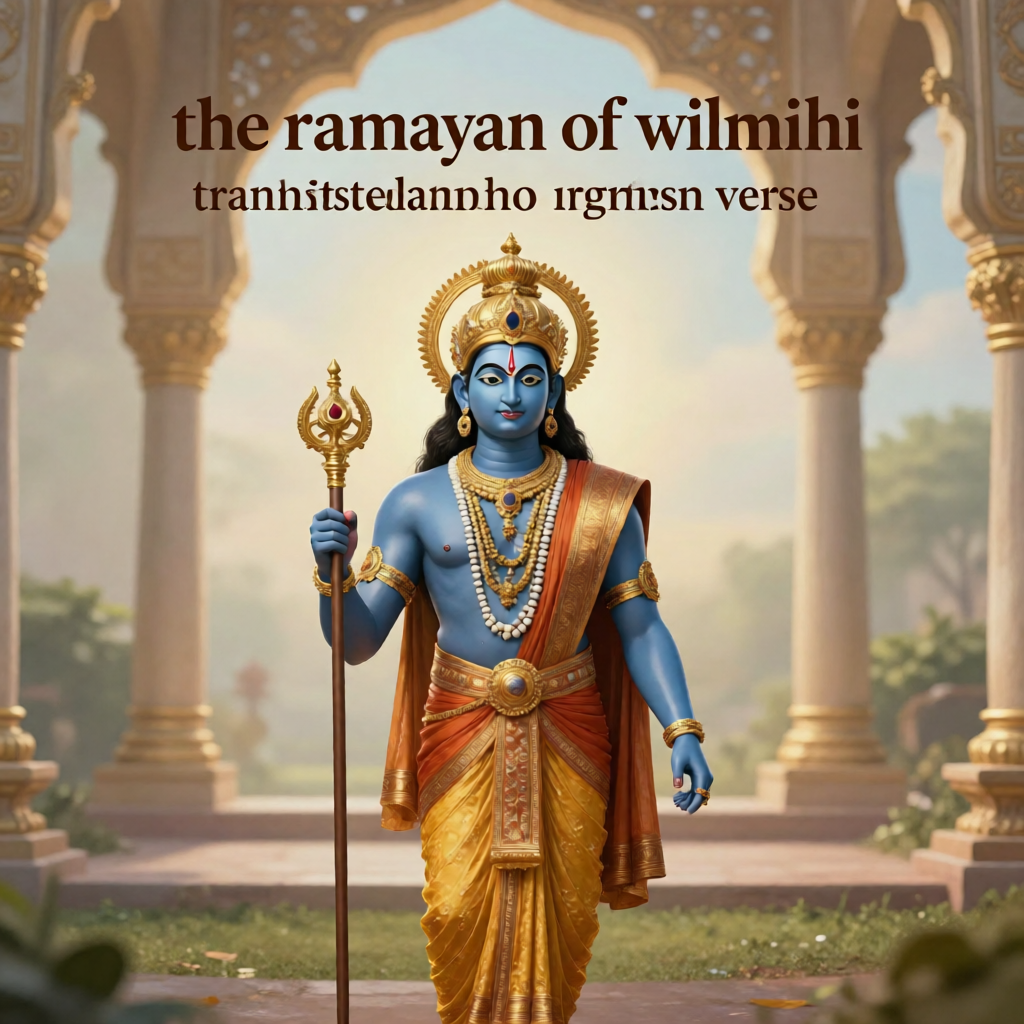
The Rámáyan of Válmíki, translated into English verse
The Rámáyan of Válmíki, translated into English verse by Valmiki unfolds through 9 chapters. Book I. - The opening book of the Ramayana, covering the lineage of King Dasaratha, the birth of Prince Ráma, and the events leading to his exile. Book II of the Ramayana, titled *Ayodhyakanda* (The Book of Ayodhya), chronicles the events surrounding Prince Rama's exile from Ayodhya. This section covers the first forty cantos, detailing the conspiracy, the exile announcement, the preparations for departure, and the initial stages of Rama's journey into exile. Book III (the Araṇyakāṇḍa) of the Ramayana follows Rāma, Sītā and Lakṣmaṇa as they dwell in the forest during exile. The book recounts encounters with hermits and demons, the establishment of the hermitage at Pañchavaṭī, the violent confrontation with the rākṣasa Khara and his army, and the growing menace of Rāvaṇa, whose fury sets the stage for Sītā’s abduction.
Book I.
Book I. - The opening book of the Ramayana, covering the lineage of King Dasaratha, the birth of Prince Ráma, and the events leading to his exile.
Canto I. Nárad.
Canto I. Nárad. - The sage Nárad appears to introduce the epic and set the narrative context.
Canto II. Brahmá’s Visit
Canto II. Brahmá’s Visit - Brahmá visits King Dasaratha’s court, foreshadowing the destiny of Ráma.
Canto III. The Argument.
Canto III. The Argument. - A discussion or debate sets the stage for subsequent events.
Canto IV. The Rhapsodists.
Canto IV. The Rhapsodists. - The storytellers recite verses, providing background and mythological context.
Canto V. Ayodhyá.
Canto V. Ayodhyá. - The city of Ayodhyá is described, highlighting its greatness and the royal lineage.
Canto VI. The King.
Canto VI. The King. - King Dasaratha’s reign and his desire for heirs are explored.
Canto VII. The Ministers.
Canto VII. The Ministers. - The ministers counsel the king, addressing matters of state and succession.
Canto VIII. Sumantra’s Speech.
Canto VIII. Sumantra’s Speech. - Sumantra delivers an important speech, influencing the course of action.
Canto IX. Rishyasring.
Canto IX. Rishyasring. - The sage Rishyasring is introduced, recounting his origins and significance.
Canto X. Rishyasring Invited.
Canto X. Rishyasring Invited. - Rishyasring is summoned to perform a sacrifice, setting the narrative in motion.
Canto XI. The Sacrifice Decreed.
Canto XI. The Sacrifice Decreed. - The decision to conduct a ritual sacrifice is announced, with far‑reaching consequences.
Canto XII. The Sacrifice Begun.
Canto XII. The Sacrifice Begun. - The sacrificial ceremony commences, drawing participation from the court and sages.
Canto XIII. The Sacrifice Finished.
Canto XIII. The Sacrifice Finished. - The ritual concludes, leading to unexpected developments and divine interventions.
Canto XIV. Rávan Doomed.
Canto XIV. Rávan Doomed. - A prophecy reveals the future doom of the demon king Rávan, shaping the story’s direction.
Canto XV. The Nectar.
Canto XV. The Nectar. - The nectar of immortality is sought, triggering a sequence of events.
Canto XVI. The Vánars.
Canto XVI. The Vánars. - The Vanar race, allies in the upcoming war, are introduced.
Canto XVII. Rishyasring’s Return.
Canto XVII. Rishyasring’s Return. - Rishyasring returns after the ritual, reflecting on the outcomes.
Canto XVIII. Rishyasring’s Departure.
Canto XVIII. Rishyasring’s Departure. - The sage departs, leaving the king with guidance for the future.
Canto XIX. The Birth Of The Princes.
Canto XIX. The Birth Of The Princes. - The four princes—Ráma, Lakshmana, Bharata, and Shatrughna—are born.
Canto XX. Visvámitra’s Visit.
Canto XX. Visvámitra’s Visit. - The sage Visvámitra arrives, seeking assistance and presenting a challenge.
Canto XXI. Visvámitra’s Speech.
Canto XXI. Visvámitra’s Speech. - Visvámitra delivers a speech outlining his demands and the rationale behind them.
Canto XXII. Dasaratha’s Speech.
Canto XXII. Dasaratha’s Speech. - King Dasaratha responds, offering his support and addressing the court.
Canto XXIII. Vasishtha’s Speech.
Canto XXIII. Vasishtha’s Speech. - The venerable sage Vasishtha provides counsel and clarifications.
Canto XXIV. The Spells.
Canto XXIV. The Spells. - Magical incantations and spells are discussed, emphasizing their power.
Canto XXV. The Hermitage Of Love.
Canto XXV. The Hermitage Of Love. - A hermitage known for love and devotion is described, influencing characters’ actions.
Canto XXVI. The Forest Of Tádaká.
Canto XXVI. The Forest Of Tádaká. - The forest where the demoness Tádaká dwells is explored.
Canto XXVII. The Birth Of Tádaká.
Canto XXVII. The Birth Of Tádaká. - The origin story of the demoness Tádaká is revealed.
Canto XXVIII. The Death Of Tádaká.
Canto XXVIII. The Death Of Tádaká. - The death of Tádaká occurs, clearing the path for the heroes.
Canto XXIX. The Celestial Arms.
Canto XXIX. The Celestial Arms. - Divine weapons are obtained, empowering the protagonists.
Canto XXX. The Mysterious Powers.
Canto XXX. The Mysterious Powers. - Unexplained supernatural abilities come into focus, affecting the narrative.
Canto XXXI. The Perfect Hermitage.
Canto XXXI. The Perfect Hermitage. - An ideal hermitage is depicted, embodying spiritual perfection.
Canto XXXII. Visvámitra’s Sacrifice.
Canto XXXII. Visvámitra’s Sacrifice. - Visvámitra performs a sacrifice, invoking celestial blessings.
Canto XXXIII. The Sone.
Canto XXXIII. The Sone. - The river Sone is described, playing a role in the journey of the sages.
Canto XXXIV. Brahmadatta.
Canto XXXIV. Brahmadatta. - King Brahmadatta’s reign and interactions are outlined.
Canto XXXV. Visvámitra’s Lineage.
Canto XXXV. Visvámitra’s Lineage. - The ancestry and lineage of the sage Visvámitra are explained.
Canto XXXVI. The Birth Of Gangá.
Canto XXXVI. The Birth Of Gangá. - The birth of the river Ganga is recounted, linking to mythic origins.
Canto XXXIX. The Sons Of Sagar.
Canto XXXIX. The Sons Of Sagar. - The sons of King Sagar are introduced, each facing distinct fates.
Canto XL. The Cleaving Of The Earth.
Canto XL. The Cleaving Of The Earth. - The earth is split, revealing subterranean realms and consequences.
Canto XLI. Kapil.
Canto XLI. Kapil. - The sage Kapil appears, delivering wisdom and performing deeds.
Canto XLII. Sagar’s Sacrifice.
Canto XLII. Sagar’s Sacrifice. - King Sagar conducts a sacrifice, invoking divine outcomes.
Canto XLIII. Bhagírath.
Canto XLIII. Bhagírath. - Prince Bhagírath undertakes a quest to bring the Ganga to earth.
Canto XLIV. The Descent Of Gangá.
Canto XLIV. The Descent Of Gangá. - The descent of the river Ganga from heaven to earth is described.
Canto XLV. The Quest Of The Amrit.
Canto XLV. The Quest Of The Amrit. - The search for the nectar of immortality intensifies the story.
Canto XLVI. Diti’s Hope.
Canto XLVI. Diti’s Hope. - Diti’s hopes and prayers for offspring are depicted.
Canto XLVII. Sumati.
Canto XLVII. Sumati. - The tale of Sumati is narrated, highlighting moral lessons.
Canto XLVIII. Indra And Ahalyá
Canto XLVIII. Indra And Ahalyá - Indra’s encounter with Ahalyá and its consequences are recounted.
Canto XLIX. Ahalyá Freed.
Canto XLIX. Ahalyá Freed. - Ahalyá’s liberation from a curse is achieved through devotion.
Canto L. Janak.
Canto L. Janak. - King Janak of Mithila is introduced, known for his righteousness.
Canto LI. Visvámitra.
Canto LI. Visvámitra. - The sage Visvámitra’s role is emphasized, detailing his motivations.
Canto LII. Vasishtha’s Feast.
Canto LII. Vasishtha’s Feast. - A feast hosted by Vasishtha provides insight into dharma and hospitality.
Canto LIII. Visvámitra’s Request.
Canto LIII. Visvámitra’s Request. - Visvámitra makes a request that sets the stage for future events.
Canto LIV. The Battle.
Canto LIV. The Battle. - A battle ensues, showcasing martial prowess and conflict.
Canto LV. The Hermitage Burnt.
Canto LV. The Hermitage Burnt. - The hermitage is set ablaze, leading to retaliation and escalation.
Canto LVI. Visvámitra’s Vow.
Canto LVI. Visvámitra’s Vow. - Visvámitra makes a solemn vow, guiding his future actions.
Canto LVII. Trisanku.
Canto LVII. Trisanku. - King Trisanku’s ambition and struggles are depicted.
Canto LVIII. Trisanku Cursed.
Canto LVIII. Trisanku Cursed. - Trisanku is cursed, illustrating the consequences of hubris.
Canto LIX. The Sons Of Vasishtha.
Canto LIX. The Sons Of Vasishtha. - The sons of Vasishtha are highlighted, each embodying virtues.
Canto LX. Trisanku’s Ascension.
Canto LX. Trisanku’s Ascension. - Trisanku’s ascent to heaven is attempted, with mixed outcomes.
Canto LXI. Sunahsepha.
Canto LXI. Sunahsepha. - Sunahsepha’s story is told, focusing on redemption and sacrifice.
Canto LXII. Ambarísha’s Sacrifice.
Canto LXII. Ambarísha’s Sacrifice. - King Ambarísha’s sacrificial rituals are described, invoking divine tests.
Canto LXIII. Menaká.
Canto LXIII. Menaká. - The apsara Menaká appears, adding celestial intrigue.
Canto LXIV. Rambhá.
Canto LXIV. Rambhá. - The apsara Rambhá enters the narrative, influencing events with her charm.
Canto LXV. Visvámitra’s Triumph
Canto LXV. Visvámitra’s Triumph - Visvámitra achieves triumph, demonstrating his spiritual power.
Canto LXVI. Janak’s Speech.
Canto LXVI. Janak’s Speech. - King Janak delivers a speech, expounding on duty and righteousness.
Canto LXVII. The Breaking Of The Bow.
Canto LXVII. The Breaking Of The Bow. - The breaking of a bow occurs, a test of strength and skill.
Canto LXVIII. The Envoys’ Speech.
Canto LXVIII. The Envoys’ Speech. - Envoys deliver messages, shaping diplomatic interactions.
Canto LXIX. Dasaratha’s Visit.
Canto LXIX. Dasaratha’s Visit. - King Dasaratha travels, meeting other characters and advancing the plot.
Canto LXX. The Maidens Sought.
Canto LXX. The Maidens Sought. - The search for suitable maidens for marriage is described.
Canto LXXI. Janak’s Pedigree.
Canto LXXI. Janak’s Pedigree. - Janak’s ancestry and royal lineage are elaborated.
Canto LXXII. The Gift Of Kine.
Canto LXXII. The Gift Of Kine. - The gift of cows is presented, emphasizing generosity.
Canto LXXIII. The Nuptials.
Canto LXXIII. The Nuptials. - The wedding ceremonies of the princes are celebrated.
Canto LXXIV. Ráma With The Axe.
Canto LXXIV. Ráma With The Axe. - Ráma wields an axe, demonstrating his strength and resolve.
Canto LXXV. The Parle.
Canto LXXV. The Parle. - A parley takes place, negotiations and dialogue among characters.
Canto LXXVI. Debarred From Heaven.
Canto LXXVI. Debarred From Heaven. - Characters are denied entry to heaven, highlighting moral lessons.
Canto LXXVII. Bharat’s Departure.
Canto LXXVII. Bharat’s Departure. - Bharata departs, showcasing sacrifice and devotion to duty.
BOOK II.
Book II of the Ramayana, titled *Ayodhyakanda* (The Book of Ayodhya), chronicles the events surrounding Prince Rama's exile from Ayodhya. This section covers the first forty cantos, detailing the conspiracy, the exile announcement, the preparations for departure, and the initial stages of Rama's journey into exile.
Canto I. The Heir Apparent
This canto introduces the concept of Rama as the rightful heir to the throne of Ayodhya. King Dasaratha expresses his intention to crown Rama as yuvaraja (prince regent), setting the stage for the political intrigue that follows. The kingdom prepares for the ceremony, and the people express their joy at the prospect of Rama's ascension.
Canto II. The People’s Speech
The citizens of Ayodhya gather to discuss the upcoming coronation. Their speeches extol Rama's virtues and express their collective wish for his rule. This section highlights the deep connection between Rama and his people, emphasizing their love and support for the future king.
Canto III. Dasaratha’s Precepts
King Dasaratha delivers teachings and guidance, particularly to Rama. These precepts cover dharma (righteousness), kingship, and the responsibilities of rule. Dasaratha shares his wisdom accumulated over years of governance, preparing Rama for the duties ahead.
Canto IV. Ráma Summoned
Rama receives the summons to appear before the king. This canto marks the beginning of the sequence of events that will lead to the exile. Rama obediently presents himself, unaware of the conspiracy forming against him.
Canto V. Ráma’s Fast
Rama undertakes a religious fast in preparation for his coronation. This spiritual practice demonstrates his devotion and his adherence to traditional customs. The fast also serves as a period of reflection before the significant event.
Canto VI. The City Decorated
Ayodhya transforms into a celebration as the city is adorned for the coronation. The decorations symbolize the people's anticipation and joy. This visual description contrasts with the tragic events that will soon unfold.
Canto VII. Manthará’s Lament
Manthara, the cunning maidservant of Queen Kaikeyi, learns of the planned coronation. She expresses distress at the news, lamenting that Rama's ascent will diminish Kaikeyi's influence. This lament marks the beginning of her scheming.
Canto VIII. Manthará’s Speech
Manthara approaches Queen Kaikeyi with her machinations. She convinces Kaikeyi that Rama's coronation threatens her position and that she should demand two boons granted by Dasaratha: the installation of her own son Bharata as prince regent and Rama's exile to the forest for fourteen years.
Canto IX. The Plot
The conspiracy between Manthara and Kaikeyi takes shape. Kaikeyi, manipulated by Manthara's words, decides to demand the boons at the coronation ceremony. This canto reveals the full extent of the plot against Rama.
Canto X. Dasaratha’s Speech
King Dasaratha addresses the assembly, unaware of Kaikeyi's scheme. He speaks of his joy at crowning Rama and his commitment to fulfilling his duties as king. The dramatic irony emerges as readers know of the plot while Dasaratha remains oblivious.
Canto XI. The Queen’s Demand
Queen Kaikeyi reveals her demands to Dasaratha during the coronation ceremony. She invokes the two boons granted long ago, demanding that Bharata be crowned instead of Rama, and that Rama be sent to exile for fourteen years. Dasaratha is horrified and bound by his oath.
Canto XII. Dasaratha’s Lament
Overwhelmed by grief and unable to defy his own promise, Dasaratha laments his fate. He curses the moment he granted the boons and expresses his devastation at the thought of sending his beloved son into exile. His anguish highlights the tragic consequences of his past promises.
Canto XIII. Dasaratha’s Distress
The king's distress intensifies as he tries to find a way to avoid fulfilling Kaikeyi's demands while remaining truthful to his oath. He oscillates between duty, love, and the constraints of his earlier promise. The canto explores the psychological torment of a father forced to harm his son.
Canto XIV. Ráma Summoned
Rama is summoned to the court, where he learns of the decision for his exile. He receives the news with composure and grace, demonstrating his commitment to dharma and his respect for his father's authority, despite the cruel command.
Canto XV. The Preparations
Preparations begin for Rama's departure into exile. The household gathers to make arrangements, and there is an atmosphere of mourning. Despite the tragic circumstances, the preparations proceed with a sense of resigned acceptance.
Canto XVI. Ráma Summoned
A second summons may refer to Rama being called to say farewell or to receive final instructions. This repetition emphasizes the gravity of the situation and the finality of the exile.
Canto XVII. Ráma’s Approach
Rama approaches the court or his family with dignity. His comportment reflects his acceptance of destiny and his adherence to the principles of righteousness. He moves forward with courage despite the adversity he faces.
Canto XVIII. The Sentence
The formal declaration of exile is made. The sentence of fourteen years in the forest is announced, marking the official beginning of Rama's separation from his kingdom and family. The term of exile is specified, becoming the defining constraint of his banishment.
Canto XIX. Ráma’s Promise
Rama makes promises to his family, particularly to his father and to those who will remain behind. He pledges to observe the conditions of his exile faithfully and to return when the fourteen years have elapsed. His word becomes his bond.
Canto XX. Kausalyá’s Lament
Queen Kausalya, Rama's mother, mourns the exile of her son. Her lament expresses the depth of a mother's love and her helplessness against the king's decree. She grieves for the separation and the hardship Rama will face.
Canto XXI. Kausalyá Calmed
After her initial grief, Kausalya is calmed, perhaps by Rama himself or by others who counsel acceptance. She finds strength to face the situation with dignity. The canto demonstrates resilience in the face of tragedy.
Canto XXII. Lakshman Calmed
Lakshmana, Rama's devoted brother, is calmed after expressing his anger and distress at the unfair exile. He is counseled to accept the situation and to support Rama. This sets the stage for his decision to accompany Rama into exile.
Canto XXIII. Lakshman’s Anger
Lakshmana's fury at the injustice boils over. He expresses his anger at Kaikeyi, at the situation, and at his powerlessness to change it. His rage reflects the emotional toll the exile takes on those who love Rama.
Canto XXIV. Kausalyá Calmed
A second instance of Kausalya being calmed suggests her ongoing struggle to come to terms with the exile. Each calming brings her closer to acceptance and inner peace.
Canto XXV. Kausalyá’s Blessing
Kausalya bestows her blessing upon Rama before his departure. These blessings carry the weight of a mother's love and prayers for his safety and well-being during the long years of exile.
Canto XXVI. Alone With Sítá
Rama and Sita share a private moment together. Their intimate conversation reveals the depth of their relationship and the mutual commitment they share as husband and wife facing adversity.
Canto XXVII. Sítá’s Speech
Sita speaks of her desire to accompany Rama into exile. She expresses her willingness to share his hardships and her refusal to remain in comfort while he suffers in the forest. Her speech demonstrates her devotion and courage.
Canto XXVIII. The Dangers Of The Wood
The conversation turns to the perils of forest life. Rama describes the dangers that await in the wilderness: wild beasts, demons, harsh conditions, and the lack of comforts. He attempts to dissuade Sita from accompanying him, citing these hazards.
Canto XXIX. Sítá’s Appeal
Sita appeals directly to Rama, arguing that she cannot bear separation from him. She expresses her willingness to face any danger as long as she is by his side. Her appeal is both emotional and logical, touching on duty and love.
Canto XXX. The Triumph Of Love
Rama ultimately accepts Sita's arguments and agrees to let her accompany him into exile. This decision represents the triumph of their bond over reason and caution. Love prevails over the practical considerations of danger and hardship.
Canto XXXI. Lakshman’s Prayer
Lakshmana offers prayers, perhaps for the success of the journey or for the well-being of his brothers. His spiritual preparations complement the practical preparations for departure.
Canto XXXII. The Gift Of The Treasures
Before departure, treasures and provisions are distributed. These gifts will sustain the exiles during their years in the forest and demonstrate the continued support of those who remain behind.
Canto XXXIII. The People’s Lament
The citizens of Ayodhya lament the exile of their beloved prince. Their collective mourning reflects the public grief at seeing Rama forced out of the kingdom. The people's attachment to Rama underscores his popularity and the injustice they perceive.
Canto XXXIV. Ráma In The Palace
Rama spends his final moments in the palace before departing. This canto may depict his farewell to the familiar surroundings of his home and his acceptance of the fate that awaits him.
Canto XXXV. Kaikeyí Reproached
Queen Kaikeyi faces reproach from various quarters. Others in the palace express their anger and condemnation at her role in the exile. This canto highlights the social and moral judgment she receives for her actions.
Canto XXXVI. Siddhárth’s Speech
Siddhartha (likely a courtier or advisor) delivers a speech, perhaps of counsel or lament. His words contribute to the emotional landscape of the departure scene.
Canto XXXVII. The Coats Of Bark
Rama, Sita, and Lakshmana prepare to adopt the simple dress of ascetics. The coats of bark symbolize their rejection of royal finery and their acceptance of the austere life of forest dwellers.
Canto XXXVIII. Care For Kausalyá
Instructions are given for the care of Queen Kausalya and other family members left behind. Rama entrusts the well-being of his loved ones to those who remain, ensuring that they will be provided for during his absence.
Canto XXXIX. Counsel To Sítá
Rama offers final counsel to Sita, preparing her for the challenges ahead. He provides guidance on how to conduct herself during the exile, emphasizing virtue and propriety even in the wilderness.
Canto XL. Ráma’s Departure
The moment of departure arrives. Rama, Sita, and Lakshmana leave Ayodhya, crossing the city gates and beginning their journey into exile. This canto marks the transition from royal life to forest wandering, a pivotal moment in the epic.
BOOK III.
Book III (the Araṇyakāṇḍa) of the Ramayana follows Rāma, Sītā and Lakṣmaṇa as they dwell in the forest during exile. The book recounts encounters with hermits and demons, the establishment of the hermitage at Pañchavaṭī, the violent confrontation with the rākṣasa Khara and his army, and the growing menace of Rāvaṇa, whose fury sets the stage for Sītā’s abduction.
The Hermitage
The Hermitage – Rāma, Sītā and Lakṣmaṇa erect a simple hermitage deep in the forest, embracing a life of austerity, devotion and self‑reliance while enduring the hardships of exile.
Virádha
Virádha – The trio meets the formidable rākṣasa Virādha, who challenges them and threatens the peace of the forest hermits.
Virádha Attacked
Virádha Attacked – Rāma and Lakṣmaṇa engage Virādha in fierce combat, confronting his immense strength and magical powers.
Virádha's Death
Virádha’s Death – After a protracted battle, the heroes slay Virādha, freeing the forest from his terror and earning the gratitude of the sages.
Sarabhanga
Sarabhanga – The venerable sage Sarabhanga welcomes the exiles, offering his ashram as a sanctuary and recounting tales of ancient dharma.
Ráma's Promise
Ráma’s Promise – Rāma vows to protect Sarabhanga and his followers, reinforcing his commitment to righteousness and the welfare of others.
Sutíkshna
Sutíkshna – The brothers receive the hospitality of the ascetic Sutīkṣṇa, who provides them with food and spiritual counsel.
The Hermitage
The Hermitage – Relocating to a new, more secluded hermitage, the trio continues its disciplined life, cultivating virtue and preparing for future trials.
Sítá's Speech
Sítá’s Speech – Sītā speaks of her inner resolve and the beauty she finds in the forest, demonstrating her grace and faith amidst adversity.
Ráma's Reply
Ráma’s Reply – Rāma comforts Sītā, emphasising dharma, patience and the divine purpose behind their exile.
Agastya
Agastya – The great sage Agastya appears, bestowing blessings upon the exiles and offering guidance for the challenges ahead.
The Heavenly Bow
The Heavenly Bow – Agastya gifts a celestial bow, a symbol of divine power that will prove decisive in forthcoming battles.
Agastya's Counsel
Agastya’s Counsel – Agastya advises Rāma on perseverance, the importance of duty, and the looming threat of the demon forces.
Jatáyus
Jatáyus – The noble vulture Jatāyus, an ally of Rāma’s lineage, pledges his protection and shares wisdom from the skies.
Panchavatí
Panchavatí – The group settles in the lush region of Pañchavaṭī, where they build a new hermitage and begin to experience the forest’s bounty.
Winter
Winter – The harsh winter season tests the exiles’ endurance, prompting them to rely on each other and their inner strength.
Súrpanakhá
Súrpanakhá – The demoness Sūrpaṇakhā, enamoured by Rāma’s beauty, attempts to seduce him, setting the stage for conflict.
The Mutilation
The Mutilation – In a violent confrontation, Sūrpaṇakhā is mutilated, provoking her rage and spurring further vengeance.
The Rousing Of Khara
The Rousing Of Khara – Sūrpaṇakhā incites her brother Khara to avenge her humiliation and destroy the hermits.
The Giants' Death
The Giants’ Death – Khara leads a massive army of giants against the hermitage; Rāma, with divine aid, slays the entire host.
The Rousing Of Khara
The Rousing Of Khara – The aftermath of the giants’ defeat fuels Khara’s determination to retaliate, intensifying the conflict.
Khara's Wrath
Khara’s Wrath – Khara’s fury grows as he marshals greater forces, vowing to annihilate Rāma and his companions.
The Omens
The Omens – Strange, foreboding omens appear in the forest, hinting at the escalation of violence and the rise of darkness.
The Host In Sight
The Host In Sight – The demon army, now led by Khara, is spotted approaching, signalling the imminent clash.
The Battle
The Battle – A decisive battle erupts, pitting Rāma’s courage and skill against the relentless demon horde.
Dúshan's Death
Dúshan’s Death – Dūṣaṇa, one of Khara’s lieutenants, falls to Rāma’s arrows, weakening the demon ranks.
The Death Of Trisirás
The Death Of Trisirás – Trisiiras, another powerful demon, is slain, further tilting the battle in the heroes’ favour.
Khara Dismounted
Khara Dismounted – Rāma dismounts Khara from his chariot, disrupting the demon’s command and shifting the momentum.
Khara's Defeat
Khara’s Defeat – Despite his formidable strength, Khara is overpowered and forced to retreat in humiliation.
Khara's Death
Khara’s Death – Rāma delivers the final blow, killing Khara and ending the immediate threat to the hermitage.
Rávan
Rávan – The demon king Rāvaṇa, hearing of his kin’s demise, is consumed by grief and rage, contemplating vengeance.
Rávan Roused
Rávan Roused – Rāvaṇa stirs from his throne, spurred on by the loss of his relatives and the desire to destroy Rāma.
Súrpanakhá's Speech
Súrpanakhá’s Speech – Sūrpaṇakhā pleads with Rāvaṇa, urging him to avenge her and bring ruin upon the exile.
Súrpanakhá's Speech
Súrpanakhá’s Speech – Further entreaties from Sūrpaṇakhā intensify Rāvaṇa’s resolve to act against Rāma.
Rávan's Journey
Rávan’s Journey – Rāvaṇa embarks on his journey toward the forest, gathering his minions for the upcoming campaign.
Rávan's Speech
Rávan’s Speech – Rāvaṇa declares his intention to capture Sītā and eliminate Rāma, outlining his audacious plan.
Márícha's Speech
Márícha’s Speech – Marīcha, a shape‑shifting demon, warns Rāvaṇa of the dangers of confronting Rāma and advises caution.
Márícha's Speech
Márícha’s Speech – Marīcha continues to counsel restraint, yet Rāvaṇa remains unmoved by his prudence.
Márícha's Speech
Márícha’s Speech – Ultimately, Marīcha complies with Rāvaṇa’s will, preparing to take part in the plot.
Rávan's Speech
Rávan’s Speech – Rāvaṇa finalises his scheme to abduct Sītā, setting in motion the pivotal event that will shape the rest of the epic.
BOOK IV.
Book Four of the Ramayana continues the epic narrative following the characters into the forested kingdom of Kishkindha, chronicling the alliance between Rama and Sugriva, the conflict with Bali, and the preparations for the search for Sita.
Ráma’s Lament
Rama mourns his separation from Sita, expressing grief and anxiety over her fate after her abduction by Ravana.
Sugríva’s Alarm
Sugriva becomes aware of the presence of Rama and Lakshmana in the forest, raising concern about potential danger to his kingdom and his own precarious situation.
Hanumán’s Speech
Hanuman, the wise monkey captain, addresses the assembled Vanara forces, providing counsel and strategic insight regarding the newcomers and their potential alliance.
Lakshman’s Reply
Lakshmana responds to the communications from Sugriva's court, establishing contact and laying the groundwork for a potential partnership between the allied parties.
The League
The alliance between Rama and Sugriva is formally established, with promises of mutual assistance and shared purpose in both Rama's quest to recover Sita and Sugriva's struggle against his enemy Bali.
The Tokens
Token exchanges or symbolic objects are exchanged between the allies to seal their pact, marking the formal commitment of both parties to the forthcoming enterprise.
Ráma Consoled
Rama receives comfort and encouragement from his companions, finding renewed strength and resolve to continue his search for Sita despite his profound sorrow.
Ráma’s Promise
Rama makes solemn pledges to Sugriva, establishing the terms of their alliance and committing himself to supporting Sugriva in his forthcoming conflict with his brother Bali.
Sugríva’s Story
Sugriva recounts his own history and the circumstances that led to his current exile, revealing the betrayal he suffered at the hands of his brother and the injustice he seeks to rectify.
Sugríva’s Story
Continuation of Sugriva's narrative, further detailing the events surrounding his conflict with Bali and the circumstances that have brought him to this point of desperation and hope.
Dundubhi
The narrative turns to the tale of Dundubhi, a powerful Asura whose story intersects with the fate of the Vanara princes, adding context to the ongoing events and rivalries.
The Palm Trees
A description or account involving palm trees, possibly relating to the geography of Kishkindha or a significant location within the kingdom that figures in the unfolding story.
The Return To Kishkindhá
The journey back to the Vanara capital Kishkindha marks a significant moment as the alliance prepares to consolidate their forces and plan their next moves.
The Challenge
A formal challenge is issued, likely by Sugriva to Bali, setting the stage for confrontation and establishing the terms of their impending conflict.
Tárá
Introduction or focus on Tara, Bali's wife, a significant female character whose presence and fate will become central to the emotional core of the ensuing events.
The Fall Of Báli
The climactic confrontation between Rama and Bali concludes with Bali's defeat, marking a pivotal turning point in the narrative and fulfilling the terms of the alliance.
Báli’s Speech
Bali, in his final moments, delivers a speech that may include accusations, blessings, or wisdom, adding gravitas to his death and revealing his character in his last moments.
Ráma’s Reply
Rama responds to Bali's speech or the circumstances of the moment, demonstrating his principles and perhaps addressing the complicated emotions surrounding the victory.
Tárá’s Grief
Tara experiences profound sorrow at Bali's death, her lamentation reflecting the personal devastation that accompanies the political and martial events of the narrative.
Tárá’s Lament
Extended mourning by Tara as she grieves for her fallen husband, expressing the depth of her loss and the tragedy that has befallen her family.
Hanumán’s Speech
Hanuman offers counsel or comfort during this time of mourning, his wisdom helping to guide the community through their grief and toward acceptance of the new order.
Báli Dead
The fact of Bali's death is established and acknowledged, with the narrative processing the consequences of this pivotal event for all the characters involved.
Tárá’s Lament
Further lamentation from Tara as she continues to mourn Bali, the grief over his death remaining a central emotional element of the story.
Sugríva’s Lament
Sugriva mourns his brother despite their enmity, grappling with complex emotions about the fratricidal conflict and its resolution through Rama's intervention.
Ráma’s Speech
Rama addresses the assembled Vanaras, speaking on the events that have transpired and perhaps offering guidance or explanation for his actions in the matter of Bali.
The Coronation
Sugriva is crowned king of Kishkindha, formalizing the new political order and celebrating the establishment of his rightful rule over the Vanara kingdom.
Ráma On The Hill
Rama, perhaps in contemplation or awaiting the promised action, is positioned on an elevated location, maintaining watch or observing the signs of the approaching season.
The Rains
The monsoon season arrives, halting military operations and forcing a delay in the search for Sita, creating a period of enforced waiting and preparation.
Hanumán’s Counsel
Hanuman provides strategic advice during the rainy season, helping to plan the next phase of operations and maintain the morale of the allied forces during the delay.
Ráma’s Lament
Another episode of lamentation finds Rama mourning Sita's absence, his grief intensified by the enforced inactivity of the rainy season and his continued separation from his beloved.
The Envoy
An envoy is sent forth, likely bearing messages or undertaking diplomatic missions, advancing the plot and maintaining communication between the scattered forces.
Hanumán’s Counsel
Hanuman offers additional guidance or strategic planning, his wisdom proving essential as the alliance prepares to resume their search and military campaigns.
Lakshman’s Entry
Lakshmana arrives at or enters a significant location, perhaps bearing news or fulfilling a specific role in the unfolding narrative of the search for Sita.
Lakshman’s Speech
Lakshmana delivers an address, possibly to the assembled forces or to Rama, contributing his perspective on the current situation and the path forward.
Tárá’s Speech
Tara addresses the assembly, her words carrying the weight of her experience and perhaps offering counsel or blessing to those embarking on the mission ahead.
Sugríva’s Speech
Sugriva speaks before his gathered forces, rallying support and outlining the plans for the enterprise upon which they are about to embark.
The Gathering
The Vanara host assembles in great numbers, preparing for the momentous campaign ahead as the alliance prepares to launch its comprehensive search for Sita.
Sugríva’s Departure
Sugriva sets out with his forces, leading the expedition personally as the campaign to locate and rescue Sita begins in earnest.
The Vánar Host
The immense army of Vanara warriors is described or mobilized, their collective strength representing the power of the alliance as they march toward their objective.
The Army Of The East
A division of the Vanara host marches eastward, one of several directional search parties dispatched to cover the vast territory where Sita may be found.
BOOK V.
BOOK V. – The fifth book of the Ramayana follows Hanumán’s daring leap to Lankā, his exploration of the demon city, and the ensuing encounters with Rāvaṇa and Sītā.
Hanumán’s Leap
Hanumán’s Leap – Hanumán springs across the ocean to reach Lankā, initiating the reconnaissance of the enemy stronghold.
Lanká
Lankā – A description of the fortified demon city, its towering walls, and its ominous atmosphere.
The Guardian Goddess
The Guardian Goddess – The protective deity of Lankā makes her presence known, foreshadowing the challenges ahead.
Within The City
Within The City – Hanumán infiltrates the city, observing its layout, streets, and the daily life of its inhabitants.
The Court
The Court – Hanumán witnesses Rāvaṇa’s royal assembly, noting the strength and organization of the demon forces.
Rávan’s Palace
Rávan’s Palace – A detailed view of Rāvaṇa’s opulent palace, its grand halls, and the surrounding defenses.
The Enchanted Car
The Enchanted Car – The magical aerial chariot is introduced, hinting at supernatural powers at play.
The Ladies’ Bower
The Ladies’ Bower – Hanumán glimpses the women’s quarters, where Sītā is held captive.
Rávan Asleep
Rávan Asleep – A moment when Rāvaṇa sleeps, offering a brief opportunity for reconnaissance.
The Banquet Hall
The Banquet Hall – The demons celebrate, and Hanumán observes their revelry and strength.
The Search Renewed
The Search Renewed – The search for Sītā intensifies as allies regroup and plan further action.
Despair And Hope
Despair And Hope – Emotional turmoil among the allies as they cope with setbacks and cling to hope.
The Asoka Grove
The Asoka Grove – A beautiful garden within Lankā where Sītā is confined, symbolizing both confinement and resilience.
Sítá
Sítá – Focus on Sītā’s plight, her isolation, and her unwavering devotion to Rāma.
Hanumán’s Lament
Hanumán’s Lament – Hanúmán mourns the处境 of Sītā and his own limitations.
Sítá’s Guard
Sítá’s Guard – The watchfulness of the demonesses protecting Sītā is examined.
Rávan
Rávan – A portrait of Rāvaṇa’s power, arrogance, and his ambitions regarding Sītā.
Sítá’s Fear
Sítá’s Fear – Sītā’s apprehension grows as threats loom larger.
Rávan’s Wooing
Rávan’s Wooing – Rāvaṇa attempts to persuade Sītā to accept him, revealing his desire and ego.
Sítá’s Scorn
Sítá’s Scorn – Sītā rejects Rāvaṇa’s advances with unwavering dignity.
Rávan’s Threat
Rávan’s Threat – Rāvaṇa threatens Sītā with dire consequences should she continue to refuse.
The Demons’ Threats
The Demons’ Threats – Various demon subordinates voice intimidation against Sītā.
Sítá’s Reply
Sítá’s Reply – Sītā’s defiant response to the demonic threats, affirming her loyalty.
Sítá’s Lament
Sítá’s Lament – Sītā mourns her separation from Rāma, expressing deep sorrow.
Sítá’s Lament
Sítá’s Lament – A continued expression of Sītā’s grief and yearning.
Trijatá’s Dream
Trijatá’s Dream – A visionary dream that provides hope and foreshadows future events.
Hanumán’s Deliberation
Hanumán’s Deliberation – Hanúmán contemplates his next moves and the best approach to aid Sītā.
Hanumán’s Speech
Hanumán’s Speech – Hanúmán addresses the monkeys, inspiring them with his resolve.
Sítá’s Doubt
Sítá’s Doubt – Sītā experiences wavering faith amidst the turmoil.
The Colloquy
The Colloquy – A dialogue among the monkey leaders to share information and plan.
Hanumán’s Speech
Hanumán’s Speech – Hanúmán reinforces the plan to infiltrate and rescue Sītā.
Hanumán’s Speech
Hanumán’s Speech – Further encouragement from Hanúmán to maintain morale.
Ráma’s Ring
Ráma’s Ring – A symbolic token from Rāma is presented, confirming identity and promise.
Sítá’s Speech
Sítá’s Speech – Sītā articulates her resolve and asks for assurance from Hanúmán.
Sítá’s Gem
Sítá’s Gem – A precious gem is given, signifying trust and a link to Rāma.
The Ruin Of The Grove
The Ruin Of The Grove – The Asoka Grove is devastated as part of the conflict.
The Giants Roused
The Giants Roused – The demon giants awaken, intensifying the threat to the intruders.
The Ruin Of The Temple
The Ruin Of The Temple – A sacred temple is destroyed in the ensuing battle.
Jambumáli’s Death
Jambumáli’s Death – The demise of a prominent demon warrior shifts the balance of power.
The Seven Defeated
The Seven Defeated – Seven demon warriors are vanquished, marking a turning point in the struggle.
BOOK VI.
This is Book VI of the Rámáyan, the Book of War, chronicling the conflict between Ráma's Vánar army and Rávan's Rákshas forces in Lanká, the campaign to rescue Sítá, and the ultimate defeat of Rávan. Book VI centers on the origin of the sacred *Rámáyan* epic as composed by the sage Válmíki. It opens with Válmíki witnessing a fowler kill a male curlew, and the mate's subsequent grief, which inspires him to speak the first structured śloka verse out of compassion. After confirming the formal nature of the verse with his disciple Bharadvája, the creator god Brahmá commissions Válmíki to compose the full life story of the virtuous Ráma in this meter, promising the epic will endure for as long as the world stands. Válmíki composes the entire *Rámáyan* through divine vision of Ráma's life, then teaches the work to his princely disciples Kuśa and Lava, who perform it for sages and eventually for Ráma himself, leading into the epic's opening narrative of Ayodhyá and the Ikshváku dynasty. This chapter, titled *BOOK VI.*, comprises four focused cantos chronicling the reign of King Daśaratha of Ayodhyá, his trusted governance council, the strategic counsel to secure a royal heir, and the arrival of the sage Rishyasring to fulfill a royal prophecy and end a regional drought. Book VI of the Rámáyan continues the narrative of Rishyaśring, the son of the hermit Vibháṇḍak. The book traces his journey from his father's forest hermitage to the court of King Lomapád of the Angas, his marriage to King Daśaratha's daughter Śántá, his prophetic announcement of Daśaratha's future sons, his invitation to preside over the great horse-sacrifice at Ayodhyá, the extensive preparations for the rite, and its solemn commencement. Book VI of the Rámáyaṇ contains four cantos covering Daśaratha's Aśvamedha sacrifice, his plea for an heir, the divine council that resolves to destroy Rávaṇ, and the delivery of heavenly nectar through which the king begets his sons. The narrative links the king's longing for offspring with the gods' need to be freed from Rávaṇ's tyranny, leading to Viṣṇu's incarnation in human form. BOOK VI. comprises five cantos that trace the divine preparations for Vishnu's earthly incarnation and the birth of the princes of Ayodhyá. The book opens with the Gods, commanded by the self-existent Lord, creating vast hosts of Vánars (monkeys) and bears to aid Vishnu in his war against the demon king. It then recounts the conclusion of King Daśaratha's great horse sacrifice and the return of the holy sage Rishyasring and his wife Śántá to King Lomapád's city, followed by Rishyasring's departure to rejoin his father Kaśyap. The narrative reaches its joyous climax with the miraculous births of the four princes—Ráma, Bharat, Lakshmaṇ, and Śatrughna—each sharing in Vishnu's essence. The book closes with the arrival of the powerful sage Viśvámitra at Ayodhyá, seeking the king's help against fiends who disrupt his sacred rites, setting the stage for the princes' future adventures. Book VI of the Rámáyan recounts Visvámitra's arrival at Dasaratha's court to request the young prince Ráma for the protection of a sacred sacrifice from demonic interference. The chapter traces the progression from the king's initial horror at the request, through Vasishtha's intervention and counsel, to the eventual departure of Ráma and Lakshman with the hermit, their reception of celestial spells, and their arrival at the hermitage sacred to Káma on the banks of the Sarjú. BOOK VI contains five cantos (XXVI–XXX) that narrate Ráma's journey with Viśvámitra to the dread forest of Tádaká. The sages cross a sacred river, learn of the demoness Tádaká who has ravaged the once-fertile lands of Malaja and Karúsha (cursed by Indra after slaying Namuchi), and receive her origin story: a daughter of the spirit Suketu, blessed by Brahmá with the strength of a thousand elephants, wed to Sunda, and mother of the giant Márícha. After she attacked the sage Agastya, he cursed her into a man-eating fiend. Ráma battles her but initially spares her life, shearing only her hands, ears, and nose; warned by the sage, he ultimately slays her with a crescent dart. The Gods rejoice and direct Viśvámitra to bestow upon Ráma a vast arsenal of celestial weapons, which manifest visibly and pledge themselves to his service; Ráma then requests and receives the corresponding counter-powers capable of restraining these arms. This book follows Prince Ráma and his brother Lakshmaṇa as they accompany the sage Viśvámitra to his hermitage, protect his sacrificial rites from demonic attack, and then journey onward toward King Janak's great sacrifice. Along the way, the sage recounts ancient histories illustrating the land through which they travel, including the legend of the demon-king Bali, the curse of Kuśanábha's hundred daughters, and the rise of King Brahmadatta. Chapter 8 of Book VI presents a continuous narrative told by the sage Viśvámitra to Ráma during their night encampment and onward journey. The cantos cover Viśvámitra's lineage and the origin of the Ganges, the birth of Kártikeya (omitted in this translation), and the legends of King Sagar's sons and their encounter with Kapil. The overarching arc moves from genealogical exposition at night, through dawn rituals and travel, to a tragic tale of royal pride, cosmic disturbance, and divine retribution by fire. BOOK VI. continues the epic narrative through three cantos, tracing the lineage from King Sagar to Bhagírath, the miraculous descent of the sacred river Gangá from heaven to earth, and the commencement of the tale of the Amrit (churning of the milky sea). The cantos progress from the search for the sacrificial horse and the resulting counsel to bring Gangá down, through the penance of successive kings and the eventual triumph of Bhagírath, to the introduction of a new mythological tale prompted by Ráma's curiosity upon reaching Viśálā's town. Overarching Chapter 8 (Book VI) of the epic, weaving together mythological narratives of the cosmic churning of the ocean, divine births, the Deva-Asura war, Indra's ascension, and interconnected stories of Diti, the Ikshvaku royal lineage, Ahalya's curse and redemption, and the journey of Rama, Lakshmana, and Vishvamitra to Mithila. This section opens Book VI, introducing Śatánanda's address to Ráma praising the sage Viśvámitra as a worthy guide, then recounting Viśvámitra's royal lineage from Kuśa through Kuśanábha and Gádhi, his early reign as a pious king, his journey to Vaśishṭha's divine hermitage, and his warm reception by the sage. This chapter (Book VI) centers on the story of King Trisanku of the Ikshváku dynasty, his quest to ascend to heaven in his living body, the conflict with his priest Vasishtha and Vasishtha's sons, the curse that transforms Trisanku into an outcaste, the intervention of the sage Viśvámitra, Trisanku's bodily ascension to the southern sky as an upside-down constellation, and the opening of the Sunahsepha subplot involving King Ambarisha's failed sacrifice. This top-level section of Book VI frames the volume’s core narratives: the intertwined story of King Ambarísha’s grand ritual sacrifice, the orphan Śunahśepha’s rescue by the sage Viśvámitra, Viśvámitra’s centuries-long ascetic trials to attain Bráhman sainthood, and the princes’ journey to King Janak’s court to view the sacred bow of Rudra. This chapter covers the origins and storied history of the divine celestial bow, the birth of Sítá and King Janak's vow to wed her only to a hero of exceptional, superhuman worth, the failed suitor contest and subsequent year-long siege of Mithila, Ráma's feat of breaking the divine bow to win Sítá's hand, the envoys' mission to Ayodhyá to inform King Dasaratha of the union, Dasaratha's visit to Mithila, the arrangement of marriages for both Ráma and Lakshmaṇ, the formal tracing of both royal lineages to confirm noble heritage, and the scheduling of the upcoming wedding rites. This chapter (Book VI) covers the final marriage arrangements for the four princes of Ayodhyá, the quadruple wedding of the princes to the four daughters of King Janak of Videha, the ritual gift of cows distributed by Daśaratha to Bráhmans, the arrival of the warrior-sage ParashuRáma to challenge Ráma after hearing of his feat of breaking Shiva's bow, and Ráma's demonstration of supreme divine might that compels ParashuRáma to renounce his claim to the heavenly realms he earned through his penances. Ráma humbles Jamadagni's son, whose arrow is rendered powerless and whose hard-won celestial worlds are barred to him. The gods and saints praise Ráma, the triumphant bowman, and the humbled sage extols him, reverently circles him, and departs through the sky. With the sage gone, Ráma restores Varuṇ's bow and urges his father to lead the host back to Ayodhyá. Daśaratha, overjoyed, presses Ráma to his breast and feels granted a second life. The city greets its king with festive splendor—pennons, music, flowers, and garlands—and the royal household welcomes the brides, who pass into blissful wedded life with their lords. Ráma and Lakshmaṇ tend dutifully to their father, mothers, and people, growing ever dearer through virtue. Ráma dwells beside Sítá, his second life, communing heart with heart, and Sítā is extolled as Beauty’s Queen, shining beside him like Lakshmi beside Vishṇu.
BOOK VI.
This is Book VI of the Rámáyan, the Book of War, chronicling the conflict between Ráma's Vánar army and Rávan's Rákshas forces in Lanká, the campaign to rescue Sítá, and the ultimate defeat of Rávan.
Canto I. Ráma’s Speech
Ráma delivers a speech to Sugríva and the assembled Vánar chiefs, outlining the plan to march to Lanká to rescue his abducted wife Sítá, rallying the forces for the upcoming war against Rávan.
Canto II. Sugríva’s Speech
Sugríva responds to Ráma's address, reaffirming his alliance with Ráma, promising the full, unwavering support of the Vánar host, and outlining his own preparations for the campaign to Lanká.
Canto III. Lanká
This canto describes the fortified island city of Lanká, Rávan's capital, including its massive walls, grand palaces, strategic coastal location, and the vast Rákshas army garrisoned within its borders.
Canto IV. The March
Ráma's combined army of Vánars and loyal allies begins its disciplined march southward toward the ocean coast, advancing through forests and plains as it moves toward the crossing point to Lanká.
Canto V. Ráma’s Lament
Overcome with grief and longing as he nears the ocean that separates him from Sítá, Ráma laments his long separation from his wife, expressing his deep sorrow and unshakable determination to rescue her at any cost.
Canto VI. Rávan’s Speech
Rávan, having been informed of Ráma's approaching army, delivers a boastful, arrogant speech to his Rákshas court, dismissing the threat posed by Ráma and the Vánars, and vowing to protect Sítá and his kingdom from invasion.
Canto VII. Rávan Encouraged
Rávan's courtiers and close allies offer him encouragement and lavish praise on his strength and power, bolstering his overconfidence as he prepares to face the incoming forces.
Canto VIII. Prahasta’s Speech
Prahasta, one of Rávan's most trusted leading generals, delivers a speech pledging his full loyalty and the support of his troops, urging Rávan to stand firm and fight against Ráma's invading army.
Canto IX. Vibhishan’s Counsel
Vibhishana, Rávan's righteous and wise younger brother, offers counsel to Rávan, urging him to return Sítá to Ráma peacefully to avoid the destructive war that will ruin Lanká and end his dynasty.
Canto X. Vibhishan’s Counsel
Vibhishana reiterates his urgent counsel, warning Rávan that defying Ráma—a divine incarnation of Vishnu—will bring about his inevitable doom, and pleading with him to choose the path of righteousness to spare his people.
Canto XI. The Summons
Rávan issues formal summonses to all his Rákshas allies, military commanders, and allied kings across his vast domain, calling them to Lanká to join the defense against Ráma's approaching forces.
Canto XII. Rávan’s Speech
Rávan delivers a fiery, rousing speech to his assembled army, praising their strength and prowess, vowing to defeat Ráma and claim Sítá as his own, and urging his troops to fight bravely for their king and city.
Canto XIII. Rávan’s Speech
Rávan continues his address to his forces, outlining detailed battle strategies, assigning command roles to his most powerful generals, and instilling confidence in his army's ability to crush Ráma's Vánar host.
Canto XIV. Vibhishan’s Speech
Vibhishana delivers a final, impassioned speech to Rávan and the Rákshas court, openly condemning Rávan's refusal to heed his advice, denouncing the abduction of Sítá as a heinous, unjust crime, and disavowing loyalty to his brother's unjust cause.
Canto XV. Indrajít’s Speech
Indrajít, Rávan's powerful son and master of illusionary and divine weaponry, delivers a speech promising to use his magical powers and celestial weapons to defeat Ráma and the entire Vánar army single-handedly, bringing victory to Lanká.
Canto XVI. Rávan’s Speech
Rávan responds to Indrajít's bold pledge with great praise and confidence, formally assigning Indrajit supreme command of the Rákshas military forces for the upcoming battle, trusting in his son's unmatched prowess.
Canto XVII. Vibhishan’s Flight
After being publicly cast out and threatened by Rávan for continuing to urge him to return Sítá, Vibhishana flees Lanká, crossing the ocean to reach Ráma's camp, where he offers his loyalty and support to Ráma's cause.
Canto XVIII. Ráma’s Speech
Ráma receives Vibhishana with warmth and respect, delivering a speech welcoming the righteous Rákshas prince, affirming his commitment to protecting all who seek refuge and fight for justice, and accepting Vibhishana's aid and counsel in the war against Rávan.
Canto XIX. Vibhishan’s Counsel
Vibhishana shares detailed, valuable intelligence with Ráma and his commanders about Lanká's defenses, Rávan's military strengths and weaknesses, and strategic advice for planning the assault on the city.
Canto XX. The Spies
Ráma dispatches a group of swift, stealthy Vánar spies to infiltrate Lanká and gather critical intelligence on the city's fortifications, Rákshas troop deployments, and Rávan's battle plans.
Canto XXI. Ocean Threatened
Impatient to cross the ocean to Lanká and begin the rescue of Sítá, Ráma threatens to dry up the entire sea with his divine weapons if the ocean god does not provide a viable crossing for his army.
Canto XXII. Ocean Threatened
The ocean god, stirred by Ráma's righteous threat, appears before him, explaining that he cannot alter his natural state, but offers to facilitate the construction of a bridge across the sea by the skilled Vánar engineer Nala to allow the army to cross.
Canto XXIII. The Omens
Favorable divine omens appear to Ráma and his army, including auspicious signs in the sky and the arrival of sacred creatures, confirming that their cause is just and that victory over Rávan is divinely assured.
Canto XXIV. The Spy’s Return
The Vánar spies return to Ráma's camp, reporting detailed findings on Lanká's massive, impenetrable walls, the size and composition of Rávan's army, and the presence of powerful Rákshas warriors and magical defensive measures.
Canto XXV. Rávan’s Spies
Rávan dispatches his own network of Rákshas spies, using illusionary magic to disguise them, to infiltrate Ráma's camp, gather intelligence on the Vánar forces' size and strategy, and report back to Lanká.
Canto XXVI. The Vánar Chiefs
Ráma convenes a council of the leading Vánar chiefs, including Sugríva, Hanumán, and other regional rulers, to discuss battle strategy, assign command roles for the upcoming assault, and coordinate the army's movements.
Canto XXVII. The Vánar Chiefs
The assembled Vánar chiefs deliver speeches of loyalty and unwavering commitment to Ráma, pledging their full support, the strength of their entire forces, and their willingness to sacrifice their lives to rescue Sítá and defeat Rávan.
Canto XXVIII. The Chieftains
Ráma holds a broader council with all his military commanders, both Vánar and human, to finalize detailed battle plans, assign specific roles for the crossing of the ocean bridge and the assault on Lanká's gates, and ensure full coordination across the army.
Canto XXIX. Sárdúla Captured
A Rákshas spy named Sárdúla is captured by Vánar patrols while attempting to infiltrate Ráma's camp under a disguise, and is brought before Ráma and his commanders for questioning.
Canto XXX. Sárdúla’s Speech
The captured spy Sárdúla, after being threatened with execution, delivers a speech revealing critical details of Rávan's military preparations, his overconfidence in his own strength, and the key weaknesses of Lanká's defenses.
Canto XXXI. The Magic Head
Rávan uses his powerful magical abilities to create an illusory severed head of Ráma, which he presents to the imprisoned Sítá to deceive her into believing Ráma has been killed in battle, causing her intense grief.
Canto XXXII. Sítá’s Lament
Sítá, believing the illusory head to be real, delivers a heartfelt, anguished lament mourning Ráma's supposed death, expressing her deep devotion to him, her grief at their separation, and her desire to join him in the afterlife.
Canto XXXIII. Saramá
Saramá, a kindhearted Rákshas woman and loyal servant of Sítá, visits Sítá in her confinement to comfort her and offer support after Sítá is devastated by the news of Ráma's supposed death.
Canto XXXIV. Saramá’s Tidings
Saramá shares reassuring tidings with Sítá, revealing that the severed head is an illusion created by Rávan's magic, that Ráma is alive and well, and that his army is preparing to attack Lanká to rescue her, restoring Sítá's hope.
Canto XXXV. Malyaván’s Speech
Malyaván, a wise and elderly Rákshas noble and respected advisor to Rávan, delivers a speech to Rávan, urging him once more to return Sítá to Ráma peacefully to avoid the catastrophic war that will destroy Lanká and kill countless Rákshas.
Canto XXXVI. Rávan’s Reply
Rávan responds to Malyaván's well-meaning counsel with arrogance and stubborn defiance, rejecting the advice outright, reaffirming his intention to keep Sítá as his wife, and vowing to defeat Ráma's forces in battle.
Canto XXXVII. Preparations
Both armies complete their final preparations for war: Ráma's forces finish constructing the massive bridge across the ocean, while Rávan's Rákshas forces man Lanká's fortifications, ready their weapons, and take their positions for the impending assault.
Canto XXXVIII. The Ascent Of Suvela
Ráma and his leading commanders ascend the Suvela mountain, which overlooks the city of Lanká, to survey Rávan's defenses and the layout of the city, planning their strategy for the upcoming attack.
Canto XXXIX. Lanká
This canto provides a detailed, vivid description of Lanká, its towering, reinforced walls, grand royal palaces, bustling market streets, and the vast Rákshas army assembled within its gates, as Ráma's forces observe from the Suvela mountain.
Canto XL. Rávan Attacked
Ráma's Vánar army launches the first full-scale assault on Lanká, attacking the city's gates and fortifications with waves of Vánar warriors, marking the official beginning of the great war between Ráma and Rávan.
BOOK VI.
Book VI centers on the origin of the sacred *Rámáyan* epic as composed by the sage Válmíki. It opens with Válmíki witnessing a fowler kill a male curlew, and the mate's subsequent grief, which inspires him to speak the first structured śloka verse out of compassion. After confirming the formal nature of the verse with his disciple Bharadvája, the creator god Brahmá commissions Válmíki to compose the full life story of the virtuous Ráma in this meter, promising the epic will endure for as long as the world stands. Válmíki composes the entire *Rámáyan* through divine vision of Ráma's life, then teaches the work to his princely disciples Kuśa and Lava, who perform it for sages and eventually for Ráma himself, leading into the epic's opening narrative of Ayodhyá and the Ikshváku dynasty.
The Slain Curlew and Hermit’s Grief
The Slain Curlew and Hermit’s Grief The sage Válmíki and his disciple Bharadvája travel to a river for ritual bathing, offerings to spirits and gods, and a walk through the surrounding forest. While observing the woods, they witness an outcast fowler stealthily kill a male curlew that was playing with his mate. The grieving female curlew flutters around her slain partner, shrieking in despair at his death. Válmíki is filled with compassion for the bird and distress at the fowler's cruel, impious deed, and curses the fowler for his crime.
The Spontaneous Śloka
The Spontaneous Śloka Overcome with grief at the curlew's loss, Válmíki spontaneously utters a structured four-line verse cursing the fowler. After speaking, he reflects on the verse's formal qualities, noting its equal lines, perfect meter, rhythm, and complete tonal structure, recognizing it as a formal poetic form. His disciple Bharadvája confirms that the verse may be named whatever Válmíki wishes, solidifying its identity as the śloka meter.
Brahmá’s Commission to Válmíki
Brahmá’s Commission to Válmíki After returning to his hermitage, Válmíki remains preoccupied with the slain curlew and the śloka he spoke. The four-faced creator god Brahmá, lord of earth and sky, appears to Válmíki, who greets him with deep reverence and offers ritual hospitality including water for his feet and a seat of honor. Brahmá reveals that the spontaneous verse Válmíki spoke is a divinely inspired śloka, and commissions Válmíki to compose the full, true life story of the virtuous Ráma, the tale previously outlined to him by the celestial sage Nárad. Brahmá promises no falsehood will appear in the text through his grace, and declares the *Rámáyan* will endure for as long as rivers flow and mountains stand, after which Válmíki will dwell with the gods in the heavens.
Composition of the Rámáyan
Composition of the Rámáyan Following Brahmá's commission and departure, Válmíki and his disciples practice chanting the newly formed śloka, marveling at its balanced, melodious structure. Válmíki selects this śloka form as the meter for his epic, and composes the full *Rámáyan* in hundreds of equal, rhythmic verses, recounting every deed of Ráma's life, both public and secret, as revealed to him through divine vision.
Canto III: The Argument
Canto III: The Argument The third canto of the *Rámáyan*, titled "The Argument", lays out the full narrative framework of the epic. It opens with Válmíki performing ritual purification, sitting on consecrated holy grass oriented eastward, and entering a deep meditative state to receive the full scope of Ráma's story.
Válmíki’s Vision of Ráma’s Life
Válmíki’s Vision of Ráma’s Life Through his sanctified meditation and ritual purity, Válmíki gains omniscient vision of all events in Ráma's life across past, present, and future. He sees clearly every moment of Ráma's life: his divine princely birth in Ayodhyá, his childhood virtues, his marriage to Sítá after breaking the unconquerable bow of King Janak, his unjust 14-year exile to the forest at the scheming of Kaikeyí, the grief and death of his father King Daśaratha, his forest wanderings with Sítá and his brother Lakshmaṇa, the abduction of Sítá by the demon king Rávaṇ, his alliance with the monkey kings Sugríva and Hanumán, the construction of the bridge to Lanká, the great battle that slays Rávaṇ and his forces, Sítá's trial by fire to prove her purity, his coronation as king of Ayodhyá, and all other events involving his family, allies, and subjects. He uses this complete vision to compose the full *Rámáyan*, aligning exactly with the outline first shared by the sage Nárad.
Canto IV: The Rhapsodists
Canto IV: The Rhapsodists The fourth canto of the *Rámáyan*, titled "The Rhapsodists", follows Válmíki after he completes the full epic. He wonders who will spread the story across the world, and identifies his two beloved princely disciples, the twin brothers Kuśa and Lava, as the ideal candidates: they are skilled in holy scripture, possess beautiful, melodious voices, and are wholly devoted to their master. He teaches them the entire *Rámáyan*, a poem woven with music, moral lessons, heroic deeds, and deep emotional resonance, and instructs them to recite it widely in hermitages, royal courts, and gatherings of virtuous people.
Kuśa and Lava Learn the Epic
Kuśa and Lava Learn the Epic Kuśa and Lava, who are Válmíki's devoted pupils and share his princely appearance, study the entire *Rámáyan* under his guidance, committing the full epic to memory. They are inspired both by their reverence for their master and the profound beauty and wisdom of the poem. Válmíki blesses the twins and formally charges them with reciting the epic to all who will listen.
The Twins’ Sacred Performances
The Twins’ Sacred Performances Kuśa and Lava begin performing the *Rámáyan* for audiences of sages and ascetics in forest hermitages, where their skilled, melodious recitation moves listeners to tears and rapt admiration. The assembled holy men praise their talent, reward them with gifts of ascetic supplies, food, and blessings, and honor the sacred epic they perform. The twins later take the poem to royal courts and public gatherings, where it is received with equal acclaim for its beauty and wisdom.
Ráma Summons the Minstrels
Ráma Summons the Minstrels While performing the royal aśvamedha (votive steed) sacrifice in Ayodhyá, King Ráma hears Kuśa and Lava reciting the *Rámáyan* and recognizes the tale as the story of his own life. He summons the twin minstrels to his court, and invites his brother Lakshmaṇa, ministers, and nobles to listen to their full performance of the epic.
Canto V: Ayodhyá
Canto V: Ayodhyá The fifth canto of the *Rámáyan*, titled "Ayodhyá", opens with the epic's prologue, which traces the ancient lineage of the Ikshváku dynasty, praises the glory of the kingdom of Kośal on the banks of the Sarjú river, and establishes the foundational context for the story of Ráma's life and rule.
Ayodhyá’s Grandeur and Daśaratha’s Rule
Ayodhyá’s Grandeur and Daśaratha’s Rule This section provides a detailed description of Ayodhyá, the capital of Kośal: a vast, meticulously planned walled city twelve leagues long and three wide, adorned with grand palaces, wide roads, deep moats, fortifications, gardens, and lakes, populated by wealthy, virtuous inhabitants including learned Brahmans, skilled artisans, brave warriors, and talented bards and minstrels. It also introduces King Daśaratha, the noble, righteous ruler of Ayodhyá, who governs the city and kingdom with the same grandeur and virtue as the god Indra rules the heavenly realm.
BOOK VI.
This chapter, titled *BOOK VI.*, comprises four focused cantos chronicling the reign of King Daśaratha of Ayodhyá, his trusted governance council, the strategic counsel to secure a royal heir, and the arrival of the sage Rishyasring to fulfill a royal prophecy and end a regional drought.
Canto VI. The King
This canto details the righteous, prosperous reign of King Daśaratha, a revered descendant of the Ikshváku dynasty, compared in virtue and stature to the legendary king Manu and the god Indra. He governs the thriving city of Ayodhyá, where social harmony prevails across all four varnas (Bráhmans, warrior Kshatriyas, merchant Vaiśyas, and serving Śúdras), poverty and crime are absent, and citizens live content, devoted lives. Daśaratha is celebrated for his dedication to duty, justice, and the welfare of his people and kingdom.
Canto VII. The Ministers
This canto introduces Daśaratha’s council of trusted, virtuous ministers and priests, led by the sages Vaśishṭha and Vámadeva, alongside eight skilled lords overseeing war, revenue, law, and royal state affairs, plus the high-ranking royal advisor Sumantra. The council is united in honesty, devoted to the king’s welfare, highly skilled in statecraft, diplomacy, and warfare, and widely beloved by the people for their just, unoppressive governance, which has driven the kingdom’s stability and growth.
Canto VIII. Sumantra’s Speech
This canto recounts a speech from the king’s chief advisor Sumantra, addressing the childless Daśaratha’s longing for an heir to continue his lineage. Sumantra shares a prophecy from the sage Sanatkumár: the forest-dwelling hermit Rishyasring, son of the sage Vibháṇdak of the Kaśyap lineage, holds the key to fulfilling the king’s desire. Rishyasring will first be brought to the Anga kingdom to end a years-long drought devastating the realm of King Lomapád, marry Lomapád’s daughter Śántá, and later perform a sacred horse sacrifice that will grant Daśaratha the sons he has prayed for.
Canto IX. Rishyasring
This canto details the plan devised by Daśaratha’s ministers to bring Rishyasring to the Anga kingdom: young women disguised as hermits use gentle charm and seduction to lure the austere, sheltered young sage—who has never encountered women—from his forest retreat. The damsels successfully entice Rishyasring to follow them to Lomapád’s court, and his arrival brings a much-needed downpour to end the drought. Rishyasring is set to marry Śántá, and will later travel to Ayodhyá to perform the horse sacrifice that will grant Daśaratha his desired heirs.
BOOK VI.
Book VI of the Rámáyan continues the narrative of Rishyaśring, the son of the hermit Vibháṇḍak. The book traces his journey from his father's forest hermitage to the court of King Lomapád of the Angas, his marriage to King Daśaratha's daughter Śántá, his prophetic announcement of Daśaratha's future sons, his invitation to preside over the great horse-sacrifice at Ayodhyá, the extensive preparations for the rite, and its solemn commencement.
Vibhāṇḍak Searches for Rishyaśring
Vibháṇḍak returns home laden with roots and fruit, only to find his hermitage empty and his son gone. Fainting with exhaustion, he rushes out to search, calling the boy through the forest without success. Eventually he reaches a village beyond the forest's bounds and asks the herdsmen and neatherds who owns the rich lands, hamlets, and herds of kine before him. They reply that King Lomapád of the Angas bestowed these gifts upon Rishyaśring, Vibháṇḍak's son. Overjoyed, the hermit perceives through his meditative insight the workings of fate and cheerfully returns to his home.
Rishyaśring Marries Śántá
A stately ship carries the hermit's son across the waters while storm clouds gather overhead. As he approaches the royal town, a mighty downpour falls, and King Lomapád, divining his guest's arrival by the rain, goes forth to greet him with humble obeisance. The king appoints his own priest to lead the reception, lavishes the young Bráhman with honor and care, watches anxiously to keep all anger from his breast, and finally bestows upon him his own lotus-eyed daughter, Śántá, as his bride. Thus honored and beloved, the glorious Rishyaśring dwells in the royal city with his beloved wife.
Rishyasring Invited
Rishyaśring relates an ancient tale to the king: from Ikshváku's line shall spring the pious King Daśaratha, who will befriend Lomapád and beget a fair daughter named Śántá. Lomapád, pining in childless grief, will beg Daśaratha for this daughter and wed her to Rishyaśring; then Daśaratha will invite the Bráhman to perform a sacrifice to win himself sons and Paradise, and will obtain four sons of boundless strength. Sumantra counsels the king to seek Vaśishṭha's guidance, who gladly consents. Daśaratha journeys to Lomapád's distant town, is welcomed, entertained for seven or eight days, and pleads for Śántá and Rishyaśring's aid at his rite. Lomapád consents, and the hermit's son with his wife Śántá travels to Ayodhyá, where the two kings embrace in mutual love. Servants are sent to prepare the city, and the people rejoice as Daśaratha returns with the radiant Rishyaśring.
The Sacrifice Decreed
The Dewy Season passes and spring returns; the king, eager to win an heir, seeks out Rishyaśring and bows before him, asking for his aid with the sacrifice. Rishyaśring consents and asks him to prepare all requisites. Daśaratha dispatches Sumantra to summon the holy guides, who arrive—Suyajǹa, Vámadeva, Jávali, and the aged Vaśishṭha. The king announces his intention to perform the horse-sacrifice to obtain sons, and the priests approve with applause and prophesy that he shall see fairest sons born to him. Cheered, the king orders all rites prepared, the sacrificial horse released under proper guard, the ground chosen on Sarjú's northern side, and saving rites performed against ill omens, warning that wandering fiends ever seek to spoil the rite and destroy the workman at the slightest slip. The Bráhmans promise obedience and bid the king farewell, and he goes to his wives to announce the lustral rites that shall prosper him.
The Sacrifice Begun
Spring brings genial heat, and the king resolves upon his vow. He approaches Vaśishṭha in modest words and asks him to prepare the rite according to Holy Writ, keeping all defiling things afar. Vaśishṭha gladly accepts and dispatches guards and workmen of every art—builders, astrologers, mimes, minstrels, and dancing damsels. He instructs the learned priests to oversee each rite, orders pavilions and handsome booths by thousands for visiting Bráhmans, ample stables for elephants and steeds, broad chambers for warriors, wide tents for his own people, and stores of meat and drink. He warns against giving gifts in scorn. Vaśishṭha then sends Sumantra to invite kings in every direction—Janak of Míthilá, the lord of Káśi, the king of Kekaya with his son, Lomapád of the Angas, and the rulers of Suráshṭra, Suvíra, Sindhu, and all allied kingdoms. Kings arrive bearing precious gems, and Vaśishṭha joyfully reports to the king that all is ready. Propitious stars shining, the world-ruler goes forth with Vaśishṭha to begin the glorious rites in which the lifeblood of the steed is shed.
The Sacrifice Finished
The Canto heading announces the conclusion of the sacrifice, though the verses describing the rite's completion are not included in this fragment.
BOOK VI.
Book VI of the Rámáyaṇ contains four cantos covering Daśaratha's Aśvamedha sacrifice, his plea for an heir, the divine council that resolves to destroy Rávaṇ, and the delivery of heavenly nectar through which the king begets his sons. The narrative links the king's longing for offspring with the gods' need to be freed from Rávaṇ's tyranny, leading to Viṣṇu's incarnation in human form.
Steed Sacrifice Rites
Daśaratha's wandering horse is brought back and the great Aśvamedha begins on the northern bank of the Sarayú, with Ṛṣyaśṛṅga guiding the rites. The Brahmins, learned in all six Vedāṅgas, conduct the Pravargya, Upasad, morning and midday bathings, the third lustration of the king, and present offerings to Indra with sweet hymns and clarified butter. Abundance prevails: no creature hungers, food is heaped like hills, gold and silver plates serve countless Brahmins, learned disputation fills the intervals, and even the animals bound for sacrifice are richly fed. Twenty-one gilded sacrificial posts of prescribed woods are erected, an eagle-shaped altar with twice nine pits is raised, and three hundred victims are tied to the stakes. Queen Kauśalyá circles the dedicated steed, wreathes it, and slays it with three swords, then keeps vigil by its body through the night. The marrow is cooked, the limbs offered by sixteen priests, and the lesser victims burn on fig-wood pyres while the horse alone requires a pyre of cane. Over three days the Cātuṣṭoma, Ukthya, Atirātra, Aptoryāma, Abhijit, Viśvajit, Jyotiṣṭoma, and Āyuṣ rites are performed without a slip. The king assigns the four quarters as fees to the Hotṛ, Adhvaryu, Brahman, and Udgātṛ priests, but they refuse the land and accept instead ten hundred thousand kine, a hundred million pieces of gold, and four times that in silver, all of which they entrust to Vaśiṣṭha and Ṛṣyaśṛṅga.
Daśaratha's Request for Sons
The Brahmins, pleased with the lavish gift but having declined the land grants, invite Daśaratha to name his own wish. He asks Ṛṣyaśṛṅga, the holy hermit, to bless him with sons, and the sage promises four noble sons who will uphold the royal line. This consummation of the Aśvamedha marks the pivot from ritual to begetting, setting up the second rite by which the sons will actually be obtained.
Rávan Doomed
The gods, sages, and celestial choristers assemble at the sacrifice, and Ṛṣyaśṛṅga presents Daśaratha's plea to them. The immortals, long tormented by Rávaṇ, go to Brahmá and recount how the demon, armed with a boon of invulnerability from every being except man, oppresses sun, wind, fire, sea, and Kuvera himself. Brahmá confirms the loophole: the boon omitted "man of woman born," so only a mortal can kill him. Viṣṇu arrives riding his eagle, bearing conch, mace, and discus, and at the gods' supplication consents to divide himself into four and be born of Daśaratha's three queens in order to destroy Rávaṇ, his kin, and his hosts, and to reign ten thousand years and a thousand upon earth. Heaven resounds with hymns of triumph as the gods acclaim the champion who will bring the curse to an end.
The Nectar
Viṣṇu, having resolved upon incarnation and chosen Daśaratha as his father, departs the divine council. At the very moment the king is preparing a second rite to win an heir, a vast dark figure robed in red rises from the sacrificial flame, his voice deep as a drum, his bearing lion-like, and embraces a golden vase lined with silver that holds heavenly nectar. Announcing himself as the messenger of the Lord of Life, he declares that the gods accept the sacrifice and offers the draught, which will give the king sons, wealth, and health. Daśaratha places the golden vase upon his head, honours the radiant envoy who vanishes from sight, and hastens to the women's apartments. He gives half the nectar to Kauśalyá, divides what remains between Kaikeyí and Sumitrá, and gives Sumitrá the leftover portion as well, so that all three queens conceive. Triumphant, the king gazes upon them as Indra, surrounded by the worshipful host of heaven.
BOOK VI.
BOOK VI. comprises five cantos that trace the divine preparations for Vishnu's earthly incarnation and the birth of the princes of Ayodhyá. The book opens with the Gods, commanded by the self-existent Lord, creating vast hosts of Vánars (monkeys) and bears to aid Vishnu in his war against the demon king. It then recounts the conclusion of King Daśaratha's great horse sacrifice and the return of the holy sage Rishyasring and his wife Śántá to King Lomapád's city, followed by Rishyasring's departure to rejoin his father Kaśyap. The narrative reaches its joyous climax with the miraculous births of the four princes—Ráma, Bharat, Lakshmaṇ, and Śatrughna—each sharing in Vishnu's essence. The book closes with the arrival of the powerful sage Viśvámitra at Ayodhyá, seeking the king's help against fiends who disrupt his sacred rites, setting the stage for the princes' future adventures.
Canto XVI. The Vánars
Canto XVI. The Vánars describes how the self-existent Lord commanded the Gods to create mighty beings to assist Vishnu in his earthly mission against the demon foe. Each God, sage, minstrel, and spirit fathered countless offspring in monkey, bear, and sylvan forms, endowed with wizard skill, shifting shapes, and strength surpassing the wind. Notable leaders arose: Báli, son of Indra; Sugríva, son of the Sun; Tára, son of Vṛihaspati; Hanúmán, son of the Wind God, swift as Garuḍ and thunderbolt-strong; along with Nala, Nila, Dwivida, Mainda, and others, each inheriting their divine parent's might. These countless champions, capable of shaking mountains, rending trees, and subduing elephants, spread across the earth under the leadership of Báli, who protected them all, forming the vast Vánar host that would one day serve Ráma.
Canto XVII. Rishyasring’s Return
Canto XVII. Rishyasring's Return opens with the conclusion of King Daśaratha's great Aśvamedh sacrifice, after which the Gods, saints, and visiting kings departed with honors. Daśaratha offered wise counsel to the kings about guarding their realms before they withdrew. The narrative then follows Rishyasring and Śántá as they journeyed toward King Lomapád's city of Champá, escorted by Daśaratha himself and a great retinue. The princess, richly adorned and serene, was beloved by all. At the forest lodge the king parted from the holy pair with tearful farewells, entrusting Śántá to the care of his queens, who blessed her with prayers to the elements and her husband's father. Daśaratha returned to Ayodhyá expecting the queens' promised sons, while Rishyasring arrived at Champá to a joyous reception by King Lomapád and his court.
Canto XVIII. Rishyasring’s Departure
Canto XVIII. Rishyasring's Departure recounts how King Lomapád sent a Bráhman messenger to the great sage Kaśyap, inviting him to visit his son Rishyasring in the city. Kaśyap, overjoyed, set out with disciples and was humbly received by villagers bearing gifts along the way. The king himself hastened to greet the holy visitor, bearing the guest-gift and apologizing for having kept Rishyasring so long at the sacrifice. The saint forgave him, blessed him, and entered the palace, where Śántá came forth to greet him. Embracing his daughter with a father's rapture, the sage then performed the purificatory rites prescribed by law for his son's return, before departing with Rishyasring back to the forest hermitage, honored by all.
Canto XIX. The Birth Of The Princes
Canto XIX. The Birth Of The Princes celebrates the miraculous births of the four princes of Ayodhyá under auspicious celestial signs—Jupiter shining in Cancer with the moon in Pushya's mansion, and five brilliant planets at their apex. Kauśalyá bore Ráma, bearing half of Vishnu's essence, come to destroy fierce Rávaṇ and aid the worlds. Kaikeyí bore Bharat, one-fourth of Vishnu manifest, born under Pushya. Sumitrá bore the noble pair Lakshmaṇ and Śatrughna, also sharing in Vishnu's essence. Heaven rejoiced with celestial music, flowers, and dancing, while Ayodhyá blazed with festivities and the king's generous largess. After the naming rites performed by Saint Vaśishṭha, the four princes grew into paragons of virtue, with Ráma shining preëminently like the full moon—skilled in elephants, chariots, horses, and bowcraft, beloved of all. Lakshmaṇ devoted himself to Ráma as a second self, and Śatrughna to Bharat, their mutual love and warrior might bringing supreme delight to Daśaratha, who shone like the Creator himself surrounded by guardian Gods.
Canto XX. Visvámitra’s Visit
Canto XX. Visvámitra's Visit introduces the mighty sage Viśvámitra, son of Gádhi, who arrived at Ayodhyá seeking King Daśaratha's aid. Plagued by evil fiends that roamed by night and disrupted his holy rites with witcheries, the sage was unable to complete his offerings unpolluted. Coming before the king's gate, he announced himself to the warders and requested an audience with the lord of men, setting in motion the events that would lead to the princes' early training in weapons and the beginning of Ráma's legendary exploits.
BOOK VI.
Book VI of the Rámáyan recounts Visvámitra's arrival at Dasaratha's court to request the young prince Ráma for the protection of a sacred sacrifice from demonic interference. The chapter traces the progression from the king's initial horror at the request, through Vasishtha's intervention and counsel, to the eventual departure of Ráma and Lakshman with the hermit, their reception of celestial spells, and their arrival at the hermitage sacred to Káma on the banks of the Sarjú.
Visvámitra’s Speech
Visvámitra presents himself at the royal court and, after due honors, requests that the king grant him his eldest son Ráma to defend a holy rite from two shape-shifting demons, Márícha and Suváhu, who repeatedly defile the altar with blood and gore. The sage argues that only Ráma can slay these fiends and pledges to shield the youth with his own power and heavenly weapons. He asks the king to weigh duty to a suppliant guest above paternal affection and warns that the appointed days for the sacrifice will not wait.
Dasaratha’s Speech
Dasaratha, struck with anguish, protests that Ráma is but a child of sixteen, unfit for such a perilous emprise. He offers instead to lead his own vast army against the demons, or even to fight them personally, declaring that he cannot survive the loss of his beloved firstborn. When Visvamitra reveals that the demons serve the terrible Rávaṇa, lord of the giants, the king laments the hopelessness of opposing such a foe and reiterates his refusal to send his son into battle.
Vasishtha’s Speech
Visvamitra, enraged at the king's apparent breach of an implied promise, threatens to depart and brands Dasaratha as faithless to his word, causing the earth to tremble. Vasishtha then intercedes, reminding the monarch that a son of Raghu's line must not violate the right; he explains that Ráma is incarnate Justice, that Visvamitra possesses the celestial weapons of the Gods, and that these arms—born of Daksha's daughters Jayá and Vijayá—will ensure Ráma's victory. By this counsel the king is persuaded to relinquish his son.
The Spells
With cheerful zeal the king summons Ráma and Lakshman, and parents, sages, and celestial beings honor their departure with prayers, blessings, and showers of flowers. Walking along the Sarjú's southern shore, Visvamitra initiates Ráma into two mighty spells granting immunity from fatigue, age, sleep, and darkness, together with unmatched eloquence, wisdom, fortune, and skill. Ráma reverently receives the mantras and the night is spent contentedly on the pleasant riverbank.
The Hermitage of Love
At dawn the sage wakes the princes, they perform their morning rites, and proceed to the confluence of the Sarjú and the three-pathed Gangá. There they visit a sacred hermitage where, in ages past, the god Káma rashly assailed Siva during his austerities and was reduced to a bodiless form by the God's scornful gaze, earning the name Ananga and giving the land the title Anga. Visvamitra explains the legend to the enraptured youths, and after being welcomed by the resident sages, the visitors bathe, offer evening prayers, and pass a peaceful night in the grove dedicated to Káma.
BOOK VI.
BOOK VI contains five cantos (XXVI–XXX) that narrate Ráma's journey with Viśvámitra to the dread forest of Tádaká. The sages cross a sacred river, learn of the demoness Tádaká who has ravaged the once-fertile lands of Malaja and Karúsha (cursed by Indra after slaying Namuchi), and receive her origin story: a daughter of the spirit Suketu, blessed by Brahmá with the strength of a thousand elephants, wed to Sunda, and mother of the giant Márícha. After she attacked the sage Agastya, he cursed her into a man-eating fiend. Ráma battles her but initially spares her life, shearing only her hands, ears, and nose; warned by the sage, he ultimately slays her with a crescent dart. The Gods rejoice and direct Viśvámitra to bestow upon Ráma a vast arsenal of celestial weapons, which manifest visibly and pledge themselves to his service; Ráma then requests and receives the corresponding counter-powers capable of restraining these arms.
Canto XXVI. The Forest Of Tádaká
Canto XXVI. The Forest Of Tádaká — At dawn Ráma and Lakshmaṇ escort Viśvámitra to the river, where a barge awaits. Mid-crossing they hear the roar of converging waters; the sage explains it as the meeting of the holy Sarjú (born from Brahmá's lake Mánas on Kailása) with the Gangá, and the princes bow in reverence. Reaching the southern shore, they approach a dark, pathless wood teeming with beasts and infernal fowl. Ráma asks who haunts it, and Viśvámitra recounts that this region was once the fertile lands Malaja and Karúsha, which Indra named after the sin and sorrow he endured for slaying his friend Namuchi. Now the shape-shifting demoness Tádaká—mother of the giant Márícha—has made the forest her abode and plagues the realm, and the sage commands Ráma to destroy her.
Canto XXVII. The Birth Of Tádaká
Canto XXVII. The Birth Of Tádaká — Ráma questions how a spirit can possess the might of a thousand elephants. Viśvámitra explains: the spirit Suketu, childless and ascetic, was granted a daughter Tádaká by Brahmá, fair and endowed with elephantine strength. She was given in marriage to Sunda and bore him Márícha. After widowhood she and Márícha attacked the great sage Agastya, who cursed Márícha into a giant's form and condemned Tádaká to a monstrous, man-devouring shape. The sage urges Ráma to slay her for the welfare of Bráhmans, kine, and subjects, citing ancient precedents (Manthará slain by Indra, Kávya's mother slain by Vishṇu) and insisting that a king's son must dare all for his people's weal regardless of praise or guilt.
Canto XXVIII. The Death Of Tádaká
Canto XXVIII. The Death Of Tádaká — Ráma consents out of filial obedience and, stringing his bow, draws the resonant string that startles the forest. Tádaká rushes forth in monstrous fury, raising dust and a hail of stones. Ráma, from compassion for her sex, resolves only to shear her nose and ears; Lakshmaṇ joins the fight and maims her further. She assumes successive magical disguises until she vanishes, but the sage warns Ráma against further mercy, for at the joints of night and day such giants regain strength. Ráma then strikes her heart with a crescent dart; she falls bleeding from mouth and side and dies. Indra and the Gods rejoice from heaven, praise Ráma, and direct Viśvámitra to bestow upon him the celestial arms long entrusted to him by King Kriśáśva, for Ráma yet has a mighty deed to accomplish. The hermits spend the night in the now-liberated grove.
Canto XXIX. The Celestial Arms
Canto XXIX. The Celestial Arms — At dawn the sage, well pleased, announces he will grant Ráma all the heavenly weapons. He enumerates and bestows an immense catalogue: the arms of Vengeance, Fate, Right, Vishṇu's might, Indra's thunderbolt (Moist and Dry), Śiva's trident, Brahmá's Head, the Charmer and Pointed clubs, the nooses of Fate and Justice, Varuṇ's cord, Śiva's dart, Vishṇu's weapon, the Fire-arm (Spire), the Wind-God's Crusher, the Horse's Head, the Curlew's Bill, the Invincible and True spears, the Skull-wreath and bone-smashing mace, the Joyous weapon of spirits, the Gem of swords, the heavenly bards' charm, the arms of Sleep and Rest, Sun and Rain, Desire, the shadow-arm, the arms of the God of Gold, False and True, Illusion, Strong-and-Bright, the Moon's Dew, Viśvakarmá's strengthener, the Mortal dart, and Slaughter. Facing east and pure, the sage recites the spells; the weapons appear visibly, hail Ráma as their lord, and pledge obedience.
Canto XXX. The Mysterious Powers
Canto XXX. The Mysterious Powers — Possessed of the celestial arms and joyful, Ráma asks the sage for the counter-powers capable of restraining them. The austere hermit then teaches Ráma the corresponding "mysterious" weapons—the sons of Kriśáśva—including True, Truly, Bold, Fleet, Warder, Progress, Averted-head, Drooping-face, the Seen, the Secret, the Thousand-eyed arm, Ten-headed, Hundred-faced, Star-gazer, Layer-waste, Omen-bird, Pure-from-spot, the wakeful pair, the Fiendish, Shaker, Strong-of-Hand, Rich-in-Gain, Guardian, Close-allied, Gaper, Love, and Golden-side. These too appear in brilliant forms—some like fire, some like dusky smoke—and offer themselves as Ráma's servants; he bids them depart but to come instantly at his call.
BOOK VI.
This book follows Prince Ráma and his brother Lakshmaṇa as they accompany the sage Viśvámitra to his hermitage, protect his sacrificial rites from demonic attack, and then journey onward toward King Janak's great sacrifice. Along the way, the sage recounts ancient histories illustrating the land through which they travel, including the legend of the demon-king Bali, the curse of Kuśanábha's hundred daughters, and the rise of King Brahmadatta.
Canto XXXI. The Perfect Hermitage
After sending his gathered arms back to Ayodhyá, Ráma questions the sage about a beautiful cloud-like wood he sees on the mountainside. Viśvámitra explains that this is the ancient Grove of the Dwarf, where Lord Vishṇu of old took a dwarflike form to humble the demon Bali, Virochan's son, who had usurped Indra's throne over the three worlds. Measuring the universe with three mighty strides, Vishṇu cast Bali into the nether world and restored the universe to its rightful ruler. The grove has ever since been revered for the sake of the divine devotee, though demons now haunt it seeking to disrupt the holy rites. The hermits of the grove greet the travelers with honor, offer them hospitality, and, with Ráma and Lakshmaṇa's protection assured, the sage prepares to begin the high preliminary rites of his sacrifice.
Canto XXXII. Visvámitra’s Sacrifice
The two princes ask when they must repel the demon Rovers of the Night, and the hermits reply that they must keep unbroken watch for six days and nights until the saint completes his Dīkshā. Ráma and Lakshmaṇa, disdaining sleep, guard the sacrifice unceasingly. On the sixth day, as Ráma urges his brother to steadfastness, the sacrificial flame bursts forth with sudden glory and the high rite begins anew. Two fearsome demons, Mārīcha and Suvāhu, appear amid dark magical clouds, raining blood from the sky. Ráma smites Mārīcha with a mystic dart that hurls him a hundred leagues into the ocean, then slays Suvāhu with a flaming shaft and scatters the demonic host with the Wind-God's own arrow. With the fiends destroyed, the saints pay Ráma due honor, the sacrifice is crowned with success, and Viśvámitra declares the Perfect Grove now even more perfect for the prince's service.
Canto XXXIII. The Sone
The princes spend the night in gladness and, at dawn, perform their morning rites before greeting the sage. The hermits, led by Viśvámitra, announce that they will travel north to King Janak's grand sacrifice in the fertile land of Míthilá, where a wondrous matchless bow given by the Gods lies in the royal palace, so heavy that no giant, fiend, or God—not even the heavenly bards—has ever been able to string it. Ráma consents, and before departing, Viśvámitra reverently addresses the woodland deities, pacing round the holy ground in farewell. Accompanied by pupils, servants, and a hundred wains, with the very birds and deer of the grove following the hermit, the company journeys northward until sunset, when they halt on the distant shore of the Śona river. After bathing, offering oblations to the fire, and gathering around their chief, Ráma humbly asks the sage to tell him the history of the fair-smiling country in which they have made their camp.
Canto XXXIV. Brahmadatta
Viśvámitra recounts that in ancient times King Kuśa, a just and faithful ruler, had four valiant sons by his bride from Vidarbha, each of whom founded a city. The youngest, Vasu, established his realm at Girivraja, the fertile land of Magadha, ringed by five mountain peaks and watered by the lovely river Sumāgadhī. The sage then tells of Kuśanábha's hundred beautiful daughters, whom the God of Wind sought to wed; when the maidens scorned his suit and declared their father their supreme lord, the enraged Wind-God bent their fair forms with his blasts. Their grieving father praised their patience and virtue, and the royal town ever after bore the name Kanyákubja. The tale turns to the devout sage Chúli, served faithfully by the heavenly nymph Somadá, who at her request granted her a son by holy penance, named Brahmadatta. Raised in splendor at Kāmpilī like Indra in heaven, Brahmadatta wedded all hundred of Kuśanábha's daughters; as each maiden's hand was placed in his, the curse of the Wind-God was lifted, their deformities vanished, and they shone in restored beauty. Honored with highest marks of esteem, the bridegroom departed with his brides to his great seat of government.
BOOK VI.
Chapter 8 of Book VI presents a continuous narrative told by the sage Viśvámitra to Ráma during their night encampment and onward journey. The cantos cover Viśvámitra's lineage and the origin of the Ganges, the birth of Kártikeya (omitted in this translation), and the legends of King Sagar's sons and their encounter with Kapil. The overarching arc moves from genealogical exposition at night, through dawn rituals and travel, to a tragic tale of royal pride, cosmic disturbance, and divine retribution by fire.
Canto XXXV. Visvámitra’s Lineage
Canto XXXV recounts Viśvámitra's lineage. The sage describes how Kuśanábha, sonless after marrying his daughters, performed a sacrifice and was promised a son named Gádhi. Gádhi fathered Viśvámitra, whose elder sister Satyavatí was wed to the sage Richíka. Upon her husband's death, faithful Satyavatí followed him to heaven, becoming the celestial stream Kauśikí. Viśvámitra dwells near Himálaya for love of his sister. After gaining perfection at the Perfect convent with Ráma's aid, he concludes his tale at midnight. The holy men praise the Kuśa line, and the company retires to rest.
Canto XXXVI. The Birth Of Gangá
Canto XXXVI narrates the birth of the Ganges. At dawn on the Śona's shore, the hermit band journeys to the Jáhnaví. Amid Sáras cranes and swans, they perform morning rites. Upon Ráma's request, Viśvámitra explains that Himálaya, son of Meru, and his wife Mená had two daughters: elder Ganges and younger Umá. The Gods sought Ganges to aid their rites, and Himálaya yielded her, enabling them to return to heaven. Umá, devoted to austerity, was given to immortal Rudra. Thus both daughters hold glorious stations—one as the foremost river, the other as supreme among goddesses.
Canto XXXVII. The Glory Of Umá
Canto XXXVII, titled "The Glory of Umá," is omitted from this translation. The translator notes that both its subject and language would be offensive to modern taste, directing readers to Schlegel's Latin version for the complete text.
Canto XXXVIII. The Birth Of Kártikeya
Canto XXXVIII, titled "The Birth of Kártikeya," is also omitted from this translation, alongside Canto XXXVII, for the same reasons of subject matter and language unsuited to modern sensibilities. Schlegel's Latin translation is again cited as the alternate source.
Canto XXXIX. The Sons Of Sagar
Canto XXXIX introduces King Sagar of Ayodhyá, childless and longing for heirs. He had two queens: Keśini of Vidarbha's royal line, and Sumati, daughter of Aríshṭanemi and sister of the bird-king. After a hundred years of penance on Himálaya at Bhrigu's spring, the sage foretold one son from one queen and sixty thousand from the other. Keśini chose the single heir, while Sumati chose the multitude. As foretold, Asamanj was born to Keśini, and from a gourd Sumati bore sixty thousand sons, reared in jars of oil until full grown. Asamanj, cruel and defiant of wise counsel, was banished; his gentle, brave son was Anśumán. In time Sagar prepared a horse-sacrifice to fulfill his vow.
Canto XL. The Cleaving Of The Earth
Canto XL, "The Cleaving of the Earth," recounts the great sacrifice. Anśumán, as Sagar's appointed guard, watched the victim steed, but Indra, disguised as a demon, stole the horse. With the priests distressed and rites imperiled, Sagar commanded his sixty thousand sons to search the entire earth, dig a league in depth each, slay the thief, and recover the steed. The heroes forced their way through earth's recesses, slaying monsters, demons, fiends, and snakes. They dug sixty thousand leagues deep, reaching hell itself and searching all Jambudvíp. The gods, serpents, and sages, terrified by the slaughter, fled to the omnipotent Father for protection.
Canto XLI. Kapil
Canto XLI, "Kapil," describes the divine response. The Father reassured the gods that Vásudeva in Kapil's form guarded Earth and would burn Sagar's sons in his foreseen wrath. The Thirty-Three Gods departed relieved. Returning unsuccessful, the sons reported their failure to Sagar, who angrily ordered them to dig deeper. They encountered the immortal elephants who support the earth: Vírúpáksha in the east, Mahápadma in the south, Saumanas in the west, and Bhadra in the north. Honoring each with reverent circuits, they pressed on to Soma's region. There they beheld Vásudeva in Kapil's form beside the grazing horse. Rushing upon him, they were reduced to heaps of ashes by his fiery wrath.
Canto XLII. Sagar’s Sacrifice
Canto XLII, "Sagar's Sacrifice," begins with Sagar's anxiety over his grandsons' delay. He commands Anśumán, skilled and bold, to follow his uncles' path, take bow and sword, pay reverence to the great beasts below, and slay all foes. Anśumán hastens underground, honoring the warder elephants—beasts venerated by gods, fiends, giants, birds, serpents, and shades. He inquired of them about his uncles' fate and the horse's thief. The elephant replied that Anśumán, son of Asamanj, would lead the rescued steed home in triumph, hinting at the successful outcome of his quest.
BOOK VI.
BOOK VI. continues the epic narrative through three cantos, tracing the lineage from King Sagar to Bhagírath, the miraculous descent of the sacred river Gangá from heaven to earth, and the commencement of the tale of the Amrit (churning of the milky sea). The cantos progress from the search for the sacrificial horse and the resulting counsel to bring Gangá down, through the penance of successive kings and the eventual triumph of Bhagírath, to the introduction of a new mythological tale prompted by Ráma's curiosity upon reaching Viśálā's town.
Bhagírath
Bhagírath. Prince Anśumán, following the guidance of King Garuḍ (son of Vinatá), recovers the sacrificial horse and learns that only the holy waters of Gangá, daughter of the Lord of Snow, can purify the ashes of Sagar's sixty thousand sons and grant them heaven. He conveys this counsel to his father, who completes the funeral rites but fails in his plan to bring Gangá down despite thirty thousand years of effort. After Anśumán and his son Dilípa likewise fail through long austerities, Dilípa's son Bhagírath undertakes severe penance on Himálaya, enduring five fires, sleeping in water in winter, and fasting terribly until Brahmá appears and grants him his wish, on the condition that he first win Śiva's aid to hold the heavenly river, for no earthly foundation can bear her weight.
The Descent Of Gangá
The Descent Of Gangá. Bhagírath continues his austerities for a year, balancing on one toe with the air as his food, until Śiva consents to receive the river on his head. Gangá rushes down in wrath, intending to sweep Śiva to hell, but is trapped in the tangles of his matted locks. After long wandering through his hair, her pride is humbled, and Śiva releases her through Vindu's lake. From her waters spring seven sacred rivers, dividing east and west, with the seventh following Bhagírath. The river's descent dazzles gods, sages, and nymphs with its splendor. When the sage Jahnu swallows her in anger for flooding his sacrifice, the gods persuade him to release her as his adopted child, earning her the name Jáhnavi. At last Bhagírath leads her through the netherworld to drench the ashes of Sagar's sons, who rise to heaven in divine forms. Brahmá proclaims their eternal reward, names Gangá Bhágirathí and Tripathagá, and the purified king returns to rule a prosperous and joyful kingdom.
The Quest Of The Amrit
The Quest Of The Amrit. With the tale of Gangá's descent concluded, dawn finds Ráma and Lakshmaṇ ready to cross the three-pathed river by boat. Reaching the northern bank, they enter the fair town of Viśálā, and Ráma asks his holy guide to tell him which race of monarchs rules there. The sage relates an ancient tale from before the Krita Age, when the rival sons of Diti and Aditi—children of Kaśyap—plotted to churn the milky sea for the life-giving Amrit, using Serpent King Vásuki as the churning-string and Mount Mandar as the pole. Their churning unleashes deadly venom that threatens all creation, prompting the gods to seek help from Śiva, who drinks the poison at Vishnu's bidding before departing. When Mount Mandar sinks into the depths, Vishnu assumes the form of a great tortoise to bear the mountain on his back and joins the immortal hosts in continuing the churning of the cosmic sea.
BOOK VI.
Overarching Chapter 8 (Book VI) of the epic, weaving together mythological narratives of the cosmic churning of the ocean, divine births, the Deva-Asura war, Indra's ascension, and interconnected stories of Diti, the Ikshvaku royal lineage, Ahalya's curse and redemption, and the journey of Rama, Lakshmana, and Vishvamitra to Mithila.
Churning of the Ocean and Divine Births
Narrates the thousand-year churning of the ocean by Devas and Asuras, which produces 60 million Apsarases (celestial nymphs rejected by both divine factions, who become consorts of the Devas), the divine horse Uchchaihshravas, the supreme gem Kaustubha, the moon god Soma, and the maiden Sura, whose rejection by Diti's sons leads to the naming of the Devas as Suras and the Asuras as her rejecters.
Birth of Lakshmi and the Amrit
Details the final gifts from the ocean churning: the emergence of Lakshmi, the lotus-born goddess of beauty and fortune who chooses Vishnu as her consort, and the Amrit, the nectar of immortality that grants eternal life to those who consume it.
Deva-Asura War and Indra's Reign
Describes the fierce fratricidal war between Devas (Aditi's sons) and Asuras (Diti's sons) fought over possession of the Amrit. Vishnu uses illusion to hide the nectar from the Asuras, defeats the Titan host, and establishes Indra as the undisputed ruler of the three worlds, celebrated by sages and bards.
Diti’s Hope
Follows Diti, who is grief-stricken after her sons are killed by the Devas in the war. She begs her husband, the sage Kashyap, for a son powerful enough to slay Indra. Kashyap agrees on the condition that Diti observes 1000 years of absolute ritual purity. Indra, aware of the plan, serves as Diti's personal attendant during her penance to try to disrupt the ritual.
Sumati
When only 10 years of Diti's penance remain, Indra (disguised as her unborn son) speaks to her. Diti asks that the embryo be split into 7 divine beings: five storm gods called the Maruts, the wind god Vayu, and one additional celestial attendant to serve Indra. Indra agrees, and the 7 beings are born as the Maruts. The section also traces the royal Ikshvaku lineage leading to King Sumati of Vishala, who later greets the sage Vishvamitra.
Indra and Ahalyá
King Sumati of Vishala welcomes Vishvamitra and the princes Rama and Lakshmana with full honors, and asks about their identity and journey. Vishvamitra recounts the story of the hermitage of the sage Gautam, whose wife Ahalya was seduced by Indra, who took Gautam's form to deceive her. When Gautam returned, he cursed Indra to lose his virility and divine power, and cursed Ahalya to live in isolated penance in the hermitage until the arrival of Rama, who would free her from the curse.
Ahalyá Freed
When Rama, Lakshmana, and Vishvamitra arrive at Gautam's abandoned hermitage, they find Ahalya, who had been hidden from all mortal, divine, and demonic beings per Gautam's curse. Rama's sacred presence purifies her, immediately freeing her from the curse. Celestial beings celebrate her redemption, and Gautam later returns to reconcile with Ahalya, before the group proceeds to Mithila.
Janak
The travelers reach the outskirts of Mithila, where they see a vast sacrificial ground prepared by King Janak for a grand Vedic ritual. Janak, alerted to Vishvamitra's presence, arrives with his chief priest Satananda and royal entourage to honor the sage and his guests. He asks about the identity of Rama and Lakshmana, and Vishvamitra recounts their journey so far, explaining they have come to Mithila to witness the famous divine bow of Shiva kept by Janak.
Visvámitra
Satananda, Janak's chief priest and the eldest son of the sage Gautam, asks Vishvamitra to confirm details of his mother Ahalya's story: that Vishvamitra met her, that Rama's presence purified her from her curse, and that Gautam reconciled with her after her redemption. Vishvamitra confirms all details, and also notes that other saintly women, including Renuka and Bhrigu's daughter, were also reconciled with their respective sage consorts.
BOOK VI.
This section opens Book VI, introducing Śatánanda's address to Ráma praising the sage Viśvámitra as a worthy guide, then recounting Viśvámitra's royal lineage from Kuśa through Kuśanábha and Gádhi, his early reign as a pious king, his journey to Vaśishṭha's divine hermitage, and his warm reception by the sage.
Śatánanda's Address to Ráma
Śatánanda greets Ráma, calls his visit welcome, hails him as a scion of King Raghu, and lauds Viśvámitra as an invincible, glorious Bráhman sage who has earned great merit through austerities, making Ráma blessed to have him as a guide. He announces he will now share Viśvámitra's lofty deeds and wondrous fate.
Lineage from Kuśa to Viśvámitra
The passage traces Viśvámitra's royal lineage: the Lord of Life sired Kuśa, king of the earth; Kuśa's son was the righteous Kuśanábha; Kuśanábha's heir was Gádhi, whose son was Viśvámitra, who governed his kingdom with just, kingly care for countless years.
Viśvámitra's Visit to Vaśishṭha's Hermitage
After many years of ruling, Viśvámitra led a massive army of chariots, elephants, foot soldiers, and horses on a tour of his realms, eventually arriving at Vaśishṭha's pure hermitage. The retreat was a divine, serene site filled with flowers, sylvan creatures, ascetics, gods, fauns, and heavenly bards, its beauty delighting the warlike king.
Canto LII: Vasishtha’s Feast
This canto opens with Viśvámitra's arrival at Vaśishṭha's hermitage, where he bows reverently at the sage's feet, is given a seat beside him, and offered forest fruits and simple fare. The two exchange warm conversation, with Vaśishṭha inquiring after the welfare of Viśvámitra's people, servants, treasury, and family, to which the king replies all is prosperous.
Vaśishṭha's Hospitality to Viśvámitra
After their initial exchange, Vaśishṭha invites Viśvámitra and his entire retinue to a banquet appropriate for his royal status, insisting on honoring his guest before he departs. Viśvámitra initially declines, stating the warm welcome and offerings he has already received are sufficient honor, but Vaśishṭha persists until the king consents to stay for the feast.
Vaśishṭha's Banquet Invitation
To prepare the banquet, Vaśishṭha calls his divine, pure cow Dapple-skin, and commands her to produce a lavish spread of every conceivable food and drink in six flavors, in copious quantities, to serve Viśvámitra and his large entourage.
Canto LIII: Visvámitra’s Request
This canto describes Dapple-skin obediently producing an abundant feast of honey, roasted grain, sweet mead, sugar cane, hot rice, sweet cakes, curdled milk, soup, foaming sugared drinks, and sweetmeats, which fully satisfies Viśvámitra and his entire army. After the meal, a gratified Viśvámitra asks Vaśishṭha to sell him Dapple-skin, offering a hundred thousand kine as payment and calling her a wondrous jewel fit for a monarch.
Viśvámitra's Demand for Dapple-skin
Viśvámitra formally demands that Vaśishṭha surrender Dapple-skin to him, framing the divine cow as a precious possession worthy of a king, and pressing the sage to part with her.
Vaśishṭha's Refusal to Surrender the Cow
Vaśishṭha flatly refuses Viśvámitra's demand, stating he will not sell Dapple-skin for any price, even ten million kine plus heaps of silver. He explains that Dapple-skin is his inseparable friend, guardian, and the source of all his religious offerings and ritual success: all his sacrifices, rites, and daily sustenance depend on her, so he will never alienate her.
Viśvámitra's Wealth Offers for the Cow
Unwilling to accept the refusal, Viśvámitra makes increasingly lavish offers to purchase Dapple-skin: 14,000 gold-adorned tusked elephants, 800 white steeds pulling gold-decorated four-horse chariots, 11,000 noble mettled steeds, 10 million multi-colored heifers, plus untold piles of priceless gems and gold. Vaśishṭha rejects all offers, reiterating that he will never give away the cow who provides for all his needs and rituals.
Canto LIV: The Battle
This canto opens with Viśvámitra, enraged by Vaśishṭha's repeated refusals, resorting to force to seize Dapple-skin. His servants drag the cow away, but she breaks free and flees back to Vaśishṭha, complaining that the sage has forsaken her. Vaśishṭha reassures her, acknowledging Viśvámitra's superior military might, and Dapple-skin offers to fight the king's forces using the Bráhman's divine power. At Vaśishṭha's command, she creates successive warrior hosts to defeat Viśvámitra's army.
Dapple-skin's Creation of Warrior Hosts
At Vaśishṭha's command, the divine cow Dapple-skin uses her power to create successive armies of otherworldly warriors: first Pahlavas, who slaughter much of Viśvámitra's forces until the king destroys them with his weapons, then Yavanas and Śakas, who rout the remaining royal troops, and finally Kámbojas and Barbars, who finish off the surviving soldiers.
Viśvámitra's Defeat and Sons' Slaying
After his entire army is wiped out by the cow-created warriors, Viśvámitra's hundred sons rush to avenge the defeat, attacking Vaśishṭha in a rage. Vaśishṭha raises his Bráhman staff, and a single glance scorches all of Viśvámitra's sons to ash, along with their chariots and horses. Grief-stricken and shamed, Viśvámitra abdicates his throne to his only surviving son and flees to the Himálaya to perform severe penance to win the favor of Mahádeva (Śiva).
Canto LV: The Hermitage Burnt
This canto recounts Viśvámitra's lengthy penance in the Himálaya, where Śiva appears and grants his desired boon: mastery of all divine weapons wielded by gods, sages, and demons, including the Pináka bow and all its fiery darts. Armed with this power, Viśvámitra returns to Vaśishṭha's hermitage and launches his weapons, burning the entire sacred grove to ash, scattering all the hermitage's inhabitants and wildlife in panic. Vaśishṭha calms the fleeing residents, then confronts Viśvámitra, condemning his senseless destruction of the holy retreat and vowing he will die for his crime.
Viśvámitra's Penance and Śiva's Boon
After his devastating defeat, Viśvámitra abdicates his kingdom to his sole surviving son and travels to the Himálaya to perform intense, lengthy penance to win Śiva's favor. When Śiva appears, Viśvámitra requests mastery of all celestial weapons, including those wielded by gods, sages, titans, and spirits, which Śiva grants before returning to his heavenly abode.
Viśvámitra's Burning of Vaśishṭha's Hermitage
Empowered by Śiva's boon, Viśvámitra returns to Vaśishṭha's hermitage and unleashes his divine weapons, reducing the entire sacred grove to ash. All the hermitage's inmates, pupils, birds, and deer flee in terror, leaving the once-thriving holy site a desolate, silent wilderness. Vaśishṭha then reassures the fleeing residents, declares Viśvámitra will die for his crime, and confronts the king with rage.
Canto LVI: Visvámitra’s Vow
This canto opens with Viśvámitra, enraged by Vaśishṭha's threat, launching a fiery weapon at the sage and vowing to stand his ground against the Bráhman. Vaśishṭha responds by raising his divine Bráhman staff, quenches Viśvámitra's fiery weapon, and taunts the king, asserting that Bráhmanic power far surpasses warrior might, and that Viśvámitra's pride will be broken and he will die that day.
Vaśishṭha's Swallowing of Viśvámitra's Weapons
Viśvámitra, furious, unleashes a barrage of all the divine weapons granted by Śiva: weapons of the gods (Varuṇ, Rudra, Indra), fearsome arms like the Lure, endless Sleep, Fate's net, Brahmá's noose, Śiva's Pináaka darts, the discus of Fate and Right, Vishṇu's discus, and many more. Vaśishṭha uses his Bráhman staff to swallow every single one of the fiery weapons, quenching them as easily as a billow extinguishes a flame.
BOOK VI.
This chapter (Book VI) centers on the story of King Trisanku of the Ikshváku dynasty, his quest to ascend to heaven in his living body, the conflict with his priest Vasishtha and Vasishtha's sons, the curse that transforms Trisanku into an outcaste, the intervention of the sage Viśvámitra, Trisanku's bodily ascension to the southern sky as an upside-down constellation, and the opening of the Sunahsepha subplot involving King Ambarisha's failed sacrifice.
Trisanku
Introduces Trisanku, a virtuous king of the Ikshváku line who develops a strong desire to perform a grand sacrifice that will allow him to dwell in heaven while still alive. He first seeks the support of his royal priest, the sage Vasishtha, but Vasishtha rejects the plan as unachievable for a mortal ruler.
Trisanku Cursed
After Vasishtha denies his request, Trisanku travels south to beg for aid from Vasishtha's hundred sons, who are engaged in rigorous penance. The sons reject his plea, angered that he would bypass their father, and curse him to be transformed into a lowly Chaṇḍāla (outcast) with dark skin, matted hair, and funeral garlands. Shunned by all his subjects, the disgraced Trisanku journeys to the powerful sage Viśvámitra to beg for help.
The Sons of Vasishtha
After taking pity on Trisanku, Viśvámitra gathers a host of holy sages to assist with the king's forbidden ritual, and sends messengers to summon Vasishtha's sons. The sons refuse the summons outright, insulting Viśvámitra and declining to participate in a rite led by a former king-turned-sage. Enraged by their scorn, Viśvámitra curses Vasishtha's sons to be reborn as dog-eaters for 700 lifetimes, and also curses the sage Mahodaya (who mocked Viśvámitra's credentials) to live a life of disgrace as a fowler who kills innocent birds.
Trisanku’s Ascension
Undeterred by the gods' refusal to attend the ritual, Viśvámitra uses his immense ascetic power to perform the sacrifice himself, and commands Trisanku to ascend to heaven in his physical body. Trisanku rises to the heavenly realms, but Indra rejects him as an unworthy outcaste and casts him back down to earth. Enraged, Viśvámitra uses his penance power to create a new set of stars in the southern sky, and threatens to depose Indra and create a new ruler of the heavens. Fearing his wrath, the gods acquiesce: Trisanku is placed upside down as a permanent constellation in the southern sky, and Viśvámitra's newly created stars are granted eternal stability.
Sunahsepha
After securing Trisanku's place in the sky, Viśvámitra decides to leave the southern region to avoid further conflict with the gods, and travels west to the Pushkar forest to resume his austere penance. The narrative then shifts to King Ambarisha of Ayodhya, who is conducting a grand sacrifice when Indra steals his ritual horse. The king's priests declare the sacrifice cannot be completed without a new victim, so Ambarisha scours the land for a suitable substitute. He eventually finds the sage Richika and his children, and requests to purchase Richika's youngest son, Sunahsepha, to serve as the sacrificial victim. Richika refuses to sell his eldest son, but Sunahsepha's mother declares she will give up her youngest, most beloved child to fulfill the king's need.
BOOK VI.
This top-level section of Book VI frames the volume’s core narratives: the intertwined story of King Ambarísha’s grand ritual sacrifice, the orphan Śunahśepha’s rescue by the sage Viśvámitra, Viśvámitra’s centuries-long ascetic trials to attain Bráhman sainthood, and the princes’ journey to King Janak’s court to view the sacred bow of Rudra.
BOOK VI
The opening verse narrative of Book VI recounts the lead-up to Ambarísha’s sacrifice: when the king requires a human victim for his ritual, his eldest son is withheld by his own father, and his youngest by his mother. The middle son Śunahśepha volunteers to take the place, declaring that the son caught between the two is the one marked for sacrifice. The delighted king accepts, purchases the required cattle for the rite, and sets out with Śunahśepha for the bank of Pushkar lake to complete the lustral rites.
Ambarísha’s Sacrifice
Covering Canto LXII (Ambarísha’s Sacrifice), this section details the events at Pushkar lake: after resting at noon, Śunahśepha flees to the hermit Viśvámitra, who is performing severe austerities with his disciples, begging for salvation from the impending sacrifice. Viśvámitra orders his sons to take Śunahśepha’s place as the ritual victim, but they refuse in disgust, calling the request akin to harming one’s own flesh. Enraged, Viśvámitra curses his sons to feed on dog flesh for a thousand births across multiple lifetimes. He then teaches Śunahśepha two sacred hymns to chant at the sacrifice to win divine protection. Śunahśepha is bound to the sacrifice post, chants the hymns praising Vishnu and Agni, and is granted long life by the thousand-eyed Vishnu, allowing Ambarísha to successfully complete his sacrifice and earn its full prescribed rewards. Viśvámitra then continues his austerities at Pushkar for another thousand years.
Menaká
Covering Canto LXIII (Menaká), this section follows Viśvámitra’s ongoing penance: after a thousand more years of austerity, Brahma descends to declare Viśvámitra has earned the status of a great saint, but he remains unsatisfied and resumes even stricter practice. The heavenly nymph Menaká is sent to bathe in Pushkar lake, and Viśvámitra, struck by her beauty and weakened by the god of love Kandarpa’s influence, begs her to stay. She remains for 10 years, during which his austerities are paused. When Viśvámitra realizes the Gods conspired to derail his penance through this temptation, he sends Menaká away and travels to the remote, snow-covered northern hills of Kauśikí, where he resumes austerities with unrelenting severity: standing on one foot with raised arms, surviving only on air, and lying in streams day and night, for another thousand years.
Rambhá
Covering Canto LXIV (Rambhá), this section details the Gods’ next attempt to disrupt Viśvámitra’s practice: fearing his growing power, the Gods led by Indra send the nymph Rambhá to seduce him, with Indra promising to assist her by taking the form of a cuckoo to amplify her charms. As Rambhá approaches, Viśvámitra is initially entranced but quickly recognizes the divine plot. In anger, he curses Rambhá to remain a stone for 10,000 years, until a powerful Bráhman sage frees her from the curse. Overcome with rage at his own momentary loss of self-control, Viśvámitra vows to conquer all desire, including love, and begins a vow of total silence and breath-holding for 1000 years, standing completely motionless and fasting to deepen his ascetic practice.
Visvámitra’s Triumph
Covering Canto LXV (Visvámitra’s Triumph), this section chronicles the culmination of Viśvámitra’s penance: after 1000 years of unbroken, extreme austerity, he completes his practice. Indra, disguised as a poor Bráhman, approaches him begging for food, and Viśvámitra gives away his entire meager meal without hesitation, then resumes his vow of silence and breath-holding. His body begins to emit thick smoke, threatening to engulf the three worlds in destruction. Terrified, the Gods led by Brahma gather and beg Viśvámitra to accept the boon of Bráhman sainthood, which he agrees to on the condition that he is also granted mastery of the sacred Vedas, official sacrificial formulas, and formal recognition from the revered sage Vaśishṭha. The Gods grant all his requests, and Viśvámitra is formally inducted as a Bráhman sage, gaining universal renown for his unparalleled ascetic power.
Janak’s Speech
Covering Canto LXVI (Janak’s Speech), this section details the princes’ and Viśvámitra’s reception at King Janak’s court: the next morning, Janak hosts the three with full royal honors as prescribed by ritual law. Viśvámitra asks Janak to display the famous divine bow of Rudra, which the princes have traveled to Mithila to see. Janak agrees, and explains the bow’s history: it was originally held by King Devarát, sixth in the lineage of King Nimi, and was the weapon Rudra wielded to launch a devastating attack on the Gods at Daksha’s sacrifice, after they denied him his rightful share of the ritual offerings.
BOOK VI.
This chapter covers the origins and storied history of the divine celestial bow, the birth of Sítá and King Janak's vow to wed her only to a hero of exceptional, superhuman worth, the failed suitor contest and subsequent year-long siege of Mithila, Ráma's feat of breaking the divine bow to win Sítá's hand, the envoys' mission to Ayodhyá to inform King Dasaratha of the union, Dasaratha's visit to Mithila, the arrangement of marriages for both Ráma and Lakshmaṇ, the formal tracing of both royal lineages to confirm noble heritage, and the scheduling of the upcoming wedding rites.
Celestial Bow's History and Storage
The divine celestial bow, which once freed the God of Gods from his foes, was restored to full strength by the deity Bhava after being damaged, and was preserved as a treasured family heirloom by the forefathers of King Janak of Mithila for generations.
Sita's Birth and Heroic Marriage Vow
While ploughing his fields, King Janak discovered an infant girl emerging from the earth, whom he named Sítá. He raised her as his cherished daughter, and vowed that her hand would only be given to a hero of exceptional valour and worth, making her the prize for a contest of heroic strength.
Suitor Contest Failure and Mithila Siege
Countless royal suitors travelled to Mithila to compete for Sítá's hand, but none could lift or string the heavy divine bow of Śiva. Enraged by their failure, the suitors joined forces to besiege Mithila for a full year, plundering the city's treasures. After performing rigorous penance, Janak gained the favour of the Gods, who sent a four-fold divine host to defeat the besiegers and lift the siege.
Canto LXVII: The Breaking of the Bow
At the request of the sage Viśvámitra, King Janak had the divine bow brought before the assembled court. Ráma effortlessly lifted the bow and snapped it in two with a single pull of the string, an act that stunned all onlookers. Convinced Ráma was the hero of his long-held vow, Janak agreed to marry Sítá to him, and sent envoys to Ayodhyá to inform King Dasaratha and invite him to Mithila for the wedding.
Canto LXVIII: The Envoys' Speech
Janak's envoys travelled to Ayodhyá, where they delivered their message to King Dasaratha: they recounted Ráma's feat of breaking the divine bow, Janak's pledge to give Sítá to the hero who could accomplish the task, and an invitation for Dasaratha to come to Mithila with his sons and holy sages. Dasaratha was overjoyed, consulted his priests and councillors, and agreed to depart for Mithila the following day.
Canto LXIX: Dasaratha's Visit to Mithila
Dasaratha led a large, grand retinue including priests, revered sages, and military troops to Mithila, where he was warmly greeted by King Janak. The two kings exchanged warm greetings, confirmed their mutual agreement to the marriage of Ráma and Sítá, and rested for the night in preparation for the upcoming wedding rites.
Canto LXX: The Maidens Sought
The following morning, Janak expressed his wish for his younger brother Kuśadhwaj, ruler of the city of Sánkáśyá, to attend the wedding. Envoys were dispatched to fetch Kuśadhwaj, who agreed to come and joined the gathering shortly after. Dasaratha and his party were then summoned to the royal hall, where the sage Vaśishṭha traced the full, unbroken lineage of the Ikshváku dynasty (Dasaratha's line) to confirm their noble, virtuous heritage, and formally claimed Urmilá (Sítá's younger sister) as a bride for Lakshmaṇ.
Canto LXXI: Janak's Pedigree
King Janak then shared his own royal lineage, tracing his descent from the virtuous ancient king Nimi, and confirming his status as the elder brother of Kuśadhwaj. He formally consented to both marriages: Sítá to Ráma, and Urmilá to Lakshmaṇ. He requested traditional wedding customs including the giving of cows as dowry and proper offerings to ancestral spirits be observed, and set the wedding date for the third night, when the moon would be in the second Phálguni asterism, for the nuptial rites to be held.
BOOK VI.
This chapter (Book VI) covers the final marriage arrangements for the four princes of Ayodhyá, the quadruple wedding of the princes to the four daughters of King Janak of Videha, the ritual gift of cows distributed by Daśaratha to Bráhmans, the arrival of the warrior-sage ParashuRáma to challenge Ráma after hearing of his feat of breaking Shiva's bow, and Ráma's demonstration of supreme divine might that compels ParashuRáma to renounce his claim to the heavenly realms he earned through his penances.
The Gift Of Kine
This canto details the proposal by sages Vaśishṭha and Viśvámitra to King Janak of Videha to marry his nieces to Daśaratha's sons Bharat and Śatrughna. Janak readily accepts the match, deeming the final day of the Phálguni month the most auspicious for the four weddings. After paying reverence to the sages, Daśaratha departs to perform offerings to his ancestors, and the next day distributes 400,000 gold-adorned cows (100,000 per prince, each accompanied by a calf and milk pail) to Bráhmans as the ritual gift of kine.
The Nuptials
This canto opens with Yudhájit, the lord of Kekaya and Bharat's uncle, arriving to deliver his father's greetings and express his desire to see Bharat. After honoring his guest, Daśaratha proceeds to the wedding ground with his sons and the sages. Once the princes complete their pre-wedding vows, King Janak, with the sages' guidance, performs the nuptial rites: he places Sítá before the sacred fire for Ráma, then Urmilá for Lakshmaṇa, Mándavi for Bharat, and Srutakírti for Śatrughna, the couples join hands, and circle the fire and the sages. Celestial omens including divine music, rain of flowers, and dancing nymphs bless the union, after which the couples proceed to the palace prepared for them, and Janak bestows lavish gifts of wealth, livestock, and attendants on his daughters.
Ráma With The Axe
This canto describes the departure of the sage Viśvámitra for the northern hills after the weddings, and the lavish dower King Janak bestows on his daughters (including fine silks, precious metals, livestock, armed retainers, and skilled attendants) before the Ayodhyá and Videha entourages part ways. As Daśaratha's party travels toward Ayodhyá, wild beasts flee in terror and ominous birds cry out, followed by a violent storm. The warrior-sage ParashuRáma (son of Jamadagni of the Bhrigu lineage, famed for his axe and vendetta against warrior kings who murdered his father) then appears, having come to challenge Ráma after hearing of his feat of breaking Shiva's celestial bow. ParashuRáma demands Ráma draw his own celestial bow (passed down from Vishṇu) to prove his strength before engaging in single combat.
The Parle
This canto features ParashuRáma recounting the history of his celestial bow, passed down from Vishṇu to his father Jamadagni, and explaining his centuries-long war on the warrior caste to avenge his father Jamadagni's murder by the treacherous king Arjuna. He states that after hearing of Ráma breaking Shiva's bow, he traveled to test Ráma's might, and demands Ráma string the bow and notch an arrow to prove his prowess before their fight. Daśaratha pleads with ParashuRáma to spare his son, reminding him of his ascetic vows and the blood feud he has already settled, but the sage remains unmoved, insisting on the challenge.
Debarred From Heaven
This canto covers Ráma's acceptance of the challenge: he easily strings ParashuRáma's bow and notches an arrow, then declares he will not kill ParashuRáma out of respect for his status as a Bráhman sage and ally of Viśvámitra, but will use the divine arrow to strip ParashuRáma of his power to wander freely and access the heavenly realms he earned through his penances. Overawed by Ráma's feat and recognizing him as the supreme Lord of the Worlds, ParashuRáma acknowledges his inferiority, concedes the challenge, and departs for Mahendra mountain, abandoning his claim to the heavenly rewards of his austerities.
BOOK VI.
Ráma humbles Jamadagni's son, whose arrow is rendered powerless and whose hard-won celestial worlds are barred to him. The gods and saints praise Ráma, the triumphant bowman, and the humbled sage extols him, reverently circles him, and departs through the sky. With the sage gone, Ráma restores Varuṇ's bow and urges his father to lead the host back to Ayodhyá. Daśaratha, overjoyed, presses Ráma to his breast and feels granted a second life. The city greets its king with festive splendor—pennons, music, flowers, and garlands—and the royal household welcomes the brides, who pass into blissful wedded life with their lords. Ráma and Lakshmaṇ tend dutifully to their father, mothers, and people, growing ever dearer through virtue. Ráma dwells beside Sítá, his second life, communing heart with heart, and Sítā is extolled as Beauty’s Queen, shining beside him like Lakshmi beside Vishṇu.
Jamadagni’s Son’s Departure
Ráma's wondrous arrow renders Jamadagni's offspring powerless, barring him from the glorious worlds once gained through long penance. The airy quarters clear, the mid-regions shine, and gods and saints unnumbered praise Ráma, the mighty bowman. Overawed, Jamadagni's son extols Ráma with highest laud, reverently strides around him, then hastens away on his airy road, far from all sight, to rest upon Mahendra's head.
Canto LXXVII. Bharat’s Departure
With cheerful mind, Ráma resigns the bow to Varuṇ's hand, pays due reverence to the saints, and tells his dismayed sire that with Bhrigu's son gone, the host may now pursue its march to Ayodhyá in four-fold bands under the king's lead. Later, Daśaratha summons Prince Bharat, son of Kaikeyí, for his uncle Lord Yudhájit waits at the gates. Bharat prepares for the road and departs with Śatrughna, first bidding adieu to his sire, to brave Ráma, and to his mothers. Yudhájit, joyful with pride, escorts the brothers home, where his father feels mighty joy.
Return to Ayodhyá
Daśaratha presses his lips to Ráma's forehead and holds him to his aged breast. Truly rejoiced that Bhrigu's son has departed so, he hails a second life begun for him and his victorious son. He urges the host to speed renewed, and soon Ayodhyá's gates come into view.
Ayodhyá’s Festive Welcome
High o'er the roofs gay pennons play; tabour and drum make loud music; fresh water cools the royal road; flowers glow in bright profusion. Glad crowds throng the ways with garlands, rejoicing to gaze upon their king. People and Bráhmans flock to meet the monarch ere he gains the street, and the glorious king rides amid the throng with his glorious sons, passing into his dear abode that gleams like Himálaya's mountain.
Ráma and Sítā’s Married Bliss
Kauśalyá, Sumitrá, Kaikeyí of the dainty waist, and the other noble dames stand side by side in the palace and welcome home each youthful bride—fair Sítā, Urmilá of glorious fame, and Kuśadhwaj's fair children—with joyous greeting and prayer. Robed in linen, they offer prayers at the altars; each princess then retires to her inmost bower to pass blissful hours with her lord. The royal youths, valorous and dutiful, dwell within their palace bounds, bright as Kuvera's pleasure-grounds, rich in friends and wedded bliss. Ráma and Lakshmaṇ honor their godlike sire with duteous will, attending to his wish and the people's good, striving to please their mothers with love and sonly courtesies, and never forgetting their holy guides. For these virtues, Ráma grows ever dearer to Daśaratha, the Bráhmans, and all in town and country. Lodged in Sítā's soul, every thought on her, Ráma loves her as lover, friend, and worshipper—her lord and second life, communing heart with heart even when apart.
Praise of Sítā
That child of Janak's race still grows, more goddess-fair in form and face—the loveliest wife ever seen, sweet Beauty's Queen in mortal mould. So the son Kauśalyá bore shines beside this bright dame like Vishṇu, adored by the Gods, with Lakshmi by his side.
Birth of Ráma’s Heir
With Ráma's union with Sítā—likened to Vishṇu with Lakshmi—blessed and firmly established, the narrative looks forward to the birth of Ráma's heir, the promised continuation of the Ikshvaku line.
BOOK II.
Book II of the epic opens the Ayodhya Kanda, in which the aged King Daśaratha, sensing the approach of death, convenes a great assembly to install his eldest son Ráma as Regent Heir and heir apparent to the throne of Ayodhyā. Across four cantos the narrative gathers momentum: the king's summons and his reflections on Ráma's incomparable virtues; the formal appeal to the gathered people and their enthusiastic endorsement; the king's instructions to the court priests for the consecration rites, Ráma's arrival at court, and the paternal counsel he receives; and finally the second summons that will draw Ráma back to his father's presence on the eve of installation. The book is dominated by themes of duty, filial obedience, counsel, and the consent of the people, with Ráma portrayed as the ideal prince whose grace and martial prowess justify the public's unanimous wish to see him crowned. Book II opens with King Daśaratha's decision to consecrate his eldest son Ráma as Regent Heir. The envoy summons Ráma, who attends the court audience and receives his father's announcement amid ominous portents and favorable astrological signs. Ráma shares the news with his mother Kauśalyá and brother Lakshmaṇ, observes a sacred fast with Sítá under Vaśishṭha's guidance, while the people of Ayodhyá festively adorn the city. The joy of the occasion is shattered when Manthará, Kaikeyí's hunchbacked handmaid, discovers the plan and rushes to alarm her mistress, delivering a poisonous speech warning of Ráma's rise as ruin for Kaikeyí and her son Bharat. BOOK II. continues the narrative of the Rámáyan, focusing on the conspiracy devised by the hunchbacked maid Manthará and Queen Kaikeyí against the impending coronation of Prince Ráma. The cantos detail the manipulation of the king through a recalled oath, the scheme to exile Ráma and enthrone Bharat, and King Daśaratha's anguished discovery of his queen prostrate in the mourner's chamber. BOOK II. contains two cantos that dramatize the pivotal crisis of the epic: Queen Kaikeyí's manipulation of King Dasaratha to secure the exile of Rama and the coronation of her own son Bharata. The narrative traces Kaikeyí's calculated exploitation of two ancient boons, and Dasaratha's overwhelming grief and helplessness in the face of her demands. Book II comprises three cantos depicting the night and morning of King Dasaratha's anguish as Queen Kaikeyi presses her demand for Rama's exile, the summoning of Rama by Sumantra, and the elaborate preparations already underway in Ayodhya for Rama's intended coronation. Book II contains four cantos depicting the pivotal events surrounding Ráma's summons to his father's court and his subsequent exile. The narrative follows Ráma from his private chambers, through a triumphant procession across the city, into the presence of the grief-stricken King Daśaratha and Queen Kaikeyí. There, Kaikeyí reveals the boons she claims: Bharat's coronation and Ráma's fourteen-year banishment to the Daṇḍak forest. Despite the king's anguish and the cruelty of the demand, Ráma accepts his fate with unwavering filial devotion, embodying the ideals of obedience and duty central to the epic. BOOK II.** This chapter traces Ráma's composed departure from the palace after receiving his exile sentence, his journey through the court to reach his mother Kauśalyá, and the emotionally charged scenes in which he breaks the news of his banishment. The narrative contrasts Ráma's steadfast serenity with the overwhelming grief of Kauśalyá and the fierce protective rage of Lakshmaṇ, while exploring the central tension between filial obedience to the king and devotion to his mother. This chapter, "BOOK II," comprises four cantos that dramatize the aftermath of Dasharatha's decree banishing Rama to the forest. The sequence moves from Rama's philosophical counsel to Lakshman, through Lakshman's fiery resistance, to the emotional farewells between Rama and his mother Kausalya, culminating in her invocation of divine guardians for his protection in the wilderness. The chapter, opening Book II of the Rámáyaṇa, contains Cantos XXVI through XXIX. It begins with religious ceremonies for Ráma's journey, including offerings to the fire and prayers by his mother Kauśalyá, who bestows blessings, sacred herbs, and amulets upon him before he departs for Sítá's home. Ráma then crosses the city alone and meets his wife, informing her of his father's decree: he must spend fourteen years in the Daṇḍak forest while Bharát takes the throne. Despite his gentle instructions for her to remain loyal to the royal household, Sítá passionately refuses to be left behind, declaring her duty to share her husband's fate. When Ráma describes the many terrors and hardships of forest life to dissuade her, she remains steadfast, citing scriptural authority, ancient prophecies, and her love for him, ultimately threatening self-destruction if he refuses to take her along. This chapter, drawn from the Ramayana tradition, comprises three cantos that depict the domestic preparations for Rama's fourteen-year exile. The narrative focuses on Sita's successful persuasion of Rama to allow her to accompany him, Lakshman's devoted petition to join the exile, and Rama's generous distribution of his wealth to Brahmans, dependents, and the needy before departing for the forest. This chapter, Book II of the Rámáyaṇa, contains three cantos that depict the final hours before Ráma's exile. It opens with the conclusion of a previous scene in which Ráma bestows a thousand cows upon the Bráhman Trijaṭa, then transitions into the people's lamentation as Ráma, Sítá, and Lakshmaṇ proceed to the palace to bid farewell to King Daśaratha, and concludes with the charioteer Sumantra's fierce reproach of Queen Kaikeyí for the ruin she has brought upon the royal house. BOOK II.** This chapter traces the unfolding of Rama's departure into exile, opening with his instructions for the entourage that will follow him, then moving through Kaikeyi's alarm, the donning of hermit garb, the women's pleas for Sita, the rebukes of Kaikeyi, the king's anguished defense of Sita, Rama's plea for his mother, Dasaratha's collapse of grief, the bestowal of wealth upon Sita, Kausalyá's counsel, Sita's vow of devotion, and Rama's farewell to the queens of the palace. Book II of the Rámáyaṇa opens with the departure of Ráma, Sítá, and Lakshmaṇ for their fourteen-year forest exile and traces the wave of grief that sweeps through Ayodhyá in their wake. Across four cantos the chapter moves from the farewell at the palace, through the laments of the citizens, the king, and finally Kauśalyá, portraying a city and a royal house undone by Kaikeyí's guile. Book II, Chapter 9 (fragment 14 of 32) continues the narrative of Ráma's exile, presenting four cantos that move from personal consolation to collective grief. Sumitrá comforts Kauśalyá with hopeful arguments about Ráma's righteousness and eventual return, while the citizens of Ayodhyá refuse to abandon their beloved prince as he journeys toward the forest. The river Tamasá becomes a setting for both the people's desperate pleas and Ráma's first night in the wilds, where Lakshmaṇ keeps watch. The chapter closes with the sorrowful return of the citizens to Ayodhyá and the women's lament over Ráma's absence, painting a city plunged into mourning. Book II of the Rámáyan continues the exile narrative, depicting the grief of Ayodhya's inhabitants following Ráma's banishment, and following Ráma, Sítá, and Lakshmaṇ on their journey through Kośala toward the Ganges. The chapter encompasses four cantos: the women's lament and Ayodhya's mourning, the crossing of rivers and the peasants' cries, the halt beneath the Ingudí tree and Guha's hospitality, Lakshmaṇ's lament and night vigil, and finally the crossing of the Ganges and Ráma's parting message to Sumantra for Ayodhya. Book II (Chapter 9) advances the exile narrative as Rama, Lakshmana, and Sita depart from King Guha's realm and journey deeper into the wilderness. The chapter interweaves heartfelt farewells—the charioteer Sumantra's tearful petition, Rama's wise instruction, and Guha's blessing—with ritual transformation, river-crossing devotion, and reflective sorrow. By the chapter's end, the royal exiles have reached the sacred confluence of the Ganges and Yamuna, where the sage Bharadvaja receives them, marking a transition from the riverine frontier into the heart of the hermit country. Book II of the Rámáyaṇa continues the exile narrative as Ráma, Sítá, and Lakshmaṇ depart Bharadvája's hermitage at Prayág, cross the river Yamuná (Kálindí), and establish their new home at Chitrakúṭa. The canto also shifts perspective to Ayodhyá, where Sumantra returns with news of the princes, plunging King Daśaratha and the entire city into deep mourning. The chapter interweaves the exiles' journey and settlement in the forest with the grief-stricken aftermath back in the capital. Book II continues the tragedy of Ráma's banishment, focusing on the grief that engulfs Ayodhyá after the prince departs for the forest. Through Sumantra's eyewitness account, the king's lament, and the bitter exchanges between Dasáratha and Kauśalyá, the chapter traces a movement from public sorrow to private anguish, and finally toward uneasy reconciliation. Nature, city, and royal household all share in the mourning, while old wounds and long-repressed resentments surface between the king and his chief queen. The book ends not in resolution but in shared suffering, with both parents brought low and clinging to memory and duty as Ráma recedes further into the wild. This book centers on King Dasaratha's final night. Kausalya's gentle counsel briefly eases his grief and he sleeps, but he wakes tormented by thoughts of exiled Rama and Lakshmana and, on the sixth night, confides to Kausalya the long-buried crime of his youth—the killing of a hermit's son by the Sarju river. He recounts the hunt, the fatal arrow, the dying lad's lament, the blind parents' grief, and the curse that he too shall die mourning a son. The telling of this doom overtakes the king, and he perishes of grief, calling in vain for Rama. Book II, Chapter 9, spans Cantos LXV through LXIX and traces the immediate aftermath of King Daśaratha's death, the lamentation of the royal women, the preservation of the king's body, the Brahmin council's deliberations on the crisis facing a kingless Ayodhyā, the dispatch of envoys to summon Bharat, and the ominous dream that troubles Bharat in his distant home. The chapter "BOOK II." comprises three cantos depicting the critical events surrounding Bharat's journey from his maternal grandfather's kingdom back to Ayodhyá, his arrival at the grief-stricken capital, and his discovery of the devastating news about his father Daśaratha's death and Ráma's exile. The narrative traces Bharat's emotional and political transformation from a dutiful son summoned home to a prince confronting a kingdom shrouded in mourning. This chapter continues the narrative of Book II as Bharat returns to Ayodhya and confronts the aftermath of King Dasharatha's death and Rama's exile. It encompasses Bharat's bitter reproaches against his mother Kaikeyi, his public renunciation of the throne, his solemn oaths of innocence and loyalty to Rama, and the elaborate funeral rites performed for the deceased king along the banks of the Sarayu river. This portion of Book II encompasses Cantos LXXVII through LXXXII, covering the mourning period for King Daśaratha and the preparations for Bharat's journey into the forest to retrieve Ráma. The narrative traces Bharat's steadfast refusal of the throne, the punishment of the scheming maid Manthará, the assembly of a vast expedition, the engineering of an imperial road, and Bharat's final resolve to bring his exiled elder brother home to rule Ayodhyá. This chapter follows the continuation of Book II of the Rámáyan, focusing on Bharat's journey to find his exiled brother Ráma. The narrative traces the assembly of a vast host led by Bharat, their arrival at the banks of the Ganges, and the encounters with Guha, the king of the Nishádas and Ráma's loyal ally. Book II continues the narrative of the Rāmāyaṇa, focusing on Bharat's journey to find Rāma. After receiving Rāma's sandals and learning of his path, Bharat leads a great army from Ayodhyā to persuade his brother to return. The book traces their travel to the banks of the Ganges, the crossing of the sacred river with Guha's help, arrival at the hermitage of Bharadvāja, and the sage's miraculous hospitality for the vast host. Book II continues the Ramayana narrative as Bharat and his vast retinue, following their departure from Ayodhyá, arrive at the hermitage of the sage Bharadvája near Prayága. The book presents four major episodes: the miraculous heavenly feast conjured by Bharadvája to welcome the army, Bharat's farewell to the sage and departure toward Chitrakúṭa, the moment when Chitrakúṭa comes into view, and Rama's poetic description of the beauties of his mountain dwelling to Sítá. The chapters emphasize divine hospitality, fraternal devotion, the splendor of the forest landscape, and the consolation Rama finds in nature amid his exile. This segment of Chapter 9, titled BOOK II., opens with Ráma guiding Sítā along the banks of the Mandákiní stream, pointing out its idyllic features: lotuses and lilies studding its waters, sárases and swans playing on its surface, fruit and flower-laden trees lining its shores, and holy hermits bathing in its waters to glorify the Lord of Day, as he tells his wife the tranquil wilderness is far sweeter to him than the life of a king in Ayodhyá. The pair then wander to a blooming Aśoka grove, where they weave each other flower-inwoven coronets and crowns in playful delight, before resting in a shaded forest cave where Ráma decorates Sítā with more blossoms and paints a sacred mark on her brow with red ore from a nearby rock. Their peaceful interlude is interrupted by a bold crow that harasses Sítā, prompting Ráma to fire a charmed magic shaft at the bird; the crow flees through the three worlds pursued by the unstoppable arrow, then begs for mercy at Ráma’s feet, and Ráma spares its life only after it agrees to surrender one of its eyes, which the shaft strikes to leave the crow permanently one-eyed. After Lakshmaṇ returns from hunting with a large haul of slain deer, he spots the approaching dust cloud and clamor of a large army, and in a furious rage declares he will slay Bharat and his entire retinue to avenge Ráma’s exile, but Ráma calmly soothes his brother’s wrath, reasoning that Bharat has come to the forest to return the royal throne to him rather than attack, and forbids Lakshmaṇ from speaking ill of their brother or raising weapons against him. This opening section of Book II establishes the scene of Rama, Lakshmana, and Sita residing in their hermitage on Chitrakuta mountain, following Lakshmana’s reply to Rama’s observation of an approaching royal host: Lakshmana identifies the party as their father King Dasharatha, come to retrieve them from exile. Bharat’s large army encamps half a league wide around the mountain to avoid trampling the forest, while Bharat proceeds on foot with elders, twice-born men, lords, and citizens to locate Rama’s dwelling. This opening section of Book II of the epic unfolds in the immediate aftermath of King Daśaratha's death, chronicling the performance of funeral rites for the late monarch, emotional familial reunions, a meeting between Ráma and the royal widows, and pivotal, extended dialogues between Ráma and his brothers Bharat and Lakshmaṇ focused on duty, fate, and adherence to their father's final decree. This section opens Book II, framing a sequence of discourses addressing Rama's refusal to abandon his exile and claim the throne of Ayodhya, covering debates over duty and truth, the royal lineage of the Ikshvaku dynasty, and counsel offered to Bharat. This opening section of Book II depicts a gathering of sages and holy men who witness the meeting of the virtuous brothers Ráma and Bharat. The sages praise the pair’s righteousness, urge Bharat to follow Ráma’s wise counsel to honor his father’s legacy, and depart after offering their guidance. Bharat beseeches Ráma to accept the throne of Ayodhyá, but Ráma refuses to break his vow to serve his father’s 14-year exile decree. He instead gifts Bharat his gold-adorned sandals as symbols of royal authority, instructing Bharat to rule the realm justly in his stead. Bharat swears he will live as a hermit for 14 years, delegating all state affairs to the sandals, and will immolate himself if Ráma does not return on schedule. The brothers share an emotional farewell before Ráma withdraws to his forest hermitage. This chapter (Book II) follows Ráma, Sítá, and Lakshmaṇ as they travel to the hermitage of the revered saint Anasúyá. Ráma instructs Sítá to seek Anasúyá’s blessing, leading to a meeting where Anasúyá shares wifely counsel with Sítá, gifts her divine adornments, and hears Sítá’s story of her marriage to Ráma. The chapter concludes with the princes receiving warnings from hermitage sages about dangerous forest creatures, then departing into the nearby woods.
BOOK II.
Book II of the epic opens the Ayodhya Kanda, in which the aged King Daśaratha, sensing the approach of death, convenes a great assembly to install his eldest son Ráma as Regent Heir and heir apparent to the throne of Ayodhyā. Across four cantos the narrative gathers momentum: the king's summons and his reflections on Ráma's incomparable virtues; the formal appeal to the gathered people and their enthusiastic endorsement; the king's instructions to the court priests for the consecration rites, Ráma's arrival at court, and the paternal counsel he receives; and finally the second summons that will draw Ráma back to his father's presence on the eve of installation. The book is dominated by themes of duty, filial obedience, counsel, and the consent of the people, with Ráma portrayed as the ideal prince whose grace and martial prowess justify the public's unanimous wish to see him crowned.
Canto I. The Heir Apparent
Canto I. The Heir Apparent.** Bharat, the son of Kaikeyī, has gone with his inseparable companion Śatrughna to the court of his maternal grandfather King Aśvapati, where he is cherished as a son and heir; yet both grandsire and grandsons constantly remember one another across the distance. The king loves all four princes as limbs of his own body, but his eldest, Ráma, holds the chief place in his heart. A long catalogue extols Ráma's virtues: he is beautiful, strong, free from envy, plighted to righteousness, mild and self-controlled in speech, reverent to Brahmins, devoted to holy teachers and to his student vows, master of the Vedas and of every princely art. No bowman rivals him on the field, no warrior in battle, no prince in counsel, diplomacy, or the management of wealth, and his judgement matches faults and merits to fitting recompense. Kind and tender to all, he greets returning citizens as a father would and shares in their joys and sorrows. Beset by ill omens and growing weakness, Daśaratha longs only to live long enough to see the sacred lustral drops poured on his son's head and to behold the land obey his first-born's sway before he ascends to heaven. Therefore he summons from town and country kings, princes, and subjects, lodges and honours them, and, splendid as the lord of creatures, takes his seat on the throne surrounded by his peers. Two royal friends—Kekaya and Janak—are not summoned in the haste of the moment, since tidings of the consecration will be sent to them afterwards.
Canto II. The People’s Speech
Canto II. The People's Speech.** Daśaratha opens the full assembly with a formal address, reminding his subjects of the unbroken paternal care of the Ikṣvāku line, confessing the weight of age and the burden of rule, and announcing his desire to enthrone Ráma as Regent and consort of his reign. He lauds Ráma's superiority to himself—his valour, his fairness compared to the moon near Puṣya's star, his worthiness to be claimed by Fortune herself, and his fitness to govern even the triple world—and invites the assembly either to approve or to propose a wiser course. The princes acclaim the plan with joy that shakes the palace like peacocks hailing rain; peasant, townsman, priest, and chief confer briefly and with one accord reply that they wish to see Ráma riding at the king's side beneath the white umbrella. When Daśaratha presses them for the reason, the people answer with a fuller portrait of Ráma: his truth, gentleness, learning, mastery of weapons, invincibility against men, fiends, and Gods in battle, his victorious returns homeward, his enquiries after the welfare of every household as a father would, his sympathy in sorrow and joy, and the universal prayer offered for him at dawn and dusk by gentle girls and aged dames, subjects and strangers alike. They conclude with an urgent plea: let the lotus-eyed Ráma be installed as Regent Heir for the welfare of all.
Canto III. Dasaratha’s Precepts
Canto III. Dasaratha's Precepts.** Accepting the people's prayer with uplifted hands likened to a bed of lotuses, the king praises their loyalty and instructs the holy priests Vaśiṣṭha and Vāmadeva to make ready for the consecration of Ráma. He names the bright month of Chaitra and the following dawn as the appointed time and orders every requisite for the rite—gold, herbs, gems, wreaths of white flowers, roasted rice, oil, honey, fresh garments, a state car, an elephant of lucky marks, the fourfold host, the white umbrella, the chowries, banner, a hundred vases, a tiger's skin, a bull with gilded horns, decorated shrines, incense, food for a hundred thousand Brahmins, curds and milk, and musicians and dancing-girls in array—to be assembled by the morning. When the priests report all done, Daśaratha bids his charioteer Sumantra hasten with his car to fetch Ráma. The prince arrives, dismounts with Sumantra's aid, ascends the terrace like Kailāsa's peak, salutes his father with bowed head and named greeting, and is embraced and seated on a gem-decked golden throne that floods the hall with a glory likened to the sun on Meru or the moon through an autumn sky. The king gazes at his son as at his own fairer image in a mirror and, smiling, addresses him as Kaśyap might address a god, counselling him to remain modest, to govern his senses, to flee the evils born of love and anger, to pursue the same noble course in private and in public, and to labour for the love of ministers and subjects; for the prince who sees his people thriving, his arsenals stored, and his treasury full earns the joy of the Gods when they won Amṛta. Ráma, having received the king's blessing, mounts his chariot and withdraws to his splendid dwelling while the joyful people turn homeward to pray, and the news is carried to Kauśalyā, who rewards the bearers with gems, gold, and kine.
Canto IV. Ráma Summoned
Canto IV. Ráma Summoned.** The crowd dismissed, Daśaratha again takes counsel with his peers and announces that on the morrow, when the moon rests in the auspicious constellation of Puṣya, Ráma shall be consecrated Regent over the state. He calls his charioteer and bids him bring Ráma a second time. Sumantra speeds to Ráma's house; the news of his unexpected return raises anxious doubt and fear in the prince, who orders the messenger admitted at once and asks him directly, omitting nothing, to declare the cause for which he has come to his dwelling again.
BOOK II.
Book II opens with King Daśaratha's decision to consecrate his eldest son Ráma as Regent Heir. The envoy summons Ráma, who attends the court audience and receives his father's announcement amid ominous portents and favorable astrological signs. Ráma shares the news with his mother Kauśalyá and brother Lakshmaṇ, observes a sacred fast with Sítá under Vaśishṭha's guidance, while the people of Ayodhyá festively adorn the city. The joy of the occasion is shattered when Manthará, Kaikeyí's hunchbacked handmaid, discovers the plan and rushes to alarm her mistress, delivering a poisonous speech warning of Ráma's rise as ruin for Kaikeyí and her son Bharat.
Envoy's Royal Summons
The envoy, having delivered King Daśaratha's summons, awaits Ráma's reply. Ráma consents without hesitation and sets out for the royal court to heed his father's call.
Ráma's Court Audience
Ráma arrives at the palace, where the king eagerly welcomes him inside. The prince prostrates himself in reverence, and Daśaratha embraces his beloved son before seating him on a golden throne to begin their parley.
Daśaratha Names Ráma Regent Heir
Daśaratha explains that having fulfilled all other debts and duties of kingship, he wishes to install Ráma on the throne. He cites dread omens—red meteors, tempests, and hostile planetary conjurations involving Ráhu, the Sun, and Mars—as warnings demanding haste. The auspicious alignment of the moon in Pushya makes the coming day ideal, though the people have already acclaimed Ráma by general voice. The king commands Ráma and Sítá to observe a strict fast through the night, and orders trusted lords to keep watch, since Bharat's absence from court makes this the most fitting moment for the consecration.
Ráma Announces Consecration to Family
Ráma returns home and proceeds to his mother Kauśalyá's chapel, where he finds her praying for his protection alongside Sumitrá and Lakshmaṇ. He announces his impending consecration and asks his mother to perform the appropriate vows for the sacred eve. Kauśalyá, overcome with joyful tears, blesses her son and affirms that her travails in bearing him were not in vain. Ráma then turns to Lakshmaṇ, declaring him joint-ruler of the land and his "second self," before withdrawing with Sítá.
Ráma’s Fast
Saint Vaśishṭha attends the king and is dispatched to Ráma's house to ordain the fast in proper ritual form. The sage arrives in his priestly car, is reverently received by Ráma, and instructs the prince and Sítá in the sacred observances, citing ancient precedent. After completing his duties, Vaśishṭha returns to report to the delighted king, who then retires to his consorts' chambers. Ráma's house glows with festive splendor, and joyful crowds fill the royal street outside.
The City Decorated
Ráma rises before dawn, bathes, performs his devotions to Náráyaṇ, and reclines on holy grass in the chapel with Sítá. At dawn, bards and Bráhmans proclaim the festal day, and the news spreads through Ayodhyá. The citizens eagerly decorate the city—streets are watered, strewn with flowers, and hung with banners, garlands, and lamps; incense sweetens the air, musicians perform, and even children celebrate. Townsfolk praise the aged king's wisdom in choosing Ráma, whose known virtue and just nature promise protection for all. Peasants from every direction pour into the city, filling it like Ocean swelling beneath a full moon.
Manthará’s Lament
Manthará, Kaikeyí's hunchbacked slave-born handmaid, ascends a terrace and marvels at Ayodhyá's transformation. Inquiring of Ráma's nurse, she learns the king will consecrate Ráma on the morrow. Fury seizes her; she descends like a falling mountain peak and rushes to wake Queen Kaikeyí from sleep, crying out in alarm that peril is near, that the king's pretended love is hollow, and that Ráma's elevation will mean her ruin.
Manthará’s Speech
Manthará spurns the jewel Kaikeyí joyfully offers and rebukes her mistress for welcoming the very doom that threatens her. She argues that Ráma, trained in arms and supported by Lakshmaṇ, will overshadow Bharat, who alone with Śatrughna stands distant from power. Manthará warns that Kauśalyá will rise to glory while Kaikeyí must bow as a slave, and Sítá's kin will exult as Bharat's line falls. Urging her queen to act before the crime is consummated, she insists that immediate intervention alone can preserve Kaikeyí, her son, and herself.
BOOK II.
BOOK II. continues the narrative of the Rámáyan, focusing on the conspiracy devised by the hunchbacked maid Manthará and Queen Kaikeyí against the impending coronation of Prince Ráma. The cantos detail the manipulation of the king through a recalled oath, the scheme to exile Ráma and enthrone Bharat, and King Daśaratha's anguished discovery of his queen prostrate in the mourner's chamber.
Canto IX. The Plot.
Canto IX. The Plot. — Manthará presses her warning upon Kaikeyí, warning that Kauśalyá's triumph will destroy Bharat, and she recounts the ancient tale of Daśaratha's battle with the demon Śambara, during which Kaikeyí nursed the wounded king and obtained his oath to grant her two unclaimed boons. She advises Kaikeyí to enter the mourner's chamber, feign wrath, and demand the boons: fourteen years' exile for Ráma and the throne for Bharat. Kaikeyí praises the hump-back's cunning, promises her rich rewards, and proceeds to the cell, stripping off her ornaments and lying in pretended fury on the cold floor, declaring she will die unless Ráma is banished and Bharat enthroned.
Canto X. Dasaratha’s Speech.
Canto X. Dasaratha's Speech. — Kaikeyí lies prostrate in the mourner's chamber while the king, having ordered every preparation for Ráma's consecration, comes joyfully to share the tidings with his favourite queen. Finding her absent from her bower, he learns from the trembling warder that she has sought the mourner's cell. Distressed, he discovers her on the bare ground, and with tender, anxious words he strives to soothe her, swearing by his merit and his boundless empire to grant whatever she desires and begging her to reveal the cause of her distress.
BOOK II.
BOOK II. contains two cantos that dramatize the pivotal crisis of the epic: Queen Kaikeyí's manipulation of King Dasaratha to secure the exile of Rama and the coronation of her own son Bharata. The narrative traces Kaikeyí's calculated exploitation of two ancient boons, and Dasaratha's overwhelming grief and helplessness in the face of her demands.
The Queen’s Demand
Kaikeyí, having been consoled by Dasaratha's tender words, presses forward with her long-plotted scheme. Flattered and beguiled by her displays of affection, the king impulsively swears by his beloved son Rama that he will grant whatever she requests. Taking witnesses from among the gods, sun, moon, and all creatures, Kaikeyí binds the king with his oath, then reveals her demand: the exile of Rama to the Dandaka forest for fourteen years and the enthronement of Bharata in his place.
Dasaratha’s Lament
Stunned and overwhelmed with anguish, Dasaratha collapses upon the bare ground. His senses reel between grief, fury, and disbelief as he confronts Kaikeyí's cruelty. He pleads with her, praises Rama's virtues, and laments the suffering the exile will cause himself, the queens, and the kingdom, but Kaikeyí answers with still fiercer demands, citing ancient tales of kings who kept their word even at great cost and threatening death if her demands are denied. Worn down by grief, Dasaratha sinks into despair and weakness, his lament a long catalogue of love for Rama, self-reproach for his fatal oath, and dread of the ruin he believes will fall upon his house.
BOOK II.
Book II comprises three cantos depicting the night and morning of King Dasaratha's anguish as Queen Kaikeyi presses her demand for Rama's exile, the summoning of Rama by Sumantra, and the elaborate preparations already underway in Ayodhya for Rama's intended coronation.
Canto XIII. Dasaratha’s Distress.
Canto XIII. Dasaratha's Distress. King Dasaratha lies prostrate in grief, tormented by Kaikeyi's insistence that he honor his rash promise. Though she had once won his favor through her beauty, she now relentlessly demands the exile of Rama. The king weeps, recalls his long struggle to obtain a worthy son, begs the night to pass swiftly, and pleads with Kaikeyi to show mercy and let Rama rule the glorious land. Despite his supplications, the queen remains unmoved; the broken monarch swoons once more upon the ground.
Canto XIV. Ráma Summoned.
Canto XIV. Ráma Summoned. Kaikeyi argues that truth is the supreme duty, citing King Shaivya, King Alarka, and the obedient ocean as exemplars who kept their word at any cost. She again demands Rama's exile, threatening to die if refused. Dasaratha, anguished, renounces his marriage to Kaikeyi and recoils at facing his subjects. As dawn breaks, the sage Vasishtha arrives at the palace with the golden vessels, sacred seat, ornaments, animals, and regalia required for the consecration. Sumantra the charioteer is admitted to the king's chamber and greets him with Vedic praises; the grief-stricken monarch can barely respond, but Kaikeyi directs Sumantra to fetch Rama. The king assents, and Sumantra departs joyfully, believing the coronation is at hand.
Canto XV. The Preparations.
Canto XV. The Preparations. The Brahmins, nobles, and citizens of Ayodhya assemble on the auspicious Pushya day beneath Cancer's benign influence. The twice-born priests arrange the fig-wood throne, golden and silver urns filled with water from the Ganges and countless holy streams, honey, curds, oil, parched rice, sacred grass, the radiant elephant, eight maidens, dancing-women, the white chowries and umbrella, the snow-white bull, the charger, musicians, and all other appurtenances of royal installation. The crowd, missing the king, grows impatient until Sumantra reassures them and is admitted to the women's bower, where he praises the slumbering king a second time. Dasaratha again bids him bring Rama. Sumantra departs through the festive, banner-lined streets, reaches the magnificent palace that rivals Mount Kailasa and Indra's own abode—rich with golden statues, sandalwood, jewels, peacocks, and a great elephant stationed for Rama—and presses onward through its splendid courts toward the prince's chamber.
BOOK II.
Book II contains four cantos depicting the pivotal events surrounding Ráma's summons to his father's court and his subsequent exile. The narrative follows Ráma from his private chambers, through a triumphant procession across the city, into the presence of the grief-stricken King Daśaratha and Queen Kaikeyí. There, Kaikeyí reveals the boons she claims: Bharat's coronation and Ráma's fourteen-year banishment to the Daṇḍak forest. Despite the king's anguish and the cruelty of the demand, Ráma accepts his fate with unwavering filial devotion, embodying the ideals of obedience and duty central to the epic.
Canto XVI. Ráma Summoned
Canto XVI. Ráma Summoned. Sumantra, the charioteer, proceeds through the inner chambers to summon Ráma to the king. Ráma, adorned with fragrant oils and accompanied by Sítá, prepares to depart and speaks confidently of the coronation. Sítá invokes blessings from the guardian deities of the four directions. Ráma joins Lakshmaṇ upon a magnificent silver chariot and departs the palace amid the acclaim of warriors, elephants, and crowds of citizens. Ladies upon the palace roofs shower him with chaplets and praise, comparing Sítá to Rohiṇí blessed with the Moon's love.
Canto XVII. Ráma’s Approach
Canto XVII. Ráma's Approach. Ráma traverses the royal street, where incense fills the air and citizens offer benedictions, hoping to witness his consecration as king. He passes shrines, cross-roads, and sacred trees before entering his father's palace. Through three courts with bowmen and two further courts on foot, he reaches the ladies' bower alone, leaving his retinue outside. The expectant multitude waits in the street for his return.
Canto XVIII. The Sentence
Canto XVIII. The Sentence. Ráma finds King Daśaratha pale, weeping, and unable to speak. Distressed by his father's condition, Ráma questions Kaikeyí, who reveals the boons she demands: Bharat's coronation and Ráma's immediate exile to the Daṇḍak forest for fourteen years in hermit's garb. She insists Ráma swear to fulfill his father's promise before she will explain further. Ráma pledges obedience without hesitation, declaring he would cast himself into fire, drink poison, or sink into the ocean at his sire's command. The king lies prostrate with grief at Ráma's fate.
Canto XIX. Ráma’s Promise
Canto XIX. Ráma's Promise. Ráma accepts the exile with serene resolve, declaring his willingness to yield realm, wealth, wife, and life to please his father and relieve the king's shame. He requests that messengers summon Bharat speedily, asks time to bid farewell to Sítá and his mother, and commits himself to the forest this very day. Kaikeyí, triumphant, urges haste and forbids the king from eating or bathing until Ráma has departed. The king collapses in grief, but Ráma, unmoved, reiterates his devotion to duty and his determination to fulfill his father's word without question.
BOOK II.
BOOK II.** This chapter traces Ráma's composed departure from the palace after receiving his exile sentence, his journey through the court to reach his mother Kauśalyá, and the emotionally charged scenes in which he breaks the news of his banishment. The narrative contrasts Ráma's steadfast serenity with the overwhelming grief of Kauśalyá and the fierce protective rage of Lakshmaṇ, while exploring the central tension between filial obedience to the king and devotion to his mother.
Kausalyá’s Lament
Kausalyá’s Lament** Ráma leaves his father's bower and walks calmly past the gathered citizens, the rich array of vases, and the offered royal insignia, refusing the chowries and white umbrella and dismissing his retinue. With Lakshmaṇ following closely, he proceeds to his mother's mansion, hiding his sorrow behind a tranquil bearing. In the palace, the women raise a wailing lament, comparing themselves to kine bereaved of their calves and bitterly reproaching the king for casting away their protector. Ráma reaches Kauśalyá's chamber as she performs her dawn offerings to Vishṇu and Lakshmí, pale from long vigils. She joyfully greets him and bestows blessings, assuming he is about to be installed as regent. Ráma gently reveals the truth: he must depart that very day for fourteen years in the Daṇḍak forest, with the regency granted instead to Bharata. Kauśalyá collapses like a felled Śal branch. Ráma raises and comforts her, and she pours out a long lament—recounting her childless sorrows, her rivals' taunts, seventeen years of patient watching for deliverance through her son, and the anguish of now facing endless grief, barren rites, and the prospect of life without him.
Kausalyá Calmed
Kausalyá Calmed** Lakshmaṇ bursts forth in fury at the king's weakness, denouncing the exile as senseless and offering to slay any who stand in the way, even threatening the king himself. Kauśalyá joins him, pleading with Ráma to remain, citing Kaśyap's ascetic son who gained immortality by honoring his mother at home, and warning that she will starve herself to death if he departs, condemning him to a terrible hell. Ráma gently but firmly refuses. He invokes the ancient precedents of Kāṇḍu, the sons of Sagara, and Jamadagni's son, all of whom obeyed their fathers even through terrible deeds. Declaring duty supreme over love and pleasure, he reproves Lakshmaṇ's warlike counsel and urges restraint. He then kneels before Kauśalyá, asks for her blessing, and promises to return after the fourteen years like King Yayáti. Though her grief flares anew, he reaffirms that obedience to their father is his highest dharma and tenderly holds her in a final embrace.
BOOK II.
This chapter, "BOOK II," comprises four cantos that dramatize the aftermath of Dasharatha's decree banishing Rama to the forest. The sequence moves from Rama's philosophical counsel to Lakshman, through Lakshman's fiery resistance, to the emotional farewells between Rama and his mother Kausalya, culminating in her invocation of divine guardians for his protection in the wilderness.
Canto XXII. Lakshman Calmed
In Canto XXII, Rama addresses the furious Lakshman with calm resolve, urging him to set aside his anger and grief. He instructs his brother to assist with the preparations for Bharata's enthronement and to comfort their mothers. Rama attributes the turn of events entirely to Fate, arguing that no mortal can resist its decrees, and he accepts banishment as the means by which Kaikeyi's distress will end. He counsels Lakshman to control his heart, cease grieving over the abandoned consecration rites, and instead sanctify his own hermit's vow, finding deeper joy in the forest life than in royal pomp.
Canto XXIII. Lakshman’s Anger
Canto XXIII captures Lakshman's defiant response to Rama's counsel. Despite bowing his head, his brow darkens with wrath as he rejects the notion of Fate's supremacy, branding it a coward's argument. He vows to oppose the king and queen, pledges to safeguard the realm as Rama's protector, and offers his own warrior might—his bow, arrows, and arms—to destroy any foe who would challenge Rama's rightful place. Lakshman declares that today the world shall see the power of human strength triumph over Fate, and he asks only that Rama name his enemies so he may strip them of fortune, fame, or life.
Canto XXIV. Kausalyá Calmed
In Canto XXIV, Kausalya, overcome with grief, laments that Rama, unused to hardship, must subsist on forest roots and fruit. She recalls her long anguish before his birth and begs to follow him into exile like a mother cow trailing her calf. Rama gently refuses, urging her to remain and care for the aged king, lest her departure bring him death. He affirms that husband, king, and sire must be served, and promises to return after fourteen years. Kausalya, still weeping but resigned, accepts his resolve as the will of Fate and prays for his safe return from the wilderness.
Canto XXV. Kausalyá’s Blessing
Canto XXV presents Kausalya setting aside her grief to bestow a solemn blessing upon her son. She invokes a vast host of cosmic powers—the great saints, Indra, the guardian lords, the Sun, Moon, planets, and time-keeping deities—to shield Rama in the Dandaka wood. She calls upon mountains, seas, sky, ether, and wind to safeguard him, and bids ferocious beasts, insects, and demons to spare her child. The benediction concludes with prayers to sacred fires, holy seers, and the Creator himself to guide Rama's steps and ensure his triumphant return from exile.
BOOK II.
The chapter, opening Book II of the Rámáyaṇa, contains Cantos XXVI through XXIX. It begins with religious ceremonies for Ráma's journey, including offerings to the fire and prayers by his mother Kauśalyá, who bestows blessings, sacred herbs, and amulets upon him before he departs for Sítá's home. Ráma then crosses the city alone and meets his wife, informing her of his father's decree: he must spend fourteen years in the Daṇḍak forest while Bharát takes the throne. Despite his gentle instructions for her to remain loyal to the royal household, Sítá passionately refuses to be left behind, declaring her duty to share her husband's fate. When Ráma describes the many terrors and hardships of forest life to dissuade her, she remains steadfast, citing scriptural authority, ancient prophecies, and her love for him, ultimately threatening self-destruction if he refuses to take her along.
Alone With Sítá
Ráma bids farewell to his mother Kauśalyá, who weeps as she blesses him with sacred texts, scents, grains, and a protective herb tied to his arm as an amulet. She invokes blessings drawn from Indra's triumph over Vritra, Suparṇa's feat, and Vishṇu's three strides, then prays for his safe return to reign in Ayodhyá. Ráma presses his mother's feet and departs radiant with her prayers. He walks alone through the crowded streets with dejected mien toward Sítá's home. The Videhan bride, unaware of any misfortune, has been worshipping the Gods in grateful joy. Alarmed by his altered countenance, pale and troubled, she rushes to him weeping and questions why he lacks the royal canopy, fans, heralds, Brahmans pouring sacred offerings, gilded chariots, elephants, and other insignia appropriate to a king on his consecration day.
Sítá’s Speech
Ráma explains that his father King Daśaratha had granted Queen Kaikeyí two ancient boons, which now command him to live fourteen years in the Daṇḍak forest while Bharát takes the throne. Before departing, he lovingly instructs Sítá to remain in Ayodhyá, serve Bharát with devotion, honor Kauśalyá and the other queens as her own mothers, treat Bharát and Śatrughna as brothers and sons, and faithfully observe her fasts, vows, and worship. Sítá, deeply wounded, rebukes him for suggesting she could stay behind. She argues from dharma that a wife shares her husband's fate in this world and the next, finding no refuge in father, mother, son, or self. She declares that following him through thorn and tangled grass would be sweeter than dwelling in palaces or roaming paradise, and vows she will live contentedly on forest roots and fruits while keeping her thoughts on truth and him alone. She swears to die if parted from him.
The Dangers Of The Wood
Ráma, true to his sense of duty, remains reluctant and endeavors to dissuade Sítá by describing in vivid detail the many dangers and miseries of the forest. He warns of roaring lions echoing from mountain caves, fierce monsters roaming freely, treacherous rivers swarming with crocodiles, paths blocked by thorn and creeper, sleeping on cold heaps of gathered leaves, meager sustenance from wind-blown fruit, ascetic matted hair, bark garments, and rigorous rituals at dawn, noon, and dusk. He catalogs the creeping serpents, scorpions, flies, and grasshoppers that disturb the hermit's rest, the dense tangled thickets, and the constant discipline required to master hope, anger, and fear. Ráma concludes that the wilds are full of woes in every form and declares Sítá unfit for such a life.
Sítá’s Appeal
Sítá, her eyes brimming with tears, gently but firmly answers each of Ráma's warnings, declaring that perils become charms when endured for love. She reasons that no beast—tiger, elephant, lion, or buffalo—will harm her while Ráma is near, and that even the god of the sky cannot threaten her in her husband's presence. She recounts how Bráhman sages at her father's court long ago read her fortune and foretold forest dwelling, a destiny she has since embraced. She cites an ancient scriptural text declaring that a woman lawfully wed with water and holy rites becomes her husband's wife in this world and the next. Confident that her spirit will be purified and her soul freed from sin by his side, she pleads to be taken with him. If denied, she threatens to perish by fire, water, or poison.
BOOK II.
This chapter, drawn from the Ramayana tradition, comprises three cantos that depict the domestic preparations for Rama's fourteen-year exile. The narrative focuses on Sita's successful persuasion of Rama to allow her to accompany him, Lakshman's devoted petition to join the exile, and Rama's generous distribution of his wealth to Brahmans, dependents, and the needy before departing for the forest.
Canto XXX. The Triumph Of Love
Canto XXX. The Triumph Of Love. Sita earnestly beseeches Rama to permit her to share his exile in the forest, but he initially refuses. Undeterred, she delivers an impassioned speech in which she compares her devotion to that of Savitri for Satyavan, declares she can look to no protector but him, and describes how every hardship of the wilderness—wind, dust, rough vegetation—will become a pleasure in his presence. She threatens to take poison if he abandons her, asserting that death would be preferable to a life separated from him. Overcome by her tears and anguish, Rama embraces his senseless wife, praises her noble spirit, and consents to take her with him to the Dandaka forest. He instructs her to distribute food and gifts to Brahmans and to collect her best attire and ornaments before their departure. Sita, overjoyed at his approval, hastens inside to prepare the distribution of their wealth.
Canto XXXI. Lakshman’s Prayer
Canto XXXI. Lakshman's Prayer. Lakshman, having overheard Rama and Sita's conversation, is overcome with grief and presses his brother's feet, begging to be allowed to accompany them into the wilderness. He vows to go ahead clearing the path, gathering roots and berries, and keeping watch. Rama gently refuses, urging Lakshman to remain behind and protect their mother Kausalya and Sumitra, since King Dasaratha is enslaved by passion and Kaikeyi's son Bharat, raised to kingship, may neglect the rival queens. Lakshman eloquently counters that Bharat will certainly care for the queens, that a thousand champions could be hired in their service, and that following Rama cannot constitute sin. Rama, moved with pride and joy, finally relents and directs Lakshman to fetch the celestial bows once given by Varuna to King Janak, along with sword-proof mail, inexhaustible quivers, and golden-hilted swords, all preserved in his preceptor's hall. Lakshman retrieves these gleaming weapons, and Rama expresses his intention to bestow his gold and wealth upon Brahmans and devoted servants before departing.
Canto XXXII. The Gift Of The Treasures
Canto XXXII. The Gift Of The Treasures. Lakshman obeys Rama's command and summons Suyajna, son of the sage Vasishtha, from the hall of Fire. Rama, with joined hands, honors the Brahman with armlets, bracelets, collars, rings, pearls, and at Sita's request, a necklace, girdle, bracelets, armlets, and an inlaid bed for his wife—along with the famed elephant Victor and a thousand gold coins. Rama next instructs Lakshman to bring the Brahmans Agastya and Kasyapa (Kusik's son), showering them with a thousand kine and rich gifts. He further commands gifts for the leader of the Taittiriya sect who serves Kausalya, for his charioteer Chitraratha, for the band of grammarians (bestowing eighty laden cars, a thousand bulls, two hundred elephants, and a thousand kine), and for Kausalya's attendants in their sacred girdles. After directing his weeping household to remain under Lakshman's protection, Rama has his treasure-keeper bring forth the wealth and, with Lakshman's aid, distributes it among the poor, the old, the young, and the twice-born. Even an impoverished elderly Brahman named Trijat, who labors in the woods with spade and plough to support his wife and many children, is rewarded with a thousand cows—the extent of the gift determined by how far he can throw his staff.
BOOK II.
This chapter, Book II of the Rámáyaṇa, contains three cantos that depict the final hours before Ráma's exile. It opens with the conclusion of a previous scene in which Ráma bestows a thousand cows upon the Bráhman Trijaṭa, then transitions into the people's lamentation as Ráma, Sítá, and Lakshmaṇ proceed to the palace to bid farewell to King Daśaratha, and concludes with the charioteer Sumantra's fierce reproach of Queen Kaikeyí for the ruin she has brought upon the royal house.
Canto XXXIII. The People’s Lament.
Canto XXXIII, "The People's Lament," follows Ráma, Sítá, and Lakshmaṇ as they walk through the city on foot to visit the aged king. The princes have donned the celestial weapons adorned by Sítá, and crowds gather on every turret, roof, and portico to gaze upon their beloved prince, now without royal canopy or shade. The citizens, overwhelmed with grief, lament that the hero who once led armies in splendor now walks humbly with only Lakshmaṇ and Sítá for company. They mourn for Sítá's delicate form, now exposed to sun and storm, and declare that some demon must have possessed the king to banish such a son, who embodies the six sovereign virtues of tenderness, kindness, purity, docility, religious devotion, and passionlessness. They vow to abandon their homes, fields, and city to follow Ráma into the wilderness, declaring that the woods where his feet shall roam shall become their city and home. Ráma hears their outcries but remains unmoved in his purpose, and the three proceed toward the palace that resembles Mount Kailása, where Sumantra stands with downcast eyes awaiting them.
Canto XXXIV. Ráma In The Palace.
Canto XXXIV, "Ráma In The Palace," recounts the poignant farewell between Ráma and his father. Ráma orders Sumantra to announce his arrival to the king, and the charioteer finds Daśaratha collapsed in grief like a sun wrapped in shade or a fire smothered by ashes. Sumantra reports that Ráma has distributed his wealth to the Bráhmans and longs to see his father before departing. The king summons his wives and ladies—some three hundred fifty in number—who gather weeping around Queen Kauśalyá. When Ráma enters, the aged monarch rushes to embrace his son but faints and falls to the ground. The brothers and Sítá help restore him, and Ráma respectfully requests permission to depart that very day for the Daṇḍak wood with Lakshmaṇ and Sítá. Daśaratha, still under Kaikeyí's sway, offers Ráma the throne, but Ráma refuses, pledging to spend fourteen years in the forest and return only when his exile is complete. He rejects every plea for delay—dainties, one more night, one more day—and affirms that his father's word and Kaikeyí's request bind him. He reminds the king that a father is the God of his children and urges him to cease his grief and keep faith with the boons he granted.
Canto XXXV. Kaikeyí Reproached.
Canto XXXV, "Kaikeyí Reproached," presents Sumantra's devastating rebuke of Queen Kaikeyí. The charioteer, wild with rage and grinding his palms, denounces her as death to her lord and house, a woman who has betrayed the world-sustaining king. He declares that no Bráhman will remain in a realm she governs, marveling that the earth does not swallow her nor the saintly rishis send fiery curses against her for plotting Ráma's banishment. Sumantra illustrates her inherited depravity with a parable: just as a mango tree cut down cannot be replaced by a neem tree that will never yield sweet fruit, so her mother's faults have descended into her. He recounts the ancient tale of Kekaya's first wife, who in a rage demanded her husband explain his laughter; warned by the donor of speech to all creatures that compliance would bring instant death, Kekaya banished her from his home and lived in happiness. Sumantra urges Kaikeyí to accept Daśaratha's word, allow Ráma to be crowned, and let the aged king retire to the forest as a hermit, assuring her that none in the city would tend her half so well as Ráma. He pleads with joined palms, mixing reproach with gentle entreaty, but Kaikeyí remains unmoved—no yielding look or change of hue appears upon her face.
BOOK II.
BOOK II.** This chapter traces the unfolding of Rama's departure into exile, opening with his instructions for the entourage that will follow him, then moving through Kaikeyi's alarm, the donning of hermit garb, the women's pleas for Sita, the rebukes of Kaikeyi, the king's anguished defense of Sita, Rama's plea for his mother, Dasaratha's collapse of grief, the bestowal of wealth upon Sita, Kausalyá's counsel, Sita's vow of devotion, and Rama's farewell to the queens of the palace.
Preparations for Rama's Departure
Preparations for Rama's Departure.** Anguished but resolute over the oath he has sworn, Rama instructs Sumantra to assemble a magnificent force of chariots, elephants, foot soldiers, and horse to follow him into the forest. Traders, storytellers, dancing-women, townsmen, and skilled hunters are to swell the train, and lavish gifts are to be bestowed upon the prince's companions. All his gold and grain shall travel with him so that he may continue sacrifices and largesse in the hermit retreats, while Ayodhya itself is left to Bharata.
Kaikeyi Fears an Empty Realm
Kaikeyi Fears an Empty Realm.** Hearing Rama command that all his wealth go with him and the kingdom pass to Bharata, Kaikeyi is struck with sudden terror. Her face withers and her trembling tongue is tied; she protests that Bharata shall not inherit an empty waste of dregs and ruin, but a kingdom full of sweetness and life.
Siddhárth's Defense of Rama
Siddhárth's Defense of Rama.** Dasaratha angrily asks why Kaikeyi, having forced his hand, now spurs him further. She retorts by citing Sagar, who drove out his eldest son Asamanj and suffered no ill. The great counsellor Siddhárth, inflamed with rage, defends Rama by recounting Asamanj's true crime—drowning infants in the Sarju—which compelled the people to demand his exile. Rama, he argues, is blameless as the moon; if Kaikeyi can name a single fault in him, let her do so, but to drive the guiltless to the wilds would shame even Indra. He warns that her scheme will earn her only hatred and disgrace.
Rama Renounces Earthly Care
Rama Renounces Earthly Care.** After Siddhárth's rebuke, Rama addresses his father with the meekness of one trained in virtue. He renounces all earthly care and lordly retinue, declaring that whoever has given away the nobler prize cannot cling to lesser things. He asks only for a small basket and a spade, content to live on woodland fare for the fourteen years of exile.
The Coats of Bark
The Coats of Bark.** Kaikeyi, bold and unblushing, brings the hermit coats of bark before the assembled court and bids Rama dress. The hero casts aside his fine raiment and binds the rough vesture about him. Lakshmana likewise doffs his garment and dons the ascetic's attire in his father's presence. Sita, in her silks, gazes fearfully on the bark coat like a shy doe eyeing a snare. Ashamed and weeping, she takes the dress from the queen's hand, and Rama hastens to her side to tie the rough bark mantle on her over her silken robes.
Sita Takes the Hermit's Dress
Sita Takes the Hermit's Dress.** Perplexed and shy, Sita stands in her silks, trembling as she gazes on the bark coat she must wear. One garment her fingers grasp, another she feebly clasps about her neck, but again and again she fails, confused by the wild garb she has never used. At last Rama, the pride of the virtuous, comes to her and with gentle hands ties the rough bark mantle on her over her silken raiment.
The Women Plead for Sita
The Women Plead for Sita.** The women of the court, seeing Rama bind the bark mantle on Sita, rain tears and cry out bitterly. They plead that this mournful lot should not fall on Sita: if he must go to fulfill his father's will, let him leave her behind to remain their hearts' delight. With Lakshmana to aid him, he should seek the lonely shade alone; Sita, they urge, is too good and fair to dwell in the woods, and their prayers should not be prayed in vain.
Vaśishṭha Rebukes Kaikeyi
Vaśishṭha Rebukes Kaikeyi.** The king's venerable guide Vaśishṭha, seeing each coat enclose Sita's waist and throat, gently restrains her zeal and turns upon Queen Kaikeyi. He shames her as an evil-hearted sinner who has cheated her lord, declaring that Sita shall not go into exile. Husband and wife are one self and one soul, so Sita must remain as empress guarding Rama's throne. If she still insists on following, the whole city and nation will follow her; Bharata will never reign over realms his father yields. The land where Rama rules not shall bear the kingdom's name no more, and the woods where he wanders shall become their home.
Dasaratha Defends Sita
Dasaratha Defends Sita.** Seeing Sita in bark vesture, the people cry shame upon the king. Grief-stricken and angry, Dasaratha abandons all hope in life and duty, then turns his burning gaze upon Kaikeyi. He declares that Sita must not flee in a devotee's garb—she is too gently nurtured and tender for the hardships of the wood. He protests her innocence: what fault can be found in Janak's child, gentle and true? One crime already sends Rama into exile; let Kaikeyi not compound it by pressing Sita into the hermit dress. The oath he swore, he reminds her, concerned only Rama, and the limit she set should content her.
Rama's Plea for Kausalyá
Rama's Plea for Kausalyá.** Still prepared to depart, Rama turns to his father, who sits with drooping head, and pleads for his mother Kausalyá. She is submissive, gentle, and old, and keeps her lips from blame of the king; with Rama gone, a sea of woe will be left to her. He asks his father to show her in her new distress still fonder love and tenderness, so that, while he dwells afar, her life resigned in constant thought of him, she may not pass to Yama's realm for sorrow.
Dasaratha's Grief
Dasaratha's Grief.** Scarcely has the king heard Rama's plea and seen Sita in her hermit dress when his senses fail him. Convulsed with woe, he cannot look upon Raghu's son, or if he looks with failing eye cannot reply. The long-armed monarch weeps and wails, half dead and distraught, while Rama fills his every thought. He cries that this is the fruit of virtues—the meed of worth—the sending of the brave and good by sire and mother to the wood. He summons Sumantra, bids him yoke the light car with the fleetest coursers, and orders that the heir of lofty fate be driven beyond the limit of the state.
Wealth and Robes for Sita
Wealth and Robes for Sita.** Weeping and faint, Dasaratha calls the lord over his treasures and bids him count the years Sita must spend in the forest wilds and provide her with robes and gems of price sufficient for the time. The treasurer hastens to the treasure-room, brings the rich stores, and gives them all to Sita in the monarch's hall. The Maithil lady, whose limbs foretell high destiny, receives each robe and ornament, adorning herself with gems and gold so gloriously that her radiance fills the hall like the Lord of Light upspringing over the sky.
Kausalyá's Counsel to Sita
Kausalyá's Counsel to Sita.** Adorned in her finery, Sita is embraced by Kausalyá, who presses lingering kisses on her head and speaks of woman's inconstant nature—how even cherished wives, when dark misfortune comes, neglect their lords and disobey. She urges Sita not to let exile lead her to contemn her husband, for be he poor or wealthy he is as a God to her. The good dames who still maintain what right, truth, and Scripture ordain hold their one beloved husband above all holy things; Sita must do likewise.
Sita's Vow of Devotion
Sita's Vow of Devotion.** Hearing Kausalyá's counsel, Sita joins her palms in reverent grace and answers face to face. She has heard and deeply stored the rules of duty to her lord, and should not be counted among the faithless. The moon shall leave its own sweet light ere she ceases to cleave to duty. The stringless lute gives no strain, the wheelless car moves in vain, and a lordless dame, though blessed with a hundred sons, knows no joy. From father, brother, and son comes only a measured share of joy, but her lord's gifts are measureless. Trained to think thus, she holds Scripture's command in awe and declares her lord is woman's God.
Rama's Farewell to the Queens
Rama's Farewell to the Queens.** Kausalyá, hearing Sita's vow, weeps tears of mingled joy and woe. Duteous Rama then comes before the honoured dame, joins reverent hands, and asks her to check her tears and look upon his father. The fourteen years of exile shall fly as sweet slumber, and on his safe return, girt by his friends, her eyes shall dwell on him. He then pays reverence to the seven hundred wives of his sire, and addressing the crowd of sorrowing matrons, asks forgiveness if any heedless taunt has ever passed his lips, and bids them all good-bye. The royal women raise a wild lament, and the hall where tabours and instruments once rang in joyous concert now resounds only with wailing, sobs, and sighs.
BOOK II.
Book II of the Rámáyaṇa opens with the departure of Ráma, Sítá, and Lakshmaṇ for their fourteen-year forest exile and traces the wave of grief that sweeps through Ayodhyá in their wake. Across four cantos the chapter moves from the farewell at the palace, through the laments of the citizens, the king, and finally Kauśalyá, portraying a city and a royal house undone by Kaikeyí's guile.
Ráma’s Departure
Ráma, Sítá, and Lakshmaṇ take reverent leave of King Daśaratha, of the queens, and of Sumitrá, who charges Lakshmaṇ to serve his elder brother as a dutiful younger son. Sumantra summons Ráma to the chariot, reminding him that the fourteen years must begin at once at Kaikeyí's behest, and Sítá ascends in bridal calm. As the car rolls from the city the people of Ayodhyá surge around it, begging Sumantra to drive slowly so they may look once more on Ráma; when Daśaratha himself staggers into view, fainting with grief, Ráma is torn between filial love and obedience, and finally commands Sumantra onward. The townsmen reluctantly fall back, but the king and queens continue to fix their eyes on the vanishing chariot.
The Citizens’ Lament
The royal ladies of Ayodhyá raise a chorus of lamentation for the prince who was the protector of the weak and the appeaser of wrath, now driven to the forest by his sire's compliance with Kaikeyí's scheme. The natural and cosmic orders respond to the calamity: sacrificial fires die, the sun is darkened, omens crowd the heavens, and even the elements lose their kindly influence. Citizens of every rank abandon food, sleep, and the ties of kin, their minds wholly fixed on Ráma, so that the capital reels like a stricken ocean and shakes with the cry of warriors, elephants, and horses.
Dasaratha’s Lament
Daśaratha, rooted to the road until the dust of Ráma's chariot vanishes, faints and is supported by Kauśalyá and Kaikeyí; reviving, he turns upon Kaikeyí with furious renunciation, casting her from his heart and foretelling that even Bharat shall have no part in his funeral offerings. Half-maddened with grief he is led back toward the palace, seeing in every trace of the horses' hooves the path of his lost son, and picturing Ráma, Sítá, and Lakshmaṇ lying on forest beds of dust. He is finally laid in Kauśalyá's bower, where his lamentation continues through the night as he begs for her hand and mourns the blindness that went with his son.
Kausalyá’s Lament
Kauśalyá, watching the stricken king, denounces Kaikeyí as a venomous serpent whose cruel plot has hurled Ráma from his high estate, and confesses she would sooner have seen her son a beggar or a slave than exiled to the wild. She bewails the hardships awaiting the tender princess and the princes bred in luxury, picturing their forest life on roots and fruit, and pouring out her yearning for the day when Ráma shall return in triumph to a rejoicing Ayodhyá. Her lament closes with a confession that she would not wish to live without her son, for grief consumes her like the summer sun scorching the thirsty plain.
BOOK II.
Book II, Chapter 9 (fragment 14 of 32) continues the narrative of Ráma's exile, presenting four cantos that move from personal consolation to collective grief. Sumitrá comforts Kauśalyá with hopeful arguments about Ráma's righteousness and eventual return, while the citizens of Ayodhyá refuse to abandon their beloved prince as he journeys toward the forest. The river Tamasá becomes a setting for both the people's desperate pleas and Ráma's first night in the wilds, where Lakshmaṇ keeps watch. The chapter closes with the sorrowful return of the citizens to Ayodhyá and the women's lament over Ráma's absence, painting a city plunged into mourning.
Sumitrá’s Speech
In "Sumitrá's Speech," the noble Sumitrá addresses the weeping Kauśalyá and urges her not to grieve, since Ráma's exile stems from his unwavering devotion to his father's word and the path of duty that bears noble fruit. She extols Ráma's virtues—his fame, modesty, self-control, and prowess with celestial arms—and assures Kauśalyá that nature itself will protect him, with tempered breezes and soothing moonbeams attending his forest life. Sumitrá foretells that Lakshmaṇ's loyal guardianship and Sítá's steadfast companionship will shield Ráma, and that he shall return in triumph to receive the king-making drops and reign once more. Her eloquence gradually soothes Kauśalyá's sorrow, likened to autumn clouds releasing their rain.
The Tamasá
"The Tamasá" depicts the citizens' refusal to turn back despite the king's entreaties, as their love for Ráma binds them to follow him to the forest. Ráma lovingly requests that they transfer their devotion to Bharata, praising his virtues as worthy of obedience, but the people cling ever closer. Aged Bráhmans, bearing their sacred fires and canopies from the VáJapeya rites, plead with Ráma—and even address his horses—urging him to return. The river Tamasá itself seems to halt his progress as the sorrowful scene unfolds. Finally, Sumantra tends to the weary horses, grooming and feeding them by the riverbank.
The Halt
"The Halt" opens with Ráma, having reached the Tamasá's banks, speaking first to Sítá and then to Lakshmaṇ, accepting the hardships of exile and entrusting their parents' care to Bharata's virtues. As night falls, Sumantra tends the horses while Lakshmaṇ and Sumantra prepare a leafy bed for Ráma and Sítá, with Lakshmaṇ keeping watch through the night and discoursing on Ráma's noble qualities. Before dawn, Ráma resolves to depart quietly while the people sleep, sparing them further suffering; Lakshmaṇ and Sumantra swiftly yoke the chariot, and Ráma crosses the fast-flowing Tamasá. To mislead the citizens, Sumantra doubles back along the road, carrying the three royal exiles toward the hermit-haunted woods.
The Citizens’ Return
In "The Citizens' Return," the people awaken at dawn to find Ráma gone and are overwhelmed with numbing grief and self-reproach for their heavy sleep. The distraught sages lament that even their devotion could not keep the hero, and some counsel death by fire rather than return home without him. When the chariot tracks at last disappear, despair seizes them, and they turn back toward Ayodhyá with wearied hearts and downcast spirits. The city they enter is dark and lifeless, like a moonless sky or a sea drained of its waters, stripped of beauty by the absence of Ráma. The sorrowful Bráhmans retire to their homes in isolation, their faces blank and joyless.
The Women’s Lament
"The Women's Lament" portrays Ayodhyá plunged into widesperead mourning, where every trade ceases, no household cooks, and no newborn child draws a smile from its mother. Each returning husband is confronted by his wife with piercing taunts, declaring that life holds no meaning without Ráma, the one man of true worth on earth—praised alongside the devoted Lakshmaṇ and Sítá. The women extol every forest, mountain, pool, and stream that will now host Ráma, declaring that nature itself will conspire to delight and protect him. They resolve to follow him into the wilds, pledging to attend Sítá while entrusting Ráma and Lakshmaṇ to the care of the people, affirming that wherever Ráma stands, the world finds its true support.
BOOK II.
Book II of the Rámáyan continues the exile narrative, depicting the grief of Ayodhya's inhabitants following Ráma's banishment, and following Ráma, Sítá, and Lakshmaṇ on their journey through Kośala toward the Ganges. The chapter encompasses four cantos: the women's lament and Ayodhya's mourning, the crossing of rivers and the peasants' cries, the halt beneath the Ingudí tree and Guha's hospitality, Lakshmaṇ's lament and night vigil, and finally the crossing of the Ganges and Ráma's parting message to Sumantra for Ayodhya.
The City Dames' Lament
The women of Ayodhya, overcome with grief at Ráma's exile, address their husbands, declaring that Ráma shall be their guardian and Sítá their protector. They refuse to remain in a city ruled by the treacherous Kaikeyí, whose base nature they condemn for casting away her lord and son. They swear by their children that they will not live as servants in her realm, predicting the land will fall to ruin under her oppressive rule. With sharp words, they compare themselves to cattle driven to the shambles, given over to Bharat.
Ayodhya in Mourning
Throughout Ayodhya, the women continue to lament Ráma's departure, weeping as if for a lost son or husband, for no child was loved as he. As night falls, the fires of worship grow cold, no sacred texts are recited, and the city is wrapped in midnight gloom. The mourning has silenced all festivity—music, song, and dance have ceased, every merchant's shop is shuttered, and the once-thriving capital resembles a dried-up sea.
Canto XLIX. The Crossing Of The Rivers
Ráma travels swiftly through the night, performing the dawn rites and surveying the countryside. He passes the Vedaśrutí river and the Gomatí, then Syandiká's swan-loved stream, showing Sítá the populous land of Manu and King Ikshváku. Looking to his charioteer, he voices his longing to return to his parents and to ride the hunt along the Sarjú's banks, declaring that royal saints have seen no blame in the monarch's matchless chase. He continues onward, breaking the silence with varied speech.
The Peasants' Cries
The peasants in the hamlets along the road cry out against King Daśaratha for yielding to love's control, and curse the malicious Kaikeyí for her cruel, virtue-less schemes. They lament the banishment of the wise, tender-hearted Ráma, ruler of his senses, beloved of the people. They condemn the king's heart of steel that could part with sinless Ráma, the darling of their hearts.
Canto L. The Halt Under The Ingudí
Ráma gazes back toward Ayodhya and, with hands upraised, bids farewell to the city, its resident Gods, and its ancient citadel, vowing to return from the wild and free his sire from debt. Weeping and raising his arm, he blesses the mourning multitude, bidding them turn home with joy. The people circle him in reverence, then depart with bitter wailing as he vanishes from their sight like the sun engulfed by night. Crossing the boundary of delightful Kośala, he arrives at the three-pathed Ganges, where he chooses to rest beneath a lofty Ingudí tree.
Guha's Hospitality
Guha, the mighty Nisháda chief and renowned friend of Ráma, comes to greet the prince with reverence, pressing him in his arms and bowing to his lotus feet. He offers his kingdom to Ráma and sets before him dainty fare, honoured guest-gifts, soft beds, and provender for the horses. Ráma, bound for the forest as an anchoret, declines all but grass and corn for the steeds, explaining that the horses are dear to his sire and kind attention to them will honor him. Guha obeys, and as night falls, Ráma pays the evening rites, tastes Lakshmaṇ-drawn water, and reclines with Sítá on the riverbank, passing the night pleasantly beneath the green branches.
Canto LI. Lakshman's Lament
Lakshmaṇ keeps his vigil through the night, and Guha, distressed, urges him to rest on a pleasant bed, swearing by his truth that none is dearer to him than Ráma. Lakshmaṇ refuses, replying that with Guha standing guard, fearless rest would be possible, but how can he sleep when Ráma lies with Sítá on grass? He laments the city's grief, the widowed queens, his mother and Kauśalyá's near death, and Ayodhyá's doomed fate with the king, hoping that after the forest years they may dwell in Ayodhyá again. Guha, heart-stricken, weeps like a wounded snake as the hours of darkness pass.
Lakshman's Vigil
Lakshmaṇ maintains his faithful watch over Ráma and Sítá as they sleep, refusing all comfort while conversing with Guha and the charioteer. He laments his mother's and Kauśalyá's likely grief, the doomed city that will share the king's death, and the mournful cries of "Too late, too late" that will arise. He expresses hope that the years of exile will pass and they may return joyfully to Ayodhyá. Through the long night, his sorrowful words pour forth, and Guha, tormented by the common blow, gives way to tears.
Canto LII. The Crossing Of Gangá
At dawn, Ráma rises and, noting the koïl's call and the peacock's cry, instructs Lakshmaṇ to cross the Jáhnaví (Ganges). Guha commands a swift, well-manned boat to be prepared. After Ráma's bow-armed chiefs bind on sword and quiver, Guha reverently announces the ready boat. Ráma thanks him and orders the gear placed aboard. Sumantra asks what remains for him to do, and Ráma, with a touch of his right hand, bids him return to Ayodhyá and attend the king with watchful care, for henceforth they will journey on foot into the deep wood.
Rama's Message to Ayodhya
Sumantra, grieving, laments that no hero's deed matches Ráma's forest exile with brother and wife, declaring Ráma will gain richer glory in the woods than from three worlds' reign. Ráma soothes him, praising his faithful heart and charging him to let no grief befall the old, sorrow-stricken king. He composes a message to be delivered: that he, Sítá, and Lakshmaṇ sorrow not, that the fourteen years will swiftly pass, and that Bharat must be brought swiftly to the throne. He commands reverence for the queens, especially Kauśalyá, and instructs Bharat to show equal observance to all the king's wives, for obedience to his father's will will earn him bliss in both worlds.
BOOK II.
Book II (Chapter 9) advances the exile narrative as Rama, Lakshmana, and Sita depart from King Guha's realm and journey deeper into the wilderness. The chapter interweaves heartfelt farewells—the charioteer Sumantra's tearful petition, Rama's wise instruction, and Guha's blessing—with ritual transformation, river-crossing devotion, and reflective sorrow. By the chapter's end, the royal exiles have reached the sacred confluence of the Ganges and Yamuna, where the sage Bharadvaja receives them, marking a transition from the riverine frontier into the heart of the hermit country.
Sumantra's Plea to Accompany Rama
Sumantra, deeply moved, pleads with Rama to allow him to accompany the prince into exile. He argues that returning to Ayodhya without Rama would be unbearable: the citizens, fasting in grief, would multiply their lamentations; he could not bring a false report to Queen Kausalya nor speak painful truth; his horses, trained only to carry Ikshvaku princes, would mourn their master; and he himself could not re-enter the city without Rama. Sumantra promises devotion, willingness to sacrifice Ayodhya or heaven itself, and offers his own death by fire if abandoned. He begs repeatedly, weeping, that Rama relent and let him share the banishment.
Rama's Reply to Sumantra
Rama, whose tender heart feels for his servants, replies with measured wisdom. He assures Sumantra of his loyal attachment but explains the strategic reason for sending him back: Sumantra's return will convince Kaikeyi that Rama truly roams the wilderness, confirming King Dasharatha's fidelity to his oath and securing the throne for Bharata. For the monarch's sake and his own, Rama urges Sumantra homeward, then comforts the grieving charioteer.
Rama's Ascetic Transformation
Rama instructs the Nishada king Guha to keep the people from thronging his retreat, as he must now adopt the strict rule of forest recluses. He asks for fig-tree juice, and Guha swiftly brings the sacred substance. With it, Rama braids his long locks—and Lakshmana's—into the hermit's coil. Both royal brothers don bark garments and matted hair, transforming into the lovely likeness of woodland saints, and Rama formally enrolls himself as a pious anchorite.
Departure from Guha
Rama offers Guha a final benediction, commending to his care the people, treasure, army, and fortified strongholds, calling the sovereign's task of watchfulness supremely hard. The hero of Ikshvaku's line then takes leave of the king, and with Lakshmana and Sita, sets forth with firm resolve along his journey.
Crossing the Ganges
Reaching the shore, Rama spies a bark waiting to carry them across the impetuous Ganges. He directs Lakshmana to help Sita aboard with gentle care and then takes his own place on the vessel. The brothers and Sita perform prescribed ablutions—dipping their hands in the water and sipping it—and bid reverent farewell to Sumantra and Guha. Vigorous arms propel the bark through the dashing waves toward the farther shore.
Sita's Prayer to the River Goddess
Halfway across the flood, the blameless Sita, pressing her reverent hands together, addresses the Goddess of the Ganges. She prays for Rama's protection and fulfillment of King Dasharatha's will, vows abundant offerings—kine, robes, meal, wine, flesh, rice—upon his safe return, and promises veneration at every holy shrine along the river's banks. Her prayer complete, the vessel, guided by her righteous heart, flies swiftly to the right bank.
Entering the Forest
The bark touches the strand, and Rama, lion-leader of the brave, leaps to land with wife and brother. He instructs Lakshmana to walk ahead, with Sita following, while Rama himself brings up the rear to guard them both. He laments that Sita, hitherto untouched by hardship, must now traverse rough rocky wilds where there is no tilth, no gardens, and no crowds—her first encounter with the toils of forest life begins this very day.
Resting by the Lake
The brothers and Sita cross the sand and enter the flowering forest, bow in hand, casting lingering glances back toward Sumantra. Eventually the charioteer's gaze loses sight of them, and he turns homeward with Guha. The princes press on through sweet-singing groves where the path is nearly hidden by flowering trees and twining creepers, until at length they rest beneath a great fig tree's shady canopy. Nearby, they espy a lotus-bright lake called "Lovely Sight." They drink its clear water, slay a deer with their shafts, cook the meat over a fire of boughs, and share the hunter's meal—deciding that the spreading tree shall be their shelter.
Rama's Lament
In Canto LIII, with evening rites completed and the first night of exile begun, reclining beneath the fig tree, Rama pours out his troubled lament. He pictures King Dasharatha passing the night in broken sleep, Kaikeyi now content, and fears she may in her frenzy bring destruction upon the aged king or harm his mother Kausalya and Sumitra. He wishes Lakshmana would return to Ayodhya to guard Kausalya, since hero prowess is useless if wielded at the cost of breaking duty. Tears fill his eyes, and he falls silent, his sorrow uncontainable.
Lakshmana's Consolation
When Rama's lament ceases, Lakshmana—like fire whose brilliant might is spent or the great sea when its waves sleep—offers consolation. He tells Rama that Ayodhya, reft of his light, is gloomy as the moonless night, and that it ill befits the chief to afflict his own soul along with Sita's and his. Neither Lakshmana nor Sita could live even one hour deprived of Rama; they would be like fish abandoned by the wave. Though his mother, Satrughna, and the king are sweet to meet, heaven itself would be nothing without Rama at his side.
Journey to Bharadvaja's Hermitage
In Canto LIV, after spending the night beneath the fig tree's boughs, the princes rise at sunrise and make their way through dense woodland toward Prayaga, where the swift waters of the Yamuna blend with the holy tide of the Ganges. They wander charmed through countless flowering trees, and when the day is half-spent, Rama points out to Lakshmana the smoke rising near the confluence—the banner of the Lord of Flames marking a saint's dwelling—along with dry logs left by woodmen and the blossoming trees of Saint Bharadvaja's home.
Arrival at Bharadvaja's Hermitage
As the sun sinks, the bow-armed princes reach the hermit's dwelling near where the rushing rivers meet. The warrior's presence scares the deer and birds with unwonted awe. They find Bharadvaja, the high-souled sage, girt by his disciples, his vows and rites well accomplished. Rama approaches with joined hands, accompanied by Sita and Lakshmana, and declares his name, race, and purpose: that he is Dasharatha's son, exiled by his father's will, seeking a holy grove wherein to lead a hermit's life on fruits and berries.
Bharadvaja's Welcome
The prudent Bharadvaja, having heard Rama's tale, bids his disciples bring water, a bull, honor-gifts in dishes, drink, food of varied taste, and berries and roots. He shows the guests a cottage for their abode, sits compassed by birds, deer, and resting hermits, and then addresses Rama. The sage reveals that he already knew of Rama's innocent exile and offers this holy, beautiful, and clear space near the mingling floods as the princes' dwelling place, bidding them dwell there and be happy.
BOOK II.
Book II of the Rámáyaṇa continues the exile narrative as Ráma, Sítá, and Lakshmaṇ depart Bharadvája's hermitage at Prayág, cross the river Yamuná (Kálindí), and establish their new home at Chitrakúṭa. The canto also shifts perspective to Ayodhyá, where Sumantra returns with news of the princes, plunging King Daśaratha and the entire city into deep mourning. The chapter interweaves the exiles' journey and settlement in the forest with the grief-stricken aftermath back in the capital.
Ráma's Reply to Bharadvája
Ráma, renowned for his compassionate heart that seeks to bless and protect all beings, responds to Bharadvája's counsel with gentle deference. He explains that this tranquil hermitage, though holy, is unsuitable because the neighboring people will flock to see him and the Videhan princess Sítá, disrupting the sacred solitude. He therefore requests a quieter, more secluded dwelling where Sítá may fully enjoy the blessed hermit life she so richly deserves.
Bharadvája Recommends Chitrakúṭa
Bharadvája, trained in sacred lore, considers Ráma's request and recommends a hill ten leagues distant, known far and wide as Chitrakúṭa. He praises its beauty and sanctity, noting that it rivals the famed Gandhamádan mountain, and that great saints with snowy locks have spent centuries there in pure devotion, attaining heavenly reward. The mountain, populated by countless langúrs and bears, purifies all who gaze upon its sacred peaks. He offers Ráma the choice between this holy retreat and remaining at his own hermitage.
Night at Bharadvája's Hermitage
The gracious sage Bharadvája entertains the princes and Sítá with warmth and presses his friendly gifts upon them as guests. After these varied exchanges, the heroes depart for Prayág. That night, exhausted from travel, Ráma, Sítá, and Lakshmaṇ rest in Bharadvája's grove. At dawn, Ráma approaches the radiant anchorite to thank him for the night's hospitality and requests permission to depart for their new home.
Bharadvája's Travel Directions
At daybreak, Bharadvája blesses Ráma and directs him toward Chitrakúṭa's hill, describing it as a place of berries, flowing sweets, elephants, and deer—perfect for a resolute ascetic. He extols the Varied Peak's auspicious glories: the cry of lapwings, the koïl's song, the roar of torrents, and the sight of lovely streams and table-lands. He assures Ráma that his heart will rejoice in this woodland home where Sítá may delight in forest beauty.
Canto LV. Passage of Yamuná
The princely heroes spend the night in calm repose, then bid reverent farewell to Bharadvája. The sage shows them fatherly affection, blessing them for the road with looks of tender love, as a father upon his own departing sons. With glory shining bright, the saint then gives Ráma directions: proceed first to the confluence of the Yamuná and Gaṅgá, then to the swift Kálindí river (the Yamuná) flowing westward to meet the Gaṅgá.
Yamuná Crossing by Raft
Ráma, Lakshmaṇ, and Sítá thank the hermit and set out together, conversing wisely as they travel toward Kálindí's woody shore with Sítá leading the way. Upon reaching the swift river, the brothers deliberate briefly, then construct a mighty raft from logs, lashing dry bamboos across and spreading grass upon it. Lakshmaṇ fashions a pleasant seat from cane and rose-apple boughs for Sítá, who mounts with a momentary blush resembling Fortune's Queen. Once all gear is stowed, the heroes push off from land and navigate the current.
Sítá's Prayer to Yamuná
When the raft has traveled halfway across, Sítá raises her hands in prayer to the goddess Kálindí, beseeching her to grant that her lord may keep his vow. She vows a thousand kine and a hundred jars of wine once Ráma returns to the city of Ikshváku's children. Landing on the far bank, she continues her fervent supplication before they leave the raft and make their way into the cool, verdant shade of the wood.
Sítá Worships the Fig Tree Śyáma
Sítá and her companions make their way to the sacred Fig-tree Śyáma, blessed source of varied gifts whose countless birds make it renowned far and wide. Approaching this best of trees, Sítá reverently invokes it, praying that her husband may complete his vow and that they may return to meet Kauśalyá and Sumitrá again. With palms joined, she duly circles the holy trunk in ritual observance while Ráma watches his blameless spouse with a heart full of tender admiration.
Forest Walk with Sítá
Ráma directs Lakshmaṇ to lead the way with Sítá close behind, while he himself guards the rear with bow in hand, gathering fruits and flowers for Janak's child as they walk. The tender Sítá asks her husband the name of every shrub, creeper, and unfamiliar tree along the way, delighting in Lakshmaṇ's offerings of flowering boughs. She rejoices at the sand-discoloured river where sáras cranes and swans cry out. After a league's travel, the brothers slay noble game, prepare a meal beneath the trees, and find a level spot by the river where they lodge for the night amid elephants, peacocks, and monkeys.
Canto LVI. Chitrakúṭa
At dawn, Ráma gently rouses Lakshmaṇ, pointing out the pleasant voices of warbling forest birds as the hour to depart. Lakshmaṇ rises promptly, shedding fatigue and sleep, and the three—Ráma, Lakshmaṇ, and Sítá—draw pure water from the stream, perform their morning rites, and resume their journey toward Chitrakúṭa. As morning light glows upon the road, Ráma calls Sítá's attention to the flowering trees touched with crimson, the bel-trees heavy with fruit, the labouring bees, and the wild-cock's cry, all marking the approach of glorious Chitrakúṭa whose peaks rise into the clouds.
Meeting with Hermit Válmíki
The three travelers, raising suppliant hands, address the ancient anchoret Válmíki whom they encounter dwelling in the woodland. They extol the mountain's abundance of creepers, trees, fruits, and roots, and express their wish to pass a blithe season there. The great saint, trained in duty, receives them with glad honor, giving them fair welcome and bidding them sit and rest in his presence.
Construction of Forest Cottage
Ráma instructs Lakshmaṇ to bring selected timber from the wood and build a small cottage, his heart rejoicing in the spot that lies beneath the mountain's side, remote and well supplied with water. Sumitrá's son obeys, cutting many branches in the forest and deftly constructing a leafy hut as commanded. When the cottage stands fair, firmly built, and walled with wood, Ráma speaks again to Lakshmaṇ about the sacrifice required for their new home.
Cottage Consecration Rituals
Ráma directs Lakshmaṇ to hunt a deer and prepare venison for the sacrificial rite that must be paid for lengthened life and the consecration of the cottage. Lakshmaṇ obeys swiftly, slaying the buck, roasting the carcass, and reporting when it is fully cooked. Ráma, trained in ritual, performs the sacred rites after bathing, repeating the verses that complete the sacrifice as celestial hosts look on. He pays honor to the Viśvedevas, Rudra, and Vishṇu, builds many altars decked with woodland chaplets, fruits, roots, and roasted meat, and offers water, grass, wood, and fire with muttered prayers. The illustrious three then enter their pleasant, well-set cottage roofed with leaves and fenced from wind and rain, their hearts filled with sweet rapture, forgetting the woe and fear of exile.
Canto LVII. Sumantra’s Return
After Ráma reaches the southern bank, King Guha's heart sinks with sorrow; he converses with Sumantra and departs homeward heavy with grief. By the king's command, Sumantra yokes his noble steeds and speeds toward Ayodhyá. As he drives past lakes, brooks, scented groves, cities, and villages, on the third day he approaches the city gates at nightfall to find Ayodhyá drowned in sorrow. Pondering the city's desolation, he urges his steeds forward through the gate, where hundreds and thousands of people rush to the car crying out for news of Ráma.
Ayodhyá Mourns Ráma's Exile
Sumantra reports that his chariot bore the duteous prince only to the Gaṅgá's shore, where he left him at his behest and returned to Ayodhyá. The people, learning Ráma is beyond the flood, draw deep sighs, weeping and wailing that they shall never again see one so true of heart, so free of hand, so generous in gifts and gatherings. The sorrowing city, which Ráma had cherished as a kind father, wails and weeps; from every mansion along the road, mourning ladies throng the windows crying out for the banished prince. With tears overflowing, Sumantra proceeds to the royal abode.
King Daśaratha's Grief
Sumantra leaps down from his chariot and passes through seven broad courts crowded with people. From every high terrace, royal ladies flock below, gently lamenting Ráma and wondering how the charioteer will reply to Queen Kauśalyá's eager cry—he who left with her son now returns alone, his steps bent homeward. Entering the eighth court, Sumantra sees the sovereign King Daśaratha in his bright palace, still weeping, pale, faint, and forlorn, worn down by grief. The charioteer bends in reverent obeisance and repeats Ráma's message; the king hears and nearly breaks, falling fainting to the earth, struck dumb by grief. A startling cry rings through the hall as women toss their arms on high. Kauśalyá, aided by Sumitrá, raises her lord from the ground and urges him to speak, for Queen Kaikeyí stands not near to intimidate him. The queen sinks prostrate, her faint voice drowned by sobs, and all the ladies gather weeping around the stricken monarch and his grieving wife.
Canto LVIII. Ráma’s Message
The king lies senseless for a while until care returns his memory. He summons Sumantra to his side, the faithful charioteer who stands with dust upon his limbs and flooded eye, his mind distraught like a great newly-caught elephant. Daśaratha, distressed with bitter pain, questions him about Ráma's current dwelling, food, rest, and the rigors of forest exile for one bred in tender luxury. He laments that Ráma, once accompanied by cars, elephants, and footmen, must now sleep on the bare earth beneath some tree's foot, dwelling in wild woods where no men are. He envies Sumantra's happy lot in having seen his two dear sons walking on foot like the heavenly Aśvins seeking the woods beneath Mandar's peak.
King Questions Sumantra on Exile Life
Daśaratha urgently asks Sumantra to repeat every word that fell from Ráma, Lakshmaṇ, and Sítá: what was Ráma's food, his bed, his seat in the wood? He declares he shall live upon the charioteer's replies as Yayáti of old held sweet converse with the saints after his expulsion from the skies. The king's desperate questioning reveals his consuming anguish and longing for any scrap of news about his exiled son's life in the forest.
BOOK II.
Book II continues the tragedy of Ráma's banishment, focusing on the grief that engulfs Ayodhyá after the prince departs for the forest. Through Sumantra's eyewitness account, the king's lament, and the bitter exchanges between Dasáratha and Kauśalyá, the chapter traces a movement from public sorrow to private anguish, and finally toward uneasy reconciliation. Nature, city, and royal household all share in the mourning, while old wounds and long-repressed resentments surface between the king and his chief queen. The book ends not in resolution but in shared suffering, with both parents brought low and clinging to memory and duty as Ráma recedes further into the wild.
Dasaratha's Lament
Sumantra, moved by the king's sobbing plea, recounts how nature itself has mourned Ráma's departure: trees have withered, lakes and rivers dried, beasts fallen silent, and flowers lost their fragrance. Returning alone through Ayodhyá, he found no welcoming crowds, only women peering from rooftops and citizens weeping at the empty chariot. The desolate capital itself seems a mother mourning her lost son. Hearing this, Dasáratha collapses into wild self-reproach, cursing his fatal submission to Kaikeyí and begging to be carried to the forest to behold his son once more. He compares his grief to a vast, raging sea fed by tears for Ráma and Sítá, with Kaikeyí as the fire beneath and the humpback's counsel as its monsters, until his senses finally fail and he sinks unconscious upon his bed.
Kausalyá Consoled
Kauśalyá, half-conscious and stricken as though by a demon's touch, begs Sumantra to carry her to the forest or to let her die. To comfort her, Sumantra paints a luminous picture of life in the wild: Lakshmaṇ guarding Ráma's feet, Sítá radiant and untroubled, wandering woodland groves as she once strolled Ayodhyá's gardens, her face still fair as the moon and her lotus feet unstained. Surrounded by Ráma's protection and devotion, she fears neither lion nor elephant, and the three exiles journey joyfully on the ancient path of sages, sustained by duty and forest fruit. Though Sumantra skillfully avoids mention of Sítá's anger and turns all talk to praise, his gentle portrait cannot ease the mother's heart, and she still cries out for her lost son.
Kausalyá's Lament
Turning upon her husband, Kauśalyá rebukes him with bitter eloquence. Pitying Sítá's delicate frame accustomed to princely luxury, she wonders how the young bride will endure wild food, heat, and cold, and how her sons will survive the wilderness at all. She recalls Ráma's noble features, his lotus eyes and lion-like shoulders, and confesses that only a heart of adamant could withstand his loss. Her sorrow curdles into suspicion: she fears that even after fourteen years Bharat will never surrender the throne, comparing Ráma's pride to a Bráhman who scorns food offered after others have eaten, and insisting that the lion of Raghu's race will not wear another leavings. She reproaches the king for acting without counsel of sages or citizens, slave to a woman's influence, and mourns that she, deprived of husband, son, and friends, is utterly destroyed.
Dasaratha Consoled
Dasáratha, overwhelmed by grief and guilt, recalls the fateful moment when his arrow—aimed at a sound—struck the boy whose death has now borne this bitter fruit. He stands before Kauśalyá with joined suppliant hands, confessing himself unmanned and pleading for her grace, reminding her that even a fallen lord remains a god in a faithful wife's eyes. Kauśalyá, her rage dissolved in tears, gently lifts his hands and lays them upon her head as though they were a lotus, asking his forgiveness for her rash words, for she knows that sorrow overthrows the strongest souls. The fifth long night since Ráma's exile has begun, and each day stretches to a year as her grief swells like an ocean fed by fresh floods, leaving husband and wife united at last in helpless lamentation.
BOOK II.
This book centers on King Dasaratha's final night. Kausalya's gentle counsel briefly eases his grief and he sleeps, but he wakes tormented by thoughts of exiled Rama and Lakshmana and, on the sixth night, confides to Kausalya the long-buried crime of his youth—the killing of a hermit's son by the Sarju river. He recounts the hunt, the fatal arrow, the dying lad's lament, the blind parents' grief, and the curse that he too shall die mourning a son. The telling of this doom overtakes the king, and he perishes of grief, calling in vain for Rama.
Kausalya Comforts the King
Kausalya speaks to the grieving king with reasoned, gentle words of wisdom. As the sun sinks and darkness covers the land, her soothing counsel partially relieves his aching heart, and the weary monarch yields to sleep and takes repose.
Dasaratha's Confession
Racked by grief, Dasaratha wakes from troubled rest before the sixth night of Rama's exile has fully passed. He tells the wakeful Kausalya that every deed bears its just fruit, likening the reckless man to a gardener who fells a mango grove to plant useless Palasas that bear no fruit. With this parable he turns to his own youthful folly—an archer famed for shooting by sound—and confesses the unwitting sin that is now bearing bitter fruit in his banishment of Rama.
The Hunt by the Sarju River
In his confession, Dasaratha recalls the first rains: the sweltering heat giving way to darkening clouds, the delighted peacocks, the heavy-winged birds, the sheet of rain draped over the hills, and the Sarju pouring down stained with every mountain ore. Seized by lawless eagerness, he armed himself with bow and arrows and drove his chariot along the Sarju's bank by night, hoping to bring down an elephant, a buffalo, or a tiger at the water's edge.
The Fatal Arrow
In the darkness and stillness beside the river, the king heard the slow, gurgling sound of a pitcher filling. Believing an elephant lurked in the deep shade, he let fly a bright, venomous shaft. When morning light came, he hurried to the spot and found, not a beast, but a young hermit gasping on the bank, pierced through and crying out in human anguish at the death-blow he could not understand.
The Dying Hermit's Lament
The wounded hermit's son laments that he came only to fill his jar for his blind parents, that the king's arrow has killed three with one shaft, and that no one will now sustain the aged couple who depend on him alone. He urges the king to extract the shaft, then reveals he is not a twice-born Brahmin but the son of a Vaisya and a Sudra woman. The arrow is drawn, and the lad, rich in penance, breathes his last on the Sarju's shore.
The Blind Parents' Grief
Guided by the dying boy, Dasaratha reaches the sage's cot, where the blind, feeble couple sit waiting and gently scold their supposed tardy son. The king leads them to the body, and the father clasps the slain youth to his breast, reproaching him for his silence and weeping over the loss of the dutiful son who tended the fire, brought them roots and berries, and was their only guide. The lad's spirit, robed in celestial form, rises with Indra to heaven and promises his parents they will soon join him.
The Hermit's Curse
After the funeral libations, the bereaved sage turns on the trembling Dasaratha. Because the king has slain a holy hermit's only son, the father pronounces that the slayer, crushed by like grief in years to come, shall perish mourning his own son—the long-deferred priestly fee of the ancient crime. With that curse, the blind pair cast themselves upon the pyre and pass to heaven, leaving Dasaratha alone with the weight of the doom.
Dasaratha's Death
Dasaratha returns to Kausalya and, weeping, feels death closing in. He asks for her hand, longs for a touch from Rama, confesses how unlike himself and how noble his banished son has been, and feels his senses and memory fail like a lamp with failing oil or a river bursting its banks. Calling for Kausalya, Sumitra, and even denouncing Kaikeyi, the king of Raghu's line breathes his last, unable to behold the virtuous son whose loss has killed him.
BOOK II.
Book II, Chapter 9, spans Cantos LXV through LXIX and traces the immediate aftermath of King Daśaratha's death, the lamentation of the royal women, the preservation of the king's body, the Brahmin council's deliberations on the crisis facing a kingless Ayodhyā, the dispatch of envoys to summon Bharat, and the ominous dream that troubles Bharat in his distant home.
The Women’s Lament
Canto LXV, "The Women's Lament," opens with Kauśalyá and Sumitrá keeping their sorrowful vigil beside the grieving and dying king, who expires mourning Ráma. At dawn, minstrels, bards, and heralds assemble outside the king's chamber, filling the palace with music, song, and praise, while eunuchs and waiting-women prepare for the morning rituals with lustral water and sacred offerings. When the king fails to rise and respond, the anxious attendants approach the royal bed and discover that he has died in the night. The queen-consorts, worn by grief and overcome with sleep, are awakened by the matrons' cries and find the king's lifeless body, collapsing in anguish. Their wailing, joined by the entire royal household led by Kaikeyí, swells through the palace, transforming it into a scene of desolate grief.
The Embalming
Canto LXVI, "The Embalming," begins with Kauśalyá, eyes flowing with tears, cradling her dead lord's head and bitterly upbraiding Kaikeyí for destroying the royal house through her scheming and for sending Ráma and Sítá into exile. Wishing to follow her husband in death, she clings to his body until chamberlains gently remove her. The counselors, unwilling to perform the cremation rites before the princes return, place the king's body in a cask of oil to embalm it. The women, learning of this, break out into wild lamentation, tearing at their heads and breasts and voicing their fears of living under Kaikeyí's dominance, so that all of Ayodhyá is plunged into night-like mourning.
The Praise Of Kings
Canto LXVII, "The Praise Of Kings," finds the twice-born peers of the realm, including Jáválí, Gautam, Kátyáyan, Márkandeya, and Vámadeva, convening in council at daybreak. Turning to the venerable Vaśishṭha, they declare that Daśaratha has joined the blessed and that Bharat and Śatrughna must be summoned from their maternal grandfather's city. They deliver a long, eloquent exposition on the calamities that befall a kingless land: rain fails, agriculture collapses, families dissolve into disorder, religious rites cease, festivals die out, merchants dare not travel, sages find no refuge, the wicked overleap all bounds, and righteousness itself disappears. They argue that the king, as the eye of the realm, is mother, sire, and friend to his people, and that without him the world would be wrapped in blinding night. Calling Vaśishṭha first in place among them, they entreat him to enthrone some scion of the Ikshváku line without delay.
The Envoys
Canto LXVIII, "The Envoys," opens with Vaśishṭha addressing the assembled counselors and announcing the plan to send swift messengers to fetch Bharat from Rájagriha. The council eagerly agrees, and Vaśishṭha summons Nandan, Aśok, Siddhárth, Jayanta, and Vijay, commissioning them to ride fleetest coursers to Kekaya's land. They are instructed to convey greetings and the summons to return home, but to conceal both Ráma's exile and the king's death. Bearing fine silken vestures, gems, and other gifts for Bharat and the king, the envoys depart and journey northward past Pralamba, Apartála, and the river Máliní, crossing the Gangá near Hástinapura and passing through Kurujángal and Panchála. They pass the Warrior's Wood, reach Abhikála and the sacred river Ikshumatí, traverse Báhíka, visit Sudáman's hill, and behold Vishṇu's footprint and the river Vipáśá, with its lions, tigers, and elephants, until at last they reach Girivraja's splendid city by night, their steeds worn by the urgent journey.
Bharat’s Dream
Canto LXIX, "Bharat's Dream," finds the envoys resting within the city's gate, while Bharat, sleeping within, is visited by a night of terrible omens. He dreams that his father Daśaratha plunges headlong from a mountain into a miry lake, scoops up oil with hollowed hands, laughs, and feasts on sesamum and cake, dripping with oil from every limb. The ocean's bed lies bare, the moon has fallen from the sky, the earth has split open, the trees are scorched, the mountains crumble, and a blood-red wreath is twined around the king as he is borne southward in a sable vest on an ass-drawn chariot by terrible dames, mocked by a crimson-clad woman and seized by a frightful she-monster. Awaking, Bharat sits unmoved by the music, dance, and jests of his companions, and confides to his dearest friend that this nightmare forebodes the death of the king, or of Ráma, or of himself, or of Lakshmaṇ, and his soul is consumed with chilling dread.
BOOK II.
The chapter "BOOK II." comprises three cantos depicting the critical events surrounding Bharat's journey from his maternal grandfather's kingdom back to Ayodhyá, his arrival at the grief-stricken capital, and his discovery of the devastating news about his father Daśaratha's death and Ráma's exile. The narrative traces Bharat's emotional and political transformation from a dutiful son summoned home to a prince confronting a kingdom shrouded in mourning.
Bharat's Departure
In Canto LXX, envoys from Ayodhyá arrive at Kekaya's court bearing summons from the household priest and peers, urging Bharat to return to his father. After receiving the gifts meant for his uncle and himself, the joyful prince inquires about the health of all family members—Ráma, Lakshmaṇ, Kauśalyá, Sumitrá, and even his own mother Kaikeyí—demonstrating his loving concern. Pressed by the envoys, Bharat prepares to depart with Śatrughna, bidding farewell to his maternal grandfather Aśvapati, who bestows upon him elephants, horses, golden ornaments, and a trusted retinue of counselors. Though laden with wealth, Bharat's heart is heavy with urgency as he mounts his chariot and leaves the city, accompanied by more than a hundred cars, servants, and a lordly escort, like a saint departing Indra's sphere.
Bharat's Return
Canto LXXI chronicles Bharat's eastward journey back to Ayodhyá, tracing his passage across numerous rivers including Śatadrú, Śilá, Akurvatí, Yamuná, Gangá, and Gomatí, as well as through forests and towns such as Prágvaṭa, Kuṭikoshṭiká, Jambuprastha, and Kalinga. After seven nights of travel, Bharat catches sight of Ayodhyá and is immediately struck by its changed appearance—the city seems lifeless, its streets silent, its gardens joyless, its birds mute, and its music stilled. Observing these dire omens—closed temples, neglected shrines, unswept courts, and tearful citizens—Bharat's boding spirit fills with dread, fearing catastrophe has befallen the kingdom. Despite his terror, he presses onward through Vaijayanta's gate toward the palace.
Bharat's Inquiry
Canto LXXII depicts Bharat's arrival at the palace and his devastating discovery. Finding his father absent, he proceeds to his mother's dwelling, where Kaikeyí greets him with feigned joy and tender questions. When Bharat seeks his father, Kaikeyí coldly reveals that Daśaratha has died, framing it as glad news. Bharat collapses in grief, wailing for his lost sire, then questions Kaikeyí about Ráma's whereabouts and the cause of the king's death. Gradually, Kaikeyí confesses her own treachery—how she engineered Ráma's exile to the Daṇḍaka wilderness with Sítá and Lakshmaṇ to secure the throne for Bharat. Shattered by this revelation but steeling himself, Bharat commands that his father's funeral rites be performed and prepares to install himself as king, though his heart remains torn between duty to his dead father and loyalty to his exiled brother.
BOOK II.
This chapter continues the narrative of Book II as Bharat returns to Ayodhya and confronts the aftermath of King Dasharatha's death and Rama's exile. It encompasses Bharat's bitter reproaches against his mother Kaikeyi, his public renunciation of the throne, his solemn oaths of innocence and loyalty to Rama, and the elaborate funeral rites performed for the deceased king along the banks of the Sarayu river.
Kaikeyí Reproached
Upon learning of his father's death and the exile of Rama and Lakshmana, Bharat, burning with grief, bitterly reproaches his mother Kaikeyi for the devastation she has wrought upon the royal house of Raghu. He denounces her as the bringer of grief upon grief, the ruin of the truthful king, and the cause of Kausalya and Sumitra's sorrow. Though he acknowledges Kaikeyi's favored status and Rama's love for her as a mother, he declares he has no interest in the kingdom without Rama and Lakshmana, and vows to depart for the forest to bring his brother back and serve him as a faithful slave.
Bharat’s Lament
Bharat's fury intensifies as he heaps further curses upon Kaikeyi, commanding her to flee the kingdom, predicting her consignment to hell for destroying her lord, and branding her a fiend and a foe rather than a true mother. To illustrate the depth of a mother's love for her son, he recounts the legend of the celestial cow Surabhi, whose tears for her laboring children fell upon Indra and moved even the Lord of Gods. Drawing the parallel to Kausalya, who has been robbed of her only son, Bharat condemns Kaikeyi's crime and collapses to the earth in rage, like a goaded and maimed serpent.
The Abjuration
Bharat rises and, before the lords and ministers, publicly abjures any desire for kingship, declaring he knew nothing of the consecration or Rama's exile, having been dwelling in a distant clime with Satrughna. Kausalya approaches with bitter reproaches, offering him the kingdom and expressing her wish to join Rama in the forest. Wounded to the heart, Bharat falls at her feet, then swears a series of terrible oaths invoking calamities upon anyone who consented to Rama's banishment. Kausalya, moved by his oaths and reassured of his virtue, embraces him, and Bharat lies prostrate in grief through the watches of the night.
The Funeral
The sage Vasishtha urges the grief-stricken Bharat to perform the funeral rites for King Dasharatha. Overcome with sorrow, Bharat laments by the king's body before the body is prepared and borne in a great procession from the palace, with mourners casting gold, silver, and rich garments in its path. The corpse is anointed with fragrant juices, placed upon the pyre, and cremated as priests chant the sacred Samans. The royal women, led by Kausalya, walk with inverted steps around the burning pyre, descend to the banks of the Sarayu to purify themselves with its waters, and return to the city to mourn and weep for ten days until their grief is somewhat stilled.
BOOK II.
This portion of Book II encompasses Cantos LXXVII through LXXXII, covering the mourning period for King Daśaratha and the preparations for Bharat's journey into the forest to retrieve Ráma. The narrative traces Bharat's steadfast refusal of the throne, the punishment of the scheming maid Manthará, the assembly of a vast expedition, the engineering of an imperial road, and Bharat's final resolve to bring his exiled elder brother home to rule Ayodhyá.
Canto LXXVII. The Gathering Of The Ashes
On the twelfth day after Daśaratha's death, the brothers distribute lavish gifts to the Bráhmanas to honor their father's obsequies. On the thirteenth day, Bharat weeps at the pyre, addressing his dead father and lamenting Ráma's exile and his mother's desolation. Śatrughna joins his brother in grief, cursing Manthará and Kaikeyí as the source of their woes and even contemplating death. The sage Vaśishṭha and Sumantra console them, reminding them that twelve days have passed and urging them to gather the remaining bones and perform the prescribed funeral rites, which the princes dutifully do.
Canto LXXVIII. Manthará Punished
Śatrughna denounces Manthará as the cause of the family's ruin and, seizing her by force, drags her screaming through the palace, scattering her ornaments across the floor. He hales her before Queen Kaikeyí, who, terrified by his wrath, appeals to Bharat. Bharat restrains his brother, reminding him that Ráma would abhor the slaying of even so wicked a woman. Śatrughna releases the trembling Manthará, who crawls to Kaikeyí's feet; the queen soothes her terrified attendant with gentle, pitying words.
Canto LXXIX. Bharat’s Commands
On the fourteenth day, the counselors of state petition Bharat to accept the throne in Ráma's absence. Bharat refuses, citing the ancient law that the eldest son must rule. He declares he will journey into the forest to bring Ráma back, commanding the assembly of a great army with chariots, elephants, cavalry, and infantry, together with the sacred regalia needed for a coronation. He also orders pioneers sent ahead to clear the roads. The assembly responds with auspicious acclaim, and tears of emotion fall from Bharat's eyes.
Canto LXXX. The Way Prepared
A vast host of workmen—joiners, smiths, well-diggers, brick-makers, and guides who know the route—marches ahead of Bharat's army to prepare the way. They fell trees, remove stumps and stones, level the ground, bridge ravines, divert streams, and sink wells and tanks. Each camping-place is adorned with plastered walls, blossoming trees, banners, and fragrant offerings, so that the imperial road resembles a heavenly pathway and the camps rival the celestial city of Indra.
Canto LXXXI. The Assembly
At dawn, heralds and bards greet the day with auspicious music of drums, horns, and shells. Bharat, rising, corrects those who hail him as king and laments the sorrows sprung from Kaikeyí's deed. The sage Vaśishṭha arrives at the great assembly hall attended by disciples, takes his golden seat, and orders the Bráhmans, warriors, nobles, and princes—including Bharat, Śatrughna, Yudhájit, and Sumantra—to be summoned. The hall fills with a splendid multitude, and Bharat enters amid general acclaim, the assembly gleaming like a serene, treasure-strewn lake.
Canto LXXXII. The Departure
Vaśishṭha urges Bharat to accept the throne as Ráma's deputy, declaring the realm rightfully his since Ráma faithfully fulfills his father's command. Bharat, overwhelmed with grief, rebukes the priest: he insists the kingdom and he himself belong to Ráma, the eldest, noblest, and most virtuous of Daśaratha's line. Declaring that to claim the throne would dim the glory of Ikshváku's race and forfeit his heavenly reward, Bharat vows to go into the pathless forest to greet Ráma and bring him back to rule as king.
BOOK II.
This chapter follows the continuation of Book II of the Rámáyan, focusing on Bharat's journey to find his exiled brother Ráma. The narrative traces the assembly of a vast host led by Bharat, their arrival at the banks of the Ganges, and the encounters with Guha, the king of the Nishádas and Ráma's loyal ally.
The Journey Begun
Bharadwaja, deeply moved by Bharat's righteous speech, pledges to use all his power to bring Ráma back, even offering to dwell in the woods himself if necessary. Bharat, resolved to lead an expedition, instructs the wise Sumantra to prepare the army. Soldiers, captains, and citizens alike rejoice at the prospect of retrieving Ráma. A magnificent host assembles, including sixty thousand chariots, nine thousand elephants, and a hundred thousand mounted archers, along with citizens of every trade. Accompanied by Kaikeyí, Sumitrá, and Kauśalyá, the army proceeds to Śringavera on the Ganges, where Guha, Ráma's devoted ally, rules. Bharat halts the force and announces the crossing for the following day, performing funeral rites for his father in the sacred river before resting.
Guha’s Anger
Observing the enormous host spread along the Ganges' shore, Guha grows suspicious of Bharat's intentions, fearing he may have come to harm his exiled brother. He mobilizes his Nisháda warriors, river keepers, and fisherfolk for defense. However, when Sumantra explains Bharat's true purpose, the aged king welcomes him with gifts of honey, meat, and fish, offering hospitality despite his country's modest resources. Guha requests the army rest one night before crossing the river.
Guha And Bharat
Guha welcomes Bharat with honors, and Bharat inquires about the path to Bharadvája's hermitage. Though Guha harbors lingering suspicions, Bharat reassures him with pure and honest words, declaring his sole purpose is to bring his beloved brother home. Guha, deeply impressed by Bharat's selfless willingness to relinquish the kingdom, praises his virtue, foretelling undying glory for him. As night falls, Guha hosts the entire army. Bharat, consumed by grief for Ráma, passes a tormented night, his anguish compared to a tree burning from within or a bull exiled from its herd.
Guha’s Speech
Guha recounts to Bharat how Lakshmaṇ faithfully guarded Ráma during their stay, refusing rest despite Guha's offers. Even when offered a comfortable bed, Lakshmaṇ insisted he could not sleep while Ráma and Sítá lay on the ground. He lamented his father's probable grief, especially Kauśalyá's suffering, and foresaw the king's death from sorrow. At dawn, after their morning rites, Guha ferried the exiles across the river, watching them depart like majestic elephants moving through the forest.
Guha’s Story
Bharat, overwhelmed by Guha's account, collapses in anguish like an uprooted tree. Śatrughna and the queens rush to his side, with Kauśalyá caressing him as a cow her calf. Recovering, Bharat asks to see where Ráma had rested. Guha describes how Ráma and Sítá declined all rich food, observing the warrior's vow to give rather than receive, fasting instead with water. After evening worship, Lakshmaṇ prepared beds of sacred grass for them, bathed their feet, and stood watch all night armed with bow and quivers, while Guha and his followers stood guard alongside him.
BOOK II.
Book II continues the narrative of the Rāmāyaṇa, focusing on Bharat's journey to find Rāma. After receiving Rāma's sandals and learning of his path, Bharat leads a great army from Ayodhyā to persuade his brother to return. The book traces their travel to the banks of the Ganges, the crossing of the sacred river with Guha's help, arrival at the hermitage of Bharadvāja, and the sage's miraculous hospitality for the vast host.
The Ingudí Tree
Canto LXXXVIII, "The Ingudí Tree," depicts Bharat and his companions examining the ingudí tree where Rāma and Sītā once slept. Bharat, overcome with grief at the sight of the rough grass bed, the imprints of his brother's limbs, and traces of Sītā's golden ornaments and silken garment, laments his brother's exile. He praises Lakshmaṇ's devotion and Sītā's noble companionship with Rāma, then vows to himself that he will live austerely in the forest on fruit, roots, bark, and matted hair during Rāma's fourteen years of banishment, with Śatrughna sharing his exile, while Rāma and Lakshmaṇ return to rule Ayodhyā. He resolves that if Rāma refuses his plea, he will remain in the forest with his brother.
The Passage Of Gangá
Canto LXXXIX, "The Passage of Gangā," describes the army encamping on the banks of the Ganges overnight. At dawn, Bharat urges Śatrughna to wake and summon Guha, the king of the Niṣādas, to help ferry the troops across the river. Guha kindly inquires about their welfare, and Bharat requests boats. Guha rallies his kinsmen, who quickly assemble five hundred boats decorated with mystic signs, bells, and flags. Bharat, Śatrughna, the royal mothers Kauśalyā and Sumitrā, the household priest Vaśiṣṭha, the Brāhmans, and the women of the household are ferried across first, followed by the rest of the army—with horses, chariots, treasure, and even swimming elephants and rafts. Having safely crossed, the host rests at Prayāga's famous wood, while Bharat, accompanied by priests, proceeds to seek the hermitage of Bharadvāja.
The Hermitage
Canto XC, "The Hermitage," follows Bharat as he leaves his army a league behind and approaches the hermitage on foot with Vaśiṣṭha, wearing linen robes. The austere sage Bharadvāja recognizes the prince, offers the traditional grace-gift of water and fruit, and inquires about Ayodhyā's welfare. Knowing Daśaratha is dead, he questions Bharat's purpose with leading words suggesting doubt about his intentions toward Rāma. Bharat, weeping, declares his innocence, disavows his mother Kaikeyī's scheme, and explains that he has come to throw himself at Rāma's feet and lead him home. The sage praises Bharat's dutiful resolve, reveals that Rāma dwells at Chitrakūṭa's heights, and invites Bharat to rest at the hermitage for the night before continuing his journey in the morning.
Bharadvája's Feast
Canto XCI, "Bharadvāja's Feast," shows the saint seeking to honor his guest despite Bharat's modest protests. When Bharadvāja asks why Bharat left his troops behind, the prince explains he feared a king's army would harm the holy ground, trees, and springs. At the saint's insistence, Bharat summons the entire host. Bharadvāja then enters his chapel, purifies himself with ritual sips of water, and invokes Viśvakarmā, Indra, the three world-guardians, and all the sacred eastward- and westward-flowing streams to supply a miraculous feast. He calls upon heavenly minstrels—Hāhā, Huhū, Viśvávasu, Tumburu—and the most beautiful Apsarases, including Alambuṣā, Ghṛtāchī, Viśváchī, Hemā, Bhīmā, and Nāgadantā. He summons Kuvera's celestial garden, asks Soma to provide food of every kind—fit to chew, lick, suck, and sip—and commands that flowering wreaths and wines of all sorts appear to feed the mighty multitude.
BOOK II.
Book II continues the Ramayana narrative as Bharat and his vast retinue, following their departure from Ayodhyá, arrive at the hermitage of the sage Bharadvája near Prayága. The book presents four major episodes: the miraculous heavenly feast conjured by Bharadvája to welcome the army, Bharat's farewell to the sage and departure toward Chitrakúṭa, the moment when Chitrakúṭa comes into view, and Rama's poetic description of the beauties of his mountain dwelling to Sítá. The chapters emphasize divine hospitality, fraternal devotion, the splendor of the forest landscape, and the consolation Rama finds in nature amid his exile.
Bharadvája's Heavenly Feast
Bharadvája, absorbed in holy meditation, summons celestial beings who fill the air with fragrant breezes, showers of flowers, and music from heavenly drums and lutes. Viśvakarmá's art levels the ground for five leagues around, transforming the hermitage grounds into a paradisiacal landscape rich with fruit-bearing trees, flowering streams, and splendid palaces adorned with jewels. Kaikeyí's son Bharat enters the radiant abode, honors Rama with the chouri fan, and takes his seat as councillor while ministers and the priest arrange themselves in order. At the sage's command, rivers flow with milk and curds, twenty thousand nymphs arrive from Kuvera's court, and Gandharva minstrels including Tumburu and Narada sing and dance. The army revels in feasts of wine, milk, meats, and every delicacy, while attendants bathe, anoint, and adorn the warriors. The host, intoxicated with delight, cries out that they will never return to Ayodhyá nor proceed to the Daṇḍak forest, declaring the spot true heaven. Soldiers and servants alike enjoy new garments, abundant food, and every luxury supplied by Bharadvája's gift, while the entire scene appears as a magical dream to the astonished multitude.
Bharat's Farewell
After spending the night in celestial bliss, Bharat approaches Bharadvája at dawn to thank him for the magnificent hospitality extended to his host of followers. Satisfied that his boon is granted, Bharat inquires how to reach Rama's retreat, and the radiant sage directs him southward, describing Chitrakúṭa's mountain and the Mandákiní stream where the princes dwell. The widowed queens, led by Kauśalyá in grief, approach the saint to clasp his feet; Sumitrá follows sorrowing for her sons, and Kaikeyí comes ashamed and conscience-stricken. Bharadvája asks Bharat to relate each queen's story, and Bharat identifies Kauśalyá as the noble mother of Rama, Sumitrá as the mother of Lakshmaṇ and Śatrughna, and Kaikeyí as the ambitious queen whose impious will has caused all their woe. The great sage, calm and wise, counsels Bharat not to blame her, promising that blessings will yet spring from Rama's exile. Cheered by this assurance, Bharat circles reverently around the saint, gives orders to gather his forces, and the army departs in a glorious procession of golden chariots, jeweled elephants, and noble litters, with Kauśalyá and the royal women hoping soon to meet the banished prince.
Chitrakúṭa in Sight
Bharat's mighty host advances through the forest like autumn clouds massing across the sky, startling elephants, bears, and deer in their path. As the army travels onward, Bharat addresses Vasishṭha and recognizes the features Bharadvája described: Chitrakúṭa rising before them, the Mandákiní flowing beside them, and dark umbrageous woods stretching afar. Śatrughna is bidden to behold the mountain where heavenly minstrels wander and horses browse beneath the steep, while fragrant blossoms rain down upon the troops like summer showers. The once lonely wood now resembles Ayodhyá itself, filled with countless men, chariots racing over glade and lawn, startled peacocks, and herds of deer. Bharat directs his warriors to search each green recess until they find Rama and Lakshmaṇ, and hero bands enter the tangled forest. Soon a spire of smoke is sighted, confirming that dwellers must be near, and Bharat orders the army to halt in silence while he, with Dhrishṭi and Sumantra, follows the trail of curling smoke alone.
The Beauties of Chitrakúṭa
Rama, dwelling long on Chitrakúṭa, speaks lovingly to his Videhan bride Sítá, comparing himself to Indra showing Swarga's charms to Śachí. Though stripped of power and kingdom, he cannot mourn his altered lot while enraptured by the mountain's beauty, with its noble peaks glowing in a thousand mineral dyes of silver, blood-red, emerald, pink, yellow, crystal, and topaz. He describes the wild inhabitants—bears, tigers, hyænas, and deer—and the trees in their summer glory: the Rose-apple, Mango, Tamarind, and giant Peepul rising through feathery bamboo. Heavenly minstrels sport above with their swords and mantles, the Daughters of the Air disport themselves in pleasant shelters, and bright cascades pour down like torrents over a majestic elephant. Rama declares that many autumns spent here with Sítá and Lakshmaṇ would make him forget the fires of woe, for the flowering spring, ripening fruits, and sweet birdsong heal the mind and senses. By night the mountain shines with herb-born fire, its ravines and crags glowing in lambent flame, while lovers' beds of lotus leaves lie in cool shadows and discarded wreaths strew the ground. Rama vows to spend his appointed years here with Sítá beside him, treading the path of his royal ancestors and keeping his oath.
BOOK II.
This segment of Chapter 9, titled BOOK II., opens with Ráma guiding Sítā along the banks of the Mandákiní stream, pointing out its idyllic features: lotuses and lilies studding its waters, sárases and swans playing on its surface, fruit and flower-laden trees lining its shores, and holy hermits bathing in its waters to glorify the Lord of Day, as he tells his wife the tranquil wilderness is far sweeter to him than the life of a king in Ayodhyá. The pair then wander to a blooming Aśoka grove, where they weave each other flower-inwoven coronets and crowns in playful delight, before resting in a shaded forest cave where Ráma decorates Sítā with more blossoms and paints a sacred mark on her brow with red ore from a nearby rock. Their peaceful interlude is interrupted by a bold crow that harasses Sítā, prompting Ráma to fire a charmed magic shaft at the bird; the crow flees through the three worlds pursued by the unstoppable arrow, then begs for mercy at Ráma’s feet, and Ráma spares its life only after it agrees to surrender one of its eyes, which the shaft strikes to leave the crow permanently one-eyed. After Lakshmaṇ returns from hunting with a large haul of slain deer, he spots the approaching dust cloud and clamor of a large army, and in a furious rage declares he will slay Bharat and his entire retinue to avenge Ráma’s exile, but Ráma calmly soothes his brother’s wrath, reasoning that Bharat has come to the forest to return the royal throne to him rather than attack, and forbids Lakshmaṇ from speaking ill of their brother or raising weapons against him.
Mandákiní
Rama leads Sita to the idyllic Mandákinī stream, describing its natural beauty: banks lined with fruit and flower-bearing trees, home to swans, sarases, and grazing deer, with ascetics bathing in its clear waters. He contrasts the serene forest life with his former royal existence in Ayodhya, invites Sita to bathe with him, and shares that he, Sita, and the devoted Lakshmana are content with their simple hermit lifestyle, free of longing for their home kingdom.
The Magic Shaft
Rama and Sita rest in a scenic forest cave during their travels, where Rama adorns Sita with flowers and paints a sacred red ore mark on her brow. A bold crow begins harassing Sita, and when Rama’s warnings fail to drive it away, he fires a charmed, lethal arrow at the bird. The crow flees across the three worlds pursued by the weapon, then begs for mercy at Rama’s feet; Rama spares its life on the condition it surrender one eye, which the crow accepts, leaving it permanently single-eyed.
Lakshman’s Anger
Rama and Sita hear the deafening roar of an approaching army, which sends forest animals fleeing in panic. Lakshmana climbs a nearby tree to scout, and identifies the force as Bharat’s army, flying Bharat’s Kovidár banner. Convinced Bharat has come to seize the throne by force, Lakshmana is overcome with rage, vowing to kill Bharat, Kaikeyi, and their entire retinue to avenge Rama’s exile, insisting there is no sin in slaying the brother who wronged Rama.
Lakshman Calmed
Rama calmly pacifies Lakshmana’s fury, explaining he believes Bharat has come in good faith to return the throne to him, not to attack. Rama swears he would never claim royal power through the death of his own kin, noting Bharat’s heart is full of love for him, and that he would rather yield the kingdom to Lakshmana than harm Bharat. He reasons Bharat likely acted under Kaikeyi’s influence when he agreed to Rama’s exile, and now comes to make amends, urging Lakshmana to abandon his violent thoughts.
BOOK II.
This opening section of Book II establishes the scene of Rama, Lakshmana, and Sita residing in their hermitage on Chitrakuta mountain, following Lakshmana’s reply to Rama’s observation of an approaching royal host: Lakshmana identifies the party as their father King Dasharatha, come to retrieve them from exile. Bharat’s large army encamps half a league wide around the mountain to avoid trampling the forest, while Bharat proceeds on foot with elders, twice-born men, lords, and citizens to locate Rama’s dwelling.
Bharat’s Approach
Bharat’s Approach Bharat issues orders to Shatrughna to lead a band of soldiers and hunters, alongside Guha and his kinsfolk, to track Rama and his brothers through the forest thickets. Bharat himself travels on foot with his entourage, expressing his unshakable resolve to see Rama, Lakshmana, and Sita again, and to restore Rama to his rightful throne. He locates Rama’s hermitage by spotting smoke rising from its sacred fire, halts his army at the site, and proceeds forward with Guha.
The Meeting
The Meeting Bharat arrives at Rama’s simple leaf-thatched hermitage, where he sees Rama dressed in ascetic deerskin robes with matted hair, seated alongside Lakshmana and Sita, surrounded by his royal weapons. Overcome with grief and self-reproach for the suffering his mother Kaikeyi’s scheming has caused Rama, Bharat weeps, falls at Rama’s feet, and begs for forgiveness. Shatrughna, Sumantra, and the forest hermits also weep at the emotional reunion.
Bharata Questioned
Bharata Questioned Rama raises Bharat from the ground, embraces him, and asks why Bharat has come to the forest in ascetic garb, and inquires after the whereabouts of their father King Dasharatha. Bharat responds that Dasharatha died of grief shortly after Rama’s exile, driven to his death by Kaikeyi’s demands, and implores Rama to return to Ayodhya to claim his rightful kingship. He argues that the kingdom is desolate without its rightful ruler, and that the widowed queens and people long for Rama’s return.
Bharat’s Tidings
Bharat’s Tidings Bharat elaborates that he and Shatrughna already performed preliminary funeral rites for Dasharatha, but notes the widely held spiritual belief that only offerings made by a beloved person like Rama can bring peace to the deceased king’s soul. He adds that Dasharatha’s final thoughts were entirely of Rama, as he grieved his son’s banishment until his death. Rama is deeply stricken by grief at the news, expressing remorse that he was not present for his father’s final moments.
The Funeral Libation
The Funeral Libation Overwhelmed by grief at the news of his father’s death, Rama faints, and is revived by Sita, Lakshmana, Sumantra, and the others present. Following the brothers’ guidance, Rama, Sita, and Lakshmana proceed to the nearby sacred Mandakini river to perform the ritual funeral libation for Dasharatha. Rama offers pure river water to his father’s spirit while facing south as is customary for funeral rites, mourning the loss of his father and the end of his guidance over Ayodhya.
BOOK II.
This opening section of Book II of the epic unfolds in the immediate aftermath of King Daśaratha's death, chronicling the performance of funeral rites for the late monarch, emotional familial reunions, a meeting between Ráma and the royal widows, and pivotal, extended dialogues between Ráma and his brothers Bharat and Lakshmaṇ focused on duty, fate, and adherence to their father's final decree.
Funeral Offering to King Daśaratha
After the solemn funeral rites for King Daśaratha conclude, Ráma travels to the riverbank with his brothers to present a ritual offering to his father's spirit. He mixes jujube fruit with moisture-free Ingudís seed, places the offering on a bed of sacred grass, and speaks words inviting the blessed gods to share the mortal food presented to the king's shade, carrying out the sacred funerary ritual as required by tradition.
Reunion with Brothers and Public Grief
Following the funeral offering, Ráma returns up the mountain to his hermitage, where he embraces his brothers and Sítá. Their collective grief erupts into loud, lion-like weeping that echoes across the mountain landscape, startling Bharat's entire encamped army. The soldiers, recognizing the princes are mourning their deceased father the king, rush eagerly toward the sound, with troops moving on foot, horseback, and elephant, creating a deafening commotion that sends all forest creatures fleeing in terror. When the crowd reaches Ráma, they weep and offer him reverence, their shared grief filling the hills, caverns, earth, and sky.
Meeting with the Queens
Led by the sage Vaśishṭha, the royal widows including Queen Kauśalyá travel to the riverbank where the brothers regularly draw water. Kauśalyá spots Ráma's humble funeral offering and laments that her noble son would present such a simple, lowly gift to her deceased husband, the great king who once ruled the entire earth. The widows proceed to Ráma's hermitage, where he rises to clasp their feet in deep reverence. Lakshmaṇ also pays his formal respects to the queens, and Sítá, worn thin by her time in the forest, bows to the widows, who embrace her pityingly and remark on the toll her exile has taken on her appearance. The queens then join Ráma, Bharat, and the gathered counselors and nobles.
Ráma's Speech on Duty and Fate
Addressing the mournful assembly, Ráma delivers a speech focused on duty and the inevitability of fate. He explains that mortal men are bound by irresistible cosmic law, that all beings are subject to death, aging, and the relentless passage of time, and that grieving the dead is futile, as tears cannot restore the departed. He notes that their father Daśaratha has earned a blissful eternal afterlife in heaven through his righteous rule, generous largesse, and adherence to sacred rites, so there is no cause for sorrow on his behalf. He urges Bharat to return to Ayodhyá, uphold their father's decree by taking the throne, and rule justly, while Ráma himself will remain in the forest to fulfill his father's promise of 14 years of exile.
Bharat's Speech to Ráma
Bharat responds to Ráma's speech, first praising Ráma's unmatched virtue, wisdom, and divine-like character. He then asks Ráma to pardon the sin committed by their father and Kaikeyí, which he argues was driven by the king's haste, Kaikeyí's wrath, and fear, rather than deliberate malice. He notes that no one born of the pure, righteous King Daśaratha could commit such a heinous, law-defying crime willingly, and urges Ráma to set aside his grief and return to Ayodhyá to take his rightful place as king, as ruling the kingdom is the highest duty of a royal householder. He offers to serve Ráma as a humble subordinate if Ráma remains in the forest, pleading with him to spare their family and people from the suffering caused by his continued exile.
Ráma's Final Speech to Bharat
Ráma firmly rejects all of Bharat's pleas, reaffirming his unwavering commitment to honoring his father's oath and decree. He reminds Bharat that their father was bound by a promise he made to Kaikeyí, and that Ráma will not break that promise to seize the throne. He reiterates that he will remain in the Dandaka forest for the full 14 years of exile, accompanied by Lakshmaṇ and Sítá, while urging Bharat to return to Ayodhyá, be consecrated as king by the sages and priests, rule justly over all four castes, uphold their father's legacy, and free their father from any suffering in the afterlife by faithfully fulfilling his promise. He calls on both brothers to follow the path of righteousness their father lived by.
BOOK II.
This section opens Book II, framing a sequence of discourses addressing Rama's refusal to abandon his exile and claim the throne of Ayodhya, covering debates over duty and truth, the royal lineage of the Ikshvaku dynasty, and counsel offered to Bharat.
Javali's Speech
Sage Javali, a respected twice-born scholar, advances an argument against Rama's commitment to his father's promise: he claims familial ties are meaningless, there is no afterlife or divine judgment, and urges Rama to abandon his exile, claim the Ayodhya throne, and enjoy worldly pleasures, dismissing funeral rites and religious austerities as baseless human inventions designed to control people.
The Praises of Truth
Rama rejects Javali's arguments entirely, extolling truth as the supreme, unshakable foundation of all virtue, duty, and royal authority. He asserts that breaking his father's vow would be a soul-destroying sin that would bar him from heavenly reward and corrupt the moral order of the world, as rulers set the example for all their subjects. Javali later retracts his hedonistic and atheistic claims, stating he only advanced them to test Rama's commitment to duty, and now fully disavows that creed.
The Sons of Ikshvaku
Sage Vasishtha, seeking to reinforce Rama's rightful claim to the throne, recounts the full lineage of the Ikshvaku dynasty from the creation of the world by the god Brahma, tracing successive rulers from Manu through Sagar, Bhagiratha, Kakutstha, Raghu, and finally Rama's father King Dasharatha, establishing Rama as the legitimate hereditary heir to the throne of Ayodhya.
Counsel to Bharat
Vasishtha and Rama offer counsel to Bharat, who has arrived to beg Rama to return to Ayodhya. Rama affirms he will not break his father's promise of 14 years of exile, but vows to rule alongside Bharat as his co-monarch when his exile ends. Bharat declares he never sought the throne, will not accept it while Rama is in exile, and will live in ascetic austerity in the forest until Rama's return, to clear his mother Kaikeyi of blame for Rama's banishment.
BOOK II.
This opening section of Book II depicts a gathering of sages and holy men who witness the meeting of the virtuous brothers Ráma and Bharat. The sages praise the pair’s righteousness, urge Bharat to follow Ráma’s wise counsel to honor his father’s legacy, and depart after offering their guidance. Bharat beseeches Ráma to accept the throne of Ayodhyá, but Ráma refuses to break his vow to serve his father’s 14-year exile decree. He instead gifts Bharat his gold-adorned sandals as symbols of royal authority, instructing Bharat to rule the realm justly in his stead. Bharat swears he will live as a hermit for 14 years, delegating all state affairs to the sandals, and will immolate himself if Ráma does not return on schedule. The brothers share an emotional farewell before Ráma withdraws to his forest hermitage.
The Sandals
Titled *The Sandals*, this canto centers on the exchange of the symbolic sandals between Ráma and Bharat. After the sages depart, Ráma expresses joy at their counsel, while Bharat pleads passionately for Ráma to take the throne, arguing he cannot win the people’s love or protect the realm alone. Ráma reaffirms his commitment to his father’s command, stating he will not break his vow even if the moon loses its beauty, snow leaves the Himalayas, or the ocean overflows its banks. He grants Bharat’s request to take his sandals, which Bharat vows will act as the realm’s protectors. Bharat places the sandals on his own head as a sign of reverence, swears to live as an ascetic for 14 years while ruling only in Ráma’s name, and secures Ráma’s request to show kindness to Kaikeyí. The brothers embrace and bid farewell, with Ráma returning to his forest dwelling.
Bharat's Return
Titled *Bharat’s Return*, this canto follows Bharat’s journey back to Ayodhyá with the sacred sandals. Bharat carries the sandals on his head, traveling with Śatrughna, royal priests including Vaśishṭha and Vámadeva, and a large royal army. He stops at the hermitage of Bharadvája, where he recounts his meeting with Ráma and the sages’ advice to entrust the sandals with the kingdom’s rule, earning the hermit’s blessings. The procession travels east, circling the Chitrakúṭa mountain, crossing the Yamuná and Gangá rivers, and passes through Śringavera before reaching Ayodhyá’s outskirts, where Bharat is immediately struck by the city’s dark, grief-stricken atmosphere in the wake of Ráma’s exile.
Bharat's Departure
Titled *Bharat’s Departure*, this canto depicts Bharat’s entrance into the desolate Ayodhyá and his decision to leave for Nandigrám. Riding through the silent, joyless streets, Bharat laments the absence of music, revelry, and celebration, noting all citizens mourn the exiled Ráma. He enters the royal palace, finding it as empty and forlorn as a lion’s den abandoned by its master, and weeps for the lost glory of his family and kingdom. After paying his respects to the widowed queens, Bharat announces to his royal guides and priests that he will depart for Nandigrám to live as a hermit and await Ráma’s return, receiving their full approval for his selfless plan.
Nandigram
Titled *Nandigrám*, this canto follows Bharat’s journey to and settlement in the town of Nandigrám. Bharat travels to the town with Śatrughna, the royal priesthood led by Vaśishṭha, and a large entourage, with crowds of Ayodhyá’s citizens following in support. Upon arrival, he installs Ráma’s gold sandals on a royal seat as the symbolic sovereign of the realm, publicly vowing to administer all state affairs only in line with the sandals’ supposed counsel until Ráma’s return. Bharat takes up the life of an ascetic, wearing hermit’s robes and matted hair, and remains in Nandigrám as the kingdom’s caretaker for the full 14-year exile period, always deferring to the sandals before making any decisions.
The Hermit's Speech
Titled *The Hermit’s Speech*, this canto focuses on the growing fear among the forest hermits near Ráma’s hermitage after Bharat’s departure. The ascetics, who had initially welcomed Ráma, grow distant and anxious after the demon Khara, Rávaṇ’s brother, intensifies his attacks on the residents of the nearby Janasthán forest, feeding on human flesh, desecrating sacred altars, extinguishing holy fires, and terrorizing holy men with vile disguises and insults. The lead hermit warns Ráma that the demons’ hostility has worsened since he settled in the grove, and urges him to flee to a safer forest before the fiends harm him, Sítá, or Lakshmaṇ. After the hermit and his community depart, Ráma refuses to abandon the grove, and more pious ascetics join him there, drawn by his virtue and steadfastness.
Anasuya
Titled *Anasúyá*, this canto follows Ráma’s visit to the hermitage of the sage Atri after growing dissatisfied with the lonely, grief-stricken forest retreat. Ráma, Sítá, and Lakshmaṇ travel to Atri’s hermitage, where they are welcomed with great honor. Atri introduces his wife Anasúyá, a revered ascetic who spent 10,000 years performing severe penance, once ended a decade-long drought by causing nourishing roots and fruit to grow and redirecting the Gangá river to the region, and once aided the Gods by condensing ten nights into one to help them defeat their enemies. Atri asks Ráma and Sítá to treat Anasúyá as a beloved mother, and the virtuous Sítá pays her full respects to the elderly, kind-hearted sage’s wife.
BOOK II.
This chapter (Book II) follows Ráma, Sítá, and Lakshmaṇ as they travel to the hermitage of the revered saint Anasúyá. Ráma instructs Sítá to seek Anasúyá’s blessing, leading to a meeting where Anasúyá shares wifely counsel with Sítá, gifts her divine adornments, and hears Sítá’s story of her marriage to Ráma. The chapter concludes with the princes receiving warnings from hermitage sages about dangerous forest creatures, then departing into the nearby woods.
Ráma Sends Sítá to Anasúyá
After hearing and approving a devotee’s counsel, Ráma directs Sítá to visit the elderly, saintly Anasúyá to receive her blessing, prompting Sítá to travel to Anasúyá’s dwelling.
Sítá Meets Anasúyá
Sítá arrives at Anasúyá’s, bows reverently to the frail aged woman, introduces herself, and inquires after Anasúyá’s well-being.
Anasúyá’s Wifely Counsel
Anasúyá commends Sítá for her unwavering devotion to Ráma, advises her to remain loyal and pure to her husband as the highest sacred duty, and explains that faithful wives attain elevated spiritual reward, while unfaithful women forfeit virtue and honor.
Sítá’s Devotion to Ráma
Sítá affirms she will stay loyal to Ráma regardless of his status, cites revered faithful wives such as Sávitrí and Rohiṇī as examples, and declares that obeying her husband’s will is her holiest duty.
Anasúyá’s Gifts
Pleased by Sítá’s devotion, Anasúyá gifts her a rare divine robe, precious gems, and fragrant balsam that enhances beauty and radiates positivity, which Sítá accepts with gratitude.
Sítá’s Marriage Story
At Anasúyá’s request, Sítá recounts her origin: she was born from the earth as King Janak’s daughter, won Ráma’s hand in a swayamvara by breaking the mighty divine bow, and married Ráma, with her sister Urmilá marrying Lakshmaṇ at the same ceremony.
The Forest
Anasúyá asks Sítá to wear the new divine robes before returning to Ráma, which Sítá does to Anasúyá’s delight. Sítá reunites with Ráma, who is overjoyed by her appearance and the gifts. The next morning, the princes bid farewell to the hermitage sages, who warn them of flesh-eating demons and savage beasts in the nearby forest, before Ráma, Sítá, and Lakshmaṇ set out into the woods.
BOOK III.
Chapter 10 (Book III) is the opening segment of the epic's third book, this first fragment covers the initial five cantos: Rama, Lakshmana, and Sita journey into the Dandaka forest, are welcomed by a community of ascetic sages, confront and defeat the giant Viradha, and set out to visit the revered hermit Sarabhanga. This opening section of Book III follows Ráma, Lakshmaṇ, and Sítá as they arrive at the hermitage of the sage Śarabhanga. Indra, who had come to take Śarabhanga to Brahmá’s celestial realm as a reward for his long, severe penance, departs immediately to avoid being seen by Ráma before their fated meeting. Ráma and his companions pay reverent respects to Śarabhanga, who reveals he delayed his ascent to the heavenly sphere to see Ráma one last time, and promises that Ráma will also earn a place in Brahmá’s eternal, undecaying realm. Śarabhanga directs Ráma to seek out the nearby hermitage of the sage Sutíkshṇa, then performs ritual self-immolation: he is reborn as a radiant, youthful being, ascends past the homes of the gods to reach Brahmá’s sphere, and is welcomed joyfully by the creator deity. Book III of the Rámáyan comprises Cantos X through XII. Rama, Sita, and Lakshman journey deeper into the Dandaka forest after receiving the suppliant prayers of the persecuted hermits. Rama explains to Sita why he must keep his promise to protect the sages from the man-eating demons. The party travels through beautiful wilderness, receives hospitality from various holy men, learns the legend of the Panchapsaras lake, visits the hermitage of Agastya's brother, and prepares to meet the great sage Agastya himself. Book III encompasses the exiled princes' journey to and reception at the hermitage of the great sage Agastya, the gift of divine weapons, counsel concerning Sítá's welfare, guidance to a new forest home at Panchavaṭí, the encounter with the vulture king Jaṭáyus who pledges his protection, and the construction of a leaf-thatched hermitage beside the Godávarí. Book III presents Ráma’s peaceful exile in the forest and the violent disruption that sets the greater epic in motion. The four cantos move from the quiet rhythm of seasons and fraternal longing, through the arrival of the demoness Śúrpaṇakhá and her attempted seduction, to her mutilation and her flight to rouse the giant chieftain Khara, thereby initiating the armed conflict that will eventually draw Rávaṇa into the tale. Book III contains Cantos XX through XXIV, chronicling the escalating conflict between the exiled prince Ráma and the demonic forces of Janasthán. The sequence opens with Khara dispatching fourteen giants to destroy Ráma, Lakshmaṇ, and Sítá; Ráma single-handedly annihilates the band, and the mutilated Śúrpaṇakhá flees back to her brother. Shamed and wounded, she goads Khara into marshalling his full host for war, and he calls upon his general Dúshan to ready fourteen thousand warriors. As the fearsome army marches out of Janasthán, a torrent of evil omens—bloody rain, stumbling horses, screaming carnivorous birds, eclipses, and prophetic voices—forebodes the giants' doom, though Khara, puffed with pride, defies every sign. From the heavens, gods and sages watch in hope that Ráma will destroy Pulastya's race. Drawing near the hermitage where Ráma awaits them, Khara's host is heralded by the very omens Ráma perceives, prompting him to send Lakshmaṇ and Sítá to a mountain cave for safety while he arms himself to face the entire demonic army alone. The high-souled gods, untainted saints, and heavenly Gandharvas gather in assembly to witness the impending battle between Ráma and the demon host led by Khara, with the gathered holy beings voicing concern that the lone hero cannot possibly overcome the 27,000 impious, cruel giants arrayed against him, while Ráma stands ready with his fearsome bow, filled with vengeful fury at the approaching fiends. When Khara leads his forces to Ráma’s forest dwelling, the demon chieftain opens the clash by loosing a thousand darts at the hero, but Ráma deflects the initial onslaught of weapons before unleashing a ceaseless storm of arrows that slaughters the entire demon horde, cutting down Khara’s key lieutenants including Dúshaṇ and the three-headed Triśirás, leaving only Khara himself to rally the remnants of his broken army for a final charge against Ráma. This chapter (Book III) chronicles Ráma's full battle with the giant host of Janasthán led by Khara, including Khara's defeat and death, and the immediate aftermath where news of the loss reaches the giant king Rávan to set up future narrative conflict. Akampan reports to the giant king Ravan that the prince Rama, aided only by his brother Lakshmana, single-handedly destroyed the Janasthan fortress, slew fourteen thousand giant warriors, and killed the giant chiefs Khara, Dushana, and Trishiras with no support from celestial forces. Furious, Ravan declares he will travel to Janasthan to kill the brothers. Akampan warns that Rama is invincible in direct combat: his strength can control natural forces, reshape the world, and no alliance of gods and demons can defeat him in open battle. He proposes the only way to overcome Rama is to abduct his wife Sita, the most beautiful woman in existence, which will crush Rama’s spirit and end his life shortly after. Ravan approves the scheme, and departs at dawn in his celestial ass-drawn chariot to consult the demon Maricha. Maricha questions Ravan’s purpose, and when Ravan shares his abduction plan, Maricha vehemently warns him the scheme is suicidal, comparing it to extracting a fang from a serpent’s jaw, and urges him to abandon the plan and return to Lanka peacefully. Ravan ignores the warning and returns to his capital. Opening of Book III: Spurred by fury, Ravana receives counsel to act against Rama, weighs the risks and rewards of abducting Sita, resolves to proceed with the plan, and has his goblin-drawn, gem-adorned chariot brought to him. He mounts the vehicle, lets out a thunderous roar, and sets off for the ocean shore. This section opens Book III of the text, framing the subsequent narrative of Rávaṇ's plot to abduct Sítá and the chain of events leading to the direct confrontation between Ráma and Rávaṇ's forces. Chapter 10, titled *BOOK III*, centers on the sequence of events triggered by Sítá's longing for a golden deer spotted near the forest hermitage, culminating in Sítá being left isolated and vulnerable to Rávaṇ's planned abduction. This is Chapter 10 (titled *BOOK III*) of the larger epic, fragment 13 of the chapter. The segment chronicles Rávaṇ's fateful encounter with Sítá during her forest exile with Ráma: he approaches her disguised as a mendicant Bráhman, attempts to woo and abduct her, reveals his true identity as the Rákshas king when she rejects his proposal, and carries her off to his island kingdom of Lanká as she cries out for rescue. This chapter recounts the abduction of Sita by the giant king Ravana, the valiant but fatal battle of the vulture king Jatayus to protect her, and the widespread grief and outrage that spreads across the natural and divine realms in response to Sita's capture. Chapter 10 of Book III, subtitled "BOOK III.," encompasses four cantos (LIII–LVI) covering the abduction's aftermath. The chapter traces Sítá's in-flight reproach of Rávaṇ, his arrival in Lanká, his wooing of the captive Sítá, and her proud refusal. These cantos advance the central conflict by establishing Rávaṇ's fatal delusion, his strategic deployment of surviving giants to Janasthán, and Sítá's unwavering fidelity to Ráma despite imprisonment and temptation. Book III, Chapter 10 continues the Rámáyan epic, depicting the abduction of Sítá by Rávaṇ and the immediate aftermath. The chapter is divided into five cantos: Sítá Comforted, The Brothers' Meeting, Ráma's Return, Lakshman Reproved, and Ráma's Lament, tracing the parallel movements of the separated lovers and brothers through fear, despair, and renewed hope. Book III of the Rámáyaṇ continues with Ráma's desperate search for his abducted wife Sítá. Upon returning to his empty cottage, Ráma is overwhelmed by grief and roams the forests calling out to trees, plants, animals, and natural elements in the hope of finding her. Joined by his loyal brother Lakshmaṇ, the prince searches hill, grove, and stream but finds no trace of his beloved. His lamentations intensify across successive cantos, expressing profound despair, self-recrimination, and thoughts of abandoning life itself. The section culminates in Ráma's wrath as he sends Lakshmaṇ to investigate the Godávarí river, returning with no news of Sítá's whereabouts. BOOK III. follows Rama and Lakshmana's desperate search for the kidnapped Sita. Rama, overcome with grief, calls out to the Godavari river for news of his beloved. Receiving no answer, he notices deer gazing southward, indicating the direction Sita was taken. Following the trail, they discover fallen garlands Sita once wore, then find the shattered remains of a chariot, broken bow, and scattered armor of a defeated foe. Convinced that demons have captured and likely killed Sita, Rama erupts in uncontrollable rage. He arms himself like the god Rudra and vows to destroy the entire triple world unless Sita is restored. Lakshmana, perceiving the madness of this intent, gently reasons with his brother, citing examples of inevitable fate, urging him to show restraint and direct his wrath only against the actual perpetrator. Comforted, Rama restrains his fury and resumes the search. The canto concludes with the grim discovery of the dying vulture Jatayus, whom Rama initially mistakes for a demon that devoured Sita. Book III continues the brothers' search for Sita after her abduction by Ravana. Following the death of the vulture king Jatayus, Rama performs solemn funeral rites and presses onward westward. In the dread Krauncha forest he and Lakshmana confront the demonic giantess Ayomukhi and then the monstrous, headless raksasa Kabandha, whose capture of both heroes becomes the occasion for the revelation of his own nature and destiny. Chapter 10 of Book III covers Rama and Lakshmana's encounter with the Danu Kabandha in the forest, his release from curse, his counsel directing them toward Sugríva on Rishyamúka hill, and their subsequent journey to Pampa's western shore where they meet the holy votaress Savarí. Book III concludes with Ráma and Lakshmaṇ's encounter with the aged votaress Śavarí at the hermitage of Matanga. The votaress recounts the saints' prophecy of Ráma's arrival, guides the princes on a tour of the sacred grove, and then renounces her mortal body to ascend to heaven. Ráma and Lakshmaṇ then journey to the Pampá River, where Ráma laments the absence of Sítá and directs Lakshmaṇ to seek out Sugríva on Mount Rishyamúka.
BOOK III.
Chapter 10 (Book III) is the opening segment of the epic's third book, this first fragment covers the initial five cantos: Rama, Lakshmana, and Sita journey into the Dandaka forest, are welcomed by a community of ascetic sages, confront and defeat the giant Viradha, and set out to visit the revered hermit Sarabhanga.
Canto I. The Hermitage
Canto I. The Hermitage Rama, Lakshmana, and Sita arrive at a lush, sacred hermitage inhabited by pious sages who live by ascetic practices, chant the Vedas, and welcome the trio with great reverence, honoring Rama as their rightful royal protector and offering them hospitality, roots, fruit, and blessings.
Canto II. Virádha
Canto II. Virádha After spending the night at the hermitage, the group resumes their journey through the dense Dandaka forest, where they are ambushed by the monstrous, flesh-eating giant Viradha, a rakshasa who captures Sita and threatens to kill Rama and Lakshmana, boasting of an invincibility boon granted by Brahma.
Canto III. Virádha Attacked
Canto III. Virádha Attacked Viradha demands the trio identify themselves and surrender Sita, but Rama refuses, and the brothers launch a volley of arrows at the giant. Though the arrows pass through his body, Viradha is unharmed by the weapons due to Brahma’s boon, and he charges at the princes, grabbing both Rama and Lakshmana and carrying them off into the forest.
Canto IV. Virádha’s Death
Canto IV. Virádha’s Death Sita cries out in terror and begs Viradha to release the princes, spurning his threats. Spurred by her distress, Rama and Lakshmana break free of Viradha’s grasp, and when they realize his charmed body cannot be pierced by weapons, they follow his own suggestion to dig a pit and bury him alive to complete his death. Before he dies, Viradha reveals he is the cursed celestial musician Tumburu, freed from his monstrous form by Rama, and directs the group to the hermitage of the sage Sarabhanga.
Canto V. Sarabhanga
Canto V. Sarabhanga After consoling Sita and completing Viradha’s burial, Rama leads the group toward Sarabhanga’s hermitage, where they witness the god Indra descending from heaven in a radiant, jewel-adorned chariot drawn by tawny coursers to visit the revered sage, leaving Rama in awe of the divine scene.
BOOK III.
This opening section of Book III follows Ráma, Lakshmaṇ, and Sítá as they arrive at the hermitage of the sage Śarabhanga. Indra, who had come to take Śarabhanga to Brahmá’s celestial realm as a reward for his long, severe penance, departs immediately to avoid being seen by Ráma before their fated meeting. Ráma and his companions pay reverent respects to Śarabhanga, who reveals he delayed his ascent to the heavenly sphere to see Ráma one last time, and promises that Ráma will also earn a place in Brahmá’s eternal, undecaying realm. Śarabhanga directs Ráma to seek out the nearby hermitage of the sage Sutíkshṇa, then performs ritual self-immolation: he is reborn as a radiant, youthful being, ascends past the homes of the gods to reach Brahmá’s sphere, and is welcomed joyfully by the creator deity.
Canto VI. Ráma’s Promise
Titled *Canto VI. Ráma’s Promise*, this section opens after Śarabhanga’s ascension, as a large gathering of hermits from diverse ascetic orders—including Vaikhánasas, Bálakhilyas, Samprakshálas, and practitioners of extreme austerities—flock to Ráma. The hermits explain that Rákshasas (giants) have been systematically murdering holy men dwelling on Chitrakúṭa hill, staining the waters of the Mandákinī and Pampá rivers with their blood, and beg Ráma to protect their lives. Ráma readily accepts their plea, stating he came to the forest of his own free will to offer this protection, and vows to slay the Rákshasas to prove his and Lakshmaṇ’s martial prowess. He then sets out for Sutíkshṇa’s hermitage with a retinue of holy men.
Canto VII. Sutíkshna
Titled *Canto VII. Sutíkshṇa*, this section follows Ráma’s party as they travel to the hermitage of the sage Sutíkshṇa, located at the foot of a lush, forested mountain that rivals the beauty of Mount Meru. Sutíkshṇa greets Ráma with great warmth, explaining he refused to ascend to the heavenly realms until he could welcome Ráma, and offers Ráma the boon of roaming celestial realms alongside his brother and wife. Ráma declines the offer, stating he will earn heavenly rewards through his own righteous actions, and asks Sutíkshṇa to direct him to a suitable place to dwell in the forest. Sutíkshṇa guides him to a quiet stretch of the Mandákinī river upstream of his hermitage, then hosts the party with generous hospitality before they rest for the night.
Canto VIII. The Hermitage
Titled *Canto VIII. The Hermitage*, this section opens the morning after the party’s arrival at Sutíkshṇa’s hermitage. After paying their morning respects to the sage, Ráma, Lakshmaṇ, Sítá, and the accompanying sages request permission to tour the surrounding hermitages and explore the full expanse of the Daṇḍak forest. Sutíkshṇa grants his blessing, describing the forest’s abundant edible roots and fruits, clear water, and peaceful populations of deer and birds, and asks the princes to return after their tour. Sítá equips Ráma and Lakshmaṇ with their quivers, bows, and unblemished swords before the party sets out on their journey.
Canto IX. Sítá’s Speech
Titled *Canto IX. Sítá’s Speech*, this section opens as Ráma begins his journey into the forest. Sítá speaks to him softly, expressing her full support for his duty to protect the hermits, but sharing quiet concerns about the risks of wielding weapons in the sacred forest. She recounts the cautionary tale of the hermit Śuchi, who was entrusted with Indra’s sword and gradually corrupted by its violent power, abandoning his holy vows and falling into damnation. Sítá advises Ráma to reserve his warrior strength for when he is restored to his royal throne in Ayodhyá, rather than risking unnecessary bloodshed or moral corruption in the forest, and urges him to counsel with Lakshmaṇ before finalizing his plans.
BOOK III.
Book III of the Rámáyan comprises Cantos X through XII. Rama, Sita, and Lakshman journey deeper into the Dandaka forest after receiving the suppliant prayers of the persecuted hermits. Rama explains to Sita why he must keep his promise to protect the sages from the man-eating demons. The party travels through beautiful wilderness, receives hospitality from various holy men, learns the legend of the Panchapsaras lake, visits the hermitage of Agastya's brother, and prepares to meet the great sage Agastya himself.
Canto X. Ráma’s Reply
In Canto X, Rama replies to Sita's tender counsel that he break his vow and return to Ayodhya. He praises her wise and gentle words, reminding her that the Bráhmans came unbidden to seek his aid. He recounts how they described the rakshasas who devour hermits and disrupt their sacred rites, and how, though the saints could destroy the fiends, they wished to preserve the merit of their long penance. Bound by his promise, Rama declares that he could sooner lose Lakshman, Sita, or his own life than break the oath sworn to the Bráhmans. His affectionate speech satisfies Sita, and the bow-armed hero leads the way onward toward the holy groves beyond.
Canto XI. Agastya
In Canto XI, Rama, Sita, and Lakshman journey through the forest, admiring wild elephants, startled herds, and flowering trees. They encounter the mysterious Panchapsaras lake, where a hermit named Dharmabhrit explains that five heavenly nymphs, sent by the Gods to seduce the great sage Mandakarni from his asceticism, still dwell beneath the waters with their tinkling zones and melodious song. The wanderers then visit various hermitages, spending days, weeks, months, and even years in tranquil happiness among the devotees until ten circling years have passed. Returning to Sutikshna's abode, Rama seeks directions to the dwelling of the illustrious Agastya. Sutikshna guides him first to Agastya's brother, whose hermitage Rama identifies by its bending boughs, fragrant Pippal trees, sacred grass, and smoking altar-fire. Along the way, Rama recounts how Agastya once slew the demon Vatapi, who, disguised in a ram's skin, was devoured by the sage at a funeral feast, while his accomplice Ilval was reduced to dust by a glance of the hermit's fury. After one night's rest, Rama departs at dawn, and as he continues through groves of sal, hibiscus, and flowering creepers, he describes to Lakshman the wonder of Agastya's southern realm, where the great saint subdued the Vindhya mountains and made the entire region a sanctuary free of fiends.
Canto XII. The Heavenly Bow
Canto XII begins as Lakshman, sent ahead by Rama, enters the sacred bounds of Agastya's hermitage and addresses the first pupil of the anchoret he meets. The canto introduces the arrival at the great sage's dwelling, with Lakshman announcing that Rama and Sita have come to pay their respects to the revered saint.
BOOK III.
Book III encompasses the exiled princes' journey to and reception at the hermitage of the great sage Agastya, the gift of divine weapons, counsel concerning Sítá's welfare, guidance to a new forest home at Panchavaṭí, the encounter with the vulture king Jaṭáyus who pledges his protection, and the construction of a leaf-thatched hermitage beside the Godávarí.
Lakshmaṇ’s Message to Agastya’s Pupil
Lakshmaṇ identifies himself and his elder brother Ráma to Agastya's pupil, explaining that they, with Sítá, have come to visit the holy hermit. The pupil conveys the message to his master at the shrine of the sacred fire, and Ráma and Lakshmaṇ await word, eager to pay their respects.
Agastya Welcomes the Exiled Princes
Learning of the princes' arrival, Agastya rejoices and dispatches his pupil to lead them in. The pupil returns swiftly, guiding Lakshmaṇ to where Ráma stands with Sítá, and escorts the prince to the sage. Agastya embraces Ráma with honor, performs the traditional guest rites by feeding the flame, offers the simple woodland fare of a hermit, and seats the royal three with kindly questions about their welfare.
Ráma Views Sacred Shrines in the Hermit Grove
As Ráma approaches through the sacred grove with Lakshmaṇ and Sítá, he observes gentle deer roaming freely and views numerous shrines dedicated to Brahmá, Agni, Sun, Moon, Vishṇu, Bhaga, Mahendra, the creator of the earth, the source of all beings, Váyu, Varuṇa, the Vasus, Gáyatrí, the serpent king, the lord of birds, Kártikeya, and Justice. The mighty Agastya himself then emerges, glowing with the light of fierce devotion, to meet his honored guests.
Agastya Gifts Divine Weapons to Ráma
Agastya bestows upon Ráma a magnificent bow adorned with gold and diamonds, crafted for Vishṇu's own hand; an unerring sun-bright shaft given by Mahendra; a quiver with an endless store of keen arrows; and a sword sheathed in gold. The sage explains that with these weapons Vishṇu vanquished the demon hosts and won glory in the heavens, and they shall grant Ráma like conquest.
Canto XIII: Agastya’s Counsel
Canto XIII. Agastya's Counsel. Delighted to host the princes, the sage notes that Sítá, young and delicate, is weary from forest travel, and praises her steadfast wifely devotion, comparing her to the chaste Arundhatí as one untouched by the inconstancy of womankind. He counsels Ráma to cherish her and offers the blessed shades of his grove as a home for the three.
Guidance to Panchavaṭí
Ráma humbly entreats the sage to indicate a suitable place for his hermit cell. Agastya directs him to Panchavaṭí, four leagues distant—a charming grove rich with deer, fruit, and springs beside the pure flood of the Godávarí, where Sítá will find peace and Ráma may shelter the dependent hermits. He traces the route through the Madhúka woods past a fig-tree and up a sloping hill. The princes bow in reverence and depart with Sítá, striding dauntlessly onward with bow and quiver ready.
Canto XIV: Jatáyus
Canto XIV. Jatáyus. As the son of Raghu proceeds toward Panchavaṭí, he beholds a vulture of unparalleled size and strength. The princes approach with reverence and awe, and the great bird, in gentlest tone, greets them as the beloved friend of their royal father.
Jatáyus Reveals Lineage and Pledges Protection
Jaṭáyus declares his name and lineage, tracing his descent from Brahmá's sons through Daksha's daughters, who bore the Ādityas, Vasus, Rudras, Aśvins, Daityas, and all the tribes of birds, beasts, serpents, and the four castes of men. From Vinatá came Aruṇ and Garuḍ; from Aruṇ, Sampati and himself, Jaṭáyus, son of Śyení. The vulture pledges to guard Sítá faithfully while the brothers hunt. Ráma embraces his father's old friend and continues toward the grove, hopeful of ridding the pleasant shades of the giant brood.
Canto XV: Panchavatí
Canto XV. Panchavatí. Arriving at the grove, Ráma directs Lakshmaṇ to survey the ground and select a fitting spot for the hermitage—one with pure water, sacred grass, and pleasant shade. Lakshmaṇ defers the choice to his elder brother. Ráma, pleased, chooses a smooth glade encircled by flowery trees, near a lake bright with lilies and ringed by the lovely banks of the Godávarí swarming with swans, geese, and deer. He describes the surrounding trees—the Sál, palm, date, jack, mango, Aśoka, Ketak, and Champac—and declares the pure, pleasant spot the perfect place to dwell with their father's friend.
Lakshmaṇ Builds the Forest Hermitage
Lakshmaṇ, obedient to his brother's word, raises a spacious cottage with hardened earth walls, bamboo pillars, and rafters of beam and lath, well thatched with Śamí boughs, knotted cord, holy grass, reeds, and leaves. He smooths the ground, bathes in the Godávarí, gathers lilies, fruit, and berries, performs sacrifice, and proudly presents the finished home. Ráma and Sítá gaze upon the hermitage with transport; Ráma embraces Lakshmaṇ, declaring himself well pleased and affirming that their mighty father, free from stain, lives again in his devoted and wise son.
BOOK III.
Book III presents Ráma’s peaceful exile in the forest and the violent disruption that sets the greater epic in motion. The four cantos move from the quiet rhythm of seasons and fraternal longing, through the arrival of the demoness Śúrpaṇakhá and her attempted seduction, to her mutilation and her flight to rouse the giant chieftain Khara, thereby initiating the armed conflict that will eventually draw Rávaṇa into the tale.
Canto XVI. Winter
Canto XVI depicts the arrival of winter during the heroes’ tranquil sojourn in the forest. Lakshmaṇ, walking with Ráma and Sítá toward the bathing ghat, delivers an elaborate description of the season—hoary rime, biting winds, weak sun, withered lilies, frost-bound waters, and the hardship endured by the farmer and the elephant—before turning to a heartfelt lament for Bharata, who lives austerely in the capital out of devotion to his exiled brother. Ráma gently reproves Lakshmaṇ for blaming Kaikeyí, praises Bharata’s virtue, and expresses his tender longing to be reunited with both Bharata and Śatrughna. The canto closes with the three bathing in the Godávarí, offering libations to the deities and shades, and emerging purified, compared to Rudra attended by his followers.
Canto XVII. Súrpanakhá
Canto XVII marks the intrusion of the demonic world into the hermitage. After the morning rites, Ráma sits beneath a canopy of leaves with Sítá and Lakshmaṇ, telling tales of old, when Śúrpaṇakhá, Rávaṇa’s fearsome sister, wanders into the grove and is struck by desire at the sight of Ráma’s beauty. A series of pointed contrasts—her ugliness against his comeliness, her cruelty against his virtue—frames her confession of love. Ráma answers with calm candour, identifying himself as Daśaratha’s eldest son and asking her lineage; she proudly names herself Śúrpaṇakhá, boasts of her demonic kin and her power of shape-shifting, and demands that Ráma abandon Sítá and take her as his bride instead, promising to devour his wife and brother. The canto closes as Ráma prepares an eloquent reply.
Canto XVIII. The Mutilation
Canto XVIII records the decisive violent encounter. Ráma, feigning interest, redirects Śúrpaṇakhá toward Lakshmaṇ by praising the unmarried youth as a fit match. Lakshmaṇ in turn mockingly urges her to seek Ráma himself, assuring her that he will discard the aging Sítá for a younger bride. Failing to perceive the sarcasm, the infatuated demoness rushes back to attack the Maithil princess. Ráma stays her, upbraids Lakshmaṇ for trifling with so dangerous a creature, and commands him to mark the monster unmistakably. Lakshmaṇ draws his irresistible sword and shears off her nose and ears. Bleeding and shrieking, the mutilated fiend flees through the forest like a wounded thundercloud, makes her way to Janasthán, and falls before Khara’s feet amid her giant host, recounting the outrage and revealing her mutilated face.
Canto XIX. The Rousing Of Khara
Canto XIX opens with Khara’s furious response to his sister’s condition. Struck by her blood-stained limbs and bewildered eye, the chieftain rouses her from her terror and demands the identity of her assailant, enumerating with rhetorical ferocity the doom that awaits whoever dared provoke a being of her power—boasting that not even Indra could affront him with impunity. Śúrpaṇakhá, recovering her senses, identifies her attackers as Daśaratha’s sons Ráma and Lakshmaṇ, ascetics of saintly virtue bearing royal marks, and describes the radiant Sítá whose presence provoked the assault. She closes by begging Khara to let her lead the vengeance and to grant her the lifeblood of her enemies, impelling the giants toward the battle that will draw Ráma into open conflict with Rávaṇa’s forces.
BOOK III.
Book III contains Cantos XX through XXIV, chronicling the escalating conflict between the exiled prince Ráma and the demonic forces of Janasthán. The sequence opens with Khara dispatching fourteen giants to destroy Ráma, Lakshmaṇ, and Sítá; Ráma single-handedly annihilates the band, and the mutilated Śúrpaṇakhá flees back to her brother. Shamed and wounded, she goads Khara into marshalling his full host for war, and he calls upon his general Dúshan to ready fourteen thousand warriors. As the fearsome army marches out of Janasthán, a torrent of evil omens—bloody rain, stumbling horses, screaming carnivorous birds, eclipses, and prophetic voices—forebodes the giants' doom, though Khara, puffed with pride, defies every sign. From the heavens, gods and sages watch in hope that Ráma will destroy Pulastya's race. Drawing near the hermitage where Ráma awaits them, Khara's host is heralded by the very omens Ráma perceives, prompting him to send Lakshmaṇ and Sítá to a mountain cave for safety while he arms himself to face the entire demonic army alone.
Canto XX. The Giants’ Death
Canto XX opens with Khara, urged on by his sister, commanding fourteen giants to find and kill the two men in deerskins and the beauteous woman lurking in Daṇḍak forest. The band follows Śúrpaṇakhá back to Ráma's leafy cottage, where they find Ráma beside Sítá and the ever-devoted Lakshmaṇ. Ráma, seeing them approach, asks Lakshmaṇ to guard Sítá while he confronts the creatures alone. Lakshmaṇ obediently steps aside, and Ráma, stringing his golden bow, addresses the giants, identifying himself and his brother as sons of King Daśaratha and warning them to depart in peace. The Bráhman-slaying demons, inflamed with fury, boast of their numbers and hurl their spears and maces at the hero. Ráma shatters every javelin with his shafts and then looses fourteen sunbright arrows, each finding its mark and slaying a giant. The fiends crash to earth like uptorn trees, bathed in their own blood. Śúrpaṇakhá, watching her champions die, flees in faint-hearted anguish back to Khara's presence, where she collapses weeping at his feet and recounts the slaughter.
Canto XXI. The Rousing Of Khara
Canto XXI depicts Khara discovering his humbled sister groveling in the dust. Although he had sent his bravest giants, she has returned defeated once more, and he demands to know the cause of her despair. With soothing words he calms her grief, and she dries her tears to explain: she had sought him with her severed nose and mangled ear only to be comforted, but the fourteen champions she was promised fell beneath Ráma's shafts. She describes the great trembling that seized her as she watched her heroes bleed, and she likens her terror to a dark and troubled sea. Should Khara have the valor, she implores him to avenge her against this Ráma who dwells in Daṇḍak's thickets; if not, she swears she will die of shame at his feet. Bitterly she taunts him as a "hero but in name," warning that he cannot stand against Ráma and Lakshmaṇ and urging him to abandon Janasthán rather than be overmastered. Overwhelmed with grief, the grim giantess weeps and swoons away at her brother's feet.
Canto XXII. Khara’s Wrath
Canto XXII shows Khara roused to fury by his sister's taunts. Standing among his giant warriors, he declares he cannot contain the anger her disdain has kindled, and vows to slay Ráma with his battle-axe before sunset, so that Śúrpaṇakhá may drink the hero's blood. Soothed by his bold words, she praises him as the boast of the giant host, and he turns to his general Dúshan, ordering him to summon fourteen thousand of the fiercest warriors in his service—demons dark as autumn clouds who never flee. Dúshan is to ready Khara's golden chariot, swords, gleaming shafts, and lances. The glittering car, yoked to dappled steeds and blazing with gold and moonstone, is brought forth, and the vast host sallies from Janasthán armed with mace, spear, axe, bludgeon, bow, and pike. Dúshan cries the order to ride, and the army pours out with banners waving, shields flashing, and tumultuous noise. Khara, terrible as Death, urges his driver to greater speed, his pride swelling as his chariot thunders through earth and sky toward the confrontation with Ráma.
Canto XXIII. The Omens
Canto XXIII catalogs the dreadful omens that accompany the giants' march. An awful cloud pours rain mixed with blood; the royal steeds stumble and fall over a strewn bed of flowers; the sun's light is choked by a pall of midnight hue edged with bloody red. A fierce vulture perches on the bannered staff, and every carnivorous bird and beast of prey rises with shrill cries as the host advances. Spirit voices bode ill from the south; vast sable clouds like mad elephants darken the sky; and the very quarters of the heavens are lost to view. A premature sanguinary hue stains the air, sun and moon alike seem eclipsed, and a mace-like comet glows beside the darkened sun. A mighty wind dries the lilies, kills the fish and birds, and strips the trees of flower and fruit, while horrific meteors roar across the sky. Earth herself shakes as Khara's chariot rumbles forth. Despite these signs—and his own left arm throbbing with prophetic dread—Khara, weeping yet unyielding, laughs off the warnings, boasting he could bring down the stars or cause Death himself to perish. The host, entangled in Fate's noose, shares his pride. From the heavens, gods, Gandharvas, sages, and saints, riding in celestial cars, pray that Ráma may destroy Pulastya's race as the death-doomed multitude rushes onward toward the hermitage.
Canto XXIV. The Host In Sight
Canto XXIV finds Khara's rage drawing his host near Ráma's little hermitage, where the princes perceive the same wondrous omens. Ráma interprets them as ruin for the fiendish crew and notes that his own shafts smoke and his great golden bow throbs eagerly for his hand. Every bird cries in melancholy warning of deadly strife. Yet he hails the omen of Lakshmaṇ's clear and bright face as a sign of triumph, and commands his brother to take his bow, arrows, and the Maithil lady Sítá to a mountain cave for shelter. He insists on fighting the fiends alone and entreats Lakshmaṇ by his honor to his elder's feet to obey without a word of argument. Lakshmaṇ silently complies, leading Sítá to the forest cave, and Ráma, calling "'Tis well," braces his blazing coat of mail around him until he shines like a great light in the darkness. With trusty bow bent and quivers of dreadful shafts at his side, the hero stands prepared as the bowstring's clang fills the welkin.
BOOK III.
The high-souled gods, untainted saints, and heavenly Gandharvas gather in assembly to witness the impending battle between Ráma and the demon host led by Khara, with the gathered holy beings voicing concern that the lone hero cannot possibly overcome the 27,000 impious, cruel giants arrayed against him, while Ráma stands ready with his fearsome bow, filled with vengeful fury at the approaching fiends. When Khara leads his forces to Ráma’s forest dwelling, the demon chieftain opens the clash by loosing a thousand darts at the hero, but Ráma deflects the initial onslaught of weapons before unleashing a ceaseless storm of arrows that slaughters the entire demon horde, cutting down Khara’s key lieutenants including Dúshaṇ and the three-headed Triśirás, leaving only Khara himself to rally the remnants of his broken army for a final charge against Ráma.
The Battle
Gods, sages, and divine Gandharvas gather to observe the impending conflict between Ráma and the demon host led by Khara, expressing collective wishes for Ráma's victory over the dark, impious fiends. A massive army of 27,000 giants advances with deafening war cries, causing all forest life to flee in terror. Ráma stands alone, ready for battle, drawing his fearsome bow and radiating wrath comparable to the god Śiva. When Khara leads his forces directly to Ráma's position, the battle erupts: the demons unleash a relentless rain of arrows and melee weapons on Ráma, who withstands the onslaught like an unmoved mountain defying a storm. Ráma then retaliates with an unstoppable torrent of arrows, cutting down thousands of giants, cleaving their bows, shields, limbs, and mounts, and routing the surviving demon forces who flee to Khara's side in despair.
Dúshan’s Death
After the initial rout, the giant chieftain Dúshan rallies 5,000 of his most formidable fiends to launch a second assault on Ráma. Ráma meets their barrage of arrows, rocks, and trees with steady, precise arrow fire, then unleashes his full wrath: he cleaves Dúshan's bow, kills his charioteer and four steeds, and severs both of Dúshan's arms, causing the giant to fall dead like a tuskless elephant. Ráma then slays all 5,000 fiends in Dúshan's company. When Khara learns of Dúshan's death and the total destruction of his army, he summons his 12 remaining giant chiefs to lead a final, massive attack on Ráma, who cuts down the last of the demon host with a torrent of arrows, leaving only Khara alive to face him.
The Death Of Trisirás
The triple-headed demon chieftain Triśirás sees Khara preparing to charge Ráma alone and volunteers to fight the hero in Khara's place. Khara agrees, and Triśirás rushes toward Ráma in his glittering chariot, loosing arrows at the hero. Ráma first dismisses Triśirás's arrows as soft as the touch of flowers, then retaliates with a barrage of deadly shafts that kills Triśirás's horses, charioteer, and destroys his banner. He then fires three arrows that decapitate all three of Triśirás's heads, killing the chieftain instantly. The remaining surviving demons, terrified by the defeat, flee to Khara's side, leaving Khara alone to launch a rage-fueled final charge at Ráma.
BOOK III.
This chapter (Book III) chronicles Ráma's full battle with the giant host of Janasthán led by Khara, including Khara's defeat and death, and the immediate aftermath where news of the loss reaches the giant king Rávan to set up future narrative conflict.
Canto XXVIII: Khara Dismounted
This canto opens with Khara, the giant leader, witnessing the deaths of his commanders Triśirás and Dúshaṇ and the decimation of his legions by Ráma's unconquerable might, which fills him with dread. Enraged, he engages Ráma in a fierce archery duel, exchanging relentless volleys of arrows that darken the sky. Khara shatters Ráma's bow and wounds him repeatedly with piercing arrows that tear through his armor, but Ráma endures the assault with unshaken, lion-like resolve. He then retrieves the divine bow gifted by the sage Agastya, uses it to destroy Khara's chariot, kill its driver and horses, and sever Khara's bow-holding hand, forcing Khara to dismount as watching celestial deities cheer Ráma's prowess.
Canto XXIX: Khara’s Defeat
After Khara is forced off his chariot, Ráma first rebukes him for his cruel, unprovoked slaughter of innocent hermit saints in the Daṇḍak forest, declaring that all evildoers who bring suffering to the world will inevitably face divine punishment, and that Ráma has been sent specifically to end his reign of terror. Furious, Khara responds with arrogant boasts, claiming he will avenge his fallen host before sunset, and hurls his massive, fiery mace at Ráma. Ráma effortlessly splits the oncoming mace in mid-air with a well-aimed arrow, rendering it harmless as it falls to the ground like a subdued serpent.
Canto XXX: Khara’s Death
After deflecting Khara's mace, Ráma delivers a final condemnation of the giant's evil deeds, noting that his death will restore peace to the Daṇḍak forest for the hermit community he terrorized. Enraged, Khara tears a large Sál tree up by its roots and hurls it at Ráma, who shatters the tree with a volley of arrows. Ráma then draws the divine Brahmá’s staff arrow, a gift from Lord Indra, and shoots it into Khara's chest; the arrow kills Khara instantly, and his body is consumed by unquenchable flame. The celestial deities and sages celebrate Ráma's victory with hymns, music, and showers of sweet flowers, praising his heroic strength and unshakable virtue before returning to their heavenly abodes. The surviving hermit saints thank Ráma for ridding the forest of the giant threat, and Ráma, Lakshmaṇ, and Sítá return to their hermitage, where Sítá embraces Ráma in unbridled joy and relief at his safe return and triumphant victory.
Canto XXXI: Rávan
The sole surviving giant from the Janasthán battle, Akampan, flees to the giant capital of Lanká to inform the giant king Rávan of the total defeat of Khara's host and Khara's death at Ráma's hands. Enraged by the news, Rávan initially boasts of his supreme, unrivaled power that even the chief gods fear, claiming he can command even Death itself. He then questions Akampan about Ráma's identity and whether he received divine aid in the battle. Akampan confirms Ráma is the son of King Daśaratha, describes his unmatched warrior prowess, and states that Ráma slew Dúshaṇ and Khara entirely on his own without celestial support, leaving Rávan seething with furious anger as the canto concludes.
BOOK III.
Akampan reports to the giant king Ravan that the prince Rama, aided only by his brother Lakshmana, single-handedly destroyed the Janasthan fortress, slew fourteen thousand giant warriors, and killed the giant chiefs Khara, Dushana, and Trishiras with no support from celestial forces. Furious, Ravan declares he will travel to Janasthan to kill the brothers. Akampan warns that Rama is invincible in direct combat: his strength can control natural forces, reshape the world, and no alliance of gods and demons can defeat him in open battle. He proposes the only way to overcome Rama is to abduct his wife Sita, the most beautiful woman in existence, which will crush Rama’s spirit and end his life shortly after. Ravan approves the scheme, and departs at dawn in his celestial ass-drawn chariot to consult the demon Maricha. Maricha questions Ravan’s purpose, and when Ravan shares his abduction plan, Maricha vehemently warns him the scheme is suicidal, comparing it to extracting a fang from a serpent’s jaw, and urges him to abandon the plan and return to Lanka peacefully. Ravan ignores the warning and returns to his capital.
Canto XXXII. Rávan Roused.
Canto XXXII. Rávan Roused. Surpanakha travels to the site of the Janasthan battle, where she sees the fourteen thousand slain giant warriors and the corpses of Khara, Dushana, and Trishiras. Overcome with rage and grief, she flees to Lanka, Ravan’s capital. There she finds the ten-headed, twenty-armed giant king seated on a magnificent throne surrounded by his counselors, his body still bearing scars from battles with gods and celestial beasts. Still marked by the facial wounds Lakshmana inflicted on her, Surpanakha approaches the throne to recount the disaster that has befallen Ravan’s forces.
Canto XXXIII. Súrpanakhá’s Speech.
Canto XXXIII. Súrpanakhá’s Speech. Burning with anger, Surpanakha rebukes Ravan for his neglect of royal duties, his indulgence in base pleasures, and his failure to act on the growing threat Rama poses to his kingdom. She details the scale of the defeat: fourteen thousand of his fiercest giants are dead, Khara and Dushana are slain, Janasthan is in ruins, and the sages of the Dandaka forest have been freed from giant oppression. She accuses Ravan of being a weak, self-absorbed ruler who ignores his responsibilities, warns his inaction will lead to the collapse of his realm, and urges him to take immediate action against Rama. Ravan listens in silence, pondering her words.
Canto XXXIV. Súrpanakhá’s Speech.
Canto XXXIV. Súrpanakhá’s Speech. Ravan questions Surpanakha about Rama’s identity, origins, and strength. She describes Rama as the son of King Dasharatha, with a form as beautiful as the love god Kamadeva, wielding a bow comparable to Indra’s and arrows that burn like venomous snakes. She recounts how Rama defeated the entire giant host in just three hours, sparing her life only because he refuses to strike women. She describes Lakshmana as Rama’s devoted, equally formidable younger brother, then lavishes praise on Sita, calling her the most beautiful woman in the three worlds, more lovely than any goddess, nymph, or divine musician. She urges Ravan to abduct Sita, arguing that claiming her as his wife will be a greater victory than defeating Rama in battle, and will allow him to avenge the slain giants. She ends by urging him to act before the day ends.
Canto XXXV. Rávan’s Journey.
Canto XXXV. Rávan’s Journey. No narrative content for this canto is included in the provided source fragment; only the canto title is present.
BOOK III.
Opening of Book III: Spurred by fury, Ravana receives counsel to act against Rama, weighs the risks and rewards of abducting Sita, resolves to proceed with the plan, and has his goblin-drawn, gem-adorned chariot brought to him. He mounts the vehicle, lets out a thunderous roar, and sets off for the ocean shore.
Ravana's Preparation
Ravana's Preparation: After dismissing his nobles from his presence, Ravana carefully assesses the potential gains and risks of his plan to abduct Sita, ultimately deciding to move forward. He summons his charioteer, who promptly yokes his finest, ornate chariot drawn by goblin-headed asses. Ravana mounts the vehicle, roaring as loud as thunder from a laboring cloud, and departs for the ocean shore.
The Ocean Shore
The Ocean Shore: As Ravana travels to the ocean, he surveys the idyllic shore landscape, filled with lilied pools, fresh cool waters, palm, plantain, sal, and betel trees, and secluded hermitages inhabited by ascetics, Gandharvas, Kinnaras, Nagas, divine beings, celestial nymphs, and gods. He also notes fragrant sandalwood and aloe groves, cassia thickets, pepper plants, pearl beds, coral reefs, gold and silver mountain peaks, waterfalls, and prosperous towns below.
The Fig-Tree of Blest
The Fig-Tree of Blest: Ravana spots a massive, cloud-like fig tree that provides shade for hermit communities across a hundred leagues, and recognizes it as the blessed Fig-Tree of Blest. He recalls the tree's origin story: the divine eagle Garuda once rested on its bough with an elephant and tortoise he had captured; when the bough broke under his weight, Garuda carried the heavy load a hundred leagues away, freed the local hermits from the danger of the falling bough, and later stole the amrita (nectar of immortality) from Indra's palace, earning the tree its blessed name.
Maricha's Hermitage
Maricha's Hermitage: Ravana arrives at a secluded hermitage tucked in the holy ocean shore woods, where he finds the demon Maricha living as an ascetic, clad in deerskin, with matted coiled hair, observing strict abstinence rules. The two meet as guest and host: Maricha offers Ravana rare, unheard-of food, provides water for his feet, and asks what urgent need has brought the giant king to his remote retreat.
Ravan's Speech
Ravan's Speech: Ravana explains his purpose to Maricha: he intends to abduct Sita, Rama's wife, to avenge the slaughter of his giant kin (including Khara, Dushana, and Trisiras) by Rama in the Dandaka forest, and the mutilation of his sister Shurpanakha. He asks Maricha to transform into a golden deer adorned with silver spots to lure Rama and Lakshmana away from Sita's side, so he can seize her unopposed, then defeat Rama and exact his revenge.
Maricha's Warning
Maricha's Warning: Terrified by Ravana's plan, Maricha pleads with him to abandon the scheme, warning that Rama is as powerful as the gods Indra and Varuna, and that attacking him will bring certain, total destruction to Ravana, his capital of Lanka, and all his people. He urges Ravana to be content with his existing wealth, rank, and many wives, avoid the supreme sin of stealing another's wife, and not provoke Rama's vengeful wrath, which will end his reign, life, and entire lineage.
Maricha's Tale
Maricha's Tale: To convince Ravana of Rama's unmatched power, Maricha recounts his own past encounter with the prince: in his prime as a mighty demon roaming the Dandaka forest and preying on sages, the revered sage Vishvamitra requested Rama's protection. The 12-year-old Rama, barely trained in warfare, faced Maricha, struck him with a single arrow that hurled him a hundred leagues into the ocean. Though Rama spared Maricha's life, all of his demon allies were slain by the prince. Maricha warns Ravana that if he proceeds with his plan to abduct Sita, he will meet the same fate as his fallen kin, with Lanka destroyed and his line wiped out.
BOOK III.
This section opens Book III of the text, framing the subsequent narrative of Rávaṇ's plot to abduct Sítá and the chain of events leading to the direct confrontation between Ráma and Rávaṇ's forces.
Canto XXXIX. Márícha’s Speech
Márícha recounts his past to Rávaṇ: after being spared by Ráma during an earlier battle, he and two other demonic fiends took deer forms to terrorize the Daṇḍak forest, killing hermits and desecrating sacred ritual sites. He explains he has since lived in hiding as a humble hermit, haunted by constant visions of Ráma, and is convinced Ráma is far too powerful for Rávaṇ to defeat. He warns Rávaṇ against attacking Ráma, predicting that Rávaṇ, his kin, and his entire kingdom will be destroyed if he proceeds with his plan to abduct Sítá.
Canto XL. Rávan’s Speech
Rávaṇ rejects Márícha's warning as cowardly and unworthy of a giant, insisting he will move forward with his plan to abduct Sítá to avenge the death of Khara. He demands Márícha assist him by taking the form of a golden, jewel-adorned deer to lure Sítá away from Ráma and Lakshmaṇ, promising him half his kingdom if he complies, and threatening to kill him immediately if he refuses.
Canto XLI. Márícha’s Reply
Márícha responds with dire warnings, arguing that Rávaṇ's sinful, reckless plan will bring ruin to his entire people and realm, and that serving a cruel, uncontrolled monarch dooms both the ruler and his subjects to shared destruction. He notes he does not fear Rávaṇ's threat of death, as he would rather die at Ráma's hands than witness the annihilation of the giant race, and repeats that Rávaṇ's scheme is doomed to fail, but Rávaṇ ignores his counsel.
Canto XLII. Márícha Transformed
Conceding to Rávaṇ's demand, Márícha agrees to take part in the plot. The pair travel to the Daṇḍak forest in Rávaṇ's flying, jewel-encrusted chariot, where Márícha sheds his giant form to take the shape of a dazzling, gem-studded golden deer with sapphire-tipped horns, lazulite hooves, and a tail that shimmers with the colors of Indra's bow. He wanders near Ráma's hermitage, grazing on grass and moving gracefully to attract the attention of the hermitage's inhabitants.
Canto XLIII. The Wondrous Deer
Sítá, returning from gathering early spring flowers, spots the magnificent deer and is instantly captivated by its extraordinary beauty. She calls excitedly to Ráma and Lakshmaṇ to come view the creature, while Lakshmaṇ expresses suspicion that the deer is actually Márícha in disguise. He notes the deer's unnatural, jewel-like appearance is inconsistent with any real animal, and warns that it is likely a magical trick designed to harm them.
BOOK III.
Chapter 10, titled *BOOK III*, centers on the sequence of events triggered by Sítá's longing for a golden deer spotted near the forest hermitage, culminating in Sítá being left isolated and vulnerable to Rávaṇ's planned abduction.
Sítá's Plea for the Golden Deer
Sítá, utterly captivated by the enchanting, jewel-like beauty of a golden deer wandering near their hermitage, earnestly begs Ráma to capture the creature for her. She describes its radiant, celestial appearance in vivid detail, asking him to bring it back alive if possible, or return with its soft golden hide if he cannot capture it unharmed.
Ráma's Decision to Pursue the Deer
Moved by Sítá's heartfelt desire, Ráma resolves to hunt the golden deer, marveling at its unmatched beauty that rivals even celestial creatures. He tells Lakshmaṇ that as a royal archer, claiming such a rare trophy is his rightful due, and assures his brother that if the deer is the demon Márícha in disguise, he will slay the fiend who has long terrorized sages and royal hunters in the forest.
Lakshmaṇ's Reassurance of Sítá
Before departing, Ráma instructs Lakshmaṇ to remain by Sítá's side to protect her from the giants who have targeted the pair since Ráma killed their leader Khara and destroyed the forest of Janasthán. Lakshmaṇ reassures Sítá that Ráma is invincible, capable of defeating all gods, demons, and celestial beings, and vows not to leave her until Ráma returns, dismissing her fears that the mournful cry she heard was Ráma calling for help.
The Chase and Death of Márícha
Ráma sets out with his bow and quiver to hunt the golden deer, which is in fact the demon Márícha in disguise. Márícha leads Ráma on a long, grueling chase through the forest, vanishing and reappearing repeatedly to lure Ráma far away from the hermitage. When Ráma finally catches up to the deer, he shoots a divine, flame-wreathed arrow that strikes Márícha's heart, killing him instantly.
Márícha's Feigned Cry for Help
As he lies dying, Márícha remembers Rávaṇ's command to create a ruse that will draw Lakshmaṇ away from Sítá. He uses his final breath to mimic Ráma's voice, crying out "Ho, Sítá! Ho, Lakshmaṇ!" in a tone identical to Ráma's, to trick Sítá into believing Ráma is in mortal danger.
Sítá's Accusations Against Lakshmaṇ
Hearing what she believes is Ráma's anguished cry, Sítá panics and begs Lakshmaṇ to rush to Ráma's aid immediately. When Lakshmaṇ refuses to leave her side, sticking to his vow to protect her, Sítá accuses him of harboring ill will toward Ráma, claiming he wants Ráma to die so he can take Sítá for himself, and hurls bitter, scathing insults at him.
Lakshmaṇ's Reluctant Departure
Though deeply pained by Sítá's harsh words, Lakshmaṇ tries to reason with her once more, reaffirming Ráma's invincibility and his own unwavering loyalty. After Sítá reiterates that she would rather die than live without Ráma and accuses him of plotting with Bharat to harm Ráma, Lakshmaṇ, unable to bear her reproaches any longer, finally agrees to go search for Ráma, leaving Sítá under the protection of the divine bird Jaṭáyus.
Sítá's Desperate Vow of Loyalty
Before Lakshmaṇ leaves, Sítá makes a desperate, public vow, declaring that if Ráma is dead, she will throw herself into the Godávarí River, hang herself, drink poison, or jump from a cliff, and will never consent to be with any other man. She repeats this vow tearfully, emphasizing her absolute, unshakable devotion to Ráma.
Rávaṇ's Disguise as a Holy Mendicant
Seizing the opportunity presented by both Ráma and Lakshmaṇ being away from the hermitage, Rávaṇ disguises himself as a saffron-robed holy mendicant, carrying a staff and water vessel, to approach Sítá without raising her suspicion.
Rávaṇ's Approach to the Isolated Sítá
Rávaṇ, in his mendicant disguise, draws near to the grieving, isolated Sítá. He is instantly struck by her ethereal beauty, likening her to the moon bereft of its lotus, and prepares to use gentle, deceptive speech to lure her into coming with him.
BOOK III.
This is Chapter 10 (titled *BOOK III*) of the larger epic, fragment 13 of the chapter. The segment chronicles Rávaṇ's fateful encounter with Sítá during her forest exile with Ráma: he approaches her disguised as a mendicant Bráhman, attempts to woo and abduct her, reveals his true identity as the Rákshas king when she rejects his proposal, and carries her off to his island kingdom of Lanká as she cries out for rescue.
Rávaṇ's Praise of Sítá's Beauty
Disguised as a wandering Bráhman, Rávaṇ delivers an elaborate, effusive monologue praising Sítá's exceptional beauty, comparing her to divine nymphs, celestial women, and goddesses of fortune and love. He questions why a woman as delicate and fair as she dwells in the dangerous, giant-infested forest, and urges her to abandon her harsh forest life for a life of luxury and comfort in his palace.
Sítá's Hospitality to the Disguised Bráhman
Deceived by Rávaṇ's convincing Bráhman disguise and saintly demeanor, Sítá extends full traditional hospitality to him: she offers him a seat, water to wash his feet, and the best of her forest provisions. She remains unaware of his true intentions, eagerly awaiting the return of Ráma and Lakshmaṇ from the hunt.
Canto XLVII: Rávan’s Wooing
This canto opens with Rávaṇ, still in his mendicant disguise, formally initiating his courtship by questioning Sítá's identity and circumstances. Following the custom of hospitality to a guest, Sítá responds by sharing the story of her life and her exile in the forest.
Sítá Recounts Her Life and Exile
Sítá recounts her personal history to the disguised Rávaṇ: she is the daughter of King Janak of Videha, the beloved wife of Ráma, with whom she spent twelve happy years in the Raghu dynasty's royal household in Ayodhyá. She explains that Queen Kaikeyí's machinations forced Ráma to accept a 14-year exile to the forest, and that she and Lakshmaṇ chose to accompany him, living as ascetics in the wilderness while awaiting his return from the day's hunt.
Rávaṇ Reveals His Identity as Rákshas King
After Sítá finishes her story, Rávaṇ drops all pretense, revealing himself as the mighty Rákshas king, lord of the giant race, and ruler of the opulent island kingdom of Lanká. He boastfully declares that his love for Sítá has made all his other thousand consorts meaningless, and offers to make her the queen of his kingdom, dismissing Ráma as a powerless, exiled prince soon to die.
Sítá Rejects Rávaṇ's Marriage Proposal
Sítá responds to Rávaṇ's proposal with fierce, scathing rejection, upholding her unwavering devotion to Ráma. She compares Rávaṇ to a jackal seeking a lioness, declares that harming Ráma's chaste wife will bring ruin to Rávaṇ and all Rákshas, and warns him that Ráma will inevitably defeat him for his attempted wrongdoing.
Canto XLVIII: Rávan’s Speech
In this canto, Rávaṇ boasts of his divine and martial achievements to intimidate Sítá into accepting his proposal: he claims to have defeated his brother Vaiśravaṇ (Kubera) to seize the magical flying Pushpak chariot, to be able to terrify celestial armies, control natural elements, and rule his impregnable, golden city of Lanká. He again pressures Sítá to abandon the doomed Ráma and join him as his queen.
Rávaṇ Reveals His Giant Form
Infuriated by Sítá's continued refusal, Rávaṇ sheds his remaining Bráhman disguise, revealing his true, terrifying giant form: ten heads, twenty arms, a dark, cloud-like monstrous physique, fiery furious eyes, and a stature as tall as a mountain. He intends to intimidate Sítá into submission through his fearsome appearance.
Canto XLIX: The Rape Of Sítá
This canto depicts Rávaṇ's abduction of Sítá: ignoring her screams and desperate protests, he seizes her by the hair and waist, places her in his magical Pushpak chariot, and carries her off through the sky toward his island kingdom of Lanká, as Sítá calls out for Ráma and Lakshmaṇ to intervene.
Sítá's Lament During Abduction
As Rávaṇ carries her through the sky, Sítá delivers a desperate, anguished lament. She calls on the forest, the Godávarí river, all the forest creatures, and the gods to bear witness to her abduction and inform Ráma of Rávaṇ's crime. She vows that Ráma will eventually defeat Rávaṇ and rescue her, before she is taken to Lanká to be held captive.
BOOK III.
This chapter recounts the abduction of Sita by the giant king Ravana, the valiant but fatal battle of the vulture king Jatayus to protect her, and the widespread grief and outrage that spreads across the natural and divine realms in response to Sita's capture.
Jatayus
While being carried away by Ravana, Sita spots the vulture king Jatayus perched on a high tree and appeals to him for help, urging him to inform Rama and Lakshmana of her abduction. Jatayus rouses himself, confronts Ravana, identifies himself as the sovereign of vultures, and begins to counsel the giant king on the error of his actions.
The Combat
Enraged by Jatayus's defiance, Ravana attacks him, sparking a fierce aerial battle. Jatayus endures Ravana's initial arrow volleys, then uses his talons and beak to shatter Ravana's bow, destroy his glittering chariot, kill his charioteer, and wound the goblin-faced asses pulling the chariot. Despite his great age and weakening strength, Jatayus continues to fight, but Ravana ultimately draws a remaining sword and strikes Jatayus repeatedly, gravely wounding him.
Ravan's Flight
With Jatayus incapacitated, Ravana seizes Sita and flies away with her through the air toward his island kingdom of Lanka. Sita cries out for Rama and Lakshmana to save her as she is carried off, her ornaments falling to the earth as she struggles in Ravana's grasp. She appears radiant even in her distress, her beauty contrasting with Ravana's dark form as they speed across the sky.
Sita's Plea to Jatayus
As Ravana carries her through the air, Sita sees Jatayus on a high tree and calls out to him with a faint, woeful voice. She begs the vulture king to deliver news of her abduction to Rama and Lakshmana, telling him that Ravana, the cruel and violent giant king, has torn her from her home and is bearing her away by force.
Jatayus's Counsel to Ravana
Jatayus identifies himself as Jaṭáyus, the supreme vulture king, and addresses Ravana as a brother, urging him to adhere to the ancient laws of dharma. He explains that taking another man's wife is a grave sin, that Rama is a righteous and powerful prince who has done Ravana no wrong, and that Ravana's actions will bring him ruin, divine punishment, and the loss of his royal throne. He implores Ravana to release Sita and return to the earth, warning him that no sinner can attain heaven.
Jatayus's Second Warning to Ravana
Jatayus delivers a second stern warning to Ravana, reminding him that Rama's vengeful wrath will be terrible and that the giant's own sinful deeds will lead to his inevitable downfall. He challenges Ravana to stay and fight, predicting that Ravana will fall as the giant Khara did before Rama, and that even the Self-existent Lord would not dare commit the sinful act Ravana is pursuing.
Jatayus's Battle with Ravana
After finishing his warnings, Jatayus launches a fierce attack on Ravana. He uses his talons and beak to tear at Ravana's body, rip his hair, and break all of his weapons and his bow. He then destroys Ravana's chariot, kills the charioteer, and wounds the asses pulling the chariot, leaving Ravana disarmed and vulnerable before Jatayus attacks him again.
Jatayus's Death
Ravana, enraged and disarmed, draws a sword and strikes Jatayus repeatedly, wounding his wings, side, feet, and throat. The elderly vulture king falls to the ground, gravely injured and near death, his body bleeding and his strength spent from the prolonged battle.
Sita's Grief for Jatayus
Seeing her loyal champion fall, Sita rushes to Jatayus's side, wrapping her soft arms around his neck and weeping as though he were a close kinsman. She mourns the vulture king who sacrificed himself to protect her, grieving deeply over his mortal wounds and the loss of her only ally in the sky.
Ravana's Abduction of Sita
After Jatayus is incapacitated, Ravana seizes Sita by her braid and lifts her into the air, flying away with her to his island kingdom of Lanka. Sita cries out for Rama and Lakshmana to rescue her as she is carried off, her silk garments and sparkling ornaments streaming behind her as she struggles in Ravana's grasp. Ravana holds her tightly as they fly, ignoring her protests and lamentations.
Nature's Mourning for Sita
The capture of Sita triggers widespread mourning across the natural and divine worlds. The sun grows dim and cold, the wind dies, and all nature shakes with dread. Celestial spirits weep at the injustice of the deed, while animals including lions, tigers, deer, and birds follow Sita's path through the sky in sorrow. Rivers, hills, and forest deities all mourn Sita's abduction, and the fawns in the forest are filled with terror and grief.
BOOK III.
Chapter 10 of Book III, subtitled "BOOK III.," encompasses four cantos (LIII–LVI) covering the abduction's aftermath. The chapter traces Sítá's in-flight reproach of Rávaṇ, his arrival in Lanká, his wooing of the captive Sítá, and her proud refusal. These cantos advance the central conflict by establishing Rávaṇ's fatal delusion, his strategic deployment of surviving giants to Janasthán, and Sítá's unwavering fidelity to Ráma despite imprisonment and temptation.
Canto LIII. Sítá’s Threats.
Canto LIII. Sítá's Threats. Upon realizing the demon Rávaṇ has carried her aloft, Sítá gives voice to anguished fury. She denounces his cowardly stratagem of using a magic deer to lure Ráma away, reminding him of the vulture king Játayu who died defending her. She catalogues the disgrace his deed will bring upon his name throughout the worlds, mocks his prowess as fit only to overpower a defenseless woman, and warns that Ráma and his allies will soon destroy him. She prays for his downfall, predicts Ráma will retrieve her, and threatens self-destruction if separated forever from her lord. Imagery of the doomed patient choosing poison over medicine, and the noose of Fate already tightening, underscores the certainty of Rávaṇ's ruin. Overcome by grief, Sítá finally collapses weeping while Rávaṇ continues his flight bearing the captive through the air.
Canto LIV. Lanká.
Canto LIV. Lanká. Rávaṇ carries the struggling Sítá across forests, hills, and the sea toward his island kingdom, unseen by any rescuer. Sítá drops her scarf, jewels, and ornaments to mark her path, which is observed by five astonished monkeys on a hill. Crossing the ocean, the waves churn and sea creatures flee; celestial voices proclaim the abduction's fatal consequences for Rávaṇ. He lands in the splendid, well-ordered city of Lanká and confines Sítá in a queenly bower guarded by she-fiends, commanding lavish treatment but strict seclusion. Departing, Rávaṇ summons eight powerful demons—the last survivors of Khara's fallen host—and instructs them to take Janasthán, watch Ráma's every move, and prepare the way for his vengeance. The chiefs bow and depart invisibly to carry out his orders.
Canto LV. Sítá In Prison.
Canto LV. Sítá In Prison. Rávaṇ returns to Sítá's chamber, finds her prostrate with grief, and orders her to rise. He leads her on a tour of his magnificent palace—gold-ablaze halls, ivory and silver lattice-work chambers, jeweled pillars, gardens, and lakes—then urges her to accept him. He boasts of three hundred million giants at his command, his invincible island realm, and his superiority to Ráma, whom he dismisses as an exiled mortal. Offering her queenship, garlands, gems, and even his brother Kumbhakarṇ's celestial chariot, Rávaṇ implores her to pity him and end her sorrow. Sítá, overwhelmed by grief, wipes a tear and stands distracted, while Rávaṇ renews his suit, declaring himself already caught in Death's coils.
Canto LVI. Sítá’s Disdain.
Canto LVI. Sítá's Disdain. Recovering composure, Sítá casts aside fear and delivers a ringing rebuke. She extols Ráma's lineage from Daśaratha and Ikshváku, his heroic limbs and godlike prowess, and reminds Rávaṇ that his mightiest warriors will fall before Ráma's arrows as serpents before the feathered king. She foretells his doom—whether by Ráma's hand or Kála's—declaring Lanká will soon be widowed by slaughter. Drawing striking analogies, she compares herself to sacred altar vessels defiled by an outcaste's tread and to a swan scornfully indifferent to the diver-bird. She offers her body to his tortures but vows her spirit will never submit: her name shall remain untainted, and Rávaṇ's touch shall never defile the wife of a virtuous lord.
BOOK III.
Book III, Chapter 10 continues the Rámáyan epic, depicting the abduction of Sítá by Rávaṇ and the immediate aftermath. The chapter is divided into five cantos: Sítá Comforted, The Brothers' Meeting, Ráma's Return, Lakshman Reproved, and Ráma's Lament, tracing the parallel movements of the separated lovers and brothers through fear, despair, and renewed hope.
Sítá Comforted
After Rávaṇ threatens Sítá with death if she refuses him within twelve months, the enraged demon orders his hideous she-fiends to convey her to the Aśoka garden. Surrounded by monstrous guards and overwhelmed with terror and grief, Sítá lies on the ground like a solitary deer beset by tigresses, unable to forget Rávaṇ's threats and weeping for Ráma and Lakshmaṇ. The Eternal Sire then informs Indra that Rávaṇ's deed will lead to the giants' overthrow and urges him to comfort the captive lady. Accompanied by Sleep, who closes every giant's eyelids in slumber, Indra enters the garden, reveals his divine form to Sítá, and offers her heavenly ambrosia to sustain her through the ordeal. Sítá asks for proof of his godhead; Indra raises his feet above the dust, and she recognizes him by the familiar signs she learned with Ráma's family. She accepts the celestial food, mentally dedicating it to Ráma and Lakshmaṇ, and is filled with renewed hope as Indra departs.
The Brothers’ Meeting
While Ráma returns to his hermitage after slaying Márícha, a jackal's piercing cry from a thicket fills him with dread, striking him as an evil omen. He fears that Lakshmaṇ, hearing the dying giant's cry in Ráma's voice, may have rushed to his aid, leaving Sítá unguarded. Plagued by dark surmises and surrounded by additional ill-boding signs—birds and deer crossing from the left with discordant cries—Ráma hurries homeward in anguish. To his relief and sorrow, he meets Lakshmaṇ coming toward him, but both brothers arrive pale and dismayed, their faces bearing identical marks of misery. Ráma immediately reproaches his brother for leaving Sítá alone in the dangerous wild wood and, gripped by terror, questions him about her fate, confessing that dread omens have convinced him she is either lost or dead.
Ráma’s Return
Pressing Lakshmaṇ with anguished questions, Ráma demands to know where he left Sítá, his darling of the dainty waist who alone gives zest to his exiled life. He declares that without her, even lordship of the skies and earth would be worthless, and threatens to die if he finds his wife perished. Imagining Sítá torn to pieces by vengeful giants thirsting for vengeance over Khara's fall, he feels himself sinking in a sea of unfathomable woe. With his thoughts fixed on his beloved, he hastens toward Janasthán alongside Lakshmaṇ, tormented by thirst, hunger, and doubt. On reaching the leafy cottage, he searches every familiar spot where Sítá used to wander, finds her absent, and collapses in overwhelming grief, crying out that his fears have been realized.
Lakshman Reproved
Still frantic with anguish, Ráma continues to upbraid Lakshmaṇ for abandoning Sítá, citing the throbbing in his left eye and arm as omens that foretold the disaster the moment he saw Lakshmaṇ arrive without her. Lakshmaṇ defends himself by recounting Sítá's urgent commands: when she heard the distant cry "O save me, Lakshmaṇ, or I die," she wept and insisted he fly to Ráma's aid, assuring him no giant could harm her lord. Despite his attempts to reassure her—praising Ráma's unmatched might, declaring no champion in hell, earth, or sky could defeat him—Sítá grew only more distraught. Interpreting her pleas as a plot to leave her alone and pursue her after killing Ráma, Lakshmaṇ left in fury. Ráma, unmoved, harshly condemns him for breaking faith and yielding to a woman's words, reminding him that he himself had slain the gold-bangled giant with a single arrow.
Ráma’s Lament
Ráma's lament concludes the chapter as he stands helpless, his spirit crushed by the weight of his loss, while Lakshmaṇ's explanations and justifications prove insufficient to console his brother or dispel his conviction that Sítá has met a terrible fate at the hands of the demon horde.
BOOK III.
Book III of the Rámáyaṇ continues with Ráma's desperate search for his abducted wife Sítá. Upon returning to his empty cottage, Ráma is overwhelmed by grief and roams the forests calling out to trees, plants, animals, and natural elements in the hope of finding her. Joined by his loyal brother Lakshmaṇ, the prince searches hill, grove, and stream but finds no trace of his beloved. His lamentations intensify across successive cantos, expressing profound despair, self-recrimination, and thoughts of abandoning life itself. The section culminates in Ráma's wrath as he sends Lakshmaṇ to investigate the Godávarí river, returning with no news of Sítá's whereabouts.
Ráma’s Lament
Canto LXII describes Ráma's frantic return to his desolate cottage after vainly searching for Sítá. Mad with grief, he roams from grove to glade, appealing to trees and plants—the Kadamba, Bel, Arjun, Basil, Tila, Aśoka, Palm, Rose-apple, and Cassia—as if they might reveal his beloved's fate. He also questions the deer, elephants, and tigers of the forest. His illusions lead him to mistake objects for Sítá, after which despair deepens as he imagines her slain or devoured by fiends. Lakshmaṇ comforts him and urges renewed effort, and together they scour every cave, ridge, and waterfall of the hill, but find no trace of the Maithil lady. Overcome by his unavailing search, Ráma's senses finally fail him.
Ráma’s Lament
Canto LXIII continues Ráma's wild lamentation as his grief drives him to hallucinate that he sees Sítá hiding among Aśoka boughs and plantain trees, only to be tormented anew by her absence. He cries out against the cruelty of giants who have stolen his wife and contemplates the shame of returning to Ayodhyá without her. His anguish turns toward thoughts of death and instructions to Lakshmaṇ to convey his final messages—to greet Bharat, honor the queens, and report the fate of Sítá. The canto closes with Lakshmaṇ himself growing pale and faint from the overwhelming weight of his brother's sorrow.
Ráma’s Lament
Canto LXIV portrays Ráma as utterly crushed beneath his grief, sharing the burden of despair with Lakshmaṇ. In mournful, measured verse he catalogs his accumulated misfortunes: his father's death, the loss of his kingdom, his mother's sorrow, and now the crowning blow of Sítá's abduction. He vividly imagines the horrors befalling his beloved—giants dragging her through the skies, her soft breast exposed to dust and gore, her moon-bright face smirched by a demon's hand. He appeals to the Sun and the Wind as universal witnesses to help him discover her fate. Lakshmaṇ counsels renewed effort, but Ráma, deaf to consolation, is engulfed by a second and greater wave of anguish.
Ráma’s Wrath
Canto LXV opens with Ráma, his voice subdued by woe, directing Lakshmaṇ to hasten to the banks of the Godávarí river to learn whether Sítá has gone there to gather lilies. Obedient to his brother's command, Lakshmaṇ searches the shelving banks and calls aloud, but no one replies. He returns to Ráma with the dismal report that he has found no trace of the Maithil lady of the dainty waist, whose steps remain unknown. The canto closes upon this failure of inquiry, leaving Ráma's wrathful grief unresolved as the search for Sítá continues.
BOOK III.
BOOK III. follows Rama and Lakshmana's desperate search for the kidnapped Sita. Rama, overcome with grief, calls out to the Godavari river for news of his beloved. Receiving no answer, he notices deer gazing southward, indicating the direction Sita was taken. Following the trail, they discover fallen garlands Sita once wore, then find the shattered remains of a chariot, broken bow, and scattered armor of a defeated foe. Convinced that demons have captured and likely killed Sita, Rama erupts in uncontrollable rage. He arms himself like the god Rudra and vows to destroy the entire triple world unless Sita is restored. Lakshmana, perceiving the madness of this intent, gently reasons with his brother, citing examples of inevitable fate, urging him to show restraint and direct his wrath only against the actual perpetrator. Comforted, Rama restrains his fury and resumes the search. The canto concludes with the grim discovery of the dying vulture Jatayus, whom Rama initially mistakes for a demon that devoured Sita.
Rama's Grief by the River
Rama, overwhelmed by grief upon hearing the death of Jatayus, collapses from anguish and seeks out the Godavari river. Standing on its bank, he cries out to Sita, but the trembling waves return no answer. Too terrified of Ravana's might to reveal what has befallen Sita, the river remains coldly silent. Rama, his heart heavy with sorrow, laments his plight, wondering how he can face Janak and Sita's mother without his beloved. He reflects on Sita's noble devotion in following him into exile as a hermit's wife, and is now utterly bereft of both friends and consort. The slow, comfortless nights stretch before him, and he vows to wander the forests in humble search of his lost love, drawing consolation from the sympathetic, gentle-eyed deer that seem to share his sorrow.
The Deer Point the Way South
As Rama mourns with hot tears and cries out "Where is Sita?", the deer, moved by pity, respond to his unspoken summons. They rise and stand before him on his right side, raising their sad eyes to heaven, then turning their gaze toward the quarter where Ravana carried his captive. Rama observes their looks, and Lakshmana, watching intently, marks the mute expressive signs. Interpreting the deer's gestures, Lakshmana speaks to his brother, noting how the pitying creatures have pointed southward with their eager glances. He urges Rama to rise and follow the direction the deer have indicated, hoping that sign or trace may guide their search and lead them to some discovery.
The Fallen Garlands
The son of Raghu agrees, and the two princes hurry southward, scanning the ground with eager eyes as they speak their anxious thoughts. Soon, scattered before them in the path, they come upon blooms of a fallen garland. The sight of these flowers pierces Rama with fresh bitterness, for he recognizes each blossom. He had gathered them in the grove, where his darling Sita had twined them in her hair. The sun, the earth, and the genial breeze have preserved these flowers specifically to delight and torment his soul.
Rama Threatens the Mountain and Stream
Rama turns to the wooded hill from which wild cascades flash, and prays to it, asking if the mountain has seen his perfect, golden-limbed darling, Sita, left alone in some tree-shaded spot. As a lion threatens a deer, he thunders his demand, threatening to rend the mountain peak from peak unless it reveals where Sita is hidden. The mountain appears to indicate her track but reveals not all that Rama seeks. Renewing his summons, Rama vows that his flaming arrows will consume the mountain to ashes—leaving no herb, bud, or tree, with no birds dwelling there. He similarly threatens the stream, declaring his wrath will dry its flood this day if it refuses to aid in tracing his lotus-faced darling.
Discovery of Sita's Traces and the Fiend's Footprint
Rama speaks as though his ire would scorch with his glance of fire, then searches further on the ground and discovers the footprint of a fiend, along with small light traces where Sita, in her great despair, had shrieked for Rama's help as she fled before the giant's mighty tread. He carefully surveys every trace left by both Sita and the fiend, including quivers, a broken bow, and the ruined chariot of the foe. Distraught by fear and grief, he reports to Lakshmana, showing him Sita's gold-dropped earrings, her torn and rent garlands, and other glittering ornaments scattered about. The ground is dyed with blood-like drops of gold, and Rama fears the fiends in strange disguises have seized the helpless prize—that his lady has been overpowered, slaughtered, mangled, and devoured.
Sita's Jewels Identified
Rama shows Lakshmana the signs of battle, asking whose mighty bow, adorned with pearls and gems, now lies cast to the ground in fragments. A bow so powerful, he reasons, must have been planned for a heavenly God or giant's hand. He points to a coat of golden mail, whose lustre has grown pale but once shone like the morning sun with studs of glittering lazulite. He identifies a bloom-wreathed parasol with its hundred ribs displayed, a royal screen with broken staff, and tall, goblin-faced asses with golden harness plates, their hideous forms stained with gore. Rama demands to know whose yoke they bore, whose pierced and broken car now shoots a flame-like blaze, and whose spent shafts with golden mountings lie at random. He shows the quivers, rent in twain but still holding their sheaves of arrows, and the dead, cold driver whose hands still grip the whip and reins.
The Ruined Chariot and Armor
Examining the evidence, Rama traces a foot of man, nay, one of giant race. His hatred, nursed of old against these shape-changing fiends, grows a hundredfold mightier. Whether Sita has been slain, eaten by the giant press, or stolen away, her virtue could bring no defence against being seized and hurried hence. If his love be slain or lost, all hope of bliss is crossed for him. The power of all the worlds would be vain to bring one joy to soothe his pain. The spirits with their blinded eyes would look in wonder and despise the Lord Creator, and the Immortals would turn cold eyes, spurning a weakling prompt at pity's call but devoted to the good of all.
Rama's Vow to Destroy the Universe
From this day, Rama declares himself changed, estranged from every gentle grace. Henceforth, he will slay all life and sweep these cursed fiends away. As the great sun leaps up the sky and cold moonbeams fade, so vengeance rises in his breast, one passion conquering all the rest. Gandharvas in their radiant place, Yakshas, giants, Kinnars, and men shall look in vain for joy they shall never see again. The anguish of his great despair fills the heaven and air, and he in wrath will slay all life within the triple world this day. Unless the Gods restore Sita safe and well, he, armed with all the fires of Fate, will devastate the triple world.
Rama Armed Like Rudra
Rama envisions cosmic catastrophe: troubled stars falling from heaven, the moon wrapped in gloomy pall, fire quenched, wind stilled, the radiant sun growing dark and chilled. Every mountain's towering pride will be crushed, every lake and river dried, every creeper, plant, and tree dead, and the mighty sea lost for aye. The world shall be seen in wild disorder, with dying life defenseless against the fierce storm his bowstring sends. His shafts, for Sita's sake, shall take the life of every fiend. The Gods shall witness the force of his arrows and how far they are impelled by his unsparing wrath. No God, not one of Daitya strain, no goblin or Rakshasa shall remain—his wrath shall end the worlds, and all demons and Gods therewith shall fall.
Lakshmana's Plea for Mercy
Rama, in a transport of rage, lays out his cosmic destruction in terrifying detail. Each world inhabited by Gods, the Danav race, and giants shall fall beneath his arrows sent in fury when his bow is bent. The arrows loosened from his string shall bring confusion on the worlds. For Sita is lost or breathes no more, and the Gods will not restore his love. Hence, all on earth with life and breath are dedicated to death this day, until they reveal his darling, all shall feel the fury of his shafts. As he speaks, his eyes turn red, his fierce lips swell, he draws his bark coat round his form, and coils his hermit braids anew—looking like Rudra yearning to slay the demon Tripura in the fray, a hero brave and wise with fury flashing from his eyes. Then Rama, conqueror of the foe, takes his bow from Lakshmana, strains the great string, lays thereon a deadly dart that flashes and shines, and speaks words as fierce in ire as the god who ends the worlds with fire.
Counsel to Spare the Innocent
Canto LXVI begins with Lakshmana's speech. Rama stands incensed with eyes of flame, still mourning his ravished dame, determined like the fire of Fate to leave the wide world desolate. His ready bow he eyes, and as again, again he sighs, the triple world would be consumed like Hara in the day of doom. Lakshmana, moved with sorrow, views his brother in this unwonted mood, applies reverent palm to palm, and speaks with terror-dried lips. He reminds Rama that his heart was ever soft and kind, inclined to every creature's good, and urges him not to cast away that tender mood nor yield to anger's mastering sway. Just as the moon is known for gentle grace, the sun for splendour, the wind for freedom, and earth for patience, so glory with her noble fruit is Rama's eternal attribute. Let not, for the sin of one, the triple world be all undone.
Rama Appeased by Lakshmana
Lakshmana confesses that he knows not whose car lies in fragments, nor who the chiefs who met and fought, nor what the prize they sought, who marked the ground with hoof and wheel, or whose the hand that plied the steel which left this spot sadly dyed with drops of gore. Searching with utmost care, he views the signs of one and not of two; wherever he turns his eyes, he traces no mighty host about the place. Let not Rama mete out for one offence this all-involving recompense. Kings should use the sword they bear, but mild in time should learn to spare. Rama, ever moved by misery's call, was the great hope and stay of all. Throughout the world, who would not blame this outrage on his ravished dame? Gandharvas, Danavas, Gods, the trees, the rocks, the rivers, and the seas can ne'er offend his soul as one befriended by holiest rites.
Examples of Inevitable Fate
But him who dared to steal the dame, Lakshmana urges, should be pursued with ceaseless aim—Rama accompanied by Lakshmana, the hermits' holy band, and his great bow arming his hand. By every mighty flood they will seek, each wood, each hill from base to peak. To the fair homes of Gods they will fly, and bright Gandharvas in the sky, until they reach, wherever he may be, the wretch who stole the spouse from Rama. Then, if the Gods will not restore Sita when the search is o'er, then, royal lord of Kosal's land, let him no longer hold his vengeful hand. If meekness, prayer, and right prove weak to bring back the sought dame, then up, brother, with a deadly shower of gold-bright shafts to overpower his foes, fierce as the flashing levin sent from King Mahendra's firmament.
Urge to Manly Strength
Canto LXVII, Ráma Appeased. As Rama, pierced by sorrow's sting, laments like a helpless thing, and by his mighty woe distraught is lost in maze of troubled thought, Sumitra's son with loving care consoles him in his wild despair. While gently pressing his feet, Lakshmana addresses the chief: For sternest vow and noblest deed was Dasaratha blessed with seed. Rama, won by gentle graces, was the son for whom the king obtained, like Amrit by the Gods regained. The monarch died, as Bharat told, unable to live apart, and now lives on high mid Gods enrolled. If Rama will not bear this grief which fills him with despair, how shall a weaker man, infirm and mean, ever hope to cope with woe? Take heart, noblest chief: what man who breathes is free from grief? Misfortunes come and burn like flame, then fly as quickly as they came.
The Search Resumes
Lakshmana cites examples of inevitable fate. Yayati, son of Nahush, reigned with Indra on the throne he gained, but falling for a light offence mourned a while the consequence. Vasishtha, the reverend saint and sage, priest of their sire from youth to age, begot a hundred sons, but they were smitten in a single day. The queen-mother, whom all revere, even the earth herself, not seldom feels fierce fever when she shakes and reels. The twin lights, the world's great eyes, on which the universe relies—do they not at times face eclipse, their brilliance fading till their fires grow pale? The mighty Powers, the Immortal Blest, bend to a law which none contest. No God, no bodied life is free from conquering Fate's supreme decree. Even Indra's self must reap the meed of virtue and of sinful deed.
Discovery of Jatayus
Will Rama, great lord of men, helpless beneath his misery bow? No—if his dame be lost or dead, he should still be comforted, nor yield forever to his woe, o'ermastered like the mean and low. His peers, with keen far-reaching eyes, spend not their hours in ceaseless sighs; in dire distress, in whelming ill, their manly looks are hopeful still. To this, great chief, let reason bend, and earnestly the truth perpend. By reason's aid the wisest learn the good and evil to discern. With sin and goodness scarcely known, faint light by chequered lives is shown; without some clear undoubted deed, we mark not how the fruits succeed. In time of old, Rama, to Lakshmana's lips such counsel gave—Vrihaspati can scarcely find new wisdom to instruct his mind. For Rama's wit and genius are high, meet for the children of the sky. Lakshmana rouses that heart benumbed by pain, calls it to vigorous life again, urging manly godlike vigour, the noblest strength, his own.
Rama's Wrath Against the Vulture
Strive, best of Ikshvaku's strain, strive till the conquered foe be slain. Where is the profit or the joy if fierce rage destroys the worlds? Search till the guilty foe is found, then let the hand show no mercy. Thus faithful Lakshmana strove to cheer the prince with counsel wise and clear. Rama, prompt to seize the pith of all, let not that wisdom idly fall. With vigorous effort he restrained the passion in his breast that reigned, and leaning on his bow for rest, addressed Lakshmana: How shall they labour now, reflect; whither again direct their search? What plan can Lakshmana devise to bring Sita to these longing eyes? The prudent Lakshmana replies: Come, though their labour yet be vain, and search through Janasthán again—a realm where giant foes abound, trees and creepers hide the ground. For there are caverns deep and dread, by deer and wild birds tenanted, hills with many a dark abyss, grotto and rock and precipice. There bright Gandharvas love to dwell, and Kinnars in each bosky dell. Great chiefs like Rama, the best of men, endowed with sense and piercing ken, though tried by trouble never fail, like rooted hills that mock the gale. Rama, pierced by anger's sting, lays a keen arrow on his string, and by Lakshmana's side roams through the forest far and wide. There, with blood-drops dyed, lying upon the ground, he spies Jatayus, huge as a mountain's shattered crest, mid all the birds of air the best. In wrath the mighty bird he eyes, and cries to Lakshmana: Ah me, these signs the truth betray; my darling was the vulture's prey. Some demon in the bird's disguise roams through the wood that round them lies. On large-eyed Sita he has fed, and rests him now with wings outspread. But his keen shafts, whose flight is true, shall pierce the ravenous monster through.
BOOK III.
Book III continues the brothers' search for Sita after her abduction by Ravana. Following the death of the vulture king Jatayus, Rama performs solemn funeral rites and presses onward westward. In the dread Krauncha forest he and Lakshmana confront the demonic giantess Ayomukhi and then the monstrous, headless raksasa Kabandha, whose capture of both heroes becomes the occasion for the revelation of his own nature and destiny.
Jatayus's Dying Words
Jatayus's Dying Words Rama approaches the wounded vulture king with bow drawn, but the dying bird steadies itself to speak. Jatayus recounts how Ravana stole Sita while the brothers were absent, how he shattered Ravana's car and bow, and how he was finally overpowered when the giant hewed his weary wings and bore Sita away through the air. He pleads with Rama to spare his vengeance, for Ravana has already slain him. Hearing the tale, Rama casts down his bow, embraces the dying bird, and weeps with Lakshmana, overcome by both the loss of his wife and the death of his father's loyal friend.
The Death Of Jatayus
The Death Of Jatayus In Canto LXIX, Rama questions the expiring vulture about the manner of Sita's seizure, Ravana's appearance, dwelling, and motives. With senses clearing but strength failing, Jatayus describes how Ravana employed magic arts of wind and cloud, how he cleft the bird's wings when their power was spent, and how the giant fled southward bearing Sita in his arms. He consoles Rama with the prophecy that the robber will meet swift destruction, then identifies Ravana as the brother of Kubera, son of Visravas. With this final disclosure the royal bird breathes his last, and Rama raises joined palms in vain appeal as the spirit departs to the skies.
The Funeral Rites
The Funeral Rites Stunned by the vulture's noble sacrifice, Rama resolves to honor him with full funeral rites. He lays the huge body on a pyre, slays deer to strew around it, recites the solemn texts Bráhmans utter over the dead, and pours libations to the bird at the river Godavari. As the brothers bathe, the vulture monarch, honored by Rama, soars to his blissful celestial seat. Their hearts newly steadied, the princes turn from the stream like sovereigns pondering how to trace the captor of the dame.
The Encounter With Ayomukhi
The Encounter With Ayomukhi In Canto LXX, after every rite is paid, the brothers press westward through lonely woods toward the southern land. Three leagues beyond Janasthán they enter the dark and tangled forest of Krauncha, then turn eastward toward a grove haunted by elephants. There, in a cave deep as hell, they behold the huge, savage giantess Ayomukhi gorging on flesh. She emerges, seizes Lakshmana, and offers herself as his love. Enraged, Lakshmana draws his sword and shears off her breast, ear, and nose. Maimed and howling, the demon flees to her secret den, and the brothers push deeper into the fearsome wood.
The Capture By Kabandha
The Capture By Kabandha Lakshmana senses ill forebodings—his arm throbs, his heart sickens, and an ill-omened bird screams of coming strife. A mighty sound tears through the trees as a monstrous, headless raksasa of towering trunk and arms a league long appears, with a single flaming eye deep in his chest. The giant seizes both princes in his vast hands, and though they are armed and bold, they are held helpless. Terrified, Lakshmana begs Rama to flee and save himself, offering himself to the fiend. Rama soothes his brother, reminding him that even the brave cannot withstand the force of conquering time.
Kabandha's Speech
Kabandha's Speech Canto LXXI opens with Kabandha addressing the imprisoned brothers, demanding to know what warriors have wandered into his dark forest and declaring their lives already forfeit. Rama laments how time has brought them from sorrow to destruction. Kabandha again presses the princes, asking why their glances are bent upon him. Lakshmana recalls his ancient courage and urges Rama to strike off the giant's mighty arms with their swords before the vilest of the raksasa race drags them to his side to be devoured.
The Dismemberment Of Kabandha
The Dismemberment Of Kabandha Hearing their plotting, Kabandha opens his monstrous mouth wide to draw them in. Skilled in timing, the princes unsheathe their swords: Rama strikes the better side while Lakshmana hews off the left arm. The dismembered trunk crashes to the earth with a hideous roar that shakes the worlds. As blood pours forth, the fallen fiend demands to know his assailants' names and lineage. Lakshmana reveals that the elder is Rama of the Ikshvaku line and that he himself is the younger brother, tells of Kaikeyi's exile of Rama, the theft of Sita, and their quest. He then asks the crushed monster to declare his own name and explain his headless, flaming form.
BOOK III.
Chapter 10 of Book III covers Rama and Lakshmana's encounter with the Danu Kabandha in the forest, his release from curse, his counsel directing them toward Sugríva on Rishyamúka hill, and their subsequent journey to Pampa's western shore where they meet the holy votaress Savarí.
Kabandha's Tale
Kabandha's Tale (Canto LXXII). Lakshmana recalls Indra's words and the monster Kabandha recounts his history: once a radiant Danu of immense beauty, his pride led him to challenge Indra, who struck him with a flaming bolt, compressing his head and thighs into his chest and granting him huge arm-like limbs through which he fed on forest creatures. A sage had cursed him to retain this hideous shape until Rama cleaved his arms and burned his body, at which point he would regain his true form. Kabandha offers his counsel in exchange for the funeral rite.
Kabandha's Counsel
Kabandha's Counsel (Cantos LXXIII–LXXIV). Rama agrees to perform the rites, and though Kabandha cannot yet name Sita's abductor due to his curse, he promises the information once his body is consumed. The brothers build a pyre in a mountain cave and burn Kabandha's corpse; he rises resplendent in celestial form upon a swan-drawn chariot. From the sky he counsels Rama to seek the exiled Vánar prince Sugríva on Rishyamúka hill near Pampa, describing him as mighty, wise, and uniquely capable of locating Sita even in Ravana's halls. He then guides them along the westward path through flowering forests toward Pampa's shores and Matanga's holy wood, detailing the trees, fruits, lotus-covered waters, and creatures they will encounter.
Savarí
Savarí (Canto LXXV). Following Kabandha's counsel, the princes travel the eastern road, rest overnight on a wooded mountain, and by dawn reach Pampa's western side, where they find the holy votaress Savarí's hermitage. The pious dame comes forth to greet them with reverence, washes their feet, and offers them water. Rama addresses her, inquiring after her spiritual welfare, her mastery over wrath, the maintenance of her vows, and the fruit of her reverence for her preceptors.
BOOK III.
Book III concludes with Ráma and Lakshmaṇ's encounter with the aged votaress Śavarí at the hermitage of Matanga. The votaress recounts the saints' prophecy of Ráma's arrival, guides the princes on a tour of the sacred grove, and then renounces her mortal body to ascend to heaven. Ráma and Lakshmaṇ then journey to the Pampá River, where Ráma laments the absence of Sítá and directs Lakshmaṇ to seek out Sugríva on Mount Rishyamúka.
Votaress's Reply to Ráma
Votaress's Reply to Ráma The aged votaress, revered by the perfect saints, rises to address Ráma. She declares that her long penance has reached fulfillment through this meeting with the divine prince. She tells Ráma that she now reaps the fruits of her toil and vows, and that heaven awaits her once she has honored him, the godlike one. She feels Ráma's gentle gaze purifying her earthly spirit, and through his grace she shall repose in bliss. Noting that Ráma's feet once strayed by Chitrakúṭa, she recounts how the great saints she served ascended to heaven in dazzling chariots, and she offers him fruits gathered from the woods of Pampá's shore.
Saints' Prophecy of Ráma's Visit
Saints' Prophecy of Ráma's Visit As the high saints were borne away to their heavenly mansions, the votaress heard their holy voices prophesy that Prince Ráma would soon visit her pure grove with Lakshmaṇ. The saints instructed her to give her guests full honor, assuring her that she would behold Ráma and then pass away to the undecaying blessed worlds. These lofty saints' words, addressed to her as the best of devotees, have been preserved within her dwelling.
Tour of Matanga's Sacred Grove
Tour of Matanga's Sacred Grove The royal pair of brothers, led by the votaress, walk through the holy wood surrounding her dwelling. She identifies Matanga's famed grove—dark as thick clouds, filled with wandering deer and joyous birds—where reverend saints once fed the holy fire with offerings. She shows Ráma the western altar where the aged saints laid their gifts of blossoms, still bright with holy power filling the air with light. She points out seven neighboring lakes that moved to the spot by the power of the saints' thought, the dripping bark mantles hung on trees, and bright-hued flowers that never fade through the saints' ascetic power.
Votaress's Renunciation and Ascension
Votaress's Renunciation and Ascension Having shown Ráma every lawn and dell, the votaress asks permission to cast off her mortal shell and rejoin the great saints of lofty mind she once served. Ráma grants her request, and she, in hermit fashion with tied locks, bark coat, and black deer-hide, consigns her body to the flame. Like a glowing fire, she rises to heaven in immortal garments, wreaths, and celestial gems, attaining the holy sphere of contemplation where high saints with pure spirits abide in everlasting bliss.
Canto LXXVI: Pampá
Canto LXXVI: Pampá The canto opens with Śavarí having ascended to the skies, her splendid virtue rewarded. Ráma, with Lakshmaṇ, remains to ponder the strange scenes they have witnessed, his mind dwelling on the saints' preëminent power and might.
Journey to Pampá River
Journey to Pampá River Ráma speaks to Lakshmaṇ of his joy at having viewed the saints' wondrous home with its peaceful tigers, birds, and herds, and having performed libations at the seven lakes. His heart now light, he proposes they hasten to bright Pampá's flood near Mount Rishyamúka, where Sugríva, offspring of the Lord of Light and fearing Báli's might, dwells with four Vánar chiefs. Lakshmaṇ agrees, and the brothers depart the grove, journeying through blossoming woods alive with curlews, peacocks, and parrots, until they reach Pampá's fair flood. They bathe in the water named for Matanga and continue onward.
Ráma's Lament for Sítá at Pampá
Ráma's Lament for Sítá at Pampá Before Ráma lies the noble Pampá flood adorned with lotus buds, Aśoka trees, and gleaming crystal waters where fish and tortoises play, and where Gandharvas, Kinnars, Yakshas, and snake-gods delight. Yet his mighty heart breaks with woe as he beholds Mount Rishyamúka bright with flowery trees—the dwelling of Sugríva, the dread Vánar chieftain. Unable to bear his pain at Sítá's loss, Ráma directs Lakshmaṇ to seek Sugríva on the peak, declaring he can no longer endure his life without her. With listless, faint footsteps, the grief-stricken chief reaches Pampá's lovely, wooded ground and pours out his anguish in wild lament, as the river's flowering groves burst upon his eyes.
BOOK IV.
Book IV opens with a single extended Canto set on the banks of the river Pampá, where Ráma, exiled from Ayodhyá and parted from his wife Sítá, pours out his anguish to his brother Lakshmaṇ. The canto weaves together a lyrical description of springtime forest beauty, Ráma’s mounting grief over his lost bride and absent brother Bharat, and Lakshmaṇ’s steady counsel urging his brother to abandon despair and pursue the search for the giant who has stolen Sítá. Book IV continues the Rāmāyaṇa narrative as Rāma and Lakshmaṇ journey toward Rishyamúka's hill in search of the exiled Vánar king Sugríva. The chapter traces the tense first encounter between the princes and the monkey folk, Sugríva's fearful flight, the diplomatic mission of Hanumán disguised as a mendicant, the revelation of Rāma's identity and plight, and the formal sealing of the alliance between Rāma and Sugríva—a turning point that sets in motion the search for the abducted Sítá. This book opens with the forging of the alliance between Ráma and Sugríva. Ráma seizes Sugríva's hand in joy, and Hanúmán casts off his wanderer's guise to reveal his true form. A sacred fire is kindled before which the two chiefs plight their solemn friendship, walking reverently around the flames. They share a transport of mutual affection, each gazing on the other with a love that cannot be sated. Sugríva declares Ráma the friend of his soul who shares his joys and woes. He fashions a seat of Sál branches for Ráma, while Hanúmán brings a sandal bough for Lakshmaṇ. Sugríva, still trembling with the sweet surprise of his great joy, recounts his exile in the forest, the loss of his wife, and the long oppression by his brother Báli, and implores Ráma's aid. Ráma, gentle and just, pledges his friendship and vows to slay Báli with his sunbright arrows, like infuriate serpents launched from the bow. Sugríva, overjoyed, asks Ráma to check his brother's might so that he may regain his realm and his darling wife. The league is struck, apportioned between bliss and bale, and omens attend it: Sítá feels a glad throbbing in her left eye, while the left eyes of Báli and his demon crew quiver with inauspicious presage of the doom to come. Sugríva recounts to Ráma the long tale of his estrangement from his brother Báli, explaining how Máyáví the demon challenged Báli at the gates of Kishkindhá and fled into a dark cave, where Báli pursued him while Sugríva stood guard at the mouth for a full year. When a torrent of blood and the roar of demons poured from the depths without any sign of Báli's triumphant shout, Sugríva sealed the cavern with a massive rock, mourned his brother as slain, and was raised to the throne by the lords of the Vánars—only to have Báli return in furious rage, exile him with a single robe, and tear his wife away. To demonstrate the terrible might of his foe, Sugríva then relates how the bull-demon Dundubhi challenged the Ocean, was directed to Himálaya, and finally came bellowing to Kishkindhá, where Báli seized him by the horns and dashed him dead; the hurled corpse defiled the grove of the sage Matanga with blood, drawing down a fatal curse that bars Báli from Rishyamúka's hill and keeps the Vánars safe in their mountain refuge. The bones of Dundubhi lie bleaching on the ground as Sugríva, pointing to seven towering sál trees that Báli could rend leafless with a single grasp, urges Ráma to weigh the magnitude of the power he must overcome. Book IV continues the alliance between Rama and Sugriva. Sugriva, still doubtful of Rama's ability to defeat his brother Bali, asks Lakshmana for proof of Rama's strength. Rama demonstrates his power by hurling the dried bones of the demon Dundubhi, then by piercing seven palm trees and the hill behind them with a single arrow, convincing Sugriva of his might. A first battle with Bali ends in Sugriva's defeat, after which Rama gives him a flowery garland to distinguish him in combat. The party returns to Kishkindha, where Sugriva issues a second challenge. Bali emerges, but his wife Tara warns him of Rama's alliance with Sugriva and urges him toward reconciliation. Book IV, Chapter 11 presents the climactic confrontation between Ráma, Sugríva, and Báli in the Rámáyana narrative. Tara, Báli's wife, warns him against fighting Sugríva, but the proud monkey-king dismisses her counsel and marches to battle. The fierce combat between the brothers sees Báli initially dominant, until Ráma, watching Sugríva falter, secretly shoots Báli with a fatal arrow. Mortally wounded, Báli delivers a powerful speech rebuking Ráma for the treacherous killing of an unengaged opponent and offering to have recovered Sita himself. Ráma responds with a lengthy justification rooted in dharma, citing Báli's transgression against his brother, royal authority, the sacred laws of Manu, and the precedent of righteous kings. The chapter explores themes of duty, kingship, the ethics of warfare, the binding nature of vows, and the moral responsibilities of rulers. This chapter traces the tragic aftermath of Báli's defeat, encompassing his confession to Ráma, Ráma's consolation, Tárá's grief and lament over her fallen husband, Hanumán's counsel to her, and Báli's final words and death. BOOK IV. contains four cantos covering the immediate aftermath of Báli's death and the subsequent coronation of Sugríva. The sequence moves from Tárá's passionate lamentation over her slain husband, through Sugríva's guilt-stricken grief before Ráma, to Ráma's consoling speech and practical funeral arrangements, and finally culminates in Sugríva's formal coronation at Kishkindhá, with Prince Angad installed as his consort of reign. Throughout, the narrative emphasizes themes of fate, duty, brotherly transgression, and royal obligation. Book IV presents a sequence of four cantos centered on the rainy-season interlude at Mount Praśravaṇ, where Ráma and Lakshmaṇ shelter while awaiting Sugríva's promised aid in the search for Sítá. The narrative moves from Ráma's appreciation of the hill and his hidden grief, through the elaborate imagery of the rains, to Hanumán's timely counsel that rouses Sugríva from pleasure, and culminates in Ráma's anguished lament and his decision to send Lakshmaṇ as envoy to reproach the negligent Vánar king. This chapter, drawn from Book IV of the Rāmāyaṇa, centers on Lakshmaṇ's embassy to the Vānar king Sugríva. After Rāma grows impatient with Sugríva's neglect of his pledge to help recover Sītā, he dispatches his brother Lakshmaṇ to the Vānar capital of Kishkindhā. The chapter traces Lakshmaṇ's wrathful journey, his reception by the frightened Vānars, Sugríva's awakening from his pleasure-induced stupor, the wise counsel of Hanúmán urging reconciliation, and ultimately Lakshmaṇ's entrance into Sugríva's palace where Tárá's gentle diplomacy softens his fury and prepares the way for renewed alliance. Book IV opens with urgent interactions between Lakshman, Vanar queen Tara, and King Sugriva, triggered by Lakshman’s frustration at Sugriva’s delay in honoring his vow to aid Rama’s quest to rescue Sita. The book progresses through Sugriva’s reaffirmation of his commitment, the rapid mass-gathering of the full Vanar host across the subcontinent, Sugriva’s departure for Rama’s camp, and the grand assembly of the allied army before Rama, ready to march on Lanka. This chapter (Book IV) details Sugríva’s coordinated deployment of four Vánar search armies across the four cardinal directions to locate the captive queen Sítá and the demon king Rávaṇ, with specific routes, geographic waypoints, and mission parameters assigned to each host. Book IV centers on the Vánar kingdom's coordinated search for Sítá after her abduction by the demon Rávaṇ. King Sugríva dispatches search parties to all four cardinal directions, with the skilled Vánar Hanumán leading the southern expedition, the region Rávaṇ was last seen fleeing. Ráma provides Hanumán with a personal engraved ring as a token of identity for the captive Sítá. The book follows the fruitless month-long search of the initial scouting parties, the continued southern expedition led by Hanumán, encounters with a cursed demon and a magical enchanted cave, aid from the cave's guardian the ascetic Svayamprabhá, and the party's safe exit from the cave to resume their quest at their base of Praśravaṇ hill. This is the opening of Book IV of the epic. The Vanar search party, tasked with finding Sita, has failed to locate her within the time limit set by their king Sugriva. Despairing and convinced they will face Sugriva's wrath for their failure, the Vanars sit sorrowfully by the ocean shore, grieving their hopeless situation. This is Book IV of the text, covering the Vánar host's journey to the ocean, their search for a volunteer to cross the sea to Lanká, the backstory of Sampáti, the selection of Hanumán for the mission, and Hanumán's pledge to find Sítá. This section opens with the Vánar army listening to sage Jámbaván’s urgent address to Hanumán, son of the Wind God, calling on him to fulfill his promise to locate the captive Sítá in Rávaṇ’s realm. Hanumán takes his position on the summit of Mahendra mountain, causing the peak to shake and disturb all forest creatures as he prepares for his great leap, with the Vánar host blessing his journey. This is Book IV of the epic, centered on Hanuman’s infiltration of Ravana’s Lankan capital to locate the abducted Sita. An interpolated Canto V (a later addition with distinct style, meter, and repetitive assonance absent from the core text, excluded as it does not impact the plot) is omitted from this section. The remaining cantos document Hanuman’s traversal of Ravana’s palace complex, his observations of its splendor and inhabitants, and his shifting emotional state as his search for Sita progresses. This segment of Book IV follows the Vanara warrior Hanuman as he searches for the captive Maithil queen Sita in the Asoka Grove of Lanka. He locates Sita, observes her deep sorrow and unwavering loyalty to Rama, witnesses the demon king Ravana's attempt to woo her, her fierce rejection of his advances, and the subsequent threats Ravana and his monstrous guards levy against her. This chapter (BOOK IV) documents key events of Sítá's captivity in Rávaṇ's Lanká: her steadfast rejection of Rávaṇ's advances, her laments over her separation from Ráma, a prophetic dream shared by the Rákshas matron Trijatá foretelling Rávaṇ's downfall, Hanumán's successful discovery of Sítá after an extensive cross-continental and cross-sea search, and the initial exchange between Hanumán and Sítá as he confirms his identity as Ráma's messenger. Two interpolated cantos (XXVIII, XXIX) describing auspicious bodily signs for Sítá are omitted from the narrative, as they are identified as later additions with no connection to the surrounding plot. A Vánar envoy addresses Sítá, recounting how he located her captors’ realm: he describes the meeting and alliance between Ráma and the banished Vánar king Sugríva, Ráma slaying Sugríva’s rival Báli, and the subsequent Vánar search across all lands for Sítá, which led him to cross the sea and reach her. He confirms Ráma is aware of her captivity, and is consumed by constant grief and longing for her. This chapter (Book IV) of the epic chronicles Hanumán's incursion into Lanká, his successive battles with Rávaṇ's military forces, his capture and interrogation by the Rákshasa king, and his retaliatory destruction of the city through fire. This section of Book IV of the epic follows Hanumán after his destruction of Lanka, tracing his fear for Sítá's safety, his return to the Vánar host, the celebratory honey feast, the delivery of Sítá's tidings and her token gem to Ráma, Ráma's grief and determination to rescue her, and the opening of Book VI with the preliminary planning for the Vánar campaign to cross the sea, defeat Rávaṇ, and free Sítá, including descriptions of Lanka's fortifications and the army's march deployment. This chapter (Book IV) covers the Vánar army's march to the ocean shore, Ráma's intense lament over Sítá's captivity, Rávan's address to his council following Hanumán's raid on Lanká, the boastful strategic counsel of his warrior lords, and Vibhishaṇ's repeated urgent warnings to Rávan to return Sítá to avoid catastrophic defeat. This is Book IV of the epic, set in the rakshasa capital of Lanka, and documents the sequence of council scenes where Ravana rejects repeated counsel from his brother Vibhishan and other advisors to return the captive Sita to Rama, escalating tensions ahead of the impending war with Rama's Vanara army. Book IV of the epic chronicles the events that unfold after the Vanara army arrives at the ocean shore, as they prepare to launch their campaign to rescue Sita from Ravana's island kingdom of Lanka. The five included cantos cover Vibhishan's defection from Ravana, Rama's deliberations over accepting the new ally, Vibhishan's intelligence on Lanka's military strengths, espionage exchanges between the two opposing forces, and Rama's ultimatum to the Ocean to secure a path for his army to cross the sea. Book IV contains four cantos (XXII–XXV) that chronicle the Vánar host's crossing of the sea, their arrival at Lanká, and the ominous portents preceding the great battle against Rávaṇ. The narrative moves from Ráma's threat to Ocean and the building of Nala's bridge, through the observation of fearsome omens, the release of Rávaṇ's spy Śuka, and the dispatch and capture of the tyrant's new spies. Book IV comprises Cantos XXVI–XXXII of the Rámáyan, focusing on Rávạn's reconnaissance of the invading Vánar host from his palace roof, his anger at his spies, the capture of the spy Sárdúla, the subsequent failed counsel urging him to release Sítá, the demon king's cruel ruse involving a magical severed head of Ráma, and Sítá's anguished lament over what she believes to be her husband's corpse. A warder interrupts Rávaṇ's confrontation with the captive Sítá to announce that Prahasta, accompanied by lords of state, craves audience. The anxious tyrant leaves his queen and hastens to greet his general, summoning all his nobles to counsel in the regal hall. As soon as Lanká's lord departs, the mysterious head and bow vanish. In the council chamber, terrible as Yama, Rávaṇ orders his nobles to muster the hosts with beat of drum and warns them not to reveal the cause; the gathered legions of night-roving Rákshas array themselves, burning for the coming fight. This chapter, designated **BOOK IV.**, comprises Cantos XL through XLVI of the Rámáyan. It depicts the climactic conflict between Ráma's Vánar (monkey) army and the Rákshas (demon) hosts defending Lanká. The sequence covers the initial assault upon Rávaṇ by Sugríva, the dispatch of Angad as envoy, the great sally of the giants, individual duels between champions, the onset of night battle, and the treacherous defeat of Ráma and Lakshmaṇ at the hands of Indrajít through sorcery, ending in their helpless fall upon the field. BOOK IV.** This chapter opens with the apparent triumph of Indrajít, Rávaṇ's son, who has laid both Ráma and Lakshmaṇ low on the battlefield by means of dark magic. The Vánar host is thrown into despair until Vibhishaṇ steadies them, assuring Sugríva that the princes are merely entranced and will revive. Rávaṇ, misled into believing his foes are slain, orders Sítá brought to gaze upon the "lifeless" brothers, hoping her heart will turn to him. Sítá is conveyed to the field and, seeing her husband fallen, pours out a heartbroken lament; Trijaṭá consoles her with signs of hope, but she returns to her grove still despairing. Ráma then awakes from the trance and laments Lakshmaṇ as dead, bidding the Vánars flee home. At last Garuḍ, king of birds, descends and dissolves the serpent spell, healing the brothers with a touch of his wing. Fresh shouts of joy rise from the Vánar host, and within Lanká, Rávaṇ hears the din with growing dread. Scouts report that the princes are restored, and Rávaṇ dispatches the fierce warrior Dhúmráksha at the head of a great army to meet the renewed threat. This chapter (designated Book IV) covers a series of clashes between the Vánar army and Rávaṇa’s giant forces, including the deaths of four giant commanders (Dhúmráksha, Vajradanshtra, and the omitted-canto figures Akampan and Prahasta) before Rávaṇa himself leads a sally onto the battlefield to face Ráma and his allies. Book IV continues the great battle for Lanka. Ráma defeats Rávaṇ in single combat but spares his life, sending the humbled king back to the city. Realizing his peril, Rávaṇ commands the awakening of his dread brother Kumbhakarṇa, who rises from his six-month slumber. When Kumbhakarṇa boasts of crushing Ráma and the Vánars, Mahodar urges a deceptive stratagem involving Sítá, but Kumbhakarṇa scorns the counsel. Encouraged by Rávaṇ, the giant champion marches out at the head of a vast host to meet the enemy. This chapter of Book IV comprises four cantos that narrate the climactic battle between Ráma's monkey army and the giants of Lanká. It opens with Kumbhakarna's devastating sally against the fleeing Vánars, follows through his combat with the Vánar champions and his ultimate slaying by Ráma, then turns to Rávaṇ's grief-stricken lament over his brother's fall, and concludes with the entry of his sons into the fray and the death of Narántak at Angad's hands. This chapter, Book IV, comprises five cantos that chronicle a series of escalating battles between the forces of Ráma and the Rákshas giants of Laṅká. The narrative progresses through the deaths of multiple giant champions, Rávaṇ's rallying response, Indrajít's magical victory over the Vánar army and the princes, and concludes with Hanúmán's aerial quest for life-restoring herbs from the Himálaya that revive the fallen warriors. Book IV continues the climactic war for Laṅkā, opening with a devastating night attack by the Vánar host that burns the city, followed by single combats in which Sugríva slays the giant brothers Kumbha and Nikumbha and Indrajít ultimately falls by Lakshmaṇ's hand. Ravana's grief turns to vengeful fury; he is dissuaded from slaying Sítá and sallies forth in his war chariot despite terrible omens. A tremendous duel between Ráma and Ravana ensues, during which Ravana hurls a magic spear that brings Lakshmaṇ down. The chapter closes with Ráma's anguished lament over his fallen brother and Sugríva's dispatching of Hanumán to fetch healing herbs from Mount Mahódaya. Book IV chapter covering the climactic battle between Ráma and Rávaṇ, including the healing of Lakshmaṇ, the gift of Indra's chariot, a hymn to the Sun, the renewed combat, Rávaṇ's death, and the ensuing laments by Vibhishaṇ, the Rákshas queens, and Mandodarí. This chapter, Book IV, follows the aftermath of Rávaṇ's defeat. After Ráma orders funeral rites for the fallen king, Vibhishaṇ is consecrated as the new ruler of Lanká. The chapter then turns to the reunion between Ráma and Sítá, including the painful test of her fidelity through fire, divine confirmation of Ráma's true identity as Vishnu, and Sítá's ultimate restoration. This chapter, Book IV, continues the narrative following Ráma's triumphant victory over Rávaṇ. It encompasses seven cantos that describe the aftermath of the battle, including Ráma's reunion with Sítá, his reception by celestial beings, his return journey to Ayodhyá aboard a magical chariot, and his thoughtful preparation for reuniting with his brother Bharat through a carefully crafted diplomatic message. BOOK IV. marks the triumphant culmination of the Ráma narrative. The chapter opens with Hanumán's arrival at Nandigráma bearing joyous tidings from Ráma, recounts the emotional reunion of Ráma with his brother Bharat, and culminates in the grand royal consecration (Rájasúya) of Ráma and Sítá at Ayodhyá. An appendix from the original Sanskrit tradition then shifts backward in narrative time to explain how the gods long ago secured Brahmá's decree that Rávaṇa would be destroyed by a man — laying the cosmic foundation for the entire epic's events. Book IV, Chapter 11 presents the narrative of Vishnu's intervention to address the celestial crisis caused by the demon Ravana. The chapter opens with Vishnu's arrival among the assembled gods, where he is entreated to incarnate on earth. Upon agreeing, Vishnu divides himself into four portions to be born as the sons of the childless King Dasharatha through his three consorts, with the divine mission of destroying Ravana. Divine sages celebrate this resolve. The chapter then presents parallel renderings of the same episode in multiple languages: an English version by Carey and Marshman, a Latin chapter (Caput XIV) from Schlegel, an Italian chapter from Gorresio, and a French version, each recounting how Brahma devises Ravana's downfall through human agency, exploiting the demon's boastful omission of mortals from his boon of invulnerability. BOOK IV. — The fourth book of the Rámáyan, here titled "Uttarakáṇḍa," serves as a supplementary appendix recounting events both prior to and following the main narrative. It begins with the gods' appeal to Brahmá to devise a means of destroying the demon Rávaṇa, followed by extensive mythic genealogies and origin stories that explain the antecedents of Rávaṇa, his brothers, and the Rákshasa race. BOOK IV. narrates the later exploits of Rávaṇ—including his defeats and victories across the three worlds—then turns to the latter portion of Ráma's life: the slander against Sítá, her abandonment, the birth and education of her sons, the Aśvamedha sacrifice, Sítá's return to the Earth, and finally Ráma's departure from Ayodhyá and apotheosis on the banks of the Sarayú. The book closes with additional notes on Queen Fortune (Lakshmî), Indra, and Vishṇu. This is Book IV of the compiled work, containing four distinct sections focused on Hindu mythological figures, theological concepts, and narrative excerpts from classical Indian literature. This is Book IV of the compiled work, drawing on Hindu epic texts (Rámáyan, Mahábhárat, Raghuvaṇśa), Vedic literature, Puráṇas, and 19th-century scholarly commentaries to cover 15 distinct topics spanning mythology, ritual, flora, fauna, and social concepts. This chapter (Book IV) includes annotated notes on narrative elements, social and religious customs, cosmological concepts, and textual details from the source epic, paired with comparative references to other literary, religious, and scholarly works. This is Book IV of *Indian Ballads and other Poems*, compiling 19th century Indological commentary and translated Rámáyana excerpts focused on Ráma's alliance with the Vánar (monkey) army, including analysis of the mythological figure Urvasî, the nature of the Vánar race, the fall of Báli, the Vánar host, the Northern Kurus, and related symbolic interpretations. Content is sourced from works by Cox, Gorresio, Wheeler, De Gubernatis, Muir, and Tylor, with cited page numbers 286, 324, 329, 342, 370, 372, 374, 378, and 428. This is Book IV of the Ramayana, comprising 15 sections that cover episodes including Ravana's exploits, sacred Brahmanical rituals, mythological predictions and events from the battle between Rama and Ravana, and concluding scholarly notes, with frequent cross-references to parallel global literary traditions and classical commentary. This chapter explores the historical, cultural, and literary context of the *Rámáyan*, covering the origins and characterization of the Rákshas race, debates over the epic’s allegorical versus historical nature, the development of the Indo-Sanskrit epic tradition, disputes over the text’s chronology, and includes a reference index of principal proper names from the work and related traditions. Book IV presents an extensive alphabetical index of proper nouns, geographical features, and mythological figures drawn from the Ramayana tradition, organized as a reference glossary with page citations. The entries range from deities such as Indra and figures like Náráyaṇ to legendary monkeys such as Hanúmán, Sugríva, and Níla, while also cataloguing rakshasa warriors and demon kings including Rávaṇ, Kumbhakarṇa, Indrajít, and Prahasta, alongside sacred rivers like the Gangá, Godávarí, and Narmadá, mountain ranges such as the Himálaya, Meru, and Kailása, and numerous kingdoms, sages, and celestial beings referenced throughout the epic narrative. The chapter is titled **BOOK IV.** and consists of two main parts: the concluding portion of an alphabetical index of names, deities, places, and concepts (covering entries from *Viráj* through *Yuvanáśwa*), and an extensive footnote section. The index entries reference page locations within the broader work, with several major recurring terms marked *passim*, indicating they appear throughout the text (e.g., Vishṇu, Viśvámitra). The entries span divine figures (Vishṇu, Viśvámitra, Yama), mythological beings (Yaksha, Vritra), geographic features (Yamuná, Yavadwípa), and peoples (Yavanas). This book (Book IV) is the eleventh chapter of the work, comprising 59 fragments covering an extensive range of scholarly annotations referenced in the Rámáyan. The notes treat Vedic and Puranic deities (Indra, Vishṇu, the Maruts, the Aśvins, Parjanya), celestial and infernal beings (Gandharvas, Yakshas, Kimpurushas, Siddhas, Nágas, Rákshasas), sacred geography (Kashmír, Bactriana, Kekaya, Anga, Benares, Surat, Tirhut), ritual objects (Sál timber, sacrificial posts of prescribed woods), and elaborate ceremonies (Aśvamedha, Pravargya, Upasads, Jyotishṭoma and its divisions, Soma libation). They also discuss the caste system and inter-caste marriage, ancient Bráhmanical philosophical disputations, the Vedic Angas, Indra's elephant-types, etymologies of key place names, the Hindu six-season year, the constellation identifications (Ursa Major as the Seven Rishis, the Pleiades, etc.), the celestial architect and the regent of Jupiter, and the deasil or Pradakshiṇá ceremony of reverential circumambulation. This chapter comprises 59 scholarly notes (numbered 150–235) attached to Book IV of the Rámáyaṇa, supplying philological, mythological, geographical, and ritual commentary. The notes draw on translations and analyses by Gorresio, Schlegel, Lassen, Muir, Haug, Max Müller, Wilson, and others, and treat Hindu deities and demigods; sacred rivers, lakes, and regions; mythological weapons, austerities, and incantations; Vedic and Brahmanical customs; foreign peoples bordering or known to ancient India; and etymological as well as literary observations. Frequent reference is made to parallel passages elsewhere in the poem and to comparative material from Greek, Latin, and Persian sources. This is Book IV of the text, comprising a series of scholarly footnotes and commentary on mythological, genealogical, linguistic, cultural, and ritual elements of the main narrative, with citations from ancient Hindu scriptures, comparative mythological parallels, and annotations from scholars Gorresio and Schlegel. This section is part of Chapter 11 (titled *BOOK IV.*), which contains 59 total fragments; this entry corresponds to fragment index 54. The annotations accompanying BOOK IV comprise an extensive body of explanatory notes spanning botanical identifications, mythological genealogies, geographical references, and observations on ritual and literary practice throughout the poem. Botanical entries identify trees such as Butea Frondosa, famed for its profusion of brilliant red blossoms appearing before the leaves, and Vitex Negundo, while mythological notes clarify references to the semi-divine centaur-reversed musicians in Kuvera's service, Daksha's daughter as the general mother of Titans and malignant beings, and Hanumán's shape-shifting powers as one of the Kámarúpís. The notes further situate the Vánar world of the exiled Sugríva wandering with his ministers about Mount Rishyamúka, locate the geographical action in the Western Ghats of Malabar and the Malaya range, and address ritual and calendrical matters including the sacred fire kindled by friction for solemn covenants, the four Vedas, the castes with the twice-born orders, and the seasonal markers of Śrávaṇ and Kártik. This chapter (Book IV, chapter 11) presents extensive editorial footnotes and supplementary notes accompanying the Sundara Kanda, the fourth book of the Ramayana. The notes span cosmological geography, mythological identification, river etymologies, demon genealogies, numerical conventions, and editorial commentary on the translation itself. This is Book IV of the annotated Rámáyaṇa translation, comprising scholarly notes on mythological etymology, Vedic deity classifications, cross-cultural literary parallels (including to Milton's works), narrative details from the epic, commentary on textual inconsistencies, and descriptions of traditional Indian customs referenced in the text. The subsequent Sixth Book of the Rámáyaṇa is known in Sanskrit as *Yuddha-Káṇḍa* (The War) or *Lanká-Kanda*, with the latter title being more commonly used today. This is Chapter 11 (BOOK IV.) of the Rámáyaṇa, the 58th of 59 total fragments in the chapter. The content consists of extensive endnotes explaining cultural, literary, textual, and mythological details from the epic, including etymological explanations, character backgrounds, recension variation notes, descriptions of weapons and ritual practices, and references to parallel Hindu texts and traditions. This is Chapter 11, titled *BOOK IV.*, the 59th and final fragment of the chapter. It contains annotations on ancient Indian regional population groups, Hindu mythological deities and hymns, ritual sacrifice practices, and variations between different recensions of classical Indian texts.
BOOK IV.
Book IV opens with a single extended Canto set on the banks of the river Pampá, where Ráma, exiled from Ayodhyá and parted from his wife Sítá, pours out his anguish to his brother Lakshmaṇ. The canto weaves together a lyrical description of springtime forest beauty, Ráma’s mounting grief over his lost bride and absent brother Bharat, and Lakshmaṇ’s steady counsel urging his brother to abandon despair and pursue the search for the giant who has stolen Sítá.
Canto I. Ráma’s Lament
The canto opens with the princes standing beside Pampá, where blooming lilies glorify the flood. Ráma, his reason overthrown by a troubled heart, makes his piteous moan and, turning tenderly to Lakshmaṇ, Sumitrá’s son, begins to speak. This framing introduces both the setting and the chief speaker whose voice will dominate the canto.
Ráma’s Praise of Pampá’s Spring Beauty
Ráma praises the surpassing loveliness of Pampá in spring: her lucid crystal waters, the towering trees along her banks, the abundant lotuses, the sapphire- and topaz-tinted grass, the bending creepers, and the cool, honey-sweet breezes that wake love in every creature. He lingers over singing koïls, calling wild-cocks, drunken bees, blooming aśokas, dancing peacocks, and lotus-covered reaches where swans, mallards, and elephants disport themselves, while confessing that every charm of the scene only deepens his torment.
Ráma’s Grief for Sítá and Bharat
Even as he praises the vernal landscape, Ráma’s thoughts turn to Bharat’s toil and to Sítá, “the giant’s spoil,” whose presence once gave meaning to every flower and breeze. He imagines Sítá far away in a springless land, captive and taunted, and wonders how his lotus-eyed love can endure her grief without him. He pictures the anguish of facing Kauśalyá and Janak with empty hands, recalls her devotion in following him into exile, and ends by begging Lakshmaṇ to hasten to Bharat, declaring his life unbearable while Sítá is torn from his side.
Lakshmaṇ’s Counsel to Ráma
After Ráma’s lament ends, Lakshmaṇ replies with wise and measured counsel, urging his brother not to sink beneath his woes as a man of his greatness should not. He reminds Ráma of the pain of loving souls forced apart, of the duty to restrain grief, and of the certainty that Rávaṇ, though he flee to hell, cannot escape avenging death. Closing with a call to action, Lakshmaṇ exhorts Ráma to cast off weak despair, renew his resolve, and with steadfast zeal pursue the search that will win his spouse back or destroy the fiend.
BOOK IV.
Book IV continues the Rāmāyaṇa narrative as Rāma and Lakshmaṇ journey toward Rishyamúka's hill in search of the exiled Vánar king Sugríva. The chapter traces the tense first encounter between the princes and the monkey folk, Sugríva's fearful flight, the diplomatic mission of Hanumán disguised as a mendicant, the revelation of Rāma's identity and plight, and the formal sealing of the alliance between Rāma and Sugríva—a turning point that sets in motion the search for the abducted Sítá.
Sugríva’s Alarm
While Rāma and Lakshmaṇ make their way through forests and past Pampá's woods, the brothers stride with majestic resolve, Rāma consoling his brother and urging boldness. As they approach Rishyamúka's height, Sugríva catches sight of the approaching warriors and is overcome with dread, fearing they may be Báli's spies in hermit disguise. Unable to stand his ground, Sugríva hastily consults his lords about whether to fight or flee, then leads his band in a panicked ascent of the mountain, scattering tigers, deer, and birds in their wild scramble for refuge on the loftiest peak.
Hanumán’s Speech
Sugríva's fearful council is answered by Hanumán, the Wind-God's son, who rebukes his lord's panic and assures him that Báli's power cannot reach Malaya's hill. He chides Sugríva for the Vánar weakness of restless, unfixed thought and urges prudence. Sugríva, still anxious about the two formidable strangers, instructs Hanumán to approach them in disguise, observe their bearing and speech, and, if their intentions prove honest, to invite them into friendly conference. Hanumán obeys, casting off his Vánar form and donning a wandering mendicant's guise before presenting himself to the princes.
Lakshman’s Reply
Hanumán addresses the two strangers in a lengthy, artful speech of reverent praise, extolling their heroic bearing, celestial beauty, and warrior equipment, and revealing himself as Sugríva's envoy seeking an alliance. Rāma, recognizing Hanumán's flawless eloquence—his measured cadence, faultless grammar, and guileless bearing—joyfully turns to Lakshmaṇ, who then delivers the princes' formal reply: he recounts the reign of Daśaratha, Rāma's exile, Sítá's abduction by the Rákshasa, the counsel of Diti's son that directed them toward Sugríva, and the desperate hope that the Vánar king will aid them. Hanumán, moved and reassured, pledges Sugríva's full support.
The League
Hanumán resumes his true Vánar form, bears both princes on his ample back, and conveys them swiftly to Malaya's hill, where he presents them to Sugríva with a glowing account of Rāma's virtues and his plight. Sugríva, overjoyed, welcomes Rāma as a true ally and extends the pledge of friendship, offering his hand as a sacred bond. The chapter closes with the formal sealing of this alliance between Rāma, prince of the Ikshváku line, and Sugríva, sovereign of the Vánar host, uniting their forces in the quest to recover Sítá.
BOOK IV.
This book opens with the forging of the alliance between Ráma and Sugríva. Ráma seizes Sugríva's hand in joy, and Hanúmán casts off his wanderer's guise to reveal his true form. A sacred fire is kindled before which the two chiefs plight their solemn friendship, walking reverently around the flames. They share a transport of mutual affection, each gazing on the other with a love that cannot be sated. Sugríva declares Ráma the friend of his soul who shares his joys and woes. He fashions a seat of Sál branches for Ráma, while Hanúmán brings a sandal bough for Lakshmaṇ. Sugríva, still trembling with the sweet surprise of his great joy, recounts his exile in the forest, the loss of his wife, and the long oppression by his brother Báli, and implores Ráma's aid. Ráma, gentle and just, pledges his friendship and vows to slay Báli with his sunbright arrows, like infuriate serpents launched from the bow. Sugríva, overjoyed, asks Ráma to check his brother's might so that he may regain his realm and his darling wife. The league is struck, apportioned between bliss and bale, and omens attend it: Sítá feels a glad throbbing in her left eye, while the left eyes of Báli and his demon crew quiver with inauspicious presage of the doom to come.
Canto VI. The Tokens
Sugríva tells Ráma that he knows, taught by wise Hanúmán, the reason for the prince's sojourn in the wilds—Sítá's abduction by a Rákshas, the slaying of the vulture king, and Ráma's widowed grief—and vows to restore her, even from heaven or hell, swearing that saints, fiends, and dwellers of the skies shall find her a bitter prize, like the rash child who rues too late the lure of poisoned cate. He relates how, from his hilltop with two comrades, he saw Rávaṇ bear the weeping lady through the clouds overhead, still writhing in his strict embrace, shrieking Ráma's and Lakshmaṇ's names, and casting down her outer robe and anklets; these tokens he has kept and will bring. Ráma eagerly commands him to fetch them. Sugríva hurries into the mountain's caverned side, brings back the robe and rings of gold, and places them in Ráma's hands. Ráma is overcome: his eyes, dim with tears like the moon assailed by mist, fail him, and he falls, crying for his lost love, clasping the ornaments and robe again and again with the quick pants of one stung by a furious serpent. Turning his piteous eye to Lakshmaṇ, he displays the relics, untarnished as when dropped on the soft young grass. Lakshmaṇ replies that the bracelets and earrings are unknown to him, but by long service he greets the anklets of his lady's honoured feet.
Canto VII. Ráma Consoled
Still oppressed with longing love and woe, Ráma asks Sugríva to what quarter of the sky the cruel fiend flew with Sítá, that he may know where the cause of his sorrow dwells and bring the Rákshas lord, he who has opened Death's dark portal wide, to Yáma's halls. Sugríva, raising reverent hands through his sobs, confesses he cannot tell the fiend's abode or trace his cursed race, but renews his promise and pledges to labour with might and skill until Rávaṇ and his legions are slain. He urges Ráma to awake from despair, recalling the valour native to him, and rebukes unmanly grief with examples of the woes he himself has borne without losing strength of mind. He counsels firmness, patience, and self-command, laying suppliant hand on hand and praying Ráma to resume his native strength, for those who yield to sorrow's sway lose all joy and glory. Ráma, soothed, brushes away his tears, embraces Sugríva, and declares that the truest part of a wise and loyal friend has been performed. Restored in strength, he asks Sugríva to bend every effort to trace Sítá's dwelling-place and assures him of his own unwavering aid, comparing himself to fostering rain that quickens scattered grain, and swearing by his truth that no lying word has ever passed his lips. Sugríva's breast, and those of his lords, are glad with the sure hope of Ráma's aid.
Canto VIII. Ráma’s Promise
Doubt banished from his heart, Sugríva proclaims that all the bliss the gods can give are his now that Ráma has sought his friendship; leagued with such a champion, his arm might win the very skies, and surely will regain the realm he seeks. He declares the fire-witnessed bond a happy fate above all he loves, and affirms that noble minds hold gold, silver, and joy as things to share with friends in every circumstance, whatever their lot. Ráma approves, glancing at Lakshmaṇ beside him like Indra in his beauty's pride. Sugríva surveys the brothers, then tears a bough of leafy twigs from a towering Sál tree for a seat for Ráma; Hanúmán likewise brings a bough and meekly entreats Lakshmaṇ to rest. There, on the mountain brow strewn with young leaves, Ráma sits calm as the sleeping sea. Sugríva, his heart swelling with rapture, declares that Ráma is dearer than life itself, recounts his exile on Rishyamúka's mountain, mourning his lost consort, and begs deliverance from Báli. Ráma, just and brave, smiles in conscious might and vows that his arm shall lay the robber low before the close of day, displaying the feathered darts and golden shafts from Skanda's dark woods, winged like Indra's bolts, that shall shatter Báli like a mountain. Sugríva's bosom swells with hope. He praises Ráma, swears by his truth that the new friendship outweighs life, and prepares to tell the tale of his woes. Overcome by sobs and sighs, he masters his tears and, more calm, recounts how Báli stripped him of power and kingship, taunted and threatened him, slew his spies, and tore away the wife dearer than life, while he preserved his wretched existence only through the faithful band of Hanúmán and his loyal lords. He ends by declaring that Báli's fall would dispel every woe and that no comfort equals friendship. Ráma, indignant at Sugríva's long-borne scorn, vows that, before he strings his bow and lets his arrow fly, he will hear the full tale of the fraternal strife, that he may weigh each foeman's strength and weakness and restore Sugríva's former bliss.
Canto IX. Sugríva’s Story
Sugríva, gladdened that Ráma would hear him, and his lords likewise cheered, prepares to recount to the mighty-souled prince the cause of his quarrel with Báli. The canto opens upon this moment of confident narration—Ráma having pledged his bow and his aid once Sugríva's story is told—and ends at the threshold of the tale, with the Vánar king about to unfold, at his ally's request, the origin of the fraternal hatred and the histories of the foes he must overthrow.
BOOK IV.
Sugríva recounts to Ráma the long tale of his estrangement from his brother Báli, explaining how Máyáví the demon challenged Báli at the gates of Kishkindhá and fled into a dark cave, where Báli pursued him while Sugríva stood guard at the mouth for a full year. When a torrent of blood and the roar of demons poured from the depths without any sign of Báli's triumphant shout, Sugríva sealed the cavern with a massive rock, mourned his brother as slain, and was raised to the throne by the lords of the Vánars—only to have Báli return in furious rage, exile him with a single robe, and tear his wife away. To demonstrate the terrible might of his foe, Sugríva then relates how the bull-demon Dundubhi challenged the Ocean, was directed to Himálaya, and finally came bellowing to Kishkindhá, where Báli seized him by the horns and dashed him dead; the hurled corpse defiled the grove of the sage Matanga with blood, drawing down a fatal curse that bars Báli from Rishyamúka's hill and keeps the Vánars safe in their mountain refuge. The bones of Dundubhi lie bleaching on the ground as Sugríva, pointing to seven towering sál trees that Báli could rend leafless with a single grasp, urges Ráma to weigh the magnitude of the power he must overcome.
Báli's Rise to Power
Sugríva recounts to Ráma how his brother Báli, the eldest son of their father, was named king by the sages upon their father's death. Báli ruled the kingdom of their ancestors from the royal seat, while Sugríva faithfully served his brother's government.
The Demon Máyáví's Challenge
The demon Máyáví, born of Dundubhi's mother, waged a deadly war with Báli over a woman. Coming to the gates of vast Kishkindhá at night, the demon shouted a challenge to Báli. Though Sugríva and Báli's weeping wives tried to detain him, Báli burned to slay his foe and rushed impetuously into the fray. Driven by love and duty, Sugríva followed where his brother sped.
The Chase to the Cave
Máyáví, seeing the brothers, fled in wild affright. The brothers pursued him swiftly, aided by the friendly moon's light that revealed a mighty cave overgrown with grass. The demon sprang into its depths, and the brothers could no longer see his form.
Báli's Disappearance
Báli, furious at losing his foe, ordered Sugríva to remain at the cavern's mouth and watch for the demon's return while he explored the dark recess. Sugríva tried to dissuade him, but Báli made him swear by his feet and entered the cave. A year passed with no return. Then horror seized Sugríva when a flood of blood and froth poured from the cave, accompanied by demon roars but never Báli's triumphant shout.
Sugríva Crowned King
Believing his brother slain, Sugríva closed the cavern with a massive rock, offered funeral rites to Báli's shade, and returned to Kishkindhá. The Vánar lords, learning of the tragedy, placed Sugríva on Báli's throne, and he ruled justly for a time.
Báli's Return
Báli returned victorious from the slain demon, only to find Sugríva ruling in his stead. Enraged, he slew the lords who had made Sugríva king and rebuked his brother with harsh words. Though Sugríva could have resisted by force, respect for his brother's birth rights held him back.
Sugríva's Supplication
Sugríva approached Báli with humble respect and pleading speech, offering to return the kingdom he had merely guarded. He explained how he had watched the cave for a year, blocked it with a stone when blood poured forth, and returned to Kishkindhá. The citizens and lords, seeing his distress, had made him king against his will. He begged Báli's forgiveness and laid his head at his brother's feet.
Báli's Harsh Judgment
Báli rejected Sugríva's supplication with bitter taunts, calling him a wretch. He summoned all his lords and subjects, then recounted his own version of events: how the demon had challenged him, how Sugríva had followed in the guise of a brother but a hidden foe, how he had pursued the demon into the cave, slain him and his kin, and emerged to find his path blocked. He accused Sugríva of trying to seize the realm for himself by barring him in.
Sugríva's Banishment
Unmoved by Sugríva's pleas, Báli left his brother a single robe and banished him with scorn. Sugríva was torn from his wife and sent forth in fear and distress to roam the lands and seas, or to dwell on Rishyamúka's hill, mourning his lost consort.
Ráma's Oath of Assistance
Hearing Sugríva's tale of unmerited grief, Ráma laughed and swore an oath. He vowed that his infallible arrows, winged by fury, would pierce Báli's wicked heart. Knowing equal suffering himself, Ráma promised to free Sugríva's captive wife and restore his kingdom. Valour awoke in Sugríva's breast at these words.
Dundubhi the Demon Bull
Sugríva, warning Ráma of the challenge ahead, described Báli's terrible might: how he could hurl mountain peaks and uproot great trees. He then told of Dundubhi, a demon shaped like a bull, matched a mountain in size and a thousand elephants in might, whose pride drove him to seek combat with the greatest.
Dundubhi's Challenge to Ocean
Dundubhi went to Ocean and challenged its king to fight, hurling his defiance at the sea. The Ocean monarch rose and calmly refused, declaring himself no match for the demon. He directed Dundubhi to the Lord of the Himalayas, a worthier foe for one seeking the fierce delight of equal combat.
Dundubhi's Challenge to the Himalayas
Believing fear had checked the Ocean king, Dundubhi rushed to the wild woods of the Himalayas. He tore massive fragments, white with snow, from the summit and hurled them to the plains. The Lord of Mountains appeared serene as a white cloud and gently rebuked the demon, saying he was the hermits' calm retreat, unmeet for deeds of war. The demon raged, demanding a champion.
Dundubhi Attacks Kishkindhá
Himálaya, angered in his righteous mind, directed Dundubhi to Vánar king Báli of Kishkindhá. The demon sped to Báli's city and thundered at its gates with bellowing roars, shaking the ground, rending the earth, and prostrating the trees. Báli, with his queens including Tára, hurried to the wall and declared his identity, demanding to know why the fiend disturbed their rest.
Báli Slays Dundubhi
Báli and Dundubhi exchanged fierce words before the battle. Dundubhi offered Báli a night to make his farewells, but Báli laughed in pride and dared the demon to fight. Seizing the monster by its horns, Báli dragged it round and round, then hurled it to the ground. After a tremendous combat with fists, feet, knees, rocks, and trees, Báli raised the demon's massive bulk and dashed it dead. He then hurled the lifeless corse a full league away.
The Curse of Matanga
As the demon's body flew through the air, blood-drops fell by Saint Matanga's hermit cell, defiling the holy grove. The enraged sage, discovering the dead bull of mountain size, cursed the Vánar who had hurled it: never to come within a league of his retreat on pain of instant death. He condemned the Vánar lords to flee, and gave them one day to leave before his curse turned all Vánars he might see to stone. The Vánars, who had been spoiling his tender saplings, fled from the ancient shade.
Báli's Fear of the Grove
When Báli inquired why the Vánar chiefs had fled, they told him of the saint's curse. Báli sought the sage with reverent hands to soothe his wrath, but the holy man spurned his supplication and turned to his cell in anger. The curse has ever since kept Báli from Rishyamúka's steep; he dares not draw nigh or even turn his eye toward the grove, allowing Sugríva and his followers to roam those woods in confidence.
Sugríva's Warning to Ráma
Sugríva points out the demon's bleached bones and the seven Sál trees that Báli could grasp and shake leafless at a single pull, illustrating his foe's matchless power. He questions how Ráma can hope to slay such a warrior in battle, urging the prince to consider the might of his enemy.
BOOK IV.
Book IV continues the alliance between Rama and Sugriva. Sugriva, still doubtful of Rama's ability to defeat his brother Bali, asks Lakshmana for proof of Rama's strength. Rama demonstrates his power by hurling the dried bones of the demon Dundubhi, then by piercing seven palm trees and the hill behind them with a single arrow, convincing Sugriva of his might. A first battle with Bali ends in Sugriva's defeat, after which Rama gives him a flowery garland to distinguish him in combat. The party returns to Kishkindha, where Sugriva issues a second challenge. Bali emerges, but his wife Tara warns him of Rama's alliance with Sugriva and urges him toward reconciliation.
Sugriva's Challenge to Rama
Sugriva, still haunted by doubts about Bali's might, asks Lakshmana what proof Rama can offer to reassure him. He describes Bali's glorious deeds and confesses that, though he trusts Rama, fears for his brother's power trouble his mind. Rama responds calmly, promising a demonstration that will dispel all doubt, and prepares to show his strength.
The Piercing of the Trees
To prove his prowess, Rama kicks the dried skeleton of the demon Dundubhi twenty leagues through the air. Sugriva notes this is a weaker test than Bali's original feat, so Rama proceeds to the test of the trees. Drawing his mighty bow, Rama lets fly a single arrow that pierces seven sal trees in line, passes through the hill behind them, traverses six subterranean realms, and returns to his quiver. Awestruck, Sugriva prostrates himself and praises Rama as invincible, pleading for him to slay Bali and restore his kingdom.
Sugriva's First Battle with Bali
The party proceeds to Kishkindha, where Sugriva raises a mighty shout to summon Bali. Bali emerges furiously, and a fierce hand-to-hand combat ensues. Unable to distinguish the nearly identical brothers, Rama withholds his arrow, and Sugriva is defeated, fleeing back to Rishyamuka bruised and bleeding. Reproaching Rama for letting him be tested by deceit, Sugriva learns that Rama refrained only because he could not tell the brothers apart.
The Garland of Recognition
Rama explains that he could not shoot because the two combatants looked identical in dress, stature, and battle-shout. To prevent such confusion in future engagements, Lakshmana plucks a flowering creeper from the mountainside and winds a bright garland around Sugriva's neck. Wearing this token of recognition, Sugriva glows like a dark cloud crowned with cranes and strides forward to face his foe once more.
The Return to Kishkindha
Accompanied by Rama, Lakshmana, Hanuman, Nala, Nila, and the valiant chieftain Tara, Sugriva journeys from Rishyamuka toward Kishkindha. Along the way, Rama notices a fair grove and learns from Sugriva that it is the sacred retreat of the Seven Sages, who lived on air for seven hundred years before ascending to heaven. Rama and Lakshmana pay reverent homage to the sainted spot, then continue on to the gates of great Kishkindha, Bali's royal city, where they stand ready for battle.
The Second Challenge
Concealed by dense foliage before Kishkindha's gate, Sugriva scans the gardens and lets loose a thunderous sky-rending battle-shout. Rama reassures him of victory, invoking the piercing of the seven trees as proof, and declares that one shaft of his will end Sugriva's sorrows. Sugriva's fierce cry shakes the city, scattering deer and birds, and strikes terror into all who hear it, summoning Bali forth to combat.
Tara's Warning to Bali
Bali hears the dread shout while resting with Tara in his bower. His amorous mood turns to fury, and he rushes out for the fight. Tara clings to him and counsels restraint, observing that Sugriva would not dare such defiance without a powerful ally. She reveals the alliance between Sugriva and the two sons of Dasaratha, Rama and Lakshmana, and warns that no one can withstand Rama's might. Urging reconciliation, she pleads with Bali to make peace with his brother, accept Rama's friendship, and avoid the doomed confrontation.
BOOK IV.
Book IV, Chapter 11 presents the climactic confrontation between Ráma, Sugríva, and Báli in the Rámáyana narrative. Tara, Báli's wife, warns him against fighting Sugríva, but the proud monkey-king dismisses her counsel and marches to battle. The fierce combat between the brothers sees Báli initially dominant, until Ráma, watching Sugríva falter, secretly shoots Báli with a fatal arrow. Mortally wounded, Báli delivers a powerful speech rebuking Ráma for the treacherous killing of an unengaged opponent and offering to have recovered Sita himself. Ráma responds with a lengthy justification rooted in dharma, citing Báli's transgression against his brother, royal authority, the sacred laws of Manu, and the precedent of righteous kings. The chapter explores themes of duty, kingship, the ethics of warfare, the binding nature of vows, and the moral responsibilities of rulers.
Canto XVI. The Fall Of Báli.
Canto XVI. The Fall Of Báli. Tara, "the starry-eyed," pleads with her husband Báli to avoid battle with Sugríva, fearing the consequences, but Báli rejects her counsel as weakness unbecoming a warrior. He vows to subdue his brother with fury, armed with uprooted trees, and departs for the fray. Báli emerges from the city with serpent-like panting, spies Sugríva glowing like fire, and rushes to attack. The two monkey-kings clash violently, striking each other with trees, fists, knees, and nails until the combat resembles two thunderclouds. As Sugríva weakens and searches the sky for aid, Ráma draws his bow and looses an arrow "like Fate's tremendous discus hurled by Yáma," which pierces Báli's breast. The mighty Vánar monarch falls like Indra's flag when the moon is full, ending the duel.
Canto XVII. Báli’s Speech.
Canto XVII. Báli's Speech. The fallen Báli lies prostrate, still radiant with his golden chain—a gift from Indra—and his form resembles a moonless sky, a torn celestial standard, or a setting sun. His body emits triple light from limbs, chain, and Ráma's life-draining shaft, which guides his soul to Brahma's imperishable worlds. As Ráma and Lakshman approach, Báli delivers an extended reproach, questioning how Ráma can claim glory for slaying one who was not his direct combatant. He catalogs Ráma's praised virtues—patience, truth, justice, compassion—then condemns him as a treacherous fire hidden in saintly attire, an elephant who has cast off duty's girth. Báli argues that the Vánars live harmlessly in the forest, that kings should subdue sin rather than attack the innocent, and that he had never wronged Ráma. He declares that even Ráma's skin is unfit for sacred purposes, condemns him to hell among regicides and treacherous friends, and boasts that he would have recovered Sita and slain Rávana himself had Ráma asked. He accepts death only as the work of sovereign Fate, warning his questioning heart to be still.
Canto XVIII. Ráma’s Reply.
Canto XVIII. Ráma's Reply. Ráma, his spirit stirred but his judgment firm, answers Báli's accusations with a comprehensive defense of his action. He reminds Báli that the entire land belongs to the Ikshvaku dynasty, ruled now by the wise and just Bharata, whose decrees all royal brothers must follow. He cites the sacred duty of honoring one's elder brother, father, and guru, and condemns Báli for violating dharma by taking his younger brother Sugríva's wife Rumá—a sin scarcely less grave than claiming one's son's wife. Because the laws of the Kshatriya order prescribe death for such offenses, and because Bharata's royal judgment demands it, Ráma cannot pardon the crime. He invokes the solemn oath he swore before Vánar chieftains to restore Sugríva's wife and kingdom, asserting that a king cannot break such a pledge. Ráma quotes Manu's ancient verse, declaring that kings who chastise sinners purify them and earn heaven, citing the precedent of King Mandhata who executed a sinful devotee. He further likens the killing of a Vánar to the lawful hunting of deer by royal sages, striking quarry whether standing, fleeing, or unaware. Ráma concludes by warning Báli not to assail his king with bitter words, for kings are children of the gods walking in human form, and those who harm their lord bring ruin upon themselves.
BOOK IV.
This chapter traces the tragic aftermath of Báli's defeat, encompassing his confession to Ráma, Ráma's consolation, Tárá's grief and lament over her fallen husband, Hanumán's counsel to her, and Báli's final words and death.
Báli's Confession and Ráma's Consolation
Báli, struck down and recognizing the justice of his punishment, humbly acknowledges Ráma's lawful authority and begs forgiveness for his angry taunts. He confesses to having broken every bond of law and submits himself to the just penalty for his sins. His deepest grief, however, is for his young son Angad, whom he entrusts to Ráma's care, asking that the boy be treated as a brother to Sugríva. He also pleads that Tárá be spared Sugríva's wrath. Ráma comforts the dying prince, assuring him that Angad will receive the same tender love as before, and that fate has inexorably sealed his doom.
Tárá's Grief
Tárá, hearing of her husband's fall, rushes from the hall with her son Angad and his retinue. The Vánars flee in terror at the sight of Ráma, but Tárá presses forward, indifferent to danger. The Vánars urge her to save Angad rather than confront Ráma, warning that their foes may soon breach their walls. Rejecting all concern for herself, her son, or the kingdom, Tárá hastens to the battlefield and throws herself upon her dying husband. Her grief overwhelms her and she collapses beside him, while Sugríva too is struck with sorrow at the sight of her anguish and Angad's presence.
Tárá's Lament
Throwing herself upon Báli's body, Tárá pours out her grief in a wild and poignant lament. She questions his silence, wonders if he plans a fairer city in heaven, and mourns the happy hours they once spent together. She recalls that she had warned him against his folly, yet he would not heed her counsel. She laments her approaching widowhood and fears for Angad's fate under Sugríva's stern rule. Calling her son to look upon his father one last time, she urges Báli to give him tender counsel. Her words conclude with bitter reproach toward Ráma for dealing a coward's blow, and the surrounding women join in weeping for the fallen king.
Hanumán's Speech
Hanumán approaches the grieving Tárá and gently reasons with her, reminding her that joy and sorrow flow from past deeds under changeless law. He urges her to look up, care for her son, and perform the rites owed to the dead, assuring her that Angad remains alive as her heir. He counsels her to accept the governance of the kingdom and Angad's future kingship. Tárá, however, rejects these consolations, declaring that nothing is sweeter than touching her slain lord's limbs, and that Sugríva as uncle must hold supreme authority. She wishes only to remain by Báli's side.
Báli Dead
Still breathing faintly, Báli turns his dying gaze upon Sugríva and addresses him with forgiveness, blaming fate rather than his brother for their estrangement. He entrusts Angad once more to Sugríva's care, commends Tárá's skill in reading omens, and presents him with a celestial golden chain, a gift whose charm will fade upon his death. He then turns to young Angad, offering him final counsel: to be strong in woe, obedient to Sugríva, and to find the balanced mean between rashness and undue restraint. With these words Báli expires, his spirit departing amid the anguished cries of the Vánars, who recall his past glories and lament the desolation of Kishkindhá. Tárá collapses beside him like a creeper clinging to a fallen tree.
BOOK IV.
BOOK IV. contains four cantos covering the immediate aftermath of Báli's death and the subsequent coronation of Sugríva. The sequence moves from Tárá's passionate lamentation over her slain husband, through Sugríva's guilt-stricken grief before Ráma, to Ráma's consoling speech and practical funeral arrangements, and finally culminates in Sugríva's formal coronation at Kishkindhá, with Prince Angad installed as his consort of reign. Throughout, the narrative emphasizes themes of fate, duty, brotherly transgression, and royal obligation.
Tárá's Lament
Tárá's Lament After Báli's fall, Tárá embraces her lifeless husband and delivers an extended lament over his body on the battlefield. She reproaches him for ignoring her warnings, praises his valor, and expresses her desolation as a widow. When the fatal arrow is drawn from Báli's wound by Níla, it emerges trailing flame like a dying sun, and a great river of blood pours forth. Tárá cleans the dust from her husband's hair and directs the young Angad to salute his fallen father, whom he embraces at the feet. Tárá then renews her grief, comparing herself to a helpless doe beside a slain stag, and laments that Báli has bathed in the sacrifice of combat without his wife's aid. The canto closes with Tárá and Angad expressing their wish to die alongside Báli.
Sugríva's Lament
Sugríva's Lament Witnessing Tárá's grief overwhelms Sugríva with anguish, and he approaches Ráma with halting steps. He acknowledges that Ráma has fulfilled his vow but declares that the throne holds no joy while his brother's widow weeps and Angad mourns his father. Sugríva confesses that pride and hatred drove him to challenge Báli, whose noble soul had spared him, reproved him gently, and even in combat refrained from killing. Comparing himself unfavorably to his virtuous elder brother, Sugríva bewails a sin worthy of Indra's crime against Viśvarúpa and feels no earthly element will bear the burden of his guilt. He concludes that the floods of sorrow overwhelm his soul like rain filling a hollow plain.
Ráma's Speech
Ráma's Speech Moved by the universal grief, Ráma counsels the mourners that tears cannot restore the dead and urges them to perform the necessary funeral rites. He preaches the doctrine of Fate as the supreme arbiter of all events, beyond which no kin, power, or charm can prevail. Ráma consoles the assembly by declaring that Báli has won the glorious warrior's fate, ascending to heaven throned among the brave for his noble deeds and gentle speech. He exhorts Sugríva to cease despair and turn to duty. Following Ráma's lead, Lakshmaṇ directs the preparations: gathering dried funeral wood and sandal, comforting Angad, and arranging a splendid litter adorned with golden birds, carven figures, jewels, flowers, and a saffron canopy. The funeral procession, led by Vánar chiefs scattering gems and followed by weeping widows including Tárá, carries Báli to a sandy island where Tárá cradles his head and wails a final lament. The pyre is lit, the rites completed, and libations of water poured for the departed shade with Angad foremost among the chief mourners.
The Coronation
The Coronation The Vánar councillors gather before Ráma, and Hanumán, son of the wind god, reports that Sugríva has regained his throne and invites Ráma and Lakshmaṇ into the city for the installation. Ráma replies that he cannot enter a town until fourteen years have passed in fulfillment of his father's mandate, but counsels Sugríva to proceed with the anointing at once. He further advises that Angad, noble and trained in righteousness, be installed as consort of the reign, and recommends waiting out the rainy season on the pleasant mountain before undertaking further martial enterprises. Sugríva enters Kishkindhá, where a thousand chiefs welcome him, and proceeds to the royal bowers where friends anoint him with king-making balm like the Gods anointing their thousand-eyed sovereign. White umbrella, golden chowries, fragrant herbs, gems, robes, sacred grass, and sacrificial flame are assembled according to ancient lore. The Vánar leaders pour sacred waters from bull horns, pitchers, and golden urns drawn from every consecrated strand and sea. As shouts of triumph arise, Sugríva embraces Angad as partner of his sway, the host acclaims the new king, and bright Kishkindhá rejoices with banners gay.
BOOK IV.
Book IV presents a sequence of four cantos centered on the rainy-season interlude at Mount Praśravaṇ, where Ráma and Lakshmaṇ shelter while awaiting Sugríva's promised aid in the search for Sítá. The narrative moves from Ráma's appreciation of the hill and his hidden grief, through the elaborate imagery of the rains, to Hanumán's timely counsel that rouses Sugríva from pleasure, and culminates in Ráma's anguished lament and his decision to send Lakshmaṇ as envoy to reproach the negligent Vánar king.
Canto XXVII. Ráma On The Hill.
After Sugríva's restoration to the throne of Kishkindhá, Ráma and Lakshmaṇ retire to the sacred hill Praśravaṇ, where a spacious cave offers shelter. Ráma, surveying the cave's northern exposure, the clear brook, sandal and Aśoka groves, lotus-strewn waters, and distant music of the city, pronounces it the loveliest place to wait out the rains. Yet beneath this pastoral appreciation he remains consumed by grief for Sítá: sleepless, tearful, and unable to find comfort. Lakshmaṇ lovingly rebukes his despondency, urging him to husband his strength for the coming battle with Rávaṇ. Ráma acknowledges the wisdom of his counsel and resolves to remain patient until the season ends and Sugríva fulfills his pledge.
Canto XXVIII. The Rains.
From the dark slopes of Mályavat, Ráma points out the portents of the rains: a chain of towering clouds, red evening fringes, cooling breezes, and hills wrapped in mist like students at their sacred tasks. The richly figured imagery—Sítá compared to the rain-soaked earth, the lightning recalling his lost wife—serves only to deepen his sorrow. He contrasts Sugríva's ease, with realm and queen restored, against his own misery, powerless to act while floods bar the roads. Acknowledging that Sugríva, having regained his throne, is unlikely to be moved by urgency, Ráma resigns himself to confident waiting until the waters clear and the Vánar king remembers his debt.
Canto XXIX. Hanumán’s Counsel.
The skies clear, the moon shines full, and the Saras dries up—but Sugríva, drunk on pleasure with Rumá and Tárá, neglects his obligations. The sagacious Hanumán, skilled in gentle eloquence, gains audience and delivers a pointed reminder of duty, friendship, and honor: Ráma restored Sugríva's kingdom and life, and the true measure of kingship lies in repaying such a debt promptly. He urges immediate dispatch of the Vánar hosts to scour earth, sea, and sky for Sítá. Stirred from his torpor, Sugríva commands Níla to summon the captains of the four quarters, warning that any captain failing to arrive within fifteen days will be put to death for dereliction.
Canto XXX. Ráma’s Lament.
On a cloudless autumn night, Ráma stands on the mountain peak, his soul torn by grief and longing. The brilliance of the moon and the splendor of the blooming season, rather than soothing him, sharpen his anguish; every cry of the Sáras, every bright tree, reminds him of Sítá. Returning to the cave, Lakshmaṇ finds him overwhelmed and again exhorts him to action, challenging any foe to withhold the Maithil lady from such a wielder of the bow. Ráma, consumed by resentment, denounces Sugríva's ingratitude—the king has forgotten his oath in the lap of pleasure, and the exile is left friendless and scorned. He dispatches Lakshmaṇ as envoy to upbraid the Vánar monarch with warnings of the shame that befalls the thankless, and to display the menace of his own golden war-bow before the negligent king.
BOOK IV.
This chapter, drawn from Book IV of the Rāmāyaṇa, centers on Lakshmaṇ's embassy to the Vānar king Sugríva. After Rāma grows impatient with Sugríva's neglect of his pledge to help recover Sītā, he dispatches his brother Lakshmaṇ to the Vānar capital of Kishkindhā. The chapter traces Lakshmaṇ's wrathful journey, his reception by the frightened Vānars, Sugríva's awakening from his pleasure-induced stupor, the wise counsel of Hanúmán urging reconciliation, and ultimately Lakshmaṇ's entrance into Sugríva's palace where Tárá's gentle diplomacy softens his fury and prepares the way for renewed alliance.
The Envoy
Rāma, vexed that Sugríva has forgotten his promise to aid in the search for Sītā once the rains ended, bids Lakshmaṇ go to Kishkindhā and deliver a stern warning: Sugríva must keep his word or share the fate of his slain brother Báli. Lakshmaṇ readily agrees, vowing to slay any traitor who breaks faith, but Rāma counsels restraint, urging him to use gentle speech rather than wrath. Lakshmaṇ departs in fury, tearing up trees and shattering stones in his path, and arrives at Kishkindhā. The Vānar hosts, terrified at the sight of his blazing bow, flee to Sugríva's hall to report his coming. The king, languishing in Tárá's arms amid wine and pleasure, does not hear the messengers, and the Vánar chieftains array themselves for defense. Prince Angad, recognizing Lakshmaṇ, conveys the message that the prince waits at the gates bearing Rāma's summons. Sugríva, dulled by wine and love, cannot be roused, until the Vánars' shouting finally breaks his slumber. Two counselors announce Lakshmaṇ's approach, and Angad is sent to parley, urging his father to humble himself before the wrathful envoy.
Hanumán's Counsel
Sugríva defends himself to his council, denying any deliberate offense and suggesting that enemies may have poisoned Rāma's mind against him. He confesses anxiety not from fear of Rāma's might but from the burden of unreturned favors and the fragile nature of friendship. Hanúmán, foremost in wisdom, gently reproves the king, reminding him how Rāma slew the formidable Báli and restored Sugríva to his throne. He warns that Rāma's anger is justified by Sugríva's obliviousness to the passing seasons and his failure to pursue the search while autumn's favorable conditions prevail. Hanúmán urges Sugríva to receive Lakshmaṇ's message with humility, sue for peace, and faithfully honor his plighted vows, emphasizing that provoking Rāma's wrath would be folly for one so deeply indebted to his grace.
Lakshman's Entry
Lakshmaṇ is admitted to Kishkindhā and proceeds through its splendid streets and courts, passing gardens, palaces, and celestial trees until he reaches Sugríva's royal residence. His fury only intensifies at the sight of the pleasure-drenched court, where music, beauty, and languor abound. The twang of his bowstring startles Sugríva, who turns to Tárá for guidance. She goes forth to meet Lakshmaṇ, and her modest grace disarms his anger. In measured words, Lakshmaṇ rebukes Sugríva for abandoning duty and friends in pursuit of sensual pleasure, noting that the agreed four months have long since passed. Tárá responds with diplomatic skill, acknowledging Rāma's grievance while pleading that love has mastery over even the wisest, and assuring Lakshmaṇ that Sugríva has at last roused himself and mobilized countless Vānar chiefs for the campaign. Pressed by Tárá and his own urgency, Lakshmaṇ enters the presence of the garlanded Sugríva, who reclines with Rumá, and the embassy reaches its climax as the way is opened for renewed alliance.
BOOK IV.
Book IV opens with urgent interactions between Lakshman, Vanar queen Tara, and King Sugriva, triggered by Lakshman’s frustration at Sugriva’s delay in honoring his vow to aid Rama’s quest to rescue Sita. The book progresses through Sugriva’s reaffirmation of his commitment, the rapid mass-gathering of the full Vanar host across the subcontinent, Sugriva’s departure for Rama’s camp, and the grand assembly of the allied army before Rama, ready to march on Lanka.
Lakshman's Speech
Lakshman arrives at Sugriva’s court to find the Vanar king trembling with fear, having neglected his promise to support Rama. He delivers a scathing reprimand, condemning Sugriva’s ingratitude for the aid Rama provided to restore his throne, and cites an ancient verse from Brahma that frames thanklessness as an unforgivable sin. He warns Sugriva that failure to uphold his vow will lead to his ruin, mirroring the fate of his treacherous brother Bali, and demands he immediately commit to Rama’s campaign against Ravana.
Tara's Speech
Tara responds to Lakshman’s harsh speech with calm, reasoned defense of Sugriva, explaining his recent distraction stems from the overwhelming joy and demands of his restored kingship, reunion with his family, and years of hardship after exile. She confirms Sugriva has already sent envoys to summon Vanar forces from every region of the earth, who will assemble within ten days, and urges Lakshman to abandon his anger, assuring him Sugriva remains fully committed to his vow and will lead his entire army to aid Rama.
Sugriva's Speech
Moved by Tara’s plea and Lakshman’s softened demeanor, Sugriva sheds his fear, apologizes for any perceived negligence, and reaffirms his eternal gratitude to Rama for restoring his throne, his queen Rumá, and his son Angad. He vows to personally lead the full Vanar host to support Rama, promises not to leave Rama’s side until Ravana is slain and Sita is recovered, and offers his loyalty as Rama’s devoted servant. Lakshman accepts his pledge warmly, apologizing for his earlier harsh tone.
The Gathering
Immediately after his exchange with Lakshman, Sugriva orders Hanuman to summon Vanar warriors from every corner of the earth: from Himalayan peaks and Mount Kailasa, to the Vindhya mountains, eastern and western ocean coasts, the forests of the Lotus Hill, and every remote wilderness. Envoys are dispatched across all directions, and millions of Vanar and bear warriors, led by their regional chiefs, assemble at the gates of Kishkindha within days, bringing sacred celestial fruit gathered from a holy Himalayan shrine as an offering to Sugriva.
Sugriva's Departure
With the full Vanar host gathered, Sugriva bids farewell to his queen Tara and the Vanar royal household, then departs Kishkindha alongside Lakshman. He travels in a royal litter borne by his strongest warriors, accompanied by a grand procession of Vanar guards fanning him with royal chowries, accompanied by music and cheers. Upon arriving at Rama’s forest hermitage, Sugriva and Lakshman dismount, approach Rama with joined hands in reverence, and present the assembled Vanar host to him.
The Vanar Host
Rama greets Sugriva warmly, praising his loyalty and the impressive scale of the assembled Vanar army. The text describes the vast, awe-inspiring host: millions of warriors of varied hues and origins, led by legendary Vanar and bear chiefs including Hanuman’s father Kesari, bear king Jambavan, Nila, Gavaksha, and many others, each commanding their own massive legions. The host stretches across the landscape, ready to march to Lanka to defeat Ravana and rescue Sita.
BOOK IV.
This chapter (Book IV) details Sugríva’s coordinated deployment of four Vánar search armies across the four cardinal directions to locate the captive queen Sítá and the demon king Rávaṇ, with specific routes, geographic waypoints, and mission parameters assigned to each host.
The Army Of The East
This canto (XL) covers the eastern army deployment. Sugríva first reviews his vast Vánar host before Ráma, pledging their full loyalty and service to the search mission. Ráma tasks Sugríva with leading the effort, and Sugríva appoints a Vánar prince to command 10,000 Vánars for the eastern search. The assigned route spans eastern rivers (Sarjú, Kauśikí, Yamuná, Sarasvati, Sindhu, Śona, Mahí), islands, mountains (Mandar, Śiśir, golden Saumanas peak), the Milky Sea, Mount Rishabh, the realm of the thousand-headed serpent Ananta, and the easternmost cosmic gate at the mountain of sunrise, beyond which lies endless night. The search party is given one month to complete their mission, with execution as the penalty for exceeding the time limit.
The Army Of The South
This canto (XLI) covers the southern army deployment. Sugríva assembles a southern host led by Angad, with Níla, Jámbaván, and Hanumán among its commanders. Their assigned route includes the Vindhya peaks, rivers (Narmadá, Krishṇaveṇí, Godávarí, Káverí, Támraparṇí), the kingdoms of Mekhal, Utkal, Daśárṇa, Avantí, and Abravanti, the Daṇḍak forests, Ayomukh hill, Agastya’s hermitage on Malaya hill, the Páṇḍya capital, a Rávaṇ-ruled island, the Flowery Hill, Súryaván and Vaidyut peaks, Kunjar mountain, Bhogavatí the fortified serpent city ruled by Vásuki, Rishabh mountain, and the boundary of Yáma’s underworld realm. Sugríva promises great honor and power equal to his own to any Vánar who successfully locates the Maithil queen.
The Army Of The West
This canto (XLII) covers the western army deployment. Sugríva tasks Susheṇ with leading 200,000 Vánars to search the western regions. Their route includes Suráshṭra, Váhlíka, Somagiri where the Sindhu river meets the sea, the golden Páriyátra mountain guarded by fierce Gandharvas, the diamond Vajra hill, the site where Vishṇu forged his divine discus, the golden Meru mountain (perpetually bathed in sunlight, home to the god Varuṇ and the hermit Sávarṇi), and Mount Asta, beyond which lies the uncharted, sunless western sea.
The Army Of The North
This canto (XLIII) covers the northern army deployment. Sugríva appoints Śatabal to lead 100,000 Vánars to search the northern regions. Their route includes the Snowy Hills, forests of Lodh and Deodár, Soma’s sacred grounds, Kála and Sudarśan peaks, Devasakhá, a vast barren desolate expanse, Kailása mountain (home to the god Kuvera, his Guhyaka companions, and Apsarases), the treacherous Krauncha hill pass, the blessed North Kurus’ land of eternal bliss, and Mount Somagiri where Brahmá and Rudra reside. The search party is explicitly instructed not to travel beyond the northern deep.
BOOK IV.
Book IV centers on the Vánar kingdom's coordinated search for Sítá after her abduction by the demon Rávaṇ. King Sugríva dispatches search parties to all four cardinal directions, with the skilled Vánar Hanumán leading the southern expedition, the region Rávaṇ was last seen fleeing. Ráma provides Hanumán with a personal engraved ring as a token of identity for the captive Sítá. The book follows the fruitless month-long search of the initial scouting parties, the continued southern expedition led by Hanumán, encounters with a cursed demon and a magical enchanted cave, aid from the cave's guardian the ascetic Svayamprabhá, and the party's safe exit from the cave to resume their quest at their base of Praśravaṇ hill.
The Ring
In this opening canto of the book, King Sugríva personally selects Hanumán for the critical mission to locate Sítá, praising his unrivaled speed, strength, and mastery of all terrestrial and celestial realms. He instructs Hanumán to search the southern quarter, where Rávaṇ was last spotted, and entrusts him with leading the southern Vánar force. Ráma, heartened by Sugríva's absolute confidence in Hanumán, gives him a ring engraved with his own name, to serve as proof of identity for the grieving, captive Sítá, so she will trust the envoy sent by her husband.
The Departure
The Vánar search parties depart immediately to cover all four cardinal directions as assigned: Śatabal leads a large contingent of warriors north, Hanumán travels south with Angad and Tára's forces, Vinata heads east with his band, and Susheṇ leads a force west. Each chieftain and their troops declare their determination to defeat Rávaṇ and rescue Sítá, vowing to overcome any obstacle—from towering mountains to the depths of hell—to complete their mission.
Sugríva's Tale
When Ráma asks Sugríva how he gained such comprehensive knowledge of the earth's geography, Sugríva recounts his years of exile fleeing his tyrannical elder brother Báli. He describes traveling to every corner of the world: to the eastern hills where the sun rises, the southern Vindhya range fragrant with sandalwood, the western Asta peak where the sun sets, and the northern Himalayas and Mount Meru. He explains that he and Hanumán eventually settled on the Rishyamúka hill, which is protected by a curse from the sage Matanga that will kill Báli if he ever sets foot on the hill, allowing them to live free from Báli's oppression.
The Return
After a full month of exhaustive, unrelenting searching across their assigned territories, all initial Vánar scouting parties return to Sugríva at Praśravaṇ hill, having found no trace of Sítá or Rávaṇ. They report that they have traversed every forest, cave, river, lake, and mountain in their designated regions, and note that the only unsearched area is the southern quarter, where Hanumán's party is still actively searching.
The Asur's Death
Hanumán, Angad, Tára, and their followers continue their southern search through the rugged Vindhya mountains, covering every cave, ravine, and forest without finding any sign of Sítá. They eventually arrive at a barren, lifeless wasteland, cursed by the sage Kaṇḍu after the death of his young son, where no vegetation, water, or animal life can survive. As they struggle through a dense, impassable thicket in the wasteland, they encounter a giant demon who attacks them; Angad strikes the demon down, killing it instantly, and the party presses on with their search.
Angad's Speech
After another full day of fruitless searching, the Vánar party grows disheartened and weary. Angad delivers an impassioned speech urging his companions to cast aside their grief, despair, and laziness, renew their efforts, and resume the search to avoid the anger of the strict King Sugríva and Ráma. His words inspire the party, and they collectively resolve to restart their full search of the southern forests and mountains the following day.
The Enchanted Cave
The reinvigorated Vánar search party continues traversing the Vindhya range, and eventually discovers a large cave opening in a mountainside, surrounded by lush green creepers and frequented by swans, cranes, and other water birds. Entering the dark, gloomy depths of the cave despite their lingering hunger and thirst, the Vánars press onward until they emerge into a breathtaking, magical forest filled with golden trees, jeweled plants, homes made of silver and gold, and lotus-covered pools of cool, fresh water. They are greeted by a holy woman dressed in a garment of black deer hide, who approaches them with a calm, reverent demeanor.
Svayamprabhá
Hanumán steps forward to explain their mission to the woman, who introduces herself as Svayamprabhá, the guardian of the enchanted cave. She reveals that the magical grove was created by the master demon artificer Maya, who won a boon of unmatched creative and magical skill from Brahmá after a thousand years of intense penance. After Maya was killed by Indra for desiring the celestial nymph Hemá, Brahmá gifted the cave and all its treasures to Hemá, and Svayamprabhá has served as its guardian ever since, out of devotion to Hemá. She offers the exhausted, starving Vánars abundant food and drink, and listens patiently as they explain their urgent quest to find Sítá.
The Exit
After the Vánars finish their meal, Hanumán explains that their search is falling behind the deadline set by King Sugríva, and asks Svayamprabhá to help them exit the cave so they can resume their quest without delay. The ascetic tells them that no living being can find their way out of the magical cave on their own, but uses the power of her holy penance to aid them. She instructs the Vánars to close their eyes tightly, and in an instant they are transported back to the base of the Vindhya mountains, right next to the ocean shore and the hill Praśravaṇ, their intended destination. Svayamprabhá blesses them for their success and returns to the cave, and the Vánars prepare to continue their search for Sítá.
BOOK IV.
This is the opening of Book IV of the epic. The Vanar search party, tasked with finding Sita, has failed to locate her within the time limit set by their king Sugriva. Despairing and convinced they will face Sugriva's wrath for their failure, the Vanars sit sorrowfully by the ocean shore, grieving their hopeless situation.
Angad’s Counsel
Angad, the imperial Vanar prince and son of Bali, addresses the despondent Vanar chieftains. He notes the deadline set by Sugriva has passed, argues there is no hope of escaping the king's punishment for their failed mission, and proposes the entire group fast to death by the ocean rather than face Sugriva's violent retribution.
Hanumán’s Speech
Hanumán speaks against Angad's plan to fast to death. He points out that if Angad hides in the magic cavern proposed by Tara, the Vanar warriors will abandon him to return to their families and remain loyal to Sugriva, leaving Angad isolated and vulnerable to Lakshmana's arrows. He urges Angad to return to Sugriva's court with the group, noting Sugriva will share the kingdom with Angad as the rightful heir and holds deep affection for Angad's mother Tara.
Angad’s Reply
Angad rejects Hanumán's counsel, insisting Sugriva is untrustworthy and treacherous: he stole the throne by betraying his brother Bali, took Bali's wife, broke his promise to aid Rama, and only continues the search for Sita out of fear of Lakshmana's anger. He believes Sugriva will kill him to eliminate a rival heir, and prefers to die by fasting rather than be imprisoned by the king. The Vanar chieftains vow to stay with Angad and die alongside him.
Sampáti
The elderly, wingless Sampati, mighty king of the vultures and brother of the deceased Jatayu, arrives at the Vanars' encampment. He initially views the starving, despairing Vanars as a final meal for himself.
Angad’s Speech
Angad addresses Sampati, recounting the full chain of events leading to their despair: Rama's exile, Sita's abduction by Ravana, Jatayu's death trying to save Sita, Bali's death at Rama's hands, Sugriva's appointment as Vanar king, and their fruitless months-long search for Sita. He explains they have resolved to fast to death for failing their mission to Sugriva and Rama.
Tidings Of Sítá
Moved by Angad's account of Jatayu's sacrifice, Sampati reveals he personally witnessed Ravana abduct a weeping, ornamented woman (Sita) and carry her south across the ocean to his fortified island city of Lanka, built by the divine architect Vishvakarma. He notes he and his vulture lineage possess the keen sight of Garuda, allowing them to see for a hundred leagues, and confirms he can see Sita and Ravana in Lanka from his current position. He explains Sita is imprisoned there under guard by demon forces, and urges the Vanars to fly south across the ocean to rescue her.
Sampáti’s Story
Sampati shares his own backstory: he and Jatayu once attempted to fly to the sun to prove their strength, but Jatayu's wings began to burn from the sun's heat. Sampati shielded his brother with his own wings until his feathers were completely scorched, leaving him stranded on the Vindhya hill, where he later learned Jatayu had died fighting Ravana to save Sita. He explains he and his vulture lineage are descended from Vinata, cursed to eat flesh, but possess Garuda's keen sight. He notes he was sustained for years by his son Suparshva bringing him food, and now vows to aid the Vanars' mission to rescue Sita in Jatayu's honor.
BOOK IV.
This is Book IV of the text, covering the Vánar host's journey to the ocean, their search for a volunteer to cross the sea to Lanká, the backstory of Sampáti, the selection of Hanumán for the mission, and Hanumán's pledge to find Sítá.
Sampáti’s Story
Sampáti, elder brother of the fallen Jaṭáyus, recounts his tragic past: he and Jaṭáyus once attempted to chase the sun to its resting place out of foolish pride, but the sun's searing heat killed Jaṭáyus and burned off Sampáti's wings, causing him to fall to Mount Vindhya. There, the hermit Niśakar found him, and prophesied that a future prince of the Ikshváku line named Ráma would arrive, and that Sampáti would regain his wings to reveal the fate of Ráma's abducted wife to the Vánars sent by Ráma. After waiting a hundred seasons for the prophesied time, Sampáti's burnt wings regrow as foretold, and he urges the assembled Vánar chieftains onward, assuring them they will find the lady alive.
The Sea
After Sampáti shares his story, the Vánar host travels to the shore of the vast ocean. Daunted by the sea's stormy, seemingly endless expanse, the Vánars' spirits sink into despair. Prince Angad rallies the group, urging them to reject hopelessness, and calls for a volunteer to leap across the hundred-league-wide ocean to reach Lanká and fulfill Sugríva's promise to Ráma, but no chief immediately steps forward to take on the task.
The Council
The Vánar chiefs hold a council to discuss the crossing. None of the assembled leaders initially volunteer for the dangerous leap, even after each declares their strength. The aged, revered chief Jámbaván admits his vigor has faded with age, and counsels the impetuous prince Angad against making the attempt himself, as Angad is the heir to the Vánar throne and the root of their mission, so he must be protected. Jámbaván then announces there is a chief among them with sufficient power for the task, and identifies Hanumán, son of the Wind-God, as the one suited for the exploit.
Hanumán
Jámbaván addresses Hanumán, recounting his divine origin: his mother Anjaná was a beautiful Apsaras cursed to live as a Vánar, who was impregnated by the Wind-God. As an infant, Hanumán leapt 300 leagues into the sky to seize what he thought was fruit, but was struck by Indra's thunderbolt, shattering his cheek. The enraged Wind-God stilled all winds across the world in grief, until Brahmá granted Hanumán invulnerability to weapons in battle, and Indra swore his thunderbolt would never harm him again. Jámbaván reminds Hanumán of his unmatched, god-given strength and urges him to undertake the leap across the ocean to find Sítá and aid Ráma.
Hanumán’s Speech
Upon hearing Jámbaván's call, Hanumán grows to a gigantic size before the Vánar host, instantly dispelling their fear and despair. He declares his divine heritage as the son of the Wind-God, boasting of his ability to leap a thousand times around Mount Meru, stir the seas into chaos, outpace the sun and the king of birds, and conquer any obstacle in his path. He solemnly resolves to find the abducted Maithil queen Sítá, destroy the city of Lanká, and fulfill the mission for Ráma, Sugríva, and the entire Vánar host.
BOOK IV.
This section opens with the Vánar army listening to sage Jámbaván’s urgent address to Hanumán, son of the Wind God, calling on him to fulfill his promise to locate the captive Sítá in Rávaṇ’s realm. Hanumán takes his position on the summit of Mahendra mountain, causing the peak to shake and disturb all forest creatures as he prepares for his great leap, with the Vánar host blessing his journey.
Canto I. Hanumán’s Leap.
Hanumán receives blessings from sages and key deities including Svayambhu, the Sun, the Wind God, and Indra before beginning his leap from Mahendra toward Lanká. The Ocean, seeking to honor Ráma’s envoy, asks the long-submerged mountain Maináka to rise above the waves to offer Hanumán rest; Maináka emerges glowing with burnished gold peaks, invites Hanumán to pause and eat his sweet mountain fruits, but Hanumán declines to delay his mission, only briefly touching the mountain’s crest before continuing his flight. He faces two trials: first, Surasá, a goddess disguised as a demonic Rákshasa, demands he enter her mouth to pass; Hanumán shrinks to the size of a thumb to slip through her jaws and escape, earning her blessing. Second, the demon Sinhiká attempts to seize him by grabbing his shadow; Hanumán expands his form to match her gaping maw, then shrinks to dart inside her body and tear her apart from within. After these feats, he lands on Lamba peak and sights the glittering, fortified city of Lanká, Rávaṇ’s capital, on the horizon.
Canto II. Lanká.
Hanumán observes the splendor of Lanká: lush gardens with fragrant blooms and fruit-bearing trees, lotus-filled ponds, golden walls, glowing moats, and heavily guarded gates staffed by Rákshasa warriors with bows at the ready. Recognizing the city is too well-defended to attack directly, and that his natural Vánar form would be detected by the Rákshasa guards, he resolves to shrink his body to the size of a cat to infiltrate the city unseen under the cover of night, so he can search for Sítá without being caught.
Canto III. The Guardian Goddess.
At the city gate, the guardian goddess of Lanká confronts Hanumán in his shrunken form, demanding his identity and purpose, and threatening to kill him for trespassing against Rávaṇ’s will. Hanumán declares he is on a mission from Ráma to find the captive Sítá, and refuses to turn away. The goddess strikes him, but he strikes her down in return, then feels shame for defeating a woman. The goddess reveals that Brahmá once foretold a Vánar would defeat her, a sign that Rávaṇ’s reign will end and his city will fall for abducting Sítá. She acknowledges Hanumán’s victory and grants him permission to proceed into the city.
Canto IV. Within The City.
After passing the guardian goddess, Hanumán enters Lanká and explores its grand imperial streets lined with crystal columns, latticed windows, and buildings that rise like clouds. He observes the city’s daily life: women singing and playing music with tinkling anklets, Rákshasa minstrels singing praises of Rávaṇ, tonsured priests performing rituals, and fierce multi-limbed Rákshasa warriors patrolling in bands. He passes Rávaṇ’s towering, heavily fortified palace built on the highest mountain crest, surrounded by elephants, gilded chariots, and horses, as he continues his search for Sítā.
BOOK IV.
This is Book IV of the epic, centered on Hanuman’s infiltration of Ravana’s Lankan capital to locate the abducted Sita. An interpolated Canto V (a later addition with distinct style, meter, and repetitive assonance absent from the core text, excluded as it does not impact the plot) is omitted from this section. The remaining cantos document Hanuman’s traversal of Ravana’s palace complex, his observations of its splendor and inhabitants, and his shifting emotional state as his search for Sita progresses.
The Court
In the Canto of the Court, Hanuman enters the heavily fortified gates of Ravana’s palace, where rakshasa sentinels stand guard. He first observes the grand outer hall lined with noble courtiers, filled with the sounds of drums, tabors, and conches, and sanctified by regular ritual worship. He wanders through the estates of prominent rakshasa lords including Prahasta and Kumbhakarna, admiring their terraces, domes, and garden grounds, before approaching Ravana’s personal palace. The palace is ringed by grotesque she-demons and multi-hued warrior fiends, flanked by rows of battle-trained elephants including the mighty Airavata, gem-adorned litters, flowering creepers covering the walls, fluttering royal banners, and loud peacock cries echoing from its roof.
Rávan’s Palace
In the Canto of Rávan’s Palace, Hanuman passes through the palace’s inner walls, awed by its lavish interior glittering with gems and gold, latticed windows set with turquoise and lapis lazuli, and successive ante-rooms and halls lined with lances, bows, and conches. The palace is likened to a terrestrial paradise, with polished floors strewn with red and white blossoms, beautiful women moving through its spaces like lightning through clouds, surrounding lakes dotted with lotuses, and the famed Pushpaka (Flower-named) craft standing out as a supreme marvel. The palace grounds are decorated with sculptured turquoise birds, coiled golden serpents, silver elephants bearing lily wreaths, and a stone image of Lakshmi, goddess of beauty, holding a lotus beside a flower-filled pool.
The Enchanted Car
In the Canto of The Enchanted Car, the focus is the Pushpaka Vimana, a divine flying craft built by the architect god Vishvakarma, declared his finest work and unmatched even by the chariots of the gods. Crafted from burnished gold and encrusted with precious gems, it glows as brightly as the sun, with flawless construction and lavish inlay work. It moves at its master’s command over land, hills, and air, outpacing the fiercest wind, with spacious, pristine chambers lit as brightly as moonlit skies, drawn through the clouds by legions of swift goblins whose clashing earrings sound as they fly.
The Ladies’ Bower
In the Canto of The Ladies’ Bower, Hanuman locates Ravana’s central residential palace, guarded by armed warriors, and enters the bower housing Ravana’s abducted princesses and noble rakshasa women, who lie asleep after a night of feasting, dancing, and song. The space is temperate and scented with endless fruit-bearing blooms, with no locked doors or barriers, adorned with jeweled arches casting shifting prismatic light, soft carpets, and crystal and gold fixtures. Hanuman observes the women in various relaxed, unguarded sleeping poses, some with loose garments and discarded jewels, comparing them to scattered stars or trampled lily blossoms.
Rávan Asleep
In the Canto of Rávan Asleep, Hanuman discovers a crystal dais fitted with luxurious couches for soft repose, adorned with gold and rare gems, where Ravana lies asleep on soft deer and sheep skins, fatigued from revelry and drunk. The giant king is described as dark as a raincloud that dims the day, adorned with glittering gold ornaments, his fiery eyes closed in slumber, massive arms outstretched, his chest marked with scars from Airavata’s tusk and Indra’s thunderbolt. His queen Mandodari, fairer than all his other consorts, sleeps at his side, leading Hanuman to briefly hope she might be Sita, before he dismisses the thought as he recalls Sita’s unwavering devotion to Rama.
The Banquet Hall
In the Canto of The Banquet Hall, Hanuman proceeds to the grand royal banquet hall, where dozens of women lie asleep, exhausted from song, dance, and feasting. The hall is laden with untouched platters of boar, buffalo, deer, peacock, and other game and delicacies, alongside golden wine cups studded with precious stones. He searches every corner of the hall from end to end, but finds no trace of Sita.
The Search Renewed
In the Canto of The Search Renewed, stricken by despair after his initial failed search, Hanuman briefly fears Sita has been killed, or has thrown herself into the sea to escape Ravana. He refuses to return to Sugriva’s vanara army empty-handed, ashamed to face Angad, Jambavan, and Rama with news of failure. He resolves to continue his search, re-scanning every chamber, hall, corridor, arbour, lodge, and retreat across the entire palace complex, passing through cool, fragrant spaces where more rakshasa women sleep, but still finds no sign of Sita.
Despair And Hope
In the Canto of Despair And Hope, consumed by grief, Hanuman briefly contemplates ending his own life rather than bring news of Sita’s fate to Rama, which he fears will kill Rama, Lakshmana, Bharata, Shatrughna, Sugriva, and all the vanaras, leading to mass despair and suicide across their community. He ultimately rejects this hopelessness, resolving to search the last unvisited ashoka grove on the palace grounds. He offers prayers to the celestial host (the Sun, Moon, Vasus, Maruts, Adityas, and Ashvins) for success in finding Sita and returning her safely to Rama in triumph.
BOOK IV.
This segment of Book IV follows the Vanara warrior Hanuman as he searches for the captive Maithil queen Sita in the Asoka Grove of Lanka. He locates Sita, observes her deep sorrow and unwavering loyalty to Rama, witnesses the demon king Ravana's attempt to woo her, her fierce rejection of his advances, and the subsequent threats Ravana and his monstrous guards levy against her.
The Asoka Grove
Hanuman enters the lush, flower-dappled Asoka Grove while searching for Sita, admiring its beauty: flowering trees, resting birds, darting peacocks, a lily-filled lake with crystal steps, a hill with stone grottoes overgrown with grass and flowers, and a babbling stream running from the hill. He climbs a nearby tree to survey the secluded grounds, confident the peaceful retreat will draw the grieving Sita to wander and dwell on thoughts of Rama.
Sítá
Hanuman spots a dazzling crystal palace where Sita is held captive, surrounded by fierce demonesses. She is pale, thin, and weeping, dressed in tattered, neglected clothes, stripped of all jewelry, her face marked by constant grief as she longs for Rama. Hanuman recognizes her as the queen Ravana abducted through the air, awed by her peerless beauty and steadfast devotion to her husband.
Hanumán’s Lament
Overcome with pity, Hanuman laments Sita's cruel imprisonment, recalling her noble birth as the daughter of Mithila's king, her marriage to Rama, and her choice to abandon royal luxury to follow him into exile. He mourns the deep anguish Rama feels at her absence, and notes Sita is entirely absorbed in grief, oblivious to her demon captors or the beauty of the grove around her, her every thought fixed on Rama.
Sítá’s Guard
Hanuman observes the grotesque, deformed demon guards posted around Sita: they have disfigured features, animal heads, fierce fiery eyes, carry weapons stained with gore, and feast on flesh and wine. He notes Sita pays them no mind, her only focus her love for Rama, her tangled hair and lack of adornments the only signs of her captivity.
Rávan
While hidden in the trees, Hanuman hears the giants' ritual hymns and sees the demon king Ravana arrive at the grove in a grand royal procession, attended by a hundred beautiful women bearing golden lamps, fans, feasts, wine, and royal regalia. Ravana is resplendent in bright, unblemished gold-embroidered robes, burning with desire for Sita, and takes his place at the center of the grove like the full moon surrounded by a retinue of stars.
Sítá’s Fear
When Ravana approaches, Sita is seized with terror: she shrinks from his bold gaze, folds her arms to shield her beauty, and prostrates herself on the ground in despair. Her profound grief is compared to a host of sorrowful, ruined symbols, and her thoughts fly to Rama as she lies helpless among the fiends.
Rávan’s Wooing
Ravana attempts to woo Sita, promising her luxury, rare jewels, fine clothes, feasts, music, dance, and rule over his thousand consorts if she becomes his bride. He disparages Rama as a powerless, penniless wanderer, boasts of his own unmatched strength in defeating gods and demons, and urges her to abandon her grief and accept his love.
Sítá’s Scorn
Sita rejects Ravana's advances with sharp scorn, reaffirming her unbreakable loyalty to Rama as her husband. She condemns his sinful lust for another's wife, warns his actions will bring ruin to him and all of Lanka, and predicts Rama will slay him with his fiery arrows, vanquishing his entire demon host.
Rávan’s Threat
Enraged by Sita's refusal, Ravana threatens to kill her if she does not submit to him within two months, vowing to have her limbs minced and served to him as morning meal. When Sita counters that Rama will avenge her, Ravana grows furious, orders his demon guards to keep her imprisoned and break her spirit through a mix of threats and false promises, then departs for his queens' quarters.
The Demons’ Threats
Ravana's monstrous demon guards surround Sita and taunt her, urging her to accept Ravana's suit by praising his divine lineage as the grandson of Brahma, his strength in defeating gods and celestial beings, and his power over the natural world. They threaten her with immediate death if she continues to refuse him.
BOOK IV.
This chapter (BOOK IV) documents key events of Sítá's captivity in Rávaṇ's Lanká: her steadfast rejection of Rávaṇ's advances, her laments over her separation from Ráma, a prophetic dream shared by the Rákshas matron Trijatá foretelling Rávaṇ's downfall, Hanumán's successful discovery of Sítá after an extensive cross-continental and cross-sea search, and the initial exchange between Hanumán and Sítá as he confirms his identity as Ráma's messenger. Two interpolated cantos (XXVIII, XXIX) describing auspicious bodily signs for Sítá are omitted from the narrative, as they are identified as later additions with no connection to the surrounding plot.
Sítá's Reply
After being subjected to harsh taunts and threats from demonesses urging her to abandon Ráma and become Rávaṇ's queen, Sítá firmly rejects their demands. She declares her total devotion to Ráma, stating she would rather die than betray her husband or submit to Rávaṇ, even if it means being killed and consumed by the demons.
Sítá's Lament
Terrified by the demons' violent threats, Sítá collapses to the bare ground and shrinks away in fear. She takes refuge under a shady tree, weeps uncontrollably over her separation from Ráma, and laments her hopeless suffering. She calls out to her mothers-in-law Kausalyá and Sumitrá, questions what past sin has condemned her to this misery, wishes for death to end her despair, and wonders why Ráma has not yet come to rescue her, expressing her conviction that Ráma would destroy all of Lanká if he knew of her captivity.
Trijatá's Dream
Trijatá, an elderly, wise Rákshas matron who sympathizes with Sítá, rebukes the other demons for tormenting the captive queen. She shares a vivid prophetic dream she had the prior night, which foretells Ráma's victory over Rávaṇ, Rávaṇ's humiliating defeat and death, the complete destruction of Lanká, and the annihilation of the Rákshas race. She urges the demons to treat Sítá with kindness to avoid Ráma's wrath and spare their own lives. The section notes that two interpolated cantos (XXVIII, XXIX) are omitted, as they are confirmed to be later additions with no narrative connection to the surrounding text.
Hanumán's Deliberation
Hidden nearby, Hanumán overhears Sítá's laments and the demons' threats. He deliberates his next steps: he has successfully located the long-sought Sítá after leading a search across the mainland and sea, but must comfort her to prevent her from dying of despair, which would doom Ráma's rescue mission. He weighs the risks of revealing himself: Sítá may be frightened by his Vánar form, the demons may attack and capture or kill him, and if he fails, no one else can cross the sea to bring news to Ráma. He resolves to first speak to Sítá, beginning by praising Ráma to ease her fears.
Hanumán's Speech
Hanumán reveals himself to Sítá, speaking to her gently from his hiding place. He recounts Ráma's noble lineage as the son of King Daśaratha of the Ikshváku dynasty, his many virtues, his voluntary exile to the forest with Sítá and Lakshmaṇ, Rávaṇ's deceitful abduction of Sítá, Ráma's alliance with the Vánar king Sugríva, and the large-scale search for Sítá launched by Sugríva's forces. He identifies himself as Hanumán, a servant of Sugríva, who crossed the hundred-league sea to Lanká on the advice of the eagle Sampáti to deliver news of Ráma to Sítá.
Sítá's Doubt
Upon seeing Hanumán's simian form, Sítá is initially terrified, wondering if he is a demon in disguise, a dream conjured by her grief, or a divine being. She prays to the gods for protection for Ráma, Lakshmaṇ, and her father, then questions if her mind is playing tricks on her. When she hears Hanumán's soft, kind voice, she begins to hope he is a messenger from Ráma, and asks for proof of his identity and connection to her husband.
The Colloquy
Hanumán confirms he is a messenger sent by Ráma, shares greetings from Ráma and Lakshmaṇ, and reassures Sítá of Ráma's safety and his determination to rescue her from Lanká. Sítá is overjoyed at the news, but briefly suspects Hanumán is Rávaṇ in disguise trying to trick her, so Hanumán repeats detailed descriptions of Ráma's unmatched virtues, physical form, and character, confirms his identity as Sugríva's servant Hanumán, and vows that Ráma, Lakshmaṇ, and Sugríva's vast Vánar army will soon arrive to defeat Rávaṇ. Sítá then asks Hanumán to describe Ráma's appearance, demeanor, and royal insignia in full to confirm his identity.
BOOK IV.
A Vánar envoy addresses Sítá, recounting how he located her captors’ realm: he describes the meeting and alliance between Ráma and the banished Vánar king Sugríva, Ráma slaying Sugríva’s rival Báli, and the subsequent Vánar search across all lands for Sítá, which led him to cross the sea and reach her. He confirms Ráma is aware of her captivity, and is consumed by constant grief and longing for her.
Ráma's Ring
The Vánar envoy presents Sítá with Ráma’s personal golden ring, engraved with his name, as proof of his identity as Ráma’s messenger. Overjoyed by the token, Sítá praises the envoy’s bravery for entering the giants’ domain, asks after Ráma and Lakshmaṇ’s wellbeing, and questions why Ráma has delayed rescuing her. The envoy reassures her that Ráma forgoes food and rest while pining for her, and will soon arrive with the full Vánar army to defeat Rávaṇ and free her.
Sítá's Speech
Sítá laments that fate has bound her and Ráma in shared sorrow, and urges the envoy to tell Ráma to attack Rávaṇ within two months, before the end of her captivity deadline. She explains Rávaṇ ignored the repeated wise counsel of his righteous brother Vibhishaṇa, who advised him to return her to Ráma. She reaffirms her absolute faith in Ráma’s unmatched valour, power, and purity. When the envoy again offers to carry her to Ráma immediately, Sítá refuses, citing the unbearable danger of the long sea journey, and her vow to only be touched by her husband.
Sítá's Gem
The envoy asks Sítá for a personal token to prove his identity to Ráma. Sítá gives him a sparkling gem from her hair, and shares a specific cherished memory of their time at Chitrakúṭa: a crow pecked her breast, and Ráma shot a magic arrow that pursued the crow across the world until it begged for mercy at his feet. She asks Ráma to channel that same righteous anger to punish Rávaṇ for stealing her. The source text notes two omitted, repetitive cantos where Sítá and the envoy reiterate their previous messages and promises.
The Ruin Of The Grove
After receiving Sítá’s token, Hanumán (the Vánar envoy) decides to provoke Rávaṇ into open battle by destroying his most beloved private grove. He tears up every flowering fruit tree, shatters fountains, levels arbours, grottoes, pleasure mounds, and shaded walkways, leaving the once-lush, vibrant grove a completely barren, ravaged wasteland.
The Giants Roused
The giant warders wake to the sounds of crashing trees and Hanumán’s roars, and discover the grove destroyed with Hanumán standing amid the ruins. They report the attack to Rávaṇ, who sends 80,000 fierce warriors to capture Hanumán. Hanumán grows to a massive, mountain-like size, declares his loyalty to Ráma and Sugríva, and fends off the attacking giants with a large club, killing hundreds before the surviving giants flee to Rávaṇ. Enraged by the report, Rávaṇ orders his mightiest chief, Prahasta’s son, to attack Hanumán.
The Ruin Of The Temple
Hanumán scales a towering, indestructible temple in the grove ruins, and from its peak shouts a defiant declaration that the Vánar army led by Sugríva will soon cross the sea, destroy Lanká, and kill Rávaṇ. Temple warders attack him from all sides, but he tears a massive load-bearing pillar from the temple’s base, uses it to set the entire structure ablaze, and kills a hundred giants before leaping high into the air to renew his threats.
Jambumáli's Death
Prahasta’s son Jambumáli, Rávaṇ’s most celebrated and powerful warrior, charges Hanumán in a chariot drawn by asses, firing a volley of arrows that wound Hanumán repeatedly across his arms, shoulders, and body. Hanumán tears up a large Sál tree, but Jambumáli’s arrows cut the tree apart before he can hurl it. Hanumán then grabs a massive stone block and hurls it with perfect aim, crushing Jambumáli, his chariot, his asses, and all his weapons into an unrecognizable mass.
BOOK IV.
This chapter (Book IV) of the epic chronicles Hanumán's incursion into Lanká, his successive battles with Rávaṇ's military forces, his capture and interrogation by the Rákshasa king, and his retaliatory destruction of the city through fire.
BOOK IV.
The section opens with the news of Jambumáli’s death at Hanumán's hands reaching King Rávaṇ. Enraged by the loss of his skilled warrior, Rávaṇ dispatches his seven exceptionally powerful, battle-trained general’s sons to confront the invading Vánar.
Canto XLV. The Seven Defeated.
Rávaṇ's seven sons, mounted on swift chariots drawn by fine horses and armed with massive bows, attack Hanumán with a dense barrage of arrows. Hanumán evades the arrow storm with agile leaps and aerial maneuvers, then launches a brutal counterattack, killing all seven chiefs and routing their entire army with his bare hands, feet, and thunderous roar, leaving the battlefield strewn with broken chariots and corpses.
Canto XLVI. The Captains.
Furious at the loss of his seven sons, Rávaṇ summons his five most senior, honored military commanders, ordering them to capture Hanumán alive. The captains attack with swords, maces, axes, and spears, but Hanumán kills them all single-handedly: he crushes Durdhar with his body weight, then uproots a nearby tree to kill Yúpáksha, Virúpáksha, Bhásakama, and Praghas.
Canto XLVII. The Death Of Aksha.
Rávaṇ next sends his young, fierce son Aksha, who fights from a divine, gem-studded chariot won through long devotion. After a cataclysmic battle that shakes the earth, stills the wind, chills the sun, and makes the ocean roar, Aksha wounds Hanumán with three arrows. Hanumán rises into the air to avoid further arrows, then strikes Aksha repeatedly, breaking his breast, neck, arms, and back, killing him instantly.
Canto XLVIII. Hanumán Captured.
Rávaṇ commands his most powerful son, Indrajít — a master of magic warfare whose chariot is drawn by four tigers — to capture Hanumán. Indrajít uses a Brahmá-charged magic arrow that numbs Hanumán's limbs and binds him; Hanumán allows himself to be captured to gain an audience with Rávaṇ. The giants then bind Hanumán with hemp and bark ropes, beat him, and drag him before the king.
Canto XLIX. Rávan.
Hanumán is brought before Rávaṇ, who is seated on a crystal throne inlaid with precious stones, adorned with untold riches of diamond, pearl, and gold, ten heads, and brawny arms ringed with jewels, surrounded by bejeweled attendants and four wise courtiers. Despite his anger at Rávaṇ's unjust rule and theft of Sita, Hanumán is awed by the king's majestic, godlike appearance, noting that Rávaṇ could rule the world righteously if he abandoned his wicked ways.
Canto L. Prahasta’s Questions.
Rávaṇ, enraged by Hanumán's boldness and the destruction he has caused, demands to know his identity and purpose. His minister Prahasta questions Hanumán, offering him freedom and safety if he truthfully states his mission, and threatening execution if he lies.
Canto LI. Hanumán’s Reply.
Hanumán reveals he is the son of the Wind God, messenger of the Vánar king Sugríva, sent to locate Sita. He warns Rávaṇ to return Sita to her husband Ráma immediately, or face the destruction of Lanká and his own death, noting that Ráma's arrows are unstoppable by god or fiend, and Rávaṇ's past defeats (such as at the hands of Báli) prove he is not invincible.
Canto LII. Vibhishan’s Speech.
Rávaṇ orders Hanumán executed for his insolence and threats, but his righteous brother Vibhishan intercedes, arguing that killing an envoy violates ancient universal law and will only provoke Ráma to greater fury. He suggests non-lethal, shaming punishments like branding, scourging, or shaving Hanumán's head instead.
Canto LIII. The Punishment.
Rávaṇ agrees to spare Hanumán's life, but orders his tail set on fire as a humiliating punishment. The giants wrap Hanumán's tail in oil-soaked cloth and light it. Sita, Hanumán's ally, prays to the fire god, who spares Hanumán from pain. Hanumán shrinks to escape his bonds, returns to his full size, kills the surrounding giants, and continues through Lanká with his burning tail.
Canto LIV. The Burning Of Lanká.
Hanumán uses his flaming tail to set fire to Rávaṇ's palaces and the rest of Lanká. The wind fans the flames, which spread rapidly and consume the entire city, sparing only Vibhishan's home, as Hanumán shouts in triumph at the destruction of his enemy's stronghold.
BOOK IV.
This section of Book IV of the epic follows Hanumán after his destruction of Lanka, tracing his fear for Sítá's safety, his return to the Vánar host, the celebratory honey feast, the delivery of Sítá's tidings and her token gem to Ráma, Ráma's grief and determination to rescue her, and the opening of Book VI with the preliminary planning for the Vánar campaign to cross the sea, defeat Rávaṇ, and free Sítá, including descriptions of Lanka's fortifications and the army's march deployment.
Burning of Lanka
Demons in Lanka fail in their attempts to stop the spread of the fire Hanumán set to the city, with flames consuming homes, groves, and the city's wealth of jewels, silver, and gold. Women flee to rooftops in despair as Hanumán watches the destruction, his fury at the demons' wrongdoing growing as the fire rages.
Fear For Sítá
After Lanka is reduced to ruin, Hanumán is gripped by guilt, fearing his rash act of setting the fire may have killed Sítá and doomed the mission to rescue her, as well as the efforts of Sugríva, Ráma, and the Vánar host. He reflects that Sítá's holy virtue may have shielded her from the flames, and his fear fades as hope rises that she is unharmed. Heavenly voices soon confirm the fire did not harm a single hair on Sítá's head, validating his hope.
Mount Arishta
With his fears for Sítá eased, Hanumán scales the majestic Mount Arishta, a peak draped in varied woods, shifting clouds, and mineral brilliance, with waterfalls, deodar trees, and wildlife including lions, serpents, Yakshas, Kinnaras, and Gandharvas that react to his passage. He pauses on the summit before departing to rejoin the waiting Vánar host.
Hanumán’s Return
Hanumán flies back across the sky to the Vánar camp on the coast, his triumphant roar announcing his success. The Vánars rejoice at his return, greeting him with offerings of fruit and celebration. Hanumán confirms to Jámbaván, Angad, and the gathered chieftains that he has found Sítá alive, held captive in Lanka by Rávaṇ's demon guards.
The Feast Of Honey
The Vánar host flies to a honey-filled grove guarded by Dadhimukh, Sugríva's uncle. After Angad grants permission, the Vánars feast on the grove's honey and fruit, growing drunk and boisterous, damaging the grove in their revelry. When Dadhimukh tries to stop them, they attack him. He escapes to report their misconduct to Sugríva, who correctly infers the monkeys' wild behavior is a sign of Hanumán's successful mission, and instructs Dadhimukh to hurry the Vánars back to camp.
The Tidings
The Vánar host flies to Praśravaṇa hill, where they bow in reverence to Ráma and Lakshmaṇa. Hanumán presents Ráma with the precious gem Sítá wore on her brow, then recounts his findings: Sítá is captive in Lanka, guarded by demons, with her hair in a single braid, lying on the bare earth and mourning Ráma. She sent a message that she will hold on for one more month before succumbing to her suffering, and sent the gem as a token of her fidelity, urging Ráma to come rescue her.
Ráma’s Speech (Book IV)
Ráma weeps as he holds Sítá's gem, grieving her suffering and fearing she will die before he can reach her. He urges Hanumán to lead him to Lanka immediately, vowing to rescue Sítá and destroy Rávaṇ, expressing despair at the thought of her enduring the cruelty of Rávaṇ's demons alone, and begging Hanumán to share every word Sítá spoke to him.
BOOK VI
Book VI opens with Ráma, consoled by Hanumán's success in locating Sítá, marveling at Hanumán's feat of crossing the sea, infiltrating Lanka's fortified gates, and finding Sítá, but expressing deep despair at the challenge of crossing the vast ocean to reach Lanka with the Vánar army.
Ráma’s Speech (Book VI)
Ráma praises Hanumán's unparalleled achievement, noting that only the Wind God and the divine eagle Garuda could have crossed the sea, bypassed the fortified gates guarded by Nagas, gods, and demons, and infiltrated Rávaṇ's stronghold unharmed. He acknowledges Hanumán's great service to himself, Lakshmaṇa, and the Raghu dynasty, but laments that the ocean stands as an impassable barrier between the Vánar host and Lanka.
Sugríva’s Speech
Sugríva responds to Ráma's despair, urging him to cast aside grief and remind him that Sítá's location is now confirmed and the path to Lanka is clear. He advises Ráma to order the construction of a bridge across the sea to reach the coastal mountain that crowns Lanka's shore, reassures him that the Vánar forces are more than capable of defeating Rávaṇ and rescuing Sítá, and urges Ráma to prepare for battle.
Lanká
Ráma asks Hanumán to describe Lanka's fortifications in detail. Hanumán recounts that Lanka is a vast, heavily fortified city, home to countless elephants and Rákshas warriors, with four massive barred gates equipped with deadly projectile engines, high golden ramparts inlaid with coral, turquoise, and pearl, deep moats filled with ravening monsters, and unnumbered giant guards posted at every gate. He notes that he already destroyed parts of the city's outer defenses during his earlier visit, and assures Ráma that the Vánar forces can easily overwhelm Lanka's remaining fortifications.
The March
Inspired by Sugríva's counsel and Hanumán's report, Ráma orders the mobilization of the Vánar host for the march to the southern coast. He outlines the battle deployment: Níla will lead the vanguard to scout the path and guard against Rákshas ambushes, with other prominent Vánar chieftains leading different divisions of the army. Ráma will ride Hanumán at the center of the host, Lakshmaṇa will ride Angad at the front, and Jámbaván will lead the rear guard, as the army sets out to cross the sea and confront Rávaṇ.
BOOK IV.
This chapter (Book IV) covers the Vánar army's march to the ocean shore, Ráma's intense lament over Sítá's captivity, Rávan's address to his council following Hanumán's raid on Lanká, the boastful strategic counsel of his warrior lords, and Vibhishaṇ's repeated urgent warnings to Rávan to return Sítá to avoid catastrophic defeat.
The Vánar Host Reaches the Sea
The Vánar Host Reaches the Sea The vast Vánar army loyal to Sugríva, carrying Ráma and Lakshmaṇ on their shoulders, marches southward through forests, mountains, and past human settlements (avoided per Ráma's orders) to the ocean coast. Before halting, Lakshmaṇ consoles Ráma with a list of auspicious omens—favorable winds, bright celestial bodies, and signs of impending victory—to ease his sorrow over Sítá's imprisonment.
Ráma’s Lament
Ráma’s Lament After the army encamps on the ocean shore, Ráma's grief over Sítá's captivity intensifies. He laments her suffering under Rávan's captivity, longs to reunite with her and defeat Rávan, wishes the wind would carry his love to her, and resolves to rest by the sea, hoping its cold waters will ease his burning anguish.
Rávan’s Speech
Rávan’s Speech Surveying his ruined Lanká in the aftermath of Hanumán's destructive raid, Rávan addresses his council. He acknowledges the grave threat posed by Ráma's approaching Vánar army, explains the critical importance of wise collective counsel for victory, and urges his lords to deliberate and devise a plan to counter the forces amassed against him, noting Ráma may either cross the ocean or drain it to reach Lanká.
Rávan Encouraged by His Lords
Rávan Encouraged by His Lords Rávan's lords dismiss his fears, boasting extensively of his past legendary victories over gods, demons, and divine entities, including overcoming Yáma, Kuvera, and the Serpent-Gods. They urge him to remain safely in his palace and send his invincible son Indrajít to lead the fight, claiming no force can withstand their might and Ráma's army will be easily defeated.
Prahasta’s Speech
Prahasta’s Speech Prahasta and other Rákshas chiefs vow to slay Ráma, Lakshmaṇ, Sugríva, and Hanumán, and propose multiple battle strategies: sweeping the Vánars from the land, disguising Rákshas forces as an army sent by Bharat to trick and ambush Ráma, or having Nikumbha personally engage Ráma in single combat to kill him. Some chiefs also pledge to guard Lanká from surprise attacks.
Vibhishaṇ’s First Counsel
Vibhishaṇ’s First Counsel Vibhishaṇ urges Rávan to immediately return Sítá to avoid the total destruction of Lanká, its people, and Rávan himself. He warns that Ráma is a supremely powerful, righteous warrior whose might is proven by Hanumán's successful infiltration of Lanká, and that holding Sítá captive will bring ruin. He appeals to Rávan's sense of duty and brotherly bond to act justly, but Rávan dismisses his counsel and ends the council.
Vibhishaṇ’s Second Counsel
Vibhishaṇ’s Second Counsel The following morning, Vibhishaṇ returns to Rávan's palace to reiterate his urgent warning. He again pleads with Rávan to release Sítá before Ráma's army crosses the ocean, emphasizing that refusal will lead to the annihilation of Lanká, its inhabitants, and Rávan's lineage. The passage cuts off as he presents this argument directly to Rávan.
BOOK IV.
This is Book IV of the epic, set in the rakshasa capital of Lanka, and documents the sequence of council scenes where Ravana rejects repeated counsel from his brother Vibhishan and other advisors to return the captive Sita to Rama, escalating tensions ahead of the impending war with Rama's Vanara army.
Vibhishan's Warning
Vibhishan approaches Ravana with warnings of catastrophic, worsening omens across Lanka: sacrificial fires sputter and choke on smoke, livestock fall ill with no cure, predatory birds hunt in packs and scavengers gather at the city gates. He argues that returning Sita to Rama is the only way to atone for Ravana's crime and avoid total disaster. Ravana reacts with furious refusal, dismissing the omens and vowing he will never release Sita, even if all the gods fight for Rama.
Canto XI. The Summons
Still defiant of his advisors' warnings, Ravana convenes a full council of his nobles and military commanders. He arrives in a jeweled, golden chariot to the council hall, where assembled chiefs bow in reverence, and Vibhishan later joins the gathering after arriving in a gilded, gem-studded chariot.
Canto XII. Rávan's Speech
Ravana opens the council by ordering his foremost captain Prahasta to secure all entry points to Lanka and array the city's defenses. He then reveals his secret motivation for abducting Sita: he is captivated by her unmatched beauty, and had granted her a one-year delay to win her affection, which has now passed. He dismisses fears of Rama and the Vanara army, arguing no force can cross the ocean to threaten Lanka, and demands his captains devise a plan to retain Sita and defeat any attackers.
Canto XIII. Rávan's Speech
After Ravana's powerful brother Kumbhakarna vows to fight on his side and promises to personally kill Rama, Ravana delivers a second speech sharing a long-suppressed secret: he was cursed by Brahma after assaulting the celestial nymph Punjikasthala, with the warning that his head would split open if he repeated such a crime. He explains this is why he has not yet forced Sita to submit, and boasts that Rama knows nothing of his true power, so he will easily defeat the prince when he arrives.
Canto XIV. Vibhishan's Speech
Vibhishan renews his urgent warning, telling Ravana that Sita is a deadly danger, and he must return her to Rama before the Vanara army surrounds Lanka and Rama's fiery arrows strike him down, noting no rakshasa—not even Kumbhakarna or Indrajit—can match Rama's power. The captain Prahasta dismisses Vibhishan's counsel as cowardly, but Vibhishan doubles down, reiterating that Ravana's refusal will lead to the destruction of his city, people, and honor, and begs him one last time to restore Sita.
Canto XV. Indrajít's Speech
Indrajit, Ravana's powerful son, scorns Vibhishan's warnings as weak and cowardly, accusing him of tarnishing their race's proud legacy. He boasts of his own unmatched might: he has previously defeated the combined forces of the gods of heaven, earth, and hell, even striking down Indra's elephant Airavata, so he will easily kill Rama and Lakshmana. Vibhishan rebukes Indrajit for his reckless pride, pointing out that his advice puts Ravana and the entire kingdom at risk, and again urges Ravana to return Sita to avoid ruin.
Canto XVI. Rávan's Speech
Enraged by Vibhishan's continued counsel, Ravana delivers a furious speech denouncing Vibhishan as a treacherous, faithless friend, comparing him to deceitful companions and empty rain clouds that make loud thunder but deliver no rain. He declares that anyone who dares give such shameful advice deserves death, and rejects Vibhishan's final plea to spare the kingdom, his people, and his own life.
BOOK IV.
Book IV of the epic chronicles the events that unfold after the Vanara army arrives at the ocean shore, as they prepare to launch their campaign to rescue Sita from Ravana's island kingdom of Lanka. The five included cantos cover Vibhishan's defection from Ravana, Rama's deliberations over accepting the new ally, Vibhishan's intelligence on Lanka's military strengths, espionage exchanges between the two opposing forces, and Rama's ultimatum to the Ocean to secure a path for his army to cross the sea.
Canto XVII. Vibhishan’s Flight
Vibhishan, Ravana's brother, flees Lanka after being rejected and scorned when he advises Ravana to return Sita to Rama. He arrives at the Vanara army's coastal encampment with four armored attendants, and declares his defection to Sugriva, who warns Rama that Vibhishan may be a crafty spy sent to infiltrate their ranks. Rama convenes his Vanara commanders to deliberate on whether to accept Vibhishan, with the chiefs offering divided counsel: some urge suspicion and testing of Vibhishan's loyalty, while Hanuman argues Vibhishan is a genuine defector motivated by his brother's heinous crimes, and advocates extending trust to him.
Canto XVIII. Ráma’s Speech
Rama declares he will never refuse sanctuary to a suppliant, invoking a sacred vow he swore to protect all who seek his aid, and citing ancient scriptural precedent that a righteous protector must shelter even a mortal foe who begs for refuge in distress. He overrules Sugriva's lingering doubts about Vibhishan's potential treachery, and orders Sugriva to bring Vibhishan to his presence, affirming he would extend the same protection even if the suppliant were Ravana himself.
Canto XIX. Vibhishan’s Counsel
Vibhishan arrives at Rama's camp and pays him deep reverence, then provides detailed intelligence on Lanka's defenses: he notes Ravana's near-invincibility granted by a boon from the Self-existent, his brother Kumbhakarna's equal strength, the prowess of his commander Prahasta and his son Indrajit, and the ten million powerful, shape-shifting Rakshasas that make up Lanka's garrison. Rama vows to slay Ravana and his entire kin to avenge Sita's abduction, accepts Vibhishan as a trusted ally, and orders his consecration as the future king of Lanka once Ravana is defeated. Vibhishan then advises Rama to pray to the Ocean, noting the sea's channels were originally dug by the ancient Sagara dynasty, and suggests the Ocean will not refuse aid to a prince of that lineage; Rama approves the plan.
Canto XX. The Spies
Ravana's spy Shardula surveys the Vanara army's encampment, is struck by fear at their size and strength, and reports their presence and preparations to Ravana, advising him to attempt bribery, division of the Vanara ranks, or other stratagems before engaging in open battle. Ravana dispatches the Rakshasa herald Shuka to deliver a message to Sugriva, ordering him to retreat with his army and warning him that his forces will never be allowed to set foot in Lanka. Shuka is attacked by the Vanaras for suspected espionage before being released at Rama's command, and delivers Ravana's threat to Sugriva, who responds with a defiant declaration that Rama will slay Ravana, destroy Lanka, and wipe out all of Ravana's kin. Angad identifies Shuka as a spy, but Rama again orders his release unharmed.
Canto XXI. Ocean Threatened
Rama performs devotional rituals on the ocean shore for three days, waiting for the Ocean to provide a path for his army to cross to Lanka, but receives no response to his entreaties. Enraged by the Ocean's perceived pride and refusal to aid his righteous cause, Rama threatens to destroy the Ocean and all its inhabitants with his arrows, declaring he will dry up the sea so his Vanara army can march across its exposed bed to Lanka, and prepares to loose his bow to carry out the threat.
BOOK IV.
Book IV contains four cantos (XXII–XXV) that chronicle the Vánar host's crossing of the sea, their arrival at Lanká, and the ominous portents preceding the great battle against Rávaṇ. The narrative moves from Ráma's threat to Ocean and the building of Nala's bridge, through the observation of fearsome omens, the release of Rávaṇ's spy Śuka, and the dispatch and capture of the tyrant's new spies.
Canto XXII. Ocean Threatened.
Canto XXII describes Ráma threatening the Ocean to force a passage to Lanká. After Lakshmaṇ counsels restraint, Ocean rises in person and agrees to let the host cross, directing Ráma's deadly Brahmá weapon against the wicked Abhíra people at sacred Drumakulya. Ráma fires the arrow, creating the well of Vraṇa, and Ocean then commissions Nala, son of Viśvakarmá, to build a bridge. The Vánar armies fell trees and hurl mountains into the sea, and within five days complete a hundred-league span across the waters. Sugríva, Ráma, Lakshmaṇ, and the legions cross, with Hanumán and Angad carrying the princes through the air, and the host establishes itself on the Lanká shore.
Canto XXIII. The Omens.
Canto XXIII opens with Ráma drawing Lakshmaṇ to his breast and instructing him to divide the Vánar troops by the water's edge into their separate woodland races. He interprets a dread catalogue of portents—dust-laden winds, trembling hills, blood-red rain, falling meteors, the hot red moon, the silence of auspicious birds, and the cries of vultures and crows—as signs that great loss of Vánar and bear warriors impends. The canto closes with Ráma's order for the host to close around the city of Lanká.
Canto XXIV. The Spy’s Return.
Canto XXIV portrays the magnificent Vánar army shining with Ráma's granted brilliance as it marches from the sea. The thunder of drums and horns reaches the giants in Lanká, who shout defiance from the walls. Ráma gazes on the city, built by Viśvakarmá, and his thoughts fly to his captive Sítá, whom he compares to Rohiṇí overpowered by Mars. He then arrays the host: Angad and Níla in the center, Rishabh on the right, Gandhamádan on the left flank, while Ráma and Lakshmaṇ lead the van with Jámbaván, Susheṇ, and Vegadarśí guiding the rear. With the legions ordered, Ráma commands Sugríva to release the spy Śuka, who returns to Rávaṇ and reports the bridge, the crossing, and the approaching host. Rávaṇ, blazing with fury, boasts that he will keep Sítá and meet Ráma in combat.
Canto XXV. Rávan’s Spies.
Canto XXV begins with Rávaṇ, still prideful despite the news, dispatching the spies Śuka and Sáraṇ in Vánar guise to count and assess Ráma's host. Overwhelmed by the countless legions filling every valley, hill, and cave, the spies despair of numbering them. Vibhishaṇ detects their disguise and has them seized, but Ráma, observing the law protecting envoys, releases them unharmed. He sends a fierce ultimatum to Rávaṇ, warning that the next day will see Lanká's towers fall and the tyrant's own doom. The freed spies return to Rávaṇ, describe the four peerless chiefs—Ráma, Lakshmaṇ, Vibhishaṇ, and Sugríva—capable of storming the city, and urge the king to restore Sítá and end the war.
BOOK IV.
Book IV comprises Cantos XXVI–XXXII of the Rámáyan, focusing on Rávạn's reconnaissance of the invading Vánar host from his palace roof, his anger at his spies, the capture of the spy Sárdúla, the subsequent failed counsel urging him to release Sítá, the demon king's cruel ruse involving a magical severed head of Ráma, and Sítá's anguished lament over what she believes to be her husband's corpse.
The Vánar Chiefs
From his palace roof, Rávạn surveys the Vánar host encamped before Lanká and angrily rebukes his trembling spies, Sáraṇ and Śuka, for implying he should surrender the Maithil lady to her lord. Obeying the king's command, Sáraṇ identifies the leading chieftains: Níla at the van, Angad as Sugríva's imperial heir, the bridge-builder Nala, the sage Śweta, Kumud of Mount Sanrochan, the boastful Chaṇḍa, Rambha of Krishṇagiri, the fiery Śarabha, Panas of Páriyátra, Vinata, Krathan of Veṇá's banks, and the haughty Gavaya who vows to trample Lanká with his single host.
The Vánar Chiefs
Sáraṇ continues naming Vánar champions devoted to Ráma's cause: golden-coated Hara, the ursine chief Dhúmra of Rikshaván, his mighty brother Jámbaván (who once aided Indra), tempest-like Pramáthí of Gangá's shore, and the eager warriors Gaja, Gaváksha, Nala, and Níla, all pressing in numberless hosts against Lanká's walls.
The Chieftains
Śuka, the second spy, points out the bear Dwivid and Mainda—offspring of Brahmá—and then Hanúmán, the Wind-God's son, before identifying Ráma himself, lotus-eyed and resplendent as prince of Ikshváku's line; beside him stands his loyal brother Lakshmaṇ, glowing like burnished gold. On Ráma's left is Vibhishaṇ, anointed by the consecrating drops as Rávạn's designated successor. Finally, towering above the Vánars like the Lord of Snows, comes Sugríva, adorned with the jewelled chain bestowed by Ráma and beloved by Queen Fortune.
Sárdúla Captured
Rávạn furiously denounces his spies for praising the enemy, threatening destruction though sparing them for past service; he dismisses them and dispatches Mahodar to bring more loyal messengers. The new spies, led by Sárdúla, find Ráma, Lakshmaṇ, Vibhishaṇ, and Sugríva resting near Mount Suvela, but Vibhishaṇ detects them. The Vánars seize and beat Sárdúla nearly to death, yet merciful Ráma orders his release, and the disgraced giants flee back to Lanká.
Sárdúla’s Speech
The returning spies report Ráma's continued encampment by Suvela. Pressed by Rávạn, the wounded Sárdúla describes the impossibility of penetrating Ráma's well-guarded forces, his own capture, and Ráma's clemency. He reveals that Ráma has bridged the sea and awaits battle close to Lanká's gate, urging his king to choose between releasing Sítá or arming for war.
The Magic Head
Rávạn, his breast filled with secret dread, summons Vidyujjihva, a Rákshas skilled in magic arts, and orders him to fashion a magical replica of Ráma's severed head along with his bow and arrows. Approaching the weeping Sítá in the grove, the tyrant falsely announces that Ráma has been slain by Prahasta while sleeping, that the Vánar host and Sugríva, Hanúmán, Mainda, and Dwivid are destroyed, and he presents the bewitched head and bow as proof, urging the desolate queen to become his bride.
Sítá’s Lament
Sítá, recognizing her husband's features, breaks into anguished lamentation: she reproaches Kauśalyá's cruel plotting that exiled Ráma, faints like a stricken plantain tree, and upon recovering pours out her grief. She implores the lifeless hero to rise and take her with him, recalls their youthful vows, imagines Kauśalyá's heartbroken death on hearing the news, blames herself for bringing ruin upon Ráma, and at last begs Rávạn to slay her too so that she may rest cheek to cheek and breast to breast beside her husband's body and follow him into death.
BOOK IV.
A warder interrupts Rávaṇ's confrontation with the captive Sítá to announce that Prahasta, accompanied by lords of state, craves audience. The anxious tyrant leaves his queen and hastens to greet his general, summoning all his nobles to counsel in the regal hall. As soon as Lanká's lord departs, the mysterious head and bow vanish. In the council chamber, terrible as Yama, Rávaṇ orders his nobles to muster the hosts with beat of drum and warns them not to reveal the cause; the gathered legions of night-roving Rákshas array themselves, burning for the coming fight.
Canto XXXIII. Saramá
Saramá, one of the she-demons set to watch over Sítá in turns, is moved by pity for the mourner and softly reveals Rávaṇ's secret. Having overheard the tyrant's speech from a nearby thicket, she followed him from the Aśoka grove and learnt his true purpose. She assures Sítá that her lord is not slain—the severed head was a magical illusion wrought by a sorcerer at Rávaṇ's command. Ráma, she reports, has bridged the ocean, led his Vánar host across, and stands on Lanká's strand, so that breathless spies bring constant tidings to the giant king. With the sound of gathering armies swelling around them, Saramá foretells Ráma's triumph and Sítá's joyful reunion.
Canto XXXIV. Saramá’s Tidings
Saramá pledges to fly faster than Garuḍa and serve as messenger between Sítá and her lord. The faint and sorrowing queen asks her instead to spy on Rávaṇ's council, for the tyrant torments her with threats, flattery, and false visions while guards surround her night and day. Saramá speeds to the council hall, where she hears Rávaṇ's mother and the elder nobles plead for Sítá's release—citing Janasthán's fall, Hanúmán's intrusion, and the warriors slain in Lanka—only to see the king unmoved, clinging to his prize as a miser to gold. She returns to report that Rávaṇ will never yield Sítá save in death, while war-drums thunder outside and the city's hosts stand trembling with dread.
Canto XXXV. Malyaván’s Speech
Malyaván, Rávaṇ's maternal grandfather and trusted sage, urges the king to choose peace. He praises the long-reigning monarch's justice in former days and reminds him that Rávaṇ has scorned the right and loved the wrong, so that Justice now fights on the side of his foes. The giants' might grows faint before the burning power of sage and saint, whose incense darkens the sky. He enumerates dread omens—blood-red meteors, black thunderclouds dropping blood upon Lanká, unnatural unions among beasts, and temple dogs stealing sacred offerings—and proclaims that Ráma is Vishṇu himself, for no mortal hand could span the ocean with a bridge. He pleads with the king to release Sítá and sue for peace.
Canto XXXVI. Rávan’s Reply
Rávaṇ, driven by Death, furiously rejects Malyaván's counsel. He derides Ráma as a banished exile seeking aid from monkeys, boasts of victories over gods and demons, and vows he will never yield Sítá—even if his enemies surround him with Lakshmaṇ, Sugríva, and every Vánar band. Dismissing the bridge as no marvel, he swears Ráma shall not leave Lanká alive. The humbled sage withdraws to his mansion. Rávaṇ then assigns his commanders—Prahasta to the eastern gate, Mahodar with Mahápárśva to the south, Indrajít to the west, and Sáraṇ with Śuka to the north—while reserving the northern approach for himself. Fired by hope of victory, he retires to his inner chambers.
Canto XXXVII. Preparations
Vibhishaṇ meets Ráma and the Vánar lords and, drawing on his spies within Lanká, describes how Rávaṇ's mightiest chieftains and their countless hosts are posted at each of the city's four gates. Ráma responds with his battle plan: Níla shall oppose Prahasta at the east, Angad the south, Hanúmán the west, and Ráma himself with Lakshmaṇ shall assail the northern gate where the tyrant stands. Jámbaván and Sugríva are to drive toward the centre with their finest warriors, retaining Vánar form so that the enemy may clearly distinguish the seven human figures—Ráma, Lakshmaṇ, Vibhishaṇ, and the four who fled Lanká with him.
Canto XXXVIII. The Ascent Of Suvela
Inspired by the prospect of the view, Ráma proposes to climb Mount Suvela with Lakshmaṇ, Sugríva, and Vibhishaṇ, so that the leaders may rest on the breezy crest and gaze upon Lanká, the city that stole his darling. The brothers and the Vánar king begin the steep ascent, followed by Vibhishaṇ and a throng of forest folk. From the summit the chieftains behold Lanká bright as a city in the air—its glittering gates, giant-built ramparts, and swarthy hosts—and raise a hundred-voiced battle shout. The sun sinks in dying flame, twilight deepens, and the full moon pours tranquil light over the resting camp.
Canto XXXIX. Lanká
At sunrise the chieftains stir and the Vánars pour into Lanká's enchanting grounds—fragrant groves of Champak and Aśoka, emerald lawns, dusky shade, and creepers heavy with fruit, where drunken bees hum and bright birds sing. Some warriors advance at Sugríva's command, their tread scattering birds and deer and shaking the earth with their shouting. Before their wondering eyes rises Trikúṭa's peak, a hundred leagues in length, crowned by Rávaṇ's golden city that stretches twenty leagues wide. They behold the lofty golden walls, domes and fanes bright as Vishṇu's mansion, and the white-crested palace of the giant king—blazing on a thousand jewelled pillars and crowned with ornaments of Lanká's town.
BOOK IV.
This chapter, designated **BOOK IV.**, comprises Cantos XL through XLVI of the Rámáyan. It depicts the climactic conflict between Ráma's Vánar (monkey) army and the Rákshas (demon) hosts defending Lanká. The sequence covers the initial assault upon Rávaṇ by Sugríva, the dispatch of Angad as envoy, the great sally of the giants, individual duels between champions, the onset of night battle, and the treacherous defeat of Ráma and Lakshmaṇ at the hands of Indrajít through sorcery, ending in their helpless fall upon the field.
Canto XL. Rávan Attacked.
From the peak of Suvela, Ráma and Sugríva observe the fortress of Lanká built by Viśvakarmá on Trikúṭa, where the tyrant Rávaṇ stands beneath a royal canopy, fanned by giant servants and adorned in red. Sugríva, identifying himself as Ráma's friend and slave, leaps to the tower and hurls a challenge. He seizes Rávaṇ's crown and dashes it down. The two grapple fiercely—matched in size, strength, and skill—fighting with fists through the air, into the moat, and back, resembling the intertwined Kinśuk and Seemal trees. When Rávaṇ resorts to magic, Sugríva divines his intent, leaps upward for breath and strength, and returns victorious to Ráma's side.
Canto XLI. Ráma’s Envoy.
Ráma sorrowfully embraces the bloodied Sugríva, rebuking him for rashness and explaining that all feared for his fall. Sugríva replies that he could not brook looking upon the fiend who stole Ráma's wife. Ráma orders Lakshmaṇ to marshal the legions, declaring they shall storm the walls and dye the streets with Rákshas blood. Each captain is assigned a gate: Ráma at the north facing Rávaṇ, Níla at the east, Angad at the south, Hanúmán at the western port, and Sugríva in the woods nearby. The surrounding host raises a thunderous shout that shakes Lanká. Ráma sends Angad as envoy, bearing a stern ultimatum—repent, restore Sítá, and seek pardon, or face annihilation. Angad delivers the message before Rávaṇ's court. Rávaṇ roars to seize him, and four giants lay hands on the Vánar, but Angad seizes his captors, springs to the palace roof, hurls them down, and tears off a turret, casting it earthward. He then soars exulting through the sky back to Ráma.
Canto XLII. The Sally.
Rávaṇ from his terrace sees the Vánar host pressing the moat, while Ráma's gaze turns sorrowfully toward Sítá. He cries, "Charge, charge," and the Vánars fill the moat with stone, trees, and mountains, scaling the ramparts, rending towers, and hurling down golden gates. Rávaṇ commands the gates be flung wide, and the giants pour forth amid the din of shell, drum, and martial instruments like successive ocean waves. The Vánars scream defiance until earth, sea, and sky resound. The armies close in terrible array, reminiscent of the Gods battling rebel fiends, and a deadly fight erupts in which axe, spear, and mace bring down Vánars, while rocks, trees, nails, and teeth destroy the giants.
Canto XLIII. The Single Combats.
Champions of both sides seek single combat. Indrajít faces Angad; Sampáti meets Prajangha; Hanúmán encounters Jambumáli; Vibhishaṇ singles out Śatrughna; Gaja Tapan confronts Tapan; Níla fights Nikumbha; Sugríva defies Praghas; Lakshmaṇ meets Vírúpáksha; and Ráma faces the triad of Agniketu, Mitraghana, Raśmiketu, and Yajnakopa. Indrajít hurls furious blows at Angad, but Angad tears away his mace, slaying his coursers, driver, and golden car. Sampáti, wounded by Prajangha's shafts, crushes the giant with a tree. Jambumáli's car-borne assault on Hanúmán ends when the Vánar rushes the chariot, crushing all. Sugríva fells Praghas with a whirled tree, and one of Lakshmaṇ's arrows lays Vírúpáksha low. Pressed by giant shafts, Ráma dispatches four arrows that each cleave a giant head from its trunk.
Canto XLIV. The Night.
As night descends, the battle grows fiercer in the gloom; warriors identify allies by speech alone. The dark-skinned giants flash like burning hills with their golden armour, while the Vánars bite with mortal, serpent-like fangs. Car, steeds, and standard-bearers fall soaked in gore. The blinded dust of trampled meads mingles with blood. Six giants charge Ráma with a roar like the raging sea; six shafts from his bow sever six heads. Ráma continues, raining a storm of fiery arrows until chieftains fall like moths in a flame, the earth glittering as if lit by autumn fireflies. Indrajít, defeated by Angad, flees invisibly into the air. The Gods and saints praise Angad, and the sons of Raghu honour him. Rage fills Indrajít, who, concealed by magic mist, rains arrows upon Ráma and Lakshmaṇ, then, finding them undefeated, binds them fast with a serpent noose none may loose.
Canto XLV. Indrajít’s Victory.
Ráma, still burning to locate his artful foe, dispatches ten of his best Vánar chiefs skyward to search. Indrajít checks them with swifter arrows, dyeing their limbs in blood, and himself appears like a sun shrouded by cloud. His shafts hiss through the air like serpents, piercing the princely pair in every limb, joint, and vital part until they stand like Kinśuk trees ablaze with crimson blossoms. Indrajít scornfully proclaims that not even Indra can assail him when veiled, declares the arrowy noose has bound them in a hopeless knot, and that this hour they go to Yáma's hall. He renews the assault; Ráma and Lakshmaṇ, transfixed, their strength relaxed and eyes dim, fall prostrate upon the battlefield like two tall standards leveled by the blast.
Canto XLVI. Indrajít’s Triumph.
The Vánar scouts, scanning earth and sky, find the royal brothers wounded and gory. Sugríva, Vibhishaṇ, Angad, Níla, Hanúmán, and others gather in lamentation. Vibhishaṇ, whose keener sight pierces magic veils, discerns Indrajít's hidden presence. Indrajít, savage in pride, eyes the fallen princes and cries aloud that he has slain them, that the magicians of his shafts have ended the dread that drove his father sleepless, and that all the wonders wrought by the forest race are now as fruitless as cloudlets after rain. The giants raise a thunderous shout of triumph, praising their conqueror and deeming Ráma dead.
BOOK IV.
BOOK IV.** This chapter opens with the apparent triumph of Indrajít, Rávaṇ's son, who has laid both Ráma and Lakshmaṇ low on the battlefield by means of dark magic. The Vánar host is thrown into despair until Vibhishaṇ steadies them, assuring Sugríva that the princes are merely entranced and will revive. Rávaṇ, misled into believing his foes are slain, orders Sítá brought to gaze upon the "lifeless" brothers, hoping her heart will turn to him. Sítá is conveyed to the field and, seeing her husband fallen, pours out a heartbroken lament; Trijaṭá consoles her with signs of hope, but she returns to her grove still despairing. Ráma then awakes from the trance and laments Lakshmaṇ as dead, bidding the Vánars flee home. At last Garuḍ, king of birds, descends and dissolves the serpent spell, healing the brothers with a touch of his wing. Fresh shouts of joy rise from the Vánar host, and within Lanká, Rávaṇ hears the din with growing dread. Scouts report that the princes are restored, and Rávaṇ dispatches the fierce warrior Dhúmráksha at the head of a great army to meet the renewed threat.
Aftermath of the Apparent Princes' Fall
Aftermath of the Apparent Princes' Fall** Indrajít, exulting in the magic he has worked, returns to Lanká, where every heart is gladdened by the news of Ráma and Lakshmaṇ's supposed destruction. On the field, Sugríva trembles as he sees the fallen princes; tears mingle with anger in his eyes. Vibhishaṇ calms him, insisting that this is not death but a numbing spell from which the heroes will surely awaken, for Lakshmí will not abandon her champion. He anoints Sugríva's eyes with dew to clear his vision and urges him either to lead the troops forward or to stand guard by Ráma's side until strength returns. Vibhishaṇ then rides among the host, whose downcast faces betray their terror, and rallies them with Ráma's name until fear gives way to renewed resolve. Sugríva's dread is dispelled, and the Vánars take fresh heart. Indrajít, his soul burning with pride, seeks out his father in the great hall, raises his hands in reverence, and recounts the battle and the princes' fall. Rávaṇ leaps from his throne in joy, embraces his warrior son amid a circle of giant courtiers, kisses his head, and hears again the welcome tale of Ráma's death.
Sítá
Sítá** In the grove where she has mourned Ráma night and day, Sítá remains under the faithful vigil of the Vánar host, with Angad and other chieftains keeping watch over the unconscious brothers. The Vánars stand in dense mass around the fallen princes, every eye sweeping the land and sky for any sign of approaching Rákshas. Within Lanká, Rávaṇ, rejoicing at his foeman's fall, summons the warders who guard the Maithil dame and commands them to bring her forth, lay her in his car, and conduct her to view the lifeless bodies of Ráma and Lakshmaṇ, hoping that once her hope is crushed her softening heart will turn to him. The warders obey, find Sítá in her shady grove, place her in the car, and fly swiftly with her through the air. She looks upon the heaps of slain Vánars, sees the Rákshas thronging in triumph, and marks the mournful-eyed chieftains watching by the brothers' side. There she beholds each prince stretched upon a gory bed, with shattered mail and splintered bow, and from her lips bursts a wild lament of grief.
Sítá’s Lament
Sítá's Lament** Sítá, overwhelmed at the sight of the fallen brothers, denounces as false every prophet and priest who once foretold a blessed, childless-widow-free life by Ráma's side. She mocks the signs of future queenship praised in her — the black fine hair, the even brows and teeth, the graceful bosom, the smooth skin, the twelve fair marks of fortune — for what profit are they now that Ráma, her lord and life, is slain? She recalls the mighty deeds of the brothers: the slaughter of the giants in Janasthán, the forcing of the sea, the fiery weapon of the sea-god, the shaft of Indra, and the mystic Brahmá's Head, all of which availed nothing against the coward's magic shafts and secret spell. She sorrows chiefly for Queen Kauśalyá, the widowed mother counting the hours of Ráma's vow. Trijaṭá, the Rákshas lady of gentler mould, then consoles her, pointing out that the Vánars show no signs of a routed army but stand in firm array around their chiefs; she observes that beauty still lingers on the brothers' brows and cheeks, a mark of life rather than of death. Sítá clasps her hands in prayer that Trijaṭá's words may prove true; the car is turned, and she is borne back to Lanká, where in her garden she yields once more to despair.
Ráma’s Lament
Ráma's Lament** Ráma at length breaks the trance that has bound him and awakens to see Lakshmaṇ lying senseless, drenched in blood from head to foot. He cries out that without his brother he has no heart to rescue Sítá, for another queen may be found, but never such a tried companion, guardian, friend, and guide. If Lakshmaṇ is dead, he will not live to meet his mother and Kaikeyí, nor bear Sumitrá's questioning and longing look, nor find words to comfort her for her son's death. He vows to quit this mortal body and follow his brother in death, recalling how Lakshmaṇ's gentle voice once soothed his despair. He addresses Lakshmaṇ's cold lips, his stilled dear voice, his numbed mighty arm, and his gory bed, comparing the fallen hero to the crimson sun sinking amid its arrowy rays. He recalls that Lakshmaṇ once followed him into forest exile and declares he will now follow him in death. Turning to Sugríva, he bids the Vánar king lead his hosts back across the sea, for he will not live to see Lanká; he praises the Vánars for all that heroic might could do and dismisses his faithful friends with a last farewell. Tears bedew every cheek as the Vánars hear him speak, and Vibhishaṇ, who has been rallying the fleeing hosts, now approaches the field, his mace on high. The sentinels, beholding his giant stride, mistake him for Rávaṇ's son and flee in terror.
The Broken Spell
The Broken Spell** Sugríva, viewing the flight of his host, asks Angad why the trembling Vánars scatter like storm-driven barks; Angad replies that they have seen the sons of Raghu lying on the ground, transfixed with shafts and bound in arrowy toils. Vibhishaṇ draws near, and Sugríva, recognizing the cause of fear, orders Jámbaván and the bears to check the rout. Vibhishaṇ stands gazing sadly at the fallen brothers, wets their eyes with dew, and laments that heroes who loved open battle have been brought low by a coward's stealthy blow — a victory he calls dishonest, won by his brother's son through deceit. He mourns that the hope of Lanká's throne is lost and that Rávaṇ will exult unchallenged. Sugríva consoles him, assuring him that Lanká shall still be his, for the princes, freed by Garuḍ's aid, will yet triumph. He bids Susheṇ convey the brothers to Kishkindhá once they recover, while he himself stays to slay the tyrant and rescue Sítá. Susheṇ counsels instead that herbs of healing be fetched from the peaks of Chandra and Droṇa on the Milky Ocean's shore, known to Panas, Sampáti, and Hanúmán. While he speaks, a rushing wind, red lightnings, shaking mountains, and roaring waves herald the coming of Garuḍ himself, revealed in flames of fiery light. At the sight of his fierce eye, all serpents flee — and with them vanish the shafts that had bound the princes. Garuḍ bends over the brothers, touches their faces with his healing wing, and every wound is closed; their eyes grow bright, their skin like gold, and memory and strength return. He reveals himself to Ráma as the lord of all that fly, his guardian and friend from of old, the only being able to loose the numbing serpent noose. He urges them to smite Rávaṇ but to guard against the giants' deceitful arts, then vanishes skyward like a blaze of fire. The Vánars greet the miracle with wild shouts of joy, while drum and shell resound and startle every distant sentinel.
Dhúmráksha’s Sally
Dhúmráksha's Sally** Within Lanká, King Rávaṇ hears the deafening din of joyous Vánar shouts, thunderous as the skies, and with a spirit ill at ease addresses his lords: such triumphant cries must denote some new-born confidence among the foe; even though Ráma and his brother are bound by the arrowy chains, the rising shout disturbs his soul with doubt. He commands swift envoys to scale the circling wall and learn what change these cries portend. The fleet giants obey, and from the ramparts they see Sugríva at the head of his formed legions and the brothers released from their bonds — hope fades and fear swells in their breasts. Pale-faced, they hasten back to the tyrant and reveal the tidings of the battlefield. For a moment rage yields to chilling fear: if the spell, a God-bestowed weapon that never failed before, is now useless, how shall giant strength avail them? Rávaṇ commands Dhúmráksha, good at need, to lead the bravest of his warriors, force through the foe, and slay Ráma and the Vánars. Dhúmráksha bows in reverence and withdraws; around him gather fierce legions led by chiefs of fame, well armed with sword, spear, and mace, who rush to battle borne at speed by elephant, car, and steed.
BOOK IV.
This chapter (designated Book IV) covers a series of clashes between the Vánar army and Rávaṇa’s giant forces, including the deaths of four giant commanders (Dhúmráksha, Vajradanshtra, and the omitted-canto figures Akampan and Prahasta) before Rávaṇa himself leads a sally onto the battlefield to face Ráma and his allies.
Dhúmráksha’s Death
This canto recounts Dhúmráksha’s fatal battle. The giant commander leads his troops against the Vánars, slaying many and routing their forces until Hanúmán hurls massive boulders that crush Dhúmráksha, killing him instantly and turning the tide of the fight.
Vajradanshtra’s Sally
After Dhúmráksha’s death, Rávaṇa orders his fierce commander Vajradanshtra to lead a host to destroy the Vánars and kill Sugríva. Vajradanshtra marches out with a grand, fully armed entourage, though ill omens (falling meteors, portentous beasts) appear before the battle. The two armies clash in brutal combat, with Vánars hurling rocks and trees, and Angad leading a devastating charge that cuts through the giant ranks.
Vajradanshtra’s Death
Vajradanshtra rains constant arrows on the Vánars, killing many until Angad confronts him directly. The pair engage in a prolonged, fierce duel: they exchange attacks with fiery arrows, uprooted trees, and mountain peaks, then fight on foot with maces and fists before drawing swords. Angad ultimately severs Vajradanshtra’s head, killing the giant commander.
Rávan’s Sally
After learning of Vajradanshtra’s death, Rávaṇa resolves to fight personally, leading a massive host out of Lanká. Vibhishaṇ identifies key giant commanders (including Rávaṇa’s sons Indrajít and Atikáya) to Ráma. Rávaṇa first strikes Sugríva down with a fiery arrow, then exchanges blows with Lakshmaṇ, gravely wounding him with a divine fire-tipped dart. Hanúmán attacks Rávaṇa but is knocked unconscious by a fist blow; after recovering, he leaps onto Rávaṇa’s chariot but is struck by another fiery dart, leaving him gravely wounded but alive. Ráma then mounts Hanúmán’s back to confront Rávaṇa directly, issuing a defiant challenge to the giant king.
BOOK IV.
Book IV continues the great battle for Lanka. Ráma defeats Rávaṇ in single combat but spares his life, sending the humbled king back to the city. Realizing his peril, Rávaṇ commands the awakening of his dread brother Kumbhakarṇa, who rises from his six-month slumber. When Kumbhakarṇa boasts of crushing Ráma and the Vánars, Mahodar urges a deceptive stratagem involving Sítá, but Kumbhakarṇa scorns the counsel. Encouraged by Rávaṇ, the giant champion marches out at the head of a vast host to meet the enemy.
Ráma Spares Rávaṇ
Ráma assails Rávaṇ's chariot with unerring shafts, slaying the charioteer and steeds, shattering car, flag, pole, and wheel. Striking Rávaṇ to the ground with a flaming dart, he cleaves the royal crown from the demon's brow. Standing beside the fallen king, Ráma declares the giant has fought well but is weary, and spares him, bidding him return to Lanká for the night and renew the fight on the morrow. The humbled monarch rises and withdraws to his city.
Kumbhakarna Roused
Canto LX. Wounded and broken in spirit, Rávaṇ re-enters Lanká. From his golden throne he laments that all his penance and might fail before a mortal, recalling Brahmá's ancient warning that he is invulnerable to Gods and demons but doomed to die at the hands of man. He recognizes Ráma as the prince foretold by Anaraṇya, Vedavatí, Nandíśvara, Umá, and Rambhá. Summoning his captains, Rávaṇ orders the ramparts manned and commands the awakening of Kumbhakarṇa. The giants proceed to his vast cave-like dwelling, pile it with flesh and wine, and after great efforts—drums, conchs, elephants, and rain of blows—break his slumber. The monster rises thirsting for blood and demands to know why he was disturbed.
The Vánars’ Alarm
Canto LXI. Ráma beholds the towering giant approaching and asks Vibhishaṇ his name. Vibhishaṇ reveals him as Viśravas' son, mightier than Gods and fiends, who at birth devoured a thousand men and wounded Indra himself, tearing a tusk from Airávat. Brahmá cursed him to lie senseless as the dead, but Rávaṇ won the boon that he sleep six months and wake for one day. Vibhishaṇ explains that the Vánars, terrified at his sight, are to be assured he is only a lifeless engine. Ráma orders Níla to place Vánar troops at every gate, armed with rocks and trees.
Rávan’s Request
Canto LXII. Kumbhakarṇa strides through Lanká beneath a rain of flowers and enters the chamber where Rávaṇ sits in despair. The king brightens at the sight, embraces his brother, and rebukes him sharply for sleeping while Ráma bridged the sea and ranged his Vánar hosts about the city. Even the bravest giants have fallen to the Vánars, and Rávaṇ, calling on Kumbhakarṇa's peerless might, commands him to go forth and save Lanká.
Kumbhakarna’s Boast
Canto LXIII. Kumbhakarṇa laughs aloud and recalls how he and other nobles had warned Rávaṇ in council against his arrogance; kings who despise their foes bring fate upon themselves. He urges Rávaṇ to restore Sítá and heed Vibhishaṇ's once-rejected counsel. When Rávaṇ reproves him for schooling his elder, the giant softens, pledges to cast off grief, and boasts that with Ráma, Lakshmaṇ, Sugríva, and Hanúmán he will dye the plain in blood, even if Yáma, Varuṇ, Indra, and the Storm-Gods came against him.
Mahodar’s Speech
Canto LXIV. Mahodar rises to rebuke Kumbhakarṇa's boasting, urging him not to meet the victor of Janasthán as one would beard a deadly snake. Instead, he proposes a stratagem: four of the greatest giants, with Kumbhakarṇa at their head, will sally forth; if they prevail, the war ends, but if they fail, they will return wounded, display Ráma-marked arrows as proof, and spread the false news that Ráma's sons are dead. With the city feasting in triumph, Rávaṇ may then court the widowed and forlorn Sítá and win her through softened grief.
Kumbhakarna’s Speech
Canto LXV. Kumbhakarṇa scorns Mahodar's counsel as the talk of slavish counselors who would mar heroic plans with mean arts, and pledges to slay the foe and free his brother. Rávaṇ laughs at Mahodar's fear and proclaims none so strong as Kumbhakarṇa, sending him forth like Yáma with the trident. The champion, grasping his black iron spear, is adorned by Rávaṇ with the jewelled chain, sweet-scented garlands, bracelets, pendants, and golden mail. Resembling Náráyaṇ or the Lord of the Sky, he marches out at the head of a mighty throng of giants mounted on elephants, cars, camels, and steeds, armed with spear, axe, and sword for battle.
BOOK IV.
This chapter of Book IV comprises four cantos that narrate the climactic battle between Ráma's monkey army and the giants of Lanká. It opens with Kumbhakarna's devastating sally against the fleeing Vánars, follows through his combat with the Vánar champions and his ultimate slaying by Ráma, then turns to Rávaṇ's grief-stricken lament over his brother's fall, and concludes with the entry of his sons into the fray and the death of Narántak at Angad's hands.
Canto LXVI. Kumbhakarna’s Sally.
Canto LXVI recounts Kumbhakarna's sally from Lanká. The giant passes the gate with pomp, his roar echoing across the shore and hills, and the Vánars flee in terror at sight of one whom even Indra and Yáma could not vanquish. Prince Angad, son of Báli, stands firm and rallies the chieftains Nala, Níla, Kumud, and Gaváksha, shaming them back into formation. The Vánars hurl mountains and trees, but Kumbhakarna is unmoved and charges them like a forest fire, crushing them beneath his feet. Some Vánars flee toward the bridge, others climb trees, hide in caves, or fall into deathlike swoons. Angad again calls them back, urging them to preserve their honour, and with gentle persuasion he dispels their dread and reforms them for battle.
Canto LXVII. Kumbhakarna’s Death.
Canto LXVII describes Kumbhakarna's death. The Vánars resolve to die gloriously, seize rocks and trees, and renew the assault. The giant, unmoved, wields his terrible mace and slays thousands upon thousands of Vánars, devouring them like snakes to Garuḍ. Dwivid hurls a mountain that crashes into Kumbhakarna's host; Hanúmán strikes the giant a blow that staggers him, and Hanúmán receives a counter-stroke that opens a crimson rent in his breast. Níla and five other chieftains charge together but are beaten down one by one, and Kumbhakarna seizes and devours many of them. Even Sugríva is captured and borne through Lanká's gate amid showers of blossoms from the citizens, but he recovers, rends his captor, and escapes over the wall. When Lakshmana wounds Kumbhakarna, the giant praises him and declares his true aim: to slay Ráma. Kumbhakarna charges Ráma, who shatters his thrown mountain, then severs his arm and mace with the Wind-God's dart, lops his other arm with Indra's arrow, cuts away both legs with crescent-headed shafts, and finally pierces his neck with a shaft of irresistible fury. The giant's head crashes through gate, tower, and wall, and his body is hurled into the sea, to the rejoicing of the heavenly hosts.
Canto LXVIII. Rávan’s Lament.
Canto LXVIII presents Rávaṇ's lament. Messengers inform the king of Kumbhakarna's fall, describing his corpse as a mountain blocking Lanká's gate. Rávaṇ faints; Atikáya, Triśirás, Mahodar, and Mahápárśva all mourn. Recovering, the king cries out in anguish over his lost brother, whose iron frame once withstood even Indra's bolt, and laments that without him he has no defence against Ráma. He despairs of empire, of Síta, of life itself, and wishes only to follow his brother to Yáma's realm. He bitterly recalls Vibhishaṇ's wise counsel, which he foolishly rejected, and acknowledges that he now reaps the harvest of his own offence.
Canto LXIX. Narántak’s Death.
Canto LXIX recounts Narántak's death. Triśirás stirs his father from despair, urging him to rouse his warrior might, and offers to sweep away the foes himself. Rávaṇ's spirits revive; Devántak, Narántak, and Atikáya eagerly accept the summons to battle. The king embraces and adorns his sons with gold and jewels, then sends them forth. Narántak, mounted on a mighty steed, ploughs through the Vánar host, leaving carnage in his path. Sugríva directs Angad to face the champion. Angad, armed only with nails and teeth, challenges Narántak to strike a worthier foe; the giant hurls a dart that breaks harmlessly on Angad's breast, whereupon Angad slays the horse with a single blow, crushing flesh and bone. Narántak strikes Angad on the head, but the prince recovers, and with a fist beyond resistance, smashes the giant to death upon the ground.
BOOK IV.
This chapter, Book IV, comprises five cantos that chronicle a series of escalating battles between the forces of Ráma and the Rákshas giants of Laṅká. The narrative progresses through the deaths of multiple giant champions, Rávaṇ's rallying response, Indrajít's magical victory over the Vánar army and the princes, and concludes with Hanúmán's aerial quest for life-restoring herbs from the Himálaya that revive the fallen warriors.
The Death of Trisirás
Angad stands against three Rákshas chiefs—Devántak, Triśirás, and Mahodar—avenging the fall of Narántak. Though Devántak shatters Angad's tree-weapon and Mahodar wounds him, Angad fights valiantly. Hanúmán and Níla arrive to assist: Hanúmán slays Devántak with a blow to the head, while Níla crushes Mahodar beneath an uprooted mountain. Triśirás then turns his fury on Hanúmán, striking him with spear and sword, but Hanúmán severs the giant's three crowned heads. Finally, Mahápárśva attacks with a massive mace, crushing Hanúmán's chest, only to have his own weapon wrested away and be destroyed in turn.
Atikáya’s Death
Atikáya, Rávaṇ's mighty son boasting of Brahmá's grace, enters battle on a sun-like chariot adorned with gold and bearing the emblem of Ráhu. The Vánars flee before him until Lakshmaṇ, "Sumitrá's noble child," steps forth to meet the challenge. Atikáya attempts to frighten the prince with boasts, but Lakshmaṇ responds with a vow to destroy him by deed. After initial shafts fail against the giant's magical armor, the Wind-God advises Lakshmaṇ to invoke Brahmá's weapon. The divine dart severs Atikáya's head and golden helm from his shoulders.
Rávan’s Speech
The Rákshas lords, stricken with grief and terror, report Atikáya's death to Rávaṇ. The king laments the loss of his greatest warriors—Dhúmráksha, Akampan, Prahasta, Kumbhakarṇa, and many others—conquered by the single arm of Raghu's son. He issues defensive orders: guard the walls, protect the Aśoka garden where Sítá is held, barricade lanes and gates, watch the Vánar movements by night, and be ready before dawn. Taught by his losses, Rávaṇ withdraws, while the Rákshas lords take up their posts.
Indrajít’s Victory
Indrajít consoles his grieving father, vowing to slay the sons of Raghu that very day. He performs a fire ritual with sacred offerings, receiving auspicious signs and the Brahmá-graced dart charmed with holy spells. Mounting his chariot, he charges into battle, his arrows raining destruction on the Vánars. Sugríva, Angad, Níla, Gaya, Hanúmán, and Mainda all fall wounded. Indrajít then weaves a magical net of arrows that overwhelms Ráma and Lakshmaṇ themselves, who counsel endurance until they lose consciousness. The victor speeds back to Laṅká to report the princes' fall to Rávaṇ.
The Medicinal Herbs
By torchlight, Hanúmán and Vibhishaṇ survey the carnage-strewn battlefield, finding the great Vánar leaders—Sugríva, Angad, Jámbaván, Nala, Dwivid, Mainda, and countless others—wounded or dying. Jámbaván, aged and pierced by shafts, explains that only Hanúmán can save them. He directs Hanúmán to fly to Himálaya, where between Kailása and Rishabh lies a mountain bearing four sovereign herbs: one that draws out arrows, one that restores breath, one that heals wounds, and one that restores color. When the herbs vanish from his grasp, Hanúmán uproots the entire mountain peak and bears it back through the air. The herbs' fragrance revives all the wounded, healing the sons of Raghu and restoring the fallen Vánar host to vigor.
BOOK IV.
Book IV continues the climactic war for Laṅkā, opening with a devastating night attack by the Vánar host that burns the city, followed by single combats in which Sugríva slays the giant brothers Kumbha and Nikumbha and Indrajít ultimately falls by Lakshmaṇ's hand. Ravana's grief turns to vengeful fury; he is dissuaded from slaying Sítá and sallies forth in his war chariot despite terrible omens. A tremendous duel between Ráma and Ravana ensues, during which Ravana hurls a magic spear that brings Lakshmaṇ down. The chapter closes with Ráma's anguished lament over his fallen brother and Sugríva's dispatching of Hanumán to fetch healing herbs from Mount Mahódaya.
The Night Attack
At Sugríva's urging, the Vánar lords launch a night assault on Laṅká with torches, driving the giant warders from their posts and setting fire to palaces, temples, gates, and towers. The conflagration consumes sandalwood, aloe, gems, pearls, gold, silks, chariots, weapons, and stables, releasing frantic elephants and steeds into the streets until the entire city blazes so brightly that headlands and bays shine a hundred leagues away. Ráma stands amid the chaos drawing his mighty bow, while Nikumbha and Kumbha sally forth by the king's command. In the ensuing combat Angad falls and Dwivid reels; Sugríva shatters Kumbha's bow, hurls him into the sea, and finally breaks his wrist and slays him with a blow to the neck. Nikumbha's axe shatters against Sugríva and the Vánar king crushes him in turn. A bracketed note summarizes omitted episodes: Makaráksha's death by Ráma's fiery dart, Indrajít's invisible slaughter of countless Vánars, his cruel display of a magic effigy of Sítá, and finally the breaking of his chariot and his own death by Lakshmaṇ's hand to the delight of the celestial hosts.
Rávan’s Lament
Messengers bring Ravana word that his son Indrajít has fallen by Lakshmaṇ's hand and urge him not to waste the moment in vain regret, for his son has gained a hero's seat in heaven. Ravana, faint and pale, breaks into anguished lament, marveling that one whom even Indra feared could be conquered by a "boy," mourning the funeral rites he will never receive from his son's hand, and declaring life empty without him. His grief gives way to fury: he recalls the long penance by which he won Brahmá's gift of burnished armor proof against all heavenly weapons and vows to arm himself and cleave through the foes who killed his son. Frenzied, he rushes to the grove where Sítá is held captive, sword raised to strike her dead, but a noble Rákshas lord checks his arm, reminding him that slaying a gentle woman would stain his Vedic glory with eternal guilt. Ravana's wrath is appeased and he returns to his council hall.
Rávan’s Sally
The groans and cries of mourning women in every house assail Ravana's ears. Bowing in troubled thought, he turns on his nobles in fury and commands that his deadly bow and chariot be brought and his host armed with sword, shield, spear, axe, club, mace, and pike. A gilded chariot studded with gems and drawn by eight noble steeds is brought forth, and amid drum, shell, and roaring shouts the tyrant wheels through Laṅká's streets toward the gate where Ráma and Lakshmaṇ are stationed. As the chariot passes the portal, dread omens multiply: the sun is overcast, earth rocks, boding birds cry, a vulture flaps against his standard, blood drops before him, his steeds tremble and stop, and a flaming meteor tears through murky air. Undeterred, the giant advances; the Vánars hear the thunder of his car and turn with fierce delight to meet him. He draws his clanging bow and sweeps myriads of Vánars from the field, slaying them by arrow through side, heart, head, thigh, and limb.
Rávan In The Field
Ráma strains his bow and rains shafts upon the giants while Angad and Sugríva, wrought to fury, crush Mahodar and Mahápársva with rocks and bring down Virúpáksha, staining the plain with gore. Seeing his three champions o'erthrown, Ravana furiously urges his charioteer onward, vowing that day to end the war by uprooting Ráma like a tree whose protecting branches are the Vánar lords. His chariot shakes the earth as it speeds toward the sons of Raghu. When the foes meet, Ráma's bow-clang makes the regions echo, and Lakshmaṇ too bends his bow against Ravana, only to have every shaft checked and baffled by the giant's own arrows. Ravana presses his fingers to the string and fixes a flight of arrows in Ráma's brow, but Ráma endures; a mystic dart rebounds from Ravana's steelproof coat. Ravana launches deadly beaked and bestial-headed shafts, yet Ráma counters with his dart of fire, sacred to the Lord of Flame, whose blazing missiles turn the giant's darts and strike down thousands as they fly.
Lakshman’s Fall
Ravána, enraged that his darts have been repelled, summons a mightier charm and unleashes a blinding storm of spear, pike, javelin, mace, and brand, but Ráma's heaven-blessed arms destroy each in turn. Vibhishaṇ fells the eight steeds of Ravána's chariot with his mace; Ravána hurls a flashing spear at him that Ráma's arrows render harmless, then seizes a mightier spear that Death himself would shun. As it speeds toward Vibhishaṇ, Lakshmaṇ plies his bowstring and showers arrows on Ravána's mail, turning the giant's aim upon himself. Ravána cries out that Lakshmaṇ has braved his wrath and saved his brother, and hurls in his stead a mortal spear forged by Máyá with magic art—a flickering, serpent-tongued dart adorned with tinkling bells. It strikes Lakshmaṇ, and the hero falls. Ráma heaves a sigh and sheds a single tear, then his grief hardens into vengeance; arrows stream from his bow until Lanká's lord, overwhelmed with terror, turns and flees.
Lakshman Healed
Ráma gazes tenderly on Lakshmaṇ's fallen face and, his spirit breaking, turns to Susheṇ and weeps, lamenting his unnerved hand, blanched cheek, and weakened heart, and longing to die by his brother's side. He recalls their shared wanderings in gloomy wood and breezy hill and the gentle care that assuaged his grief. Sugríva reproves his unmanly grief and assures him that Lakshmaṇ is not dead, pointing to the clear skin and tender lotus hues still suffusing his palms. He then addresses Hanumán, bidding him fly to tall Mahódaya's peak where herbs of sovereign virtue grow that bestow life, health, and strength, and to bring the leaves so that Lakshmaṇ may be healed and well again.
BOOK IV.
Book IV chapter covering the climactic battle between Ráma and Rávaṇ, including the healing of Lakshmaṇ, the gift of Indra's chariot, a hymn to the Sun, the renewed combat, Rávaṇ's death, and the ensuing laments by Vibhishaṇ, the Rákshas queens, and Mandodarí.
Healing of Lakshmaṇ
The Wind-God's son swiftly tears up an entire mountain and brings it to the physician Susheṇ, who selects the sovereign healing herb. Ground and applied to Lakshmaṇ's face, its divine fragrance restores the warrior fully, and he rises fresh and strong.
Canto CIII: Indra’s Car
Ráma, renewed, re-enters the fight and rains arrows on the king of Lanká. The Gods, seeing the unequal contest, send Mátali with Indra's celestial car, bow, mail, spear, and unfailing shafts. Mounted on the heavenly chariot, Ráma overwhelms Rávaṇ: serpents shot by the giant are scattered by the weapon of the Feathered King, and Ráma's spear and arrows crush the demon's lance, kill his horses, and pierce his breast with crimson wounds.
Canto CVI: Glory To The Sun
While Rávaṇ bleeds apart, the sage Agastya approaches Ráma and instructs him to praise the Sun, the universal Lord. The hymn identifies the solar deity with Brahmá, Vishṇu, Śiva, Indra, Time, Death, the Moon, and the ruler of the sea; affirms him as the source of life, fire, and the seasons; and promises that true worshippers shall never fall beneath misfortune. Ráma is thus fortified for his final victory.
Canto CVIII: The Battle
Ráma worships the rising Sun and returns to the fray. Rávaṇ's darts are turned aside by the divinely made chariot, and Ráma splits the giant's banner with a blazing shaft. The demon hurls trees, mountain peaks, and weapons by magic art, but the storm falls beyond the car and crushes a thousand Vánars.
Canto CIX: The Battle
The duel intensifies as chariot clashes against chariot. Ráma's arrows make Rávaṇ's coursers swerve; the giant's rain of missiles disturbs the oceans and shakes the earth. Though Ráma severs head after head from the demon's body, each is instantly replaced, and the seemingly indestructible Rávaṇ fights on without pause through night and day.
Canto CX: Rávan’s Death
At Mátali's urging, Ráma takes up the celestial dart given him by Agastya, forged by the Eternal Father and once borne by Indra. He launches the Brahma-made shaft, which pierces Rávaṇ's heart, and the ten-headed lord of Lanká falls like Vritra slain by the thunderbolt. The Rákshas host flees in despair; the Vánars, celestial minstrels, and fragrant showers of blossoms celebrate Ráma's victory.
Canto CXI: Vibhishan’s Lament
Vibhishaṇ mourns his fallen brother as a royal tree laid low, recalling how Rávaṇ had once broken even Indra's might. Ráma bids him cease idle grieving, declaring that hatred dies with the foeman and ordering funeral rites. Vibhishaṇ ultimately answers that one who violated another's wife cannot receive the honours of the dead.
Canto CXII: The Rákshas Dames
The royal dames of the Rákshas court rush dishevelled to the battlefield and throw themselves on Rávaṇ's mangled form, weeping as creepers broken by a storm. They lament that his stubborn pride and refusal to heed counsel, especially regarding the Maithil dame, brought him to ruin and brought this day of mourning upon them all.
Canto CXIII: Mandodarí’s Lament
Mandodarí, foremost among the queens, approaches alone and questions how a mortal could have slain one whom Indra himself feared. She declares that it was no earthly warrior but Vishṇu himself, in Ráma's shape and girt by the Gods, who brought destruction on the giant race from Janasthán onward. She reproaches her lord for ignoring her earlier counsel of peace and for his fatal fancy, recalling the lost joys they once shared on Mandar, Meru, and in Chaitraratha's grove.
BOOK IV.
This chapter, Book IV, follows the aftermath of Rávaṇ's defeat. After Ráma orders funeral rites for the fallen king, Vibhishaṇ is consecrated as the new ruler of Lanká. The chapter then turns to the reunion between Ráma and Sítá, including the painful test of her fidelity through fire, divine confirmation of Ráma's true identity as Vishnu, and Sítá's ultimate restoration.
Vibhishan Consecrated
With Rávaṇ slain, Ráma directs that funeral honours be granted even to his fallen enemy. Vibhishaṇ oversees the elaborate rites—bathing the body, anointing it with sacred oils and scents, placing it on a golden litter, and conducting the cremation according to sacred law. After the rites, Ráma unstrings his bow and sets aside his celestial armour. Joy fills the heavens as the gods celebrate Ráma's triumph and Sítá's unblemished virtue. Mátali departs with the celestial charioteer, and Ráma, embracing Sugríva, instructs Lakshmaṇ to pour the king-making drops upon Vibhishaṇ's head. Lakshmaṇ fetches sea water in a golden urn, and Vibhishaṇ is formally installed as lord of Lanká. Ráma then sends Hanúmán to Sítá with word of victory.
Sítá’s Joy
Hanúmán finds Sítá pallid and despairing in her garden, guarded by Rákshas warders. He delivers Ráma's message: the foe is slain, Lanká is won, and she should rejoice. Vibhishaṇ, now king, will treat her as an honoured guest. Sítá, overwhelmed with rapture, can barely speak but declares the news more precious than gems or gold. She refuses Hanúmán's offer to slay her cruel guards, counselling mercy since servants act under royal command. Asked what she desires, she answers simply: to see her lord. Hanúmán assures her Ráma will come before sunset, comparing her restored joy to Śachí reunited with Indra. He then returns to deliver her message to Ráma.
The Meeting
Hanúmán urges Ráma to meet the queen for whose sake the great task was undertaken. Ráma, pensive and tearful, instructs that Sítá bathe and adorn herself before being brought to him. Vibhishaṇ has her arrayed in glorious robes and jewels, and bearers convey her on a litter toward the plain. As the Vánars press close to behold her, Ráma reproves the excessive restriction of the crowd, declaring that her conduct is her best defence and that a woman may unveil her face in such circumstances. He orders the litter set down so Sítá may approach on foot. Lakshmaṇ and the Vánar chiefs are grieved, but Sítá comes shyly forward, her eyes at last lifting in joy and trusting love to meet her husband's.
Sítá’s Disgrace
Ráma addresses Sítá with harsh severity. He declares that his oath is fulfilled and the stain on his honour removed, but asserts his mission was to avenge insulted law, not out of love for her. He claims his love is fled, for her fame bears the blot of shame from her captivity. He questions how his home could receive a wife sullied by Rávaṇ's grasp and evil gaze, and casts her out, bidding her go where she will but not with him. Sítá stands stricken, each word piercing her heart like a dart, as she struggles to reply through choking sobs.
Sítá’s Reply
Sítá rebukes Ráma for words unworthy of his noble birth. She protests her purity by every virtuous act of her life, arguing that blame should fall on fate and the robber, not on her helpless heart. She asks why he did not reject her when Hanúmán first came to Lanká, sparing her this prolonged suffering and her friends their toils. She recalls her birth from the earth, her marriage, and her faithful devotion, wondering if all is forgotten. Turning to Lakshmaṇ, she begs him to prepare a funeral pyre as her refuge from shame. No chieftain dares to plead for her. She circles Ráma in worship, invokes Fire as universal witness to her chastity, and walks fearlessly into the flames.
Glory To Vishnu
A piercing cry rises as Sítá enters the fire, and Ráma weeps. Then a glorious host of gods arrives through the sky—the Manes, Kuvera, Yáma, Indra, Varuṇa, Śiva, and Brahmá himself. They reproach Ráma for permitting his spouse to brave the pyre and declare that he does not yet recognize his own divine nature. Ráma replies that he deems himself a mortal of Ikshváku's line. Brahmá reveals his true identity: Ráma is Náráyaṇ, Vishnu himself—sustainer of the worlds, wielder of the discus, eternal and all-pervading. Sítá is Lakshmí, his celestial spouse. The gods proclaim his task complete and urge him to ascend in triumph to heaven, promising great bliss to devotees who proclaim his praise.
Sítá Restored
At Brahmá's word, the flames roll backward and the Lord of Fire himself emerges, bearing Sítá alive and unharmed. She is radiant as the morning, adorned in crimson robes, fresh garlands, and undimmed ornaments. Standing beside Ráma, Fire declares her free from every blemish—her heart never strayed from her lord. Though Rávaṇ bore her away by force and tempted her with bribes and threats, she remained nobly faithful, her soul abhorring the giant's suit. The universal witness bids Ráma receive his queen again, pure and ever pure from spot or stain.
BOOK IV.
This chapter, Book IV, continues the narrative following Ráma's triumphant victory over Rávaṇ. It encompasses seven cantos that describe the aftermath of the battle, including Ráma's reunion with Sítá, his reception by celestial beings, his return journey to Ayodhyá aboard a magical chariot, and his thoughtful preparation for reuniting with his brother Bharat through a carefully crafted diplomatic message.
Canto CXXI. Dasaratha
In Canto CXXI, Ráma reflects joyfully on Sítá's vindication by fire, declaring his absolute trust in her purity even before the ordeal, comparing Rávaṇ's restraint to the ocean staying within its bounds. Maheśvar (Shiva) then addresses Ráma, praising his victory, urging him to restore peace to Bharat and his mother, receive his kingdom, perform the horse sacrifice, and ascend to heaven. The gods descend, and Dasaratha appears in radiant glory, embracing Ráma with overwhelming joy at being reunited with his beloved son. Dasaratha reveals he has yearned for Ráma even in heaven, expresses sorrow over Kaikeyí's past cruelty, and prophesies Kausalyá's joy at her son's return. Ráma humbly asks his father to revoke the curse he pronounced against Kaikeyí, which Dasaratha gladly grants. The king then blesses Lakshmaṇ with future glory and assures him of Ráma's divine supremacy, before addressing Sítá tenderly, absolving her of any wrath and praising her steadfast faith through the fiery ordeal. Having bidden farewell to the three, Dasaratha returns exultantly to heaven.
Canto CXXII. Indra’s Boon
In Canto CXXII, Indra addresses Ráma, offering him a boon. Ráma humbly requests that the slain Vánar warriors be restored to life, so that he might honor their noble sacrifice. Indra acknowledges this is a great boon but grants it because of his promise. The Vánars rise from death renewed in strength, and the gods praise Ráma, urging him to return to Ayodhyá, console Sítá, see Bharat who has lived as a hermit for love of him, dry Kausalyá's tears, and gladden his stepmothers' eyes. Having spoken, the gods depart to their radiant celestial homes.
Canto CXXIII. The Magic Car
In Canto CXXIII, Ráma rests overnight, and at dawn Vibhishaṇ arrives with attendants offering precious oils, scents, and rich attire for his bath. Ráma declines these luxuries, explaining his urgent longing to reach Bharat and Ayodhyá, which lies far away. Vibhishaṇ reveals that the wondrous Pushpak chariot, once seized by Rávaṇ from the God of Gold and now his prized possession, can carry Ráma through the air to Ayodhyá in a single day. He requests that Ráma spend some time in Lanká as an honored guest, but Ráma, though grateful for Vibhishaṇ's loyal service, yearns for home and cannot bear even an hour's delay. The magical car, wrought by the divine artificer Viśvakarmá and blazing with sunlike radiance, is brought forth for their journey.
Canto CXXIV. The Departure
In Canto CXXIV, Vibhishaṇ presents the prepared chariot, and Ráma instructs him to richly reward the Vánar hosts who helped defeat the giants. After Vibhishaṇ distributes gold and gems, Ráma ascends the glorious car with Sítá modestly veiled in his lap, accompanied by Lakshmaṇ. Ráma delivers a farewell address to Vibhishaṇ, Sugríva, and the Vánar chiefs, praising their aid in the victorious campaign and bidding them return to their realms. The Vánars request permission to accompany Ráma to witness his consecration, and he gladly welcomes Sugríva, Vibhishaṇ, and the other chiefs aboard. With the Vánar lords and giant chiefs aboard, the wondrous car, adorned with silver swans and wings, rises swiftly through the clouds, bearing its royal passengers through the skies.
Canto CXXV. The Return
In Canto CXXV, Ráma, soaring through the heavens, points out the landmarks of his journey to Sítá. He shows her Lanká enthroned on Trikúṭa's crest, the bloodstained battlefields, and the place where Mandodarí mourned Rávaṇ. He identifies the unconquered sea of King Varuṇ, the golden peak Hiraṇyanábha where Hanumán rested, and the famous bridge spanning the ocean, whose holiness shall only grow with time. He then guides her gaze over Kishkindhá where Báli was slain, the hill Ríshyamúka where he first met Sugríva, and Pampá lake where he had mourned her loss. He points out where Kabandha fell in battle, the tree beneath which Jaṭáyus died defending her, their former hermitage, the holy Godávarí river where Agastya and Śarabhanga dwelt, the ashram of Atri and his sainted wife, Chitrakúṭa's wooded height with the gleaming Jumna, Bharadvája's hermitage, the sacred Gangá, Śringavera's towers where Guha rules, and finally, the glittering spires of Ayodhyá itself, calling on her to bow in greeting for their homecoming.
Canto CXXVI. Bharat Consoled
In Canto CXXVI, Ráma halts the chariot at Bharadvája's hermitage to inquire about Ayodhyá and to pay homage. The sage reports that Bharat remains faithful, living as a hermit with matted hair, humbly serving before Ráma's shoes and managing the kingdom in his stead. Bharadvája reveals that he foresaw Ráma's exile from the beginning and felt deep compassion for him, and now rejoices in his triumphant return. He bestows a hospitable gift upon Ráma, who requests a further boon: that the road to Ayodhyá be lined with fruit-bearing trees and honeyed flowers to delight his Vánar companions. The hermit grants this wish, and for many leagues the road becomes a shaded colonnade of paradisiacal beauty through which the delighted Vánars pass.
Canto CXXVII. Ráma’s Message
In Canto CXXVII, upon first glimpsing Ayodhyá in the distance, Ráma summons Hanumán and dispatches him ahead to inquire about the palace's welfare. He instructs the Vánar to pause at Śringavera to inform Guha of his victorious return with Sítá, and then to proceed to Ayodhyá to greet Bharat and Lakshmaṇ and deliver the tale of their exploits. Crucially, Ráma asks Hanumán to observe Bharat's demeanor with keenest attention, noting that power can corrupt even the loyal-hearted, and to discern whether his brother harbors any secret yearning for the throne. If so, Ráma declares he will gladly yield the kingdom to Bharat, since the throne of old Ikshváku is more important than his own claim. Hanumán, taking human form, flies swiftly through the upper air past the confluence of the Ganges and Jumna, descends to Śringavera to deliver Ráma's message to the delighted Guha, then soars on past Válúkiní and Gomatí toward Nandigráma. There his searching gaze falls upon Bharat, pale and worn in hermit weeds, with tangled hair, faithfully keeping his vows and venerating Ráma's sandals, his royal arms still serving to protect the land.
BOOK IV.
BOOK IV. marks the triumphant culmination of the Ráma narrative. The chapter opens with Hanumán's arrival at Nandigráma bearing joyous tidings from Ráma, recounts the emotional reunion of Ráma with his brother Bharat, and culminates in the grand royal consecration (Rájasúya) of Ráma and Sítá at Ayodhyá. An appendix from the original Sanskrit tradition then shifts backward in narrative time to explain how the gods long ago secured Brahmá's decree that Rávaṇa would be destroyed by a man — laying the cosmic foundation for the entire epic's events.
Hanumán's Story
Hanumán, son of the Wind-God, arrives in human form at Bharat's hermitage at Nandigráma and announces that Ráma sends his greeting and will return that very day with Sítá, Lakshmaṇ, and the defeated foe in his train. Overcome by sudden joy, Bharat faints, then embraces Hanumán, offering him a hundred thousand kine, a hundred villages, and twenty noble maidens as a reward. Bharat urges Hanumán to recount Ráma's adventures, and the mighty Vánar delivers a comprehensive narrative covering their exile in Daṇḍaka forest, the slaying of Virádha, the visit to Śarabhanga's hermitage where Indra descended, the mutilation of Śúrpaṇakhí, the destruction of Khara, Triśirás, and Dúṣaṇ's armies, the chase and slaying of the golden deer, Rávaṇ's abduction of Sítá, the heroic death of the vulture-king Jaṭáyu, the search for Sítá, the bridging of the ocean, and the final rescue of the queen.
The Meeting With Bharat
Bharat, overwhelmed with rapture, dispatches Śatrughna to make elaborate preparations for welcoming Ráma: adorning shrines with flowers and incense, leveling and watering the roads, strewing them with blossoms, and decking towers and temples with banners. A magnificent procession departs, with nobles mounted on jeweled elephants and glittering chariots, a thousand chiefs on horseback, countless foot soldiers, and the widowed queens carried veiled in silk litters. Kausalyá leads, followed by Sumitrá and the other royal dames, while a white-robed Bráhman throng accompanies Bharat, who still bears Ráma's shoes upon his head. Approaching Nandigráma, Bharat anxiously questions Hanumán about Ráma's whereabouts; the Vánar chief points to signs of Ráma's approach — trees made to bloom out of season by a grateful sage, the sound of the Vánar host, and finally Brahmá's radiant.Pushpaka chariot carrying Ráma, Lakshmaṇ, Sítá, Vibhishaṇ, and Sugríva. A universal cry of recognition rises; Bharat descends from his elephant, embraces his brothers, greets Sítá and Lakshmaṇ, welcomes Sugríva as a fifth brother, honors Vibhishaṇ and Jámbaván, and reverently touches the feet of Kausalyá, Sumitrá, and Kaikeyí. Returning Ráma's wooden shoes as a sign of restored sovereignty, Bharat escorts him to the hermitage grove, from whence the celestial chariot ascends northward to return to its true owner, the Lord of Gold.
The Consecration
With reverent joined hands, Bharat formally restores to Ráma the realm he has governed as regent and entreats him to undergo the great consecration ceremony. Tonsors trim Ráma's matted locks; bathed and splendidly attired, the hero is placed in a chariot with Sítá and Sugríva's consorts, with Bharat holding the reins, Śatrughna bearing the white parasol, Lakshmaṇ and Vibhishaṇ waving the chowries, and Sugríva mounted on the mighty elephant Śatrunjay. A grand procession of nine thousand Vánar chieftains, Bráhmans, kine, and rejoicing maidens scattering grain and gold conducts the king to Ayodhyá. Bharat assigns Sugríva the palace's finest chambers and sends Vánar envoys to fill four golden urns with water from the four oceans and five hundred additional sacred streams. Girt by sages including Vaśishṭha, Jábáli, Vijay, Kaśyap's son, Gautama, Kátváyan, and Vámadeva, Ráma and Sítá are seated on a jeweled throne; the priests pour the consecrating drops, celestial guardians distill rare juices, and Manu's ancestral golden diadem is bound upon his brow. The sky rings with acclamation, nymphs dance and minstrels sing, the earth spontaneously bears golden grain, and trees bend with untimely fruits. Ráma distributes boundless gifts to Bráhmans, kine, and citizens, bestows a diamond-gleaming chain upon Sugríva, armlets upon Aṅgada, and a moon-bright pearl necklace upon Sítá. Sítá, noting Hanúmán, silently asks Ráma's permission and joyfully transfers the chain onto the Vánar's chest. The chapter closes with the dawn of a golden age: ten thousand years of unbroken peace, prosperity, and health for Ayodhyá.
Rávan Doomed
An appendix drawn from the earlier Sanskrit tradition reveals how Rávaṇ's doom was decreed. The sage Rishyaśriṅga, performing a second Aśvamedha sacrifice for childless King Daśaratha, is joined by Brahmá, Stháṇu, Náráyaṇa, the four world-supporters, the divine mothers, and Indra with his Maruts. When Rishyaśriṅga supplicates the gods to grant the king four illustrious sons, they consent. Having witnessed the sacrifice, the gods then approach Brahmá to complain that Rávaṇa, whom Brahmá once blessed with invulnerability against gods, Dánavas, and Yakshas, has grown intolerably proud and oppresses the entire universe — where he lingers, the sun loses force, winds cease to blow, fire refuses to burn, and the ocean stills its waves. Brahmá reflects and explains that he has devised the means of destruction: when Rávaṇa sought immunity, he neglected to mention humans out of contempt, and so the tyrant shall be slain by mortal man. The gods, led by Śakra, rejoice at this pronouncement, which retroactively establishes the cosmic warrant for Ráma's destined victory.
BOOK IV.
Book IV, Chapter 11 presents the narrative of Vishnu's intervention to address the celestial crisis caused by the demon Ravana. The chapter opens with Vishnu's arrival among the assembled gods, where he is entreated to incarnate on earth. Upon agreeing, Vishnu divides himself into four portions to be born as the sons of the childless King Dasharatha through his three consorts, with the divine mission of destroying Ravana. Divine sages celebrate this resolve. The chapter then presents parallel renderings of the same episode in multiple languages: an English version by Carey and Marshman, a Latin chapter (Caput XIV) from Schlegel, an Italian chapter from Gorresio, and a French version, each recounting how Brahma devises Ravana's downfall through human agency, exploiting the demon's boastful omission of mortals from his boon of invulnerability.
The Arrival of Vishnu
Vishnu arrives in celestial glory, clothed in yellow garments and adorned with gold bracelets, carrying his conch, discus, and club. He rides upon Vinateya (Garuda) like the sun upon a cloud. The supreme gods, led by Brahma, adore and welcome him as he approaches and stands before the assembly.
The Supplication of the Gods
The assembled celestials address Vishnu as Madhusudana, the slayer of Madhu, declaring him the refuge of the distressed and the abolisher of woes. They describe the childless King Dasharatha, renowned for virtue and truth, who is performing an Ashvamedha sacrifice to obtain offspring. They entreat Vishnu, for the welfare of the universe, to divide himself into four parts and become the son of Dasharatha through his three consorts—Sri, Kirti, and a third equal to Hari—so that, born as a man, he may conquer Ravana in battle. They recount Ravana's outrages against gods, Gandharvas, Siddhas, and sages, including the desecration of the heavenly forest Nandana, and proclaim Vishnu their sole refuge.
Vishnu's Promise to the Gods
Vishnu, sovereign of the gods and adored by all beings, responds to the supplication with reassurance, bidding the gods abandon fear. He promises that for their benefit he will slay Ravana—the cruel and destructive terror of divine sages—together with his entire posterity, courtiers, counselors, kinsmen, and friends. To accomplish this, Vishnu will remain incarnate among men for the span of eleven thousand years, protecting the earth throughout that time.
The Incarnation of Vishnu
Having given his promise to the gods, the divine Vishnu, eager for the task, seeks a birthplace among mortals. He, the lotus-eyed lord, divides himself into four portions and chooses King Dasharatha, ruler of men, as his father, through whose consorts the incarnations will be born.
The Praises of the Divine Sages
The divine sages, together with the Gandharvas, the Rudras, and various Apsaras, extol the destroyer of Madhu in magnificent strains. They implore him to uproot Ravana—fierce, devastating, swollen with pride, the enemy of Indra, the terror of holy ascetics—and, having destroyed him with his army and allies, to dismiss all sorrow and return to the stainless heaven protected by the celestial sovereign.
The Plan for the Death of Ravana
This section closes the English narrative portion, designated as the Section containing the plan for the death of Ravana, in the Carey and Marshman translation.
Carey and Marshman
The Carey and Marshman translation provides an English rendering of the preceding Sanskrit narrative, recounting Rishyasringa's offer to Dasharatha of another generative sacrifice for male offspring. Rishyasringa prepares the rite, and the gods gather—including Brahma, Sthanu, Narayana, and Indra with the Maruts—to receive their portions. Rishyasringa entreats them to bless the childless king with four sons renowned throughout the three worlds. The gods consent and depart under Indra's lead. The gods then approach Brahma, lamenting that Ravana, fortified by Brahma's own boon, has become insufferable; even the sun, wind, fire, and ocean cannot endure his presence, and he has driven Kubera from Lanka. Brahma, after deliberation, devises the plan: since Ravana asked protection from gods, Danavas, and Yakshas but in contempt omitted humans, he can be killed by a man, and no other means of death is available. The gods rejoice. Vishnu arrives in splendor and is implored by the celestials to assume human form as Dasharatha's son, dividing himself among his three wives, to slay Ravana. He promises to remain incarnate for eleven thousand years and is praised by the divine sages in celestial hymns.
Caput XIV. RATIO NECANDI RAVANAE EXCOGITATA
The Latin rendering, titled "Caput XIV. RATIO NECANDI RAVANAE EXCOGITATA," recounts the same episode: Rishyasringa offers Dasharatha a second generative sacrifice. The gods, including Brahma, Sthanu, Narayana, Indra with the Maruts, gather at the Ashvamedha. Rishyasringa implores them to grant the king four illustrious sons. The gods agree and vanish. The gods then lament to Brahma that Ravana, empowered by Brahma's boon of invulnerability from gods, Danavas, and Yakshas, tyrannizes all three worlds. Brahma devises the plan: Ravana overlooked humans in his boast, so only a mortal can kill him. Vishnu arrives, hailed as savior, and the gods entreat him to be born as Dasharatha's son through his three queens—pudicitia, venustas, and fama—divided fourfold, to destroy Ravana. Vishnu promises to remain on earth for 110,000 years after annihilating Ravana and his host. The divine sages and celestial choirs hymn the slayer of Madhu with praises fitting for his heavenly task.
SCHLEGEL
The Schlegel section heading introduces the German scholarly tradition's treatment of the chapter, situating the Latin Caput XIV within the broader comparative framework of Schlegel's editorial work.
Caput XIV. IL MEZZO STABILITO PER UCCIDERE RÁVANO
The Italian rendering, "Caput XIV. IL MEZZO STABILITO PER UCCIDERE RÁVANO," begins with Rishyasringa promising Dasharatha another sacred generative rite to obtain the sons he desires. The divine gathering at the great Ashvamedha is described, including Brahma, Sthanu, Narayana, the four guardians of the universe, the Mothers of the Gods, the Yakshas, and Indra surrounded by the Maruts. Rishyasringa beseeches the gods to bless the pious, faithful king with four sons celebrated throughout the three worlds; the gods consent and vanish led by Indra. The gods then approach Brahma, recounting how Ravana, favored by Brahma's boon, terrorizes the three worlds—so much so that sun, wind, and fire cannot endure where he walks, and the ocean itself is troubled at his sight, while Kubera has been driven from Lanka. Brahma, after reflection, reveals the means: Ravana obtained immunity from gods, Rishis, Gandharvas, Yakshas, Rakshasas, and serpents, but despised humans and omitted them; therefore he shall be slain by a man. The gods rejoice, and Vishnu arrives radiant, summoned by Brahma's mind. Brahma and the celestials entreat Vishnu, comforter of the afflicted, to become Dasharatha's son by dividing himself fourfold among his three wives. Vishnu asks what service is required, and the gods describe Ravana's universal torment. They explain that Ravana secured protection from all beings except humans through severe austerities, so only by assuming human form can he be destroyed. The Italian passage concludes with praise of Vishnu as the supreme among gods who must, by becoming man, extirpate the terrible, overweening Ravana, enemy of the celestials and scourge of penitents.
GORRESIO
The Gorresio section heading introduces the Italian scholar's editorial treatment of the chapter, framing the French translation that follows.
XIV.
The French rendering, Chapter XIV, opens with Rishyasringa again addressing the king, promising to celebrate another sacrifice so that heaven may grant him the sons he desires. The son of Vibhandaka, seeking the king's welfare and the fulfillment of his wish, commences the new rite. Previously, the gods had gathered to receive their portions of the offering at Dasharatha's great Ashvamedha: the Devas with the Gandharvas, the Siddhas with the divine Munis, Brahma as monarch of the Suras, the immutable Shiva, the august Narayana, the four vigilant guardians of the world, the Mothers of the Immortals, all the Gods escorted by Yakshas, and the eminent sovereign of heaven, Indra, made visible and surrounded by the host of Maruts. On that occasion, the young anchorite had supplicated all the gods, and now the husband of Shanta entreats them a second time: this king in prayer, Daçaratha, is childless, full of living faith, has inflicted painful austerities, has already served the august divinities with an Ashvamedha, and now studies to please them further with a new sacrifice in hope of obtaining sons. He implores them to pour forth their benevolence and smile upon his vow. For him, Rishyasringa joins his hands and beseeches them to send four sons celebrated in the three worlds. The gods respond affirmatively, declaring that the holy brahmin merits their favorable hearing, as does the king in the first place, and that as reward for these various sacrifices the monarch will obtain the dearest object of his desires.
BOOK IV.
BOOK IV. — The fourth book of the Rámáyan, here titled "Uttarakáṇḍa," serves as a supplementary appendix recounting events both prior to and following the main narrative. It begins with the gods' appeal to Brahmá to devise a means of destroying the demon Rávaṇa, followed by extensive mythic genealogies and origin stories that explain the antecedents of Rávaṇa, his brothers, and the Rákshasa race.
UN EXPÉDIENT POUR TUER RÁVANA
UN EXPÉDIENT POUR TUER RÁVANA — After witnessing the great saint conclude his pious sacrifice, the gods led by Indra ascend to Brahmá. They report that the demon Rávaṇa, proud of a boon granting him immunity from gods, yakshas, and demons, oppresses all three worlds, terrorizing sun, wind, and fire. Brahmá reflects and discloses his strategy: since Rávaṇa neglected to include humans among those from whom he would be invulnerable, he must be slain by a human. Vishnu then arrives, and the gods implore him to be born as a son of the pious King Daśaratha, dividing himself into four portions through Daśaratha's three queens. Vishnu consents to this heroic avatāra and vows to destroy Rávaṇa, the scourge of the world.
Uttarakánda
Uttarakánda — The Uttarakáṇḍa, or Last Book, functions as an appendix to the Rámáyan, even though Indian tradition ascribes it to Válmíki himself. While the epic's main narrative concludes with Ráma's triumphant return and coronation at Ayodhyá, this supplementary book fills in antecedent and subsequent events. The translator acknowledges debts to Signor Gorresio's Italian prose translation and to Mr. Muir's English epitome. The book's content, as summarized, begins with the rishis' assembly to greet Ráma after his return and Agastya's recounting of ancient particulars.
Origin of Viśravas and Kubera
Origin of Viśravas and Kubera — In the Krita Yuga, the austere Brahman rishi Pulastya, son of Brahmá, proclaimed that any damsel seen again near his hermitage would become pregnant. The daughter of the royal rishi Triṇavindu, unaware of this warning, came near and conceived. Pulastya accepted her as his wife, and she bore a son named Viśravas, who himself became a pious sage. Viśravas married the daughter of the muni Bharadvája, and she bore him a son whom Brahmá named Vaiśravaṇ-Kuvera. After thousands of years of austerities, Kuvera received from Brahmá the boon of becoming a world-guardian and god of riches. He then took possession of the city of Lanká, formerly built by Viśvakarmá for the Rákshasas but abandoned through fear of Vishṇu.
Origin of the Rákshasas
Origin of the Rákshasas — Ráma expresses surprise that Lanká once belonged to the Rákshasas, since he had understood them to be descendants of Pulastya. Agastya explains their true origin: when Brahmá created the waters, he formed certain beings to guard them, some of whom were called Rákshasas. The first Rákshasa kings were Heti and Praheti. Heti married a sister of Kála, who bore him Vidyutkeśa. Vidyutkeśa married Lankatanká, daughter of Sandhyá, who bore him Sukeśa. Abandoned by his mother, Sukeśa was blessed by Śiva and Párvatí, who made him as old as his mother and immortal, and gave him a celestial city. Sukeśa married the Gandharví Devavatí, who bore him three sons: Mályavat, Sumáli, and Máli.
Rákshasa kings oppress the gods
Rákshasa kings oppress the gods — After practising intense austerities, Mályavat and his brothers received from Brahmá the boon of invincibility and long life. They began to oppress the gods, rishis, and others. Viśvakarmá built them the city of Lanká on the mountain Trikúṭa beside the southern ocean at Indra's command. The gods, in their distress, resorted to Mahádeva for aid. Mahádeva, mindful of his protégé Sukeśa, the father of Mályavat, declared that he could not kill the Rákshasas but advised the suppliants to seek Vishṇu's help. The gods did so and received Vishṇu's promise to destroy their enemies.
Vishnu battles the Rákshasas
Vishnu battles the Rákshasas — The three Rákshasa kings, hearing of the gods' appeal to Vishṇu, consulted together and proceeded to heaven to attack them. Vishṇu prepared to meet them in battle. The encounter is described in detail, with the Rákshasas being defeated by Vishṇu with great slaughter and driven back to Lanká, one of their leaders, Máli, being slain in the fighting.
Mályavat remonstrates with Vishnu
Mályavat remonstrates with Vishnu — As the Rákshasas fled, Vishṇu assaulted their rear, prompting Mályavat to remonstrate with him for this unwarrior-like conduct and to wish to renew the combat. Vishṇu replied that he must fulfill his promise to the gods by slaying the Rákshasas and that he would destroy them even if they fled to Pátála. Agastya emphasizes that these Rákshasas were more powerful than Rávaṇa and could only be destroyed by Náráyana, that is, by Ráma himself, the eternal and indestructible god.
Sumáli's scheme to restore his family
Sumáli's scheme to restore his family — After the defeat, Sumáli and his family lived for a long time in Pátála, while Kuvera dwelt in Lanká. One day Sumáli happened to visit the earth and observed Kuvera going in his chariot to visit their father Viśravas. This led him to devise a scheme for restoring his fortunes. He sent his daughter Kaikasí to woo Viśravas, who received her graciously. Kaikasí became the mother of the dreadful Rávaṇa, the huge Kumbhakarṇa, Śúrpaṇakhá, and the righteous Vibhishaṇa. The children grew up in the forest, with Kumbhakarṇa roaming about eating rishis. When Kuvera visited his father, Kaikasí urged Rávaṇa to strive to equal his half-brother's splendour, and Rávaṇa promised to do so.
Rávaṇa's austerities and boon from Brahmá
Rávaṇa's austerities and boon from Brahmá — Rávaṇa went to the hermitage of Gokarna with his brothers to perform austerities. After a thousand years of penance, he threw his head into the fire, repeating this oblation nine times at equal intervals. As he was about to do so a tenth time, Brahmá appeared and offered a boon. Rávaṇa asked for immortality but was refused; he then asked to be indestructible by all creatures more powerful than men, which was granted, along with the recovery of his sacrificed heads and the power of assuming any shape. Vibhishaṇa asked for unwavering righteousness and the weapon of Brahmá appearing unlearnt; Brahmá granted this and added the gift of immortality. When Brahmá turned to offer a boon to Kumbhakarṇa, the gods interposed because he had devoured seven Apsarases, ten followers of Indra, and many rishis and men, asking that stupefaction be inflicted on him under the guise of a boon. Sarasvatí entered Kumbhakarṇa's mouth and caused him to ask for sleep lasting many years, which Brahmá granted. When Kumbhakarṇa recovered his senses, he perceived he had been deluded. Following his father's advice, Kuvera gave up the city of Lanká to Rávaṇa.
Rávaṇa marries Mandodarí
Rávaṇa marries Mandodarí — Rávaṇa married Mandodarí, the beautiful daughter of the Asur Maya, a wondrous artist whose name had appeared earlier in the Rámáyan. She bore him a son named Meghanáda, or the Roaring Cloud, who was afterwards called Indrajít because of his victory over the sovereign of the skies.
Conquest of Kuvera and magic chariot
Conquest of Kuvera and magic chariot — The conquest of Kuvera and the acquisition of the magic self-moving chariot, which has done much service throughout the Rámáyan, form the subject of sections XIII, XIV, and XV. These events secured for Rávaṇa the celestial vehicle that would later play a significant role in his conflicts.
Tale of Vedavatí
Tale of Vedavatí — In the course of his progress through the world, Rávaṇa came to a forest on the Himálaya where he saw a brilliant and beautiful damsel in ascetic garb. He learned she was Vedavatí, the vocal daughter of the rishi Kuśadhwaja (Vṛihaspati's son), sprung from him during his study of the Veda. The gods and gandharvas had wished her to choose a husband, but her father would give her to no one other than Vishṇu, and she had inwardly wedded Náráyana, performing great austerities to obtain him. Rávaṇa's passion was undiminished, and he urged her to become his bride, boasting that he was superior to Vishṇu. She rebuked him, and when he touched her hair with his fingertip in insult, she cut off her hair and entered the blazing fire before his eyes, vowing to be born again for his destruction as the daughter of a righteous man, not produced from a womb. It is she, Agastya explains, who was reborn as the daughter of the king of the Janakas and became Ráma's bride, Sítá; thus she was the principal cause of Rávaṇa's death, though the function of destroying him is ascribed to Ráma. The commentator notes that "thou art Vishṇu" affirms Sítá to be Lakshmí, who became Sítá in Ráma's life and Rukminí in Krishṇa's.
Rávaṇa disrupts Marutta's sacrifice
Rávaṇa disrupts Marutta's sacrifice — Rávaṇa violently interrupted a sacrifice being performed by King Marutta. The assembled gods, in terror, assumed different shapes to escape: Indra became a peacock, Yáma a crow, Kuvera a lizard, and Varuṇa a swan. Each deity bestowed a boon on the animal he had chosen—the peacock's tail recalls Indra's thousand eyes, the swan's whiteness resembles ocean foam under Varuṇa's lordship, the lizard gained a golden colour, and the crow was granted that it would never die except by a violent death, while the dead would still enjoy funeral oblations when devoured by crows.
BOOK IV.
BOOK IV. narrates the later exploits of Rávaṇ—including his defeats and victories across the three worlds—then turns to the latter portion of Ráma's life: the slander against Sítá, her abandonment, the birth and education of her sons, the Aśvamedha sacrifice, Sítá's return to the Earth, and finally Ráma's departure from Ayodhyá and apotheosis on the banks of the Sarayú. The book closes with additional notes on Queen Fortune (Lakshmî), Indra, and Vishṇu.
Rávaṇ's Defeat by Arjuna
Rávaṇ attacks Arjuna (Kárttavírya), the mighty king of Máhishmati, on the banks of the Narmadá. He is defeated, captured, and imprisoned, but is later released from his bonds at the intercession of Pulastya.
Alliance with Báli the Vánar
After his release, Rávaṇ visits Kishkindhá and enters into an alliance with Báli, King of the Vánars, proposing that they share everything in common: dames, sons, cities, kingdoms, food, vesture, and all delights.
Rávaṇ's Battle with Yáma
Rávaṇ invades the kingdom of departed spirits and engages in a terrific battle with the sovereign Yáma. The poet's description of these regions, with its blood-red river, lamentations, cries for water, the devouring worm, and the tortures of the guilty and pleasures of the just, evokes the underworld scenes of Homer, Virgil, and Dante. Yáma is defeated, partly because at Brahmá's request he refrains from using his deadly weapon against the Rákshasa whom Brahmá had once promised to protect.
Invasion of Pátála
Rávaṇ descends under the earth into Pátála, the treasure-house of the waters inhabited by serpents and Daityas, defended by Varuṇ. He subdues Bhogavatí, the city ruled by Vásuki, reduces the Nágas to subjection, and penetrates to the imperial seat of Varuṇ. Though Varuṇ himself is absent, his sons come forth to battle and are defeated by the invader.
Battle with King Mándhátá
A terrific battle takes place between Rávaṇ and Mándhátá, King of Ayodhyá and a distinguished ancestor of Ráma. Supernatural weapons are employed on both sides, and the issue remains long doubtful. When Mándhátá prepares to use a mighty weapon acquired through Rudra's grace, two Munis—Pulastya and Gálava—part the combatants with words of exhortation, sparing Rávaṇ's life.
Meghanáda's Capture of Indra
Returning homeward in his car Pushpak, Rávaṇ carries with him the virgin daughters of kings, Rishis, Daityas, and Gandharvas seized on his way. Later, Meghanáda, son of Rávaṇ, defeats Indra in battle, binds the King of the Gods with his magic art, and carries him captive to Lańká. Brahmá intercedes, and Indrajít releases Indra in exchange for the boon that sacrifice to the Lord of Fire shall always render him invincible.
Legend of Hanumán's Strength
The sage Agastya relates to Ráma a legend explaining the stupendous strength of the monkey Hanumán as described in the Rámáyaṇa. Ráma wonders why such a powerful being did not easily overcome Báli and secure the throne for Sugríva; Agastya explains that Hanumán was then under a curse from a Rishi and was not conscious of his own might.
Slander Against Sítá
After the events of the Rámáyaṇa, Ráma and Sítá enjoy a happy spring in the shade of the Aśoka trees. Sítá, soon to be a mother, expresses her wish to visit the holy hermitages on the banks of the Ganges. Meanwhile, slanderous tongues in Ayodhyá have criticized Ráma for taking back the wife who lived so long in Rávaṇ's palace. Though Ráma knows of Sítá's purity, he cannot endure the public mockery and resolves to abandon her.
Sítá Abandoned at the Hermitage
Ráma orders Lakshmaṇ to convey Sítá to the hermitage she wishes to visit and to leave her there forever. Upon hearing the truth, Sítá faints, then recovers and weeps over her cruel fate, but resolves to live for the sake of Ráma and her unborn son. She sends a dignified message to her husband accepting his will, since the husband is the wife's lord and guide.
Birth and Education of Kuśa and Lava
Sítá is honourably received by the saint Válmíki, whose holy women are charged to entertain and serve her. In this retreat she gives birth to two sons, Kuśa and Lava, who are carefully brought up and taught by Válmíki himself to recite the Rámáyaṇ.
The Aśvamedha Sacrifice
Ráma at length determines to celebrate the Aśvamedha or Sacrifice of the Steed. Válmíki attends with his two young pupils, and the unknown princes recite before their delighted father the poem recounting his deeds. Ráma inquires into their history and recognizes them as his sons.
Sítá's Return to the Earth
Sítá is invited to return and solemnly affirm her innocence before the great assembly. Too full of grief to submit to this second ordeal, she appeals to Mádhaví, the goddess of Earth, who opens the ground, raises a divine throne borne by dragons, and welcomes Sítá to her side. Descending to Hades amid a shower of flowers from heaven, Sítá departs from the mortal world.
Sorrowful Endings of the Hindu Epics
Both great Hindu epics end in disappointment and sorrow: in the Mahábhárata the five victorious brothers abandon their throne and die on a pilgrimage, while Ráma regains his wife only to lose her. The same melancholy tone marks the later Homeric cycle, where the heroes of the Iliad perish by ill-fated deaths and even Ulysses falls by his own son's hand. The passage suggests this somber ending is an afterthought of a later, self-conscious age added to the cheerful spirit of heroic times.
The Arrival of Time
Time, in the form of an ascetic, comes to Ráma's palace gate as the messenger of Brahmá. Admitted and received with honour, Time insists his message must be delivered in private, on pain of death to any witness. Ráma informs Lakshmaṇ, who stands guard outside. Time reminds Ráma that he is Vishṇu, born as son of Aditi to destroy Rávaṇ and to live on earth for ten thousand and ten hundred years—a period now about to expire—and offers him the choice of prolonging his stay or ascending to heaven.
Lakshmaṇ's Sacrifice
The irritable rishi Durvásas arrives demanding to see Ráma under threat of cursing him and all his family. Lakshmaṇ, preferring to save his kinsman though knowing the cost is his own life, interrupts the interview. Ráma emerges, and after Durvásas departs, he reflects in distress on Time's demand that Lakshmaṇ must die. Lakshmaṇ exhorts his brother not to grieve, and abandoning him, goes to the river Sarayú, suppresses his senses, and is conveyed bodily by Indra to heaven, where the gods rejoice at the arrival of the fourth part of Vishṇu.
Ráma's Departure from Ayodhyá
Ráma resolves to install Bharata as his successor and retire to the forest. Bharata refuses the succession and determines to accompany his brother, as do Śatrughna and Ráma's grieving subjects. Ráma sets out in solemn procession from his capital—the "great departure"—silent, joyless, with Śrí on his right, the goddess Earth on his left, attended by weapons in human form, the Vedas as Bráhmans, the Gáyatrí, Omkára, Vashaṭkára, rishis, women, eunuchs, and servants, followed by Bharata, Śatrughna, Bráhmans bearing the sacred fire, the people, and even animals.
Ráma's Apotheosis at the Sarayú
Ráma reaches the banks of the Sarayú, where Brahmá appears with all the gods and celestial cars. Pure breezes blow and flowers fall from the sky. Ráma enters the waters, and Brahmá's voice from heaven bids Vishṇu, Rághava, to enter his own body as the eternal ether. Ráma, with body and followers, enters the glory of Vishṇu, and Brahmá appoints a celestial residence to those who followed him out of devotion.
Additional Notes: Queen Fortune
An additional note on Queen Fortune (Lakshmî) describes a curious festival celebrated in her honour on the fifth lunar day of the light half of Mâgha (February), when she is identified with Saraswatí. According to Raghunandana and Wilson, Lakshmî is worshipped in the forenoon with flowers, perfumes, rice, and water; inkstand and writing-reed receive honour and no writing is done. Pens, inkstands, and books are collected, cleaned, and arranged upon a platform strewn with flowers and young barley, and the family makes prostrations while writing implements enjoy an entire holiday—any necessary writing being done with chalk or charcoal on a black or white board.
Additional Notes: Indra
An additional note on Indra describes him as the Hindu Jove or Jupiter Tonans, chief of the secondary deities, presiding over Swarga as god of the atmosphere and winds and regent of the east. He bears many titles: Devapati, Divaspati, Vásava, Purandara, Śatakratu, Sahasráksha, Śachípati. His wife is Śachí (also Indráṇí, Paulomí); his son Jayanta. His elysium is Nandana, his city Amarávatí, his palace Vaijayanta, his horse Uchchaihśravas, his elephant Airávata, his charioteer Mátali.
Additional Notes: Vishṇu
An additional note on Vishṇu identifies him as the second person of the Hindu triad and the personification of the preserving power, who became incarnate in nine forms for the preservation of mankind. Before creation he sleeps on the waters on the serpent Śesha and is identified with Náráyaṇa, while Brahmá springs from a lotus growing from his navel. His ten avatárs are enumerated: the Matsya (fish), Kúrma (tortoise), Varáha (boar), Narasinha (man-lion), Vámana (dwarf), Paraśuráma, Rámchandra, Krishṇa (or Balaráma), Buddha, and the yet-to-come Kalki (white horse), who will end the Kaliyug, destroy the world, and renovate creation by an age of purity.
BOOK IV.
This is Book IV of the compiled work, containing four distinct sections focused on Hindu mythological figures, theological concepts, and narrative excerpts from classical Indian literature.
Śiva
This section reproduces the Williams' Dictionary entry for Śiva, describing him as the destroyer and regenerator of the Hindu Trimurti, the patron deity of Śaiva followers. It outlines his core iconographic features: white coloration, dark blue throat, thick matted reddish hair, variable number of arms, central third eye, trident, tiger-skin loincloth, crescent moon on his forehead, and serpent adornments symbolizing immortality and the passage of time, noting he has over a thousand names recorded in the Śiva Puráṇa.
Apsarases
This section reproduces the Goldstücker's Sanskrit Dictionary entry for Apsarases, tracing their evolution from Vedic personifications of vapors drawn to the sun, to later deities tied to elemental and celestial phenomena associated with the Gandharvas, and finally to subordinate divine figures in Indra's paradise, often depicted as licentious wives of Gandharvas who are offered as rewards to fallen heroes and tasked with tempting ascetic sages to break their austerities.
Vishnu’s Incarnation as Ráma
This section presents an excerpt from Gorresio's work contrasting the Hindu concept of Vishnu's avatars (including the seventh avatar of Ráma from the Rámáyana) with the Christian doctrine of Incarnation. It explains the Hindu Trimurti (Brahmá the creator, Vishnu the preserver, Śiva the destroyer) as existing externally to the neutral, unworshipped ultimate reality Brahma, argues that avatars are external to Brahma, serve only temporary cosmogonic or historical purposes, and bear no meaningful analogy to the eternal, redemptive Christian Incarnation.
Kusa and Lava
This section presents an excerpt from the author's partial translation of Kálidása's Raghuvaṇśa, recounting the narrative of Ráma banishing his wife Sítá to the hermitage of sage Válmíki after public rumors cast doubt on her purity following her rescue from Rávaṇa. It details Sítá's grief-stricken journey to the grove, her farewell to Lakshmaṇa, and Válmíki's welcoming promise that she will safely give birth to her sons Kusa and Lava in the sacred space.
BOOK IV.
This is Book IV of the compiled work, drawing on Hindu epic texts (Rámáyan, Mahábhárat, Raghuvaṇśa), Vedic literature, Puráṇas, and 19th-century scholarly commentaries to cover 15 distinct topics spanning mythology, ritual, flora, fauna, and social concepts.
The Birth and Training of Kuśa and Lava
The Birth and Training of Kuśa and Lava This section recounts the birth of Kuśa and Lava, twin sons of Sítá and Ráma, who were raised by the sage Válmíki. The twins were trained in Vedic lore and minstrelsy from childhood, later wandering the land to perform Válmíki’s Rámáyan for the public. Their performance impressed Ráma, who recognized his own features in the young bards, and prompted Válmíki to reveal their lineage. Ráma acknowledged the twins as his sons, and asked Válmíki to help clear lingering public doubts about Sítá’s faithfulness so he could restore her to his side.
Paraśuráma
Paraśuráma This section outlines the myth of Paraśuráma, who destroyed the Kshatriya caste 21 times, filling five large lakes with their blood to offer libations to the Bhrigu lineage. He later gifted the conquered earth to Kaśyapa before retiring to Mahendra mountain, creating a permanent enmity between himself and the Kshatriya race. It also notes scholarly debate that Paraśuráma’s appearances in the Rámáyan may be later interpolations intended to frame Ráma as an incarnation of Vishṇu.
Yáma
Yáma This section identifies Yáma as the son of Vivasvat, equivalent to the Persian figure Jamshíd, as noted in comparative mythological studies.
The Indian Concept of Fate
The Indian Concept of Fate This section contrasts the Indian concept of fate with the ancient Greek view: while Greek fate was an inexorable, unavoidable force governing human life, Indian fate was understood as an inevitable consequence of actions taken in prior lifetimes, tied to the doctrine of metempsychosis. Misfortune was typically framed as expiation for unatoned faults from past existences.
Viśvámitra
Viśvámitra This section describes Viśvámitra, a figure of royal birth who earned Brahman status for himself and his family through superhuman penances, breaking traditional caste rules. It notes that while Brahmanic tradition emphasizes the extremity of his efforts to discourage others from attempting the same path, Vedic sources frame his story as a rivalry with the Brahman Vaśishtha for the role of chief royal priest (Purohita) to King Sudás.
Household Gods
Household Gods This section outlines Hindu household deity traditions: the hereditary family deity (Kuladevatá) is typically a major god such as Śiva, Vishṇu, or Durgá, while the domestic household god (Grihadevatá) has no fixed form, taking shapes such as the Sálagrám stone, tulasi plant, rice basket, water jar, small images of Lakshmi or Chaṇdi, or even a visiting snake. Historically, household deities were also viewed as unseen spirits and goblins that claimed specific domestic sites, with small offerings made to them to keep them appeased; they are compared to Roman lares and penates, or local protective genii.
The Suppliant Dove
The Suppliant Dove This section presents a retelling of an ancient Mahábhárat tale of King Śaivya of Káśí, who protected a dove chased by a hawk. When the hawk demanded the dove as his rightful prey, the king offered to provide any other food, but the hawk insisted only dove flesh would satisfy him. The king began cutting off his own flesh to weigh against the dove, and even offered his own remaining bone when no flesh was left. Impressed by his noble act of protecting a suppliant, the gods descended to restore the king, crown him with immortality, and escort him to heaven.
Royal Inauguration Ceremonies
Royal Inauguration Ceremonies This section describes the Vedic and epic-era royal consecration ritual (Abhikshepa, or “sprinkling over”), using the inaugurations of Ráma and Yudhishṭhira as key examples. It outlines the preparatory rites performed by Ráma and Sítá before the ceremony, the full list of ceremonial items including sacred water from multiple rivers, clarified butter, Kuśa-grass, flowers, livestock, musical instruments, and royal regalia, and the participation of Brahmans and community leaders in the rite.
The Office of a Purohita
The Office of a Purohita This section defines the role of the Purohita, or royal house-priest, noting that Hindu belief holds that gods will not accept offerings from a king who lacks a Purohita. As such, even kings not preparing for a formal sacrifice are required to appoint a Brahman to this role.
The Sáras, or Indian Crane
The Sáras, or Indian Crane This section describes the Sáras (Indian Crane) as a large, easily domesticated bird that often acts as a watchman for its owner’s home and garden. It notes that the bird can quickly become troublesome and aggressive, attacking strangers and waging unrelenting war on small creatures with its long bill and powerful wings.
Ráma's Mothers
Ráma's Mothers This section notes that in the Rámáyan, Ráma refers to all of his father Daśaratha’s wives as his mothers, reflecting the cultural framing of royal consorts as maternal figures to the prince.
The Defeat of Vritra
The Defeat of Vritra This section explains the myth of Vritra, originally understood in the oldest Rig-veda hymns not as a demon, but as a personification of thick, dark rain-blocking clouds. Indra, the god of the firmament, defeats Vritra with his thunderbolt, cleaving the clouds to release rain, restore the sun, and uphold the sky, earth, and atmosphere. It notes that Vritra is also opposed by other deities in some Vedic accounts, and the myth is compared to parallel Aryan myths of storm gods defeating chaos beings.
The Prized Herb and Homer's Moly
The Prized Herb and Homer's Moly This section connects a prized Vedic herb with sovereign power to ward off misfortune, enchantment, and supernatural harm to Homer’s Moly from the Odyssey. It notes that scholar Dierbach identifies Moly as the mandrake, likely a corruption of the Sanskrit word múla (root), linking Greco-Indo mythological botanical motifs.
The Neem Tree
The Neem Tree This section describes the Neem tree, noting that it emits a strong, unpleasant onion-like odor during the rainy season, but its leaves make effective cooling poultices, and Neem extract is a well-regarded remedy for skin disorders.
The Origin of the Nishádas
The Origin of the Nishádas This section recounts the origin myth of the Nishádas, an outcaste group associated with the Vindhyá mountains, from the Vishṇu Puráṇa: after King Vena died without an heir, sages rubbed his thigh to produce a son, who emerged with dark, dwarfish, African-like features, and was told to “sit down” (nishída), giving him his name. His descendants, the Nishádas, are described as forest-dwelling, uncivilized tribes including the Kirátas, Bhillas, and Gonds, considered predecessors of the modern indigenous communities of central India.
BOOK IV.
This chapter (Book IV) includes annotated notes on narrative elements, social and religious customs, cosmological concepts, and textual details from the source epic, paired with comparative references to other literary, religious, and scholarly works.
Origin of the Nishádas
Manu provides a distinct origin story for the Nishádas, identifying them as the offspring of a Bráhman father and a Súdra mother, per Muir’s *Sanskrit Texts*, Vol. I. p. 481.
Fig-Tree Passage (Paradise Lost)
This section quotes a passage from John Milton’s *Paradise Lost* (Book IX) describing a large, sprawling fig tree with pendent shoots and rooting branches, noted as corresponding to the fig tree referenced in the source text (page 157).
House-Completion Sacrificial Rites
Notes that sacrificial rites performed in India upon the completion of a house are analogous to the modern European tradition of a "house-warming", paired with a verse referencing the need to perform due sacrifice after a dwelling is finished (page 161).
Royal Caste Elephant Killing Prohibition
States that members of the regal or military caste were prohibited from killing elephants except in the context of battle, paired with a verse expressing a desire to kill an elephant at night (page 169).
Punishment for Brahman Slayers
Details that Manu’s Code prescribes the punishment of branding the forehead with the mark of a headless corpse and full banishment from society for those who kill a Brahman, with this penalty commutable to a fine. The source text notes the epic aligns with the Code on the severity of Brahman killing, but is more progressive in allowing a non-twice-born hermit to attain heaven, per Mrs. Speir’s *Life in Ancient India* p. 107 (page 169).
Eulogium of Kings
Presents a eulogium of kings and kingly government, with a comparative note contrasting the Indian tradition of revering ancient, consecrated kingship with the Biblical account from 1 Samuel VIII, which frames kings as oppressive rulers who exploit their people. The note observes that in India, kingship was the long-held sacred traditional system, while in Judaea, theocracy held that status, per Gorresio (page 174).
Sálmalí River Identification
Discusses identification of the Sálmalí river: per the Bengal recension of the text, Sálmalí is another name for the Vipáśá, possibly an epithet meaning "rich in Bombax heptaphyllon", though some commentators treat it as a separate distinct river (page 176).
Bharat’s Return Itinerary
Details the itinerary of Bharat’s return journey from Ayodhyá to Rájagriha/Girivraja, noting he took a different, longer route than the envoys who preceded him. It lists the rivers, towns, and regions passed along the route per different text recensions, with scholarly mapping of the named rivers to their modern equivalents per Lassen’s *Indische Alterthumskunde*, Vol. II. p. 524 (page 178).
Indian Cosmological World Divisions
Outlines Indian cosmological divisions of the universe: the three primary worlds (heaven, earth, hell), or an alternative seven-world division including Bhúrloka (the earth), Bhuvarloka (the space between earth and sun, home to Munis and Siddhas), Svarloka (Indra’s heaven between the sun and the polar star), and Brahmaloka (the world of Brahma, where souls are exempt from rebirth), per Gorresio (page 183).
Luminous Night Herb Flames
References the phenomenon of lambent, self-generated flames emitted by herbs at night, comparing it to similar descriptions in Lucan’s *Pharsalia* (a Druidical forest near Marseilles), Seneca’s *Thyestes* (a forest in Argolis), and the biblical burning bush at Horeb. The Indian explanation for the phenomenon is that the sun deposits his rays with deciduous plants overnight, per *Journal of the Royal Asiatic Society of Bengal*, Vol. II. p. 339 (page 203).
Spurious Buddhist Slander Verses
Addresses verses in the text that rank Buddhists with thieves, which scholar Schlegel identifies as spurious, added to the text long after its original composition due to later violent hostility between Brahmans and Buddhist communities. Schlegel notes these verses use a distinct, later meter, only appear in commentator recensions, and have inflated, disjointed diction. The section also includes scholarly commentary on the obscure narrative of Rama’s exile, noting chronological contradictions between the sages visited by Rama and their appearances in earlier Vedic texts, per Wheeler’s *History of India*, Vol. II p. 229 (page 219).
Umá, Daughter of Himálaya
Identifies Umá (also called Párvatí) as the daughter of Himálaya and Mená, and the heroine of Kálidása’s *Kumára-Sambhava* (or *Birth of the War-God*), paired with a related verse reference (page 249).
Kumbhakarṇa’s Prolonged Slumber
Describes Kumbhakarṇa, the giant brother of the titanic Rávaṇ, named for his ears large enough to hold a *kumbha* (large water jar). He had a ravenous appetite that led him to consume six months’ worth of provisions in a single day, so Brahmá decreed he would sleep for six months at a time, waking only one day every six months to eat his allocated allowance without depleting the world’s resources, per *Scenes from the Rámáyan* p. 153, 2nd Edit. (page 250).
Shiva and Daksha’s Sacrifice
Summarizes the story of Shiva and Daksha’s sacrifice: Daksha held a grand sacrificial rite to which all gods were invited except Shiva and his wife Umá. After the sage Nárad encourages Umá to attend, Daksha publicly insults Shiva, prompting Umá to throw herself into the sacrificial fire. Her wrath manifests as a fiery vision that destroys the rite; the personified sacrifice flees as a deer and is beheaded by the Rudras. Daksha begs Shiva for aid, and Shiva restores the sacrifice and blesses the completed rite, per Waterfield’s version of the story (page 257).
BOOK IV.
This is Book IV of *Indian Ballads and other Poems*, compiling 19th century Indological commentary and translated Rámáyana excerpts focused on Ráma's alliance with the Vánar (monkey) army, including analysis of the mythological figure Urvasî, the nature of the Vánar race, the fall of Báli, the Vánar host, the Northern Kurus, and related symbolic interpretations. Content is sourced from works by Cox, Gorresio, Wheeler, De Gubernatis, Muir, and Tylor, with cited page numbers 286, 324, 329, 342, 370, 372, 374, 378, and 428.
Urvasí
This section explores the mythological and etymological background of the Vedic dawn figure Urvasî. It notes her name appears in the Vedas as a term for the dawns that carry humans to old age and death, with roots linking her to Greek dawn deities such as Eôs, Selênê, Eurôpê, and Euryphassa. It outlines her core myth: she is the mother of the sage Vasishtha (son of the gods Mitra and Varuṇa, representing night and day) and lover of the mortal Purûravas (counterpart to the Hellenic Polydeukês). Their union ends when Gandharvas trick Purûravas into revealing himself naked, violating their agreement that he never appear unclothed to her. Urvasî vanishes, but later grants him a single annual visit on the last night of the year, where he fathers a son, and advises him to ask the Gandharvas to make him one of their kind. Content is sourced from Cox’s *Mythology of the Aryan Nations* Vol. I p. 397.
The Sovereign of the Vánar Race
This section defines the term Vánar, the name used in the Rámáyana for the monkeys of Ráma's army. It traces the word’s likely derivation from the Sanskrit *vana* (wood), meaning forester or woodland inhabitant, and identifies the Vánars as fierce woodland tribes from the mountainous regions of southern India, whose descendants still reside in the area. The term will be used interchangeably to refer to these combatants of Ráma's army for the remainder of the analysis. Content is attributed to Gorresio, cited on page 324 of the source text.
Ráma’s Alliance With Sugríva
This section addresses both the traditional Hindu literal interpretation of Ráma's alliance with the Vánar army, and proposed real-world origins of the myth. The traditional view holds Ráma (an incarnation of Vishnu) assembled an army of divine-progeny monkeys to defeat the demon Rávana, rescue his captured wife Sítá, free the gods and Bráhmans from Rákshasa oppression, and avenge his personal wrongs. It also explores possible historical bases for the monkey army myth: the high intelligence, social organization, and large-group mobility of southern India's monkeys, combined with the likely conflation of aboriginal southern Indian tribes (such as the distinct-featured Marawars of the southern Carnatic) with monkeys in the epic, with accompanying monkey plundering bands reinforcing the narrative of a monkey-led army. Content is sourced from Wheeler’s *History of India* Vol. II pp. 316 ff, cited on page 329.
The Fall of Báli
This section analyzes the narrative of Báli's death as likely referencing a real inter-tribal conflict among aboriginal groups: a dispute between elder brother Báli and younger brother Sugríva over control of a kingdom, with Ráma allying with Sugríva despite Báli having the stronger claim to the throne. It notes Ráma killed Báli via unfair means (shooting him from hiding while he fought Sugríva), and sanctioned the transfer of Báli's wife Tárá to Sugríva, a practice contrary to mainstream Hindu custom but consistent with the traditions of the aboriginal Marawars of the southern Carnatic, who still permit marriage of widows and divorced women. Content is sourced from Wheeler’s *History of India* Vol. II p. 324, cited on page 342.
The Vánar Host
This section draws mythological and symbolic parallels between the Vánar and bear army of the Rámáyana and Vedic mythological figures, framing the host as having a solar and mythical nature. It identifies the original monkey king Bálin as the son of Indra, and his usurper younger brother Sugríva (who can change shape at will) as the son of the sun, reflecting the Vedic antagonism between Indra and Vishnu: the old winter sun (represented by Bálin/Indra) is overthrown by the new spring/summer sun (represented by Sugríva/Vishnu/Ráma). It also links the monkey hero Hanumant (whose parentage is ascribed to the wind, the elephant of the monkeys Keśarin, or the long-haired sun) to solar myth: his broken jaw, inflicted by Indra's thunderbolt when he tried to stop the sun as a child, represents the sun entering a cloud; his tail, which Rávana orders burned to shame him, personifies the morning/spring sun's rays that destroy the abode of nocturnal/winter monsters, and which Hanumant uses to burn Rávana's city Lanká. It notes the epic's descriptions of the Vánars closely match Vedic descriptions of the storm gods Marutas, and draws a parallel between Hanumant's self-imposed binding by Indrajit (who burns his tail) and the biblical figure of Samson. It also cites Tylor’s *Primitive Culture* Vol. I p. 341, noting the Jaitwa Rajput tribe of Rajputana claims descent from Hanuman, with a tradition of a tail-like spinal prolongation pointing to non-Aryan origins. The section also includes notes that the metrical translation of the Rámáyana omits the names of the numerous peoples and regions the Vánar host is dispatched to, including the Brahmamálas, Videhas, Málavas, Káśikośalas, Mágadnas, Puṇḍras, Angas, silk-weaving lands, silver mines, Mandar hill regions, Karṇaprávaraṇas, Oshṭhakarṇakas, Ghoralohamukhas, Ekapádakas, Eaters of Men, Kirátas, Eaters of Raw Fish, island Kirátas, Tiger-men, Vidarbhas, Rishṭikas, Mahishikas, Matsyas, Kalingas, Kauśikas, Andhras, Cholas, Paṇḍyas, Keralas, Mlechchhas, Pulindas, Śúrasenas, Prasthalas, Bharatas, Madrakas, Kámbojas, Yavanas, Śaka towns, and Varadas. Content is sourced from De Gubernatis’ *Zoological Mythology* Vol. II pp. 100 ff, cited on pages 370, 372, and 374.
Northern Kurus
This section examines the Northern Kurus (Uttara Kurus) as a region referenced in Indian epic and Vedic texts, with 19th century Indologists arguing it has a basis in real geography rather than pure myth. It cites Professor Lassen’s work noting the Uttara Kurus are mentioned in the Vedas, existed as a real historical country, and are described in the Mahábhárata as a land of primitive, idyllic customs, including the practice of women living freely without social restriction for marital infidelity, a custom said to still be observed there. It also notes Ptolemy’s *Geographia* references a corresponding region called *Ottorakorra*, which Lassen places east of Kashgar, and the possible link between the Uttara Kurus and the mythical Hyperboreans fabled to live a thousand years. Lassen concludes the region’s descriptions blend real geographical reminiscences with idealised golden age paradise imagery. Content is sourced from Muir’s *Sanskrit Texts* Vol. II pp. 336, 337, cited on page 378.
Trust to These Mighty Vánars
This section notes the corresponding passage in the Bengal recension of the Rámáyana refers to Ráma's army as "silvans in the forms of monkeys" (*vánaráh kapirupinah*). It cites Gorresio’s interpretation that the monkey army Ráma led to conquer Lanká (Ceylon, the seat of the Hamitic Rákshasa race) were in fact wild, monkey-like inhabitants of southern India's mountainous regions, likely the remote ancestors of the Malay races, rather than literal monkeys. Content is cited on page 428 of the source text.
BOOK IV.
This is Book IV of the Ramayana, comprising 15 sections that cover episodes including Ravana's exploits, sacred Brahmanical rituals, mythological predictions and events from the battle between Rama and Ravana, and concluding scholarly notes, with frequent cross-references to parallel global literary traditions and classical commentary.
Exploits of Ravana
Summarizes Ravana's past exploits, including his storming of the Serpent-Gods' stronghold, noting these details are recorded in full in the Uttarakanda and epitomized in the text's Appendix.
The Three Sacred Fires
Outlines the three sacred fires (Gárhapatya, Ahavaniya, Dakshiṇa) that Brahman householders are obligated to maintain, noting their use in formal Brahmanical ceremonies including funeral rites, where they are arranged in a prescribed order.
Punjikasthala, Daughter of Varuna
Introduces Punjikasthala, daughter of the god Varuna, referencing a commentary on Ramayana verse VI 60, 11 that states a Brahma-issued curse pronouncing the death penalty for the rape of women was enacted on her account, per Muir's *Sanskrit Texts*.
Funeral Honours and Prayers
Describes the funeral honours and prayers for deceased members of Raghu's lineage, citing Gorresio's reference to Müller's work on Brahman funeral rites, including the specific sacred prayer recited when laying a body's ashes in the earth, which Sita laments will not be performed for Rama.
Marks of Royalty
Notes the tradition of physical marks of royalty as markers of legitimate royal status, citing Josephus's account of Roman emperor Caesar detecting a false claimant to Herod's throne by the absence of such marks on the man's hand.
The Gandharva Dance in Battle
Explains the commentator's framing of battle as the "dance of the Gandharvas", outlining the dual traditional understanding of Gandharvas as both celestial musicians and primitive heroic warrior figures, noting the battle dance evokes the "horrid dance of war", a motif with parallels in Homeric war-dance descriptions.
Anaranya's Prediction
Recounts the story of Anaranya, a descendant of Iksvaku and King of Ayodhya, who chose to fight Ravana rather than surrender, was defeated, and predicted Ravana would be slain by his own descendant Rama prior to his death, as recorded in the Uttara Kanda.
The Magic Image of Sita
Discusses the magical illusory image of Sita created by Indrajit, noting the parallel of this literary motif in Greek works: Apollo creating an image of Aeneas in Homer's *Iliad*, and Juno creating a false Aeneas in Virgil's *Aeneid* to save Turnus, per Gorresio's commentary.
Indra's Chariot and Arms
Notes the parallel between the Ramayana episode where Indra lends Rama his own chariot, charioteer, and divine arms for battle, and the corresponding episode in Virgil's *Aeneid* where Venus brings celestial arms to Aeneas before he enters combat, per Gorresio's analysis.
Agastya's Hymn to the Sun
Details the Adityahridaya (Sun-delighting) hymn to the sun delivered by the sage Agastya to Rama before his final battle with Ravana, outlining the hymn's promised benefits: victory over all enemies, removal of sin, sorrow and distress, extended lifespan, and its description of the sun as the embodied essence of all gods and cosmic principles. Rama memorized and recited the hymn facing the rising sun before engaging Ravana.
Ravan's Funeral
Describes the funeral rites performed for Ravana after his death, noting the ritual arrangement of the three sacred fires (Dakshina on the south, Garhapatya on the west, Ahavaniya on the east) on the pyre, the sequence of ritual offerings, and the observation that the poem assigns Aryan Brahman funeral rites to the Rakshasa race, a parallel to Homer's inclusion of Greek cult rites in Trojan settings in his epics.
Brahma's Address to Rama
Presents Brahma's address to Rama, in which the gods reveal Rama's true divine nature as an incarnation of Vishnu, the primordial creator and lord of the three worlds, and explain that he took mortal human form solely to defeat Ravana, after which he may return to his divine abode in paradise.
The Meeting with Bharat
Describes the Bharat-Milap (meeting with Bharat) as the closing scene of the annual Ramlila dramatic performance of Rama's story in northern India, noting the event is staged over 15 days with a one-day break, marked by elaborate public processions, spectator enthusiasm, and formal celebrations in cities including Benares.
Rama's Shoes as Emblems of Royalty
Explains that Rama's shoes are treated as emblems of royal authority and rightful sovereignty, citing parallel cross-cultural traditions including a Hebrew scriptural reference and a 1872 *Notes & Queries* extract from a Greenlandic chronicle describing a ruler sending shoes to a subordinate king as a symbol of his rule over that realm.
Final Notes
Closing scholarly notes acknowledging the author's significant obligations to Gorresio's edited and translated Bengal recension of the Ramayana, and Muir's observation that the Bengal recension serves as an admirable commentary on the genuine northern Indian Ramayana, used by the author to confirm difficult passage interpretations.
BOOK IV.
This chapter explores the historical, cultural, and literary context of the *Rámáyan*, covering the origins and characterization of the Rákshas race, debates over the epic’s allegorical versus historical nature, the development of the Indo-Sanskrit epic tradition, disputes over the text’s chronology, and includes a reference index of principal proper names from the work and related traditions.
Rákshas Race Origins and Distribution
Describes the Rákshas as a dark-skinned, ferocious race indigenous to southern Lanka (Ceylon) and the Southeast Asian Archipelago, with lingering cultural traces in Java. Averse to Aryan peoples and hostile to their religious practices, the group was labeled "Rákshas" by Sanskrit-Indians, using a pre-existing Vedic term for hostile, savage beings, with this real-world population forming the historical substrate for the *Rámáyan*’s central conflict.
Aryan Depiction of the Rákshas
Notes that Aryan traditions mythically exaggerated Rákshas traits (giant stature, shape-shifting ability, bloodthirstiness, monstrous appearance) in line with broader Semitic depictions of opposing peoples. Despite these embellishments, the *Rámáyan* retains verisimilar details of the historical Rákshas: dark skin, curly woolly hair, thick lips, a cultural affinity for gold adornments, materialist religious practices, and active disruption of Aryan rituals and sacrifices.
Historical Basis of the Rámáyan Narrative
Argues that the core narrative of Ráma’s expedition against the Rákshas has a real historical substrate, even as it is overlaid with mythical elements. Cites Puranic traditions of an earlier pre-Ráma Aryan-Rákshas conflict (the Yádava royal descendant Kárttavírya’s capture of Rávaṇ in Lanka) as evidence of how deeply rooted this historical conflict was in Aryan collective memory.
Allegorical Interpretations of the Rámáyan
Engages with claims that the *Rámáyan* is a purely allegorical work, conceding that interweaving myth with historical truth is a defining feature of primitive epic, but rejecting the view that its core narrative (Ráma’s war, the conquest of Lanka) is entirely symbolic. Dismisses outdated solar allegory interpretations of the epic as unsubstantiated by modern Indo-Sanskrit scholarship.
Weber's Allegorical Epic Theory
Outlines Professor A. Weber’s allegorical framing of the *Rámáyan*: Sítá is a personification of the plough furrow (already referenced in Rig-vedic hymns), Ráma is the bearer of the plough representing the spread of Kosala agricultural practices to southern India, and the Rákshas are entirely allegorical demonic/giant figures with no corresponding historical human group.
Counterarguments to Pure Rámáyan Allegory
Counters Weber’s pure allegory thesis by highlighting the *Rámáyan*’s 50,000-verse length, deep entanglement with Indian popular culture, explicit geographic specificity, and centuries of public ritual performance in Ayodhyá, all of which make a purely allegorical, invented origin impossible. Also critiques the broader critical tendency to overapply allegorical interpretation to mythical works, citing spurious allegorical readings of the Homeric epics as a precedent for this flawed approach.
Formation of Indo-Sanskrit Epic Tradition
Traces the development of the Indo-Sanskrit epic tradition to the innate epic genius of Indo-European peoples, combined with specific Sanskrit cultural inputs: Rig-vedic hymns celebrating heroic deeds of gods and ancient figures, bardic songs composed for ritual occasions like the Aśvamedha horse sacrifice, legendary and historical anecdotes recorded in the *Bráhmaṇas*, and mythico-historical traditions about the natural world (e.g., the descent of the Ganges). Notes that epic creators also personified natural forces and integrated ancient Vedic figures into narratives to bridge disparate historical time periods.
Antiquity of the Rámáyan
Presents the author’s critical conclusion that the original core of the *Rámáyan* (celebrating Ráma’s expedition against the Rákshas) was composed circa the 12th century BCE, with later oral rhapsodic transmission adding episodes, legends, and mythological elements to the poem over time.
Debate Over Rámáyan Chronology
Outlines the scholarly debate over the *Rámáyan*’s date of composition, noting Professor A. Weber’s opposing view that the epic was composed much later than the 12th century BCE, near the common era and after the *Mahábhárat*, based on his interpretation of Megasthenes’ *Indica*, the poem’s structural unity, and its allegorical elements.
Critique of Weber's Dating Arguments
Refutes Weber’s chronological claims: notes that Megasthenes’ *Indica* was a physical description of India, not a literary history, so his silence on the *Rámáyan* and *Mahábhárat* is irrelevant to their dating; argues that structural unity is not evidence of recent composition, citing the more unified but far older Homeric epics as a counterexample; and asserts that artistic perfection does not indicate a recent origin, as primitive artistic production can create works unmatched by later eras.
Pre-Ráma Aryan-Rákshas Conflicts
Cites Puranic traditions of an earlier Aryan-Rákshas conflict predating Ráma’s expedition: the Yádava royal descendant Kárttavírya (contemporary with Parasurama, slightly pre-dating Ráma) attacked Lanka and captured Rávaṇ, demonstrating the deep, longstanding roots of Aryan-Rákshas conflict in Aryan cultural memory.
Index of Principal Names
Presents an alphabetical index of key proper nouns from the *Rámáyan* and related Indian traditions, including deities, heroic figures, geographic locations, and social groups, with associated reference page numbers for each entry.
BOOK IV.
Book IV presents an extensive alphabetical index of proper nouns, geographical features, and mythological figures drawn from the Ramayana tradition, organized as a reference glossary with page citations. The entries range from deities such as Indra and figures like Náráyaṇ to legendary monkeys such as Hanúmán, Sugríva, and Níla, while also cataloguing rakshasa warriors and demon kings including Rávaṇ, Kumbhakarṇa, Indrajít, and Prahasta, alongside sacred rivers like the Gangá, Godávarí, and Narmadá, mountain ranges such as the Himálaya, Meru, and Kailása, and numerous kingdoms, sages, and celestial beings referenced throughout the epic narrative.
D
The "D" section of the alphabetical index lists proper names, peoples, places, and concepts beginning with the letter D that appear in Book IV of the Rámáyana. Entries include demons such as Dúshaṇ and Dhúmráksha; sages and kings such as Dilípa, Dhundhumár, and Dyumatsena; epic figures such as Droṇa and Dundubhi; mythological beings such as Dragon; and places such as Drishṭi. The section also catalogues locations, rivers (notably the Gangá region), dynasty names, weapons, and assorted epithets encountered throughout the book.
E
The "E" section of the alphabetical index contains entries beginning with E, including the mythical creatures Ekapádakas and the place Ekaśála, both cited in Book IV of the Rámáyana.
F
The "F" section of the alphabetical index covers abstract nouns beginning with F used as headings in Book IV of the Rámáyana, including Fame, Fate (extensively cross-referenced), Fire, Fortune, and Fire-god, each listing the page references where the term appears in the text.
G
The "G" section of the alphabetical index is one of the largest letter sections and enumerates a wide range of proper names, peoples, and places beginning with G. It includes kings and sages such as Gádhi, Gautama, Garga, and Kuśanábha; places such as Girivraja, Gayá, Gokarna, and Gomatí; rivers such as the Gangá and Godávarí; mythological beings such as Garuḍ and Gandharvas; mountains such as Gandhamádan; and epic characters including Guha, Gálava, and Gaváksha. The section also lists lesser-known figures, foreign peoples (Kirátas, Mlechchhas), and divine or celestial entities encountered in Book IV.
H
The "H" section of the alphabetical index collects proper names, peoples, and epithets beginning with H as cited in Book IV of the Rámáyana. Entries include the monkey hero Hanúmán (extensively cross-referenced), the demon Hayagriva, sages such as Hraśvaromá and Huhú, mythological beings such as Hiraṇyakaśipu, the Haihayas people, and places such as Himálaya, Hástinapura, and Hastiprishṭhak. The section also lists divine epithets, rivers, and the celestial choristers Háhá.
I
The "I" section of the alphabetical index catalogues proper names beginning with I, with Indra dominating the section through extensive cross-referencing. Other entries include kings and sages such as Ikshváku and Ilval; epic warriors such as Indrajít and Indrajánu; rivers such as Ikshumatí and Irávatí; and places and titles associated with Indra's dynasty and dominion in Book IV of the Rámáyana.
J
The "J" section of the alphabetical index lists proper names beginning with J that appear in Book IV of the Rámáyana, with Janak and Jáváli featuring prominently among sages and kings. The section also includes the monkey king Jámbaván, epic characters such as Jaṭáyu and Jaṭáyus, the giant Kabandha, places such as Janasthán, Mithilá (Míthilá), and Jumna, celestial figures such as Jayanta and Jupiter, and numerous other named individuals, kings, and locations encountered throughout the book.
K
The "K" section of the alphabetical index is the largest single letter section and contains an extensive array of proper names beginning with K. It includes epic figures such as Kabandha, Kuśa, Kuvera, and Kumbhakarṇa; sages and kings such as Kaśyap, Kakustha, Kuśik, and Kártikeya; rivers such as Káverí, Krishṇveni, and Kauśikí; mountains such as Kailása and Krauncha; peoples such as Kalingas, Keralas, Kirátas, and Kámbojas; places such as Kishkindhá, Kámpili, Kanyákubja, and Kośala; and numerous other named individuals, demons, divine beings, locations, and concepts appearing throughout Book IV.
L
The "L" section of the alphabetical index lists proper names beginning with L that appear in Book IV of the Rámáyana. Principal entries include the hero Lakshmaṇ (extensively cross-referenced) and the goddess Lakshmí. The section also lists places such as Lanká and Lankaṭankaṭá, epic figures such as Lava, sages such as Lomapád, rivers such as Lohitya, and celestial guardians such as the Lokapálas.
M
The "M" section of the alphabetical index is the second-largest letter section and contains a vast array of proper names beginning with M. It includes demons and warriors such as Márícha, Mahápáráśva, Mahodar, and Mainda; sages and kings such as Mándhátá, Manu, Márkaṇḍeya, and Matanga; epic figures such as Mandodarí, Maya, and Máyáví; rivers such as Mandákiní, Godávarí, Narmadá, and Támraparṇí; mountains such as Meru, Mahendra, and Malaya; celestial beings such as Maruts, Mátariśva, and Mercury; places such as Máhishmatí, Mithilá, and the Mahábhárat epic itself; and numerous other named individuals, peoples, locations, and concepts encountered in Book IV.
N
The "N" section of the alphabetical index lists proper names beginning with N that appear in Book IV of the Rámáyana. It includes kings and sages such as Nahush, Nábhág, Nimi, and Nandivardhan; epic figures such as Nala and Nárad; demons such as Nikumbha and Narak; rivers such as Narmadá; places such as Nandigráma; mythological beings such as Nágas, Naliní, and Niśakar; and the celestial Náráyaṇ with extensive cross-referencing.
O
The "O" section of the alphabetical index contains a small set of entries beginning with O, chiefly the Ocean (referenced in Book IV of the Rámáyana) and the Oshṭhakarṇakas, a class of beings cited in the text.
P
The "P" section of the alphabetical index is one of the largest sections and catalogues a wide range of proper names, peoples, and places beginning with P in Book IV of the Rámáyana. It includes demons such as Prahasta, Pralamba, and the Triśirás; kings and sages such as Prithu, Praśravaṇ, and Paraśuráma; epic figures such as the monkey Pulastya's descendants, Panchápsaras, and Pampá; rivers such as Prayág and the Godávarí region; mountains such as Páriyátra and Vindhya; peoples such as Páṇḍyas, Pahlavas, Pulindas, and Prasthalas; divine beings such as Prajápati, Púshá, and Pitris; and numerous other named individuals, locations, and concepts.
R
The "R" section of the alphabetical index collects proper names beginning with R, with Ráma and Rávaṇ dominating the section through pervasive cross-referencing ("passim"). It also includes the dynasty name Raghu and Rághava; epic figures such as Rishyamúka, Rishyaśring, and Richíka; sages such as Reṇuká; demons and warriors such as Ráhu and Raśmiketu; rivers such as Rumá; celestial beings such as Rudra; and numerous other named individuals, places, and mythological references encountered throughout Book IV of the Rámáyana.
S
The "S" section of the alphabetical index is by far the largest section and catalogues a vast array of proper names beginning with S in Book IV of the Rámáyana. It includes the monkey king Sugríva and his allies (Sampáti, Susheṇ, Hanúmán); demons such as Súrpaṇakhá, Śambar, and Sthúláksha; sages and kings such as Sumantra, Satyaván, Śatánanda, and Śatrughna; epic figures such as Sítá (extensively cross-referenced) and Stháṇu; rivers such as Sarjú, Sarasvatí, Sindhu, and Śatadrú; mountains such as Somagiri; places such as Śringavera, Śálmalí, and Śatrunjay; celestial beings such as Śakra, Sachí, Soma, and Súrya; peoples such as Śakas, Súrasenas, and Śúdras; and numerous other named individuals, locations, weapons, divine epithets, and concepts.
T
The "T" section of the alphabetical index lists proper names and concepts beginning with T that appear in Book IV of the Rámáyana. Entries include the demoness Táḍaká; places such as Tamasá, Tripura, and Trikúṭa; epic figures such as Triśirás and Triśanku; sages such as Tumburu; divine epithets such as Thousand-eyed, Town-Destroyer, Trident, and Three-eyed God; mythological beings such as the Titans; and the constellations Tára and Tárak. The section also includes rivers, mountains, and various named individuals referenced throughout the book.
U
The "U" section of the alphabetical index catalogues proper names beginning with U in Book IV of the Rámáyana. Entries include the celestial horse Uchchaihśravas; queens such as Urmilá and Umá; sages such as Uśanas and Udávasu; places such as Utkal and Ujjiháná; the god Upendra; the nymph Urvaśí; and ritual or sacrificial terms such as Ukthya and Upasad.
V
The "V" section of the alphabetical index contains a substantial collection of proper names, peoples, and places beginning with V in Book IV of the Rámáyana. It includes the sage Válmíki (with extensive cross-referencing), Vibhíshaṇ, and Videhan; kings such as Vaśishṭha and Vasudeva; epic figures such as Virádha, Vásuki, and Vindhya; rivers such as Vipáśá, Veṇá, and Vaitaraṇí; mountains such as Vindhya; demons and warriors such as Vajradanshṭra and Vidyujjihva; peoples such as Vangas, Vidarbhas, and Videhas; divine beings such as Varuṇ, Váyu, and Vahni; and numerous other named individuals, locations, weapons, and concepts encountered throughout the book.
BOOK IV.
The chapter is titled **BOOK IV.** and consists of two main parts: the concluding portion of an alphabetical index of names, deities, places, and concepts (covering entries from *Viráj* through *Yuvanáśwa*), and an extensive footnote section. The index entries reference page locations within the broader work, with several major recurring terms marked *passim*, indicating they appear throughout the text (e.g., Vishṇu, Viśvámitra). The entries span divine figures (Vishṇu, Viśvámitra, Yama), mythological beings (Yaksha, Vritra), geographic features (Yamuná, Yavadwípa), and peoples (Yavanas).
FOOTNOTES
The **FOOTNOTES** section contains 64 numbered annotations that clarify, expand upon, and provide scholarly context for terms, names, and references appearing in the main text. The footnotes are drawn from a variety of sources, including Wilson's *Specimens of the Hindu Theatre*, Schlegel's writings, Gorresio, Colebrooke, and the *Chips from a German Workshop*. They address: Authorial and textual matters**: Variants in invocation stanzas (1), the legend of Válmíki's origin and name (2), the pun on *śoka* (grief) and *śloka* (verse) (46), and the dating of introductory cantos (24, 43). Mythological figures**: Válmíki as son of Varuṇa (2, 5); Nárada as divine messenger and inventor of the víṇá (7); Kuvera as God of Wealth (23); Chandra's curse and the lunar asterisms (25); Brahmá's four heads and limited worship (37, 47); Paraśuráma (54). Religious concepts and terminology**: The mystic syllable *Om* (8); the meaning of *devarshi*, *brahmarshi*, and *rájarshi* (13); *trikálajǹa* or *trilokajǹa* (14); the *dwija* or twice-born status (29); Vedic origins and the Indo-European linguistic connection (18); the *kuśa* grass and sacrificial ritual (52, 53). Cosmology and geography**: The ages or *yugas* (40); Mount Meru and Kailása as Indian Olympi (27); the Himalayas as the "Mansion of snow" (21); Ráma's Bridge between Ceylon and the mainland (39); the Sarayú river (62); Ajudhyá as the Jerusalem or Mecca of the Hindus (63). Cultural practices**: Physiognomy and palmistry in India (16); archery as military science (19); the *argha* libation (48); the sipping of water as preliminary to rites (51); the prohibited reading of the poem by Śúdras (42); the Aśvamedha or Horse Sacrifice (60). Linguistic and literary notes**: The cuckoo or *Kokila* (3); the implied comparison with the Ganges (4); *Bála-Káṇḍa* as the Book of Childhood (6); the meaning of *yoga* and heroic arms as signs of strength (17); the Aśvamedha; the Sarjú river; and the meaning of *Manu* as "thinker" (64), with parallel references to the Cretan Minos and the German Mannus.
BOOK IV.
This book (Book IV) is the eleventh chapter of the work, comprising 59 fragments covering an extensive range of scholarly annotations referenced in the Rámáyan. The notes treat Vedic and Puranic deities (Indra, Vishṇu, the Maruts, the Aśvins, Parjanya), celestial and infernal beings (Gandharvas, Yakshas, Kimpurushas, Siddhas, Nágas, Rákshasas), sacred geography (Kashmír, Bactriana, Kekaya, Anga, Benares, Surat, Tirhut), ritual objects (Sál timber, sacrificial posts of prescribed woods), and elaborate ceremonies (Aśvamedha, Pravargya, Upasads, Jyotishṭoma and its divisions, Soma libation). They also discuss the caste system and inter-caste marriage, ancient Bráhmanical philosophical disputations, the Vedic Angas, Indra's elephant-types, etymologies of key place names, the Hindu six-season year, the constellation identifications (Ursa Major as the Seven Rishis, the Pleiades, etc.), the celestial architect and the regent of Jupiter, and the deasil or Pradakshiṇá ceremony of reverential circumambulation.
Sál (Shorea Robusta) Timber Tree
The Sál (Shorea Robusta) is a valuable Indian timber tree of considerable height.
City of Indra (Amarávatī)
The city of Indra is called Amarávatī, meaning "Home of the Immortals." Schlegel interpreted the description as referring to the polychrome marble adorning the houses; a more natural reading takes it to signify the regular arrangement of streets and houses.
Śataghní (Centicide) Weapon
The Śataghní — literally "centicide" or slayer of a hundred — is generally supposed to be a kind of firearm or the ancient Indian rocket, though it is also described as a stone set with iron spikes.
Nágas (Serpent Demigods)
The Nágas are serpent demigods with human faces and serpent bodies who inhabit Pátála, the regions beneath the earth. Their capital is Bhogavatī. Serpent worship continues in India, as documented in Fergusson's "Tree and Serpent Worship."
Caste System: Fourth Lowest Caste and Inter-Caste Marriage
The fourth and lowest pure caste was charged with serving the three higher classes. The note also touches on forbidden marriages between persons of different castes.
Váhlí/Váhlíka (Bactriana)
Váhlí or Váhlíka corresponds to Bactriana; the ancient name survives in the modern city of Balkh.
Etymology of Sindhu/Hind
The Sanskrit word Sindhu is singular for the Indus River and plural for its peoples and territories. It appears as Hidku in the cuneiform inscriptions of Darius' son Xerxes, as Hodda in Hebrew (Esther I.1), and as Hendu in Zend. With the later Persians, Hind expanded with their acquaintance with the country; the Ionic dialect dropped the Persian h, producing Ἴνδος in Hecatæus and Herodotus, the form transmitted to us through the Romans. The Arabian geographers, unaware that Hind and Sind are the same word, made them two brothers descended from Noah (Lassen, Indische Alterthumskunde, Vol. I, pp. 2–3).
Locations of Vanáyu and Kámboja
Vanáyu lay to the north-west of India, though its exact position is uncertain. Kámboja was probably further still to the north-west; Lassen connected its name etymologically with Cambyses, written Ka(m)bujia in the Behistun inscription.
Indra's Elephants and Elephant Types
These are the elephants of Indra and the other deities who preside over the four cardinal points. The Aín-i-Akbarí distinguishes four kinds: Bhaddar (well-proportioned, erect-headed, bold, capable of bearing fatigue); Mand (black, with yellow eyes, wild and ungovernable); Mirg (whitish skin with black spots); and Mir (small-headed, obedient, easily frightened by thunder).
Meaning of Ayodhyá
Ayodhyá means "not to be fought against."
Indra's Eight Attendant Gods
Indra is attended by eight Gods whose names signify fire, light, and related phenomena.
Kaśyap and Kashmír Etymology
Kaśyap was a grandson of Brahmá. He is credited with giving his name to Kashmír = Kaśyapa-míra, "Kaśyap's Lake."
People of Anga
The people of Anga. Though lexicons identify Anga with Bengal, Gorresio specifies a different region at the confluence of the Sarjú with the Ganges, near Daśaratha's dominions, comprising parts of Behar and Bhagulpur.
Koïl/Kokila as Spring Harbinger
The Koïl or kokila (Cuculus Indicus), as harbinger of spring and love, is a universal favourite of Indian poets. Its voice is pleasant on a spring morning but becomes wearisome to European ears in the hot season.
Sons and Paradise in Indian Belief
In Indian belief, sons and paradise are intimately connected. A man chiefly desires a son to perpetuate his race and to assist with sacrifices and funeral rites that make him worthy of, or help him preserve, a lofty heavenly seat (Gorresio).
Pleiades as Wifely Excellence Model
One of the Pleiades is regarded as the model of wifely excellence.
Hindu Six-Season Year
The Hindu year is divided into six two-month seasons: spring, summer, rains, autumn, winter, and dews.
Horse Sacrifice Rituals
The horse intended for sacrifice had to wander free for a year before immolation, signifying that the paramount sovereignty of his master was acknowledged by all neighboring princes.
Vidcha/Tirhut Province
Also called Vidcha, later Tirabhukti, corrupted into the modern Tirhut. The province was bounded on the west and east by the Gaudakí and Kauśikí rivers, on the south by the Ganges, and on the north by the skirts of the Himálayas.
City of Benares
The celebrated holy city of Benares, treated in Dr. Hall's learned monograph in Rev. M. A. Sherring's "The Sacred City of the Hindus."
Kekaya Region and King Aśvapati
Kekaya is supposed to have lain in the Panjáb. Its king was Aśvapati ("Lord of Horses"), father of Daśaratha's wife Kaikeyí.
Surat and Western India Locations
References Surat and another location in western India, apparently not far from the Indus.
Pravargya and Upasads Ceremonies
The Pravargya ceremony lasts three days and is performed twice daily (morning and afternoon), preceding animal and Soma sacrifices; participation in the Soma feast is forbidden without it (Haug, Aitareya Bráhmaṇam, Vol. II, p. 41). The Upasads are burnt offerings through which the gods "besieged" and conquered fortified towns (ibid., p. 32).
Soma Plant
The Soma plant (Asclepias Acida). Its fermented juice was drunk by priests and offered to the gods, who enjoyed the intoxicating draught.
Ancient Indian Philosophy and Bráhman Disputations
During the intervals of ceremonies, Bráhmans engaged in public disputations on the nature of things. Schlegel, citing a śloka attested across different recensions of the Rámáyan, presents this as trustworthy evidence of the antiquity of philosophy among the Indians and of the close bond between theology and philosophy.
Vedas' Angas (Appendices)
The Angas or appendices of the Vedas comprise pronunciation, prosody, grammar, ritual, astronomy, and the explanation of obscurities.
Sacrificial Post Wood Types
Different woods are prescribed for the Yúpa (sacrificial post) according to the worshipper's aim: Vilva (Ægle Marmelos) for food and growth; Khádira (Mimosa Catechu) for heaven; Paláśa (Butea Frondosa) for beauty and sacred knowledge. Other acceptable woods include the Cardia Latifolia and a kind of pine called literally the "tree of the Gods," comparable to the Hebrew "trees of the Lord" (Haug, Aitareya Bráhmaṇam, Vol. II, p. 73).
Jupiter Regent (Preceptor of the Gods)
The regent of the planet Jupiter, who serves as preceptor of the Gods.
Rishyaśring and Viśvámitra Background
Rishyaśring was a Bráhman who married Śántá, a Kshatriya; an expiatory ceremony was required on account of this inter-caste violation. His father was Vibháṇdak; Viśvámitra is the son of Kuśik. The saint's story is told in Cantos LI–LV; he gave his name to the district and city east of Benares, whose original name survives in a copper land-grant at Benares College and has been Moslemized into Ghazeepore ("City of the Soldier-martyr").
Rávaṇ (Rákshas King of Lanká)
The Rákshas (giant or demon) Rávaṇ, king of Lanká.
Aśvins (Twin Horse Deities)
The Aśvins (from aśva "horse," cf. Persian asp, Greek ἵππος, Latin equus, Welsh ech) — "Horsemen." Twin deities frequently mentioned in the Vedas, sharing much with the Greek Dioscuri. Their mythical genealogy suggests an astronomical origin, possibly the morning and evening stars. Children of the Sun and the nymph Aśviní (a personified lunar asterism), they are regarded in popular mythology as physicians of the Gods (Gorresio).
Hindu Ursa Major as Seven Rishis
The Hindus call the constellation of Ursa Major the Seven Rishis or Saints.
Vedic Sacrifice Rituals and Priest Classes
The Ágnishṭoma is a five-day fire-sacrifice, the first and principal part of the Jyotishṭoma, in which Soma juice is offered to obtain Swarga; the name signifies the gods' praise of Agni. Related forms include the Chatushṭoma (four Stomas), Jyotishṭoma (praise of Agni risen as light), Atirátra ("lasting through the night"), Abhijit ("everywhere victorious," a sub-division of the Gavámanaya), Viśvajit ("all-conquering"), Áyus (a service of the Abhiplava), the Aptoryám (seventh, voluntary part of the Jyotishṭoma for a specific desire), and the Ukthya (a slight modification of the Ágnishṭoma supplementing the Hotri's recitation). Four classes of priests served: acolytes/manual laborers (Yajur-veda-sanhitá), choristers (Sama-veda-sanhitá), reciters (Rigveda), and overseers/bishops familiar with all Vedas (Atharva-veda) (Chips from a German Workshop; Goldstücker's Dictionary; Haug).
Maruts as Deified Winds
The Maruts are winds, deified in the religion of the Veda like other mighty powers and phenomena of nature.
Titan Destroyed by Vishṇu (Mádhava Origin)
A Titan or fiend whose destruction earned Vishṇu one of his well-known titles, Mádhava.
Indra's Garden
Indra's garden forms part of the heavenly paradise ruled over by the king of the Gods, whose capital city bears the name Amaravati, or Home of the Immortals. The demigods known as Yakshas attend especially upon Kuvera and are charged with the care of his garden and treasures, joined by the Kimpurushas, who are likewise in Kuvera's service as celestial musicians, and the Gandharvas, whose strains enliven the banquets of the principal deities.
Indra's Consort (Śachī/Indrāṇī)
The consort of Indra, also called Śachī and Indrāṇī.
Vishṇu Name Etymology and Bird Vehicle
Vishṇu is one of the most ancient and popular of the gods; his name has been variously derived, possibly meaning "he who moved on the (primordial) waters" or "he who pervades/influences men or their thoughts." His bird and vehicle is generally depicted as a being between man and bird, sovereign of the feathered race — comparable to the Persian Simurgh, the Arabian 'Anká, the Griffin of chivalry, the Egyptian Phoenix, and the bird that sits upon the ash Yggdrasil of the Edda.
Pradakshiṇá (Deasil) Ceremony
Walking round an object while keeping the right side toward it (Pradakshiṇá) marks great respect. The Sanskrit term derives from pra and daksha ("right"), cf. Greek δεξιός, Latin dexter, Gaelic deas-il. Scott, in "The Two Drovers," describes a similar ceremony, possibly derived from Druidic mythology, in which the person making the deasil walks three times round the object following the course of the sun.
Amrit (Nectar of Indian Gods)
The Amrit, the nectar of the Indian Gods.
BOOK IV.
This chapter comprises 59 scholarly notes (numbered 150–235) attached to Book IV of the Rámáyaṇa, supplying philological, mythological, geographical, and ritual commentary. The notes draw on translations and analyses by Gorresio, Schlegel, Lassen, Muir, Haug, Max Müller, Wilson, and others, and treat Hindu deities and demigods; sacred rivers, lakes, and regions; mythological weapons, austerities, and incantations; Vedic and Brahmanical customs; foreign peoples bordering or known to ancient India; and etymological as well as literary observations. Frequent reference is made to parallel passages elsewhere in the poem and to comparative material from Greek, Latin, and Persian sources.
Deities and Demigods
Notes under this heading clarify references to major Hindu gods and their epithets. Kumára is identified with Skanda or Kártikeya, the war-god son of Śiva and Umá; Umá or Parvatí is the daughter of Himálaya. Śiva receives the names Stháṇu (the Unmoving), Śankar, Rudra, and is called "The Bodiless." Tennyson's "Indian Cama" denotes Káma, the god of love. Vishṇu is identified by the names Śárṅgin (bow-bearer) and Puruṣottama; his fifth avatár is discussed, and a solar allegory is offered for the myth of his three strides. The notes cover Indra (Purandhar, Mahendra), Garuḍa the eagle-mount of Vishṇu, Dhanvantari the heavenly physician, Kuvera the god of wealth, Nandi the bull of Śiva, and Lakshmí born from the milky sea. Mythic figures include Agastya (regent of Canopus), Kapil (linked to volcanic phenomena and to Agni), the Aśvins as the Heavenly Twins, the Maruts as wind-gods born from Diti's unborn child, and Diti and Aditi as mothers respectively of Titans and Gods. The thirty-three gods of the Vedic enumeration (eight Vasus, eleven Rudras, twelve Ádityas, with Prajápati and Vashatkára) and the world-supporting elephants (compared to Enceladus under Ætna) are also explained.
Sacred Rivers and Geography
The notes identify and explain rivers, lakes, cities, and territorial names occurring in the text. Tripathaga denotes a river flowing in heaven, on earth, and underground. Lake Mánasa is described as a sacred Himalayan lake near Kailása, source of the river Sarayú (now Sarjú); Sarovar means "best of lakes." Holy confluences, especially Prayág (Allahabad) where the underground Sarasvatí joins the Jumna and Ganges, are noted. Botanical identifications are supplied for the six trees named in the text (Grislea Tormentosa, Shorea Robusta, Echites Antidysenterica, Bignonia Suaveolens, Œgle Marmelos, and Diospyrus Glutinosa). Cities and regions explained include Mahodaya or Kanyakubja (modern Kanauj), Prayága, Girivraja, Dharmáraṇya, the Malabar coast region, the Mádhyadeśa or middle region bounded by Himálaya and Vindhya, and Jambudvípa (the central division of the known world, named for the rose-apple). Rivers discussed include one in Budelcund falling into the Ganges near Patna, the river Kośí (formerly Kauśikí), and seven legendary rivers including the Hládiní, Pávaní, Naliní, and Suchakshu, of which only the Ganges and Indus are known to geography.
Mythological Weapons and Austerities
The notes discuss the Vedic Sávitrí hymn to the Sun, prescribed at sunrise and noon. The Indian practice of tapas (volcanic ardour, fervent devotion) is explained through Gorresio, who describes austerities undertaken by gods and men to expiate sins, acquire merit, or counterbalance rivals; a tapasvin is one who practises them. The magical weapons enumerated in Cantos dealing with secret knowledge and superhuman powers are discussed by Schlegel, who treats the Śankáras as partly allegorical creations whose powers the poet himself may not have defined; manuscript variations in their enumeration are noted, and four weapons omitted from the translation. The weapons myth is further glossed as a contest between Kshattriya and Bráhmanical authority. A legend involving King Triśanku of Ayodhyá, the seers Vaśishṭha and Viśvámitra is examined with attention to chronology, and a textual problem concerning the word śákhā (school or branch) is discussed using Muir and Gorresio.
Ancient Customs and Religious Observances
Sacrificial preliminaries are explained, and ghí (clarified butter) is identified as the "holy oil" essential to Vedic ritual. The five daily duties of a Bráhman (study and teaching of the Veda, oblations to the manes, sacrifice to the gods, hospitality, and the gift of food to all creatures) are quoted from Manu. Sacred words of invocation such as sváhá and vashaṭ are noted. The four fires together with the sun are explained as a religious conception. Kings are described as the husbands of their kingdoms, with quotations from the Raghuvaṅśa and Shakespeare's Richard II illustrating the metaphor. The cosmological belief that Devas were defeated by Asuras in all directions except the north-east (aparájitá) is cited from Haug's translation of the Aitareya Bráhmaṇa. The Golden Age, the seven concentric seas surrounding as many worlds, and the belief that gods were not banished from heaven like demigods are also recorded. The myth of Indra and Ahalyá is interpreted allegorically by Kumárila as representing the sun seducing the night. Indian cranes and geese (hamsa) are distinguished. The six tastes (sweet, salt, pungent, bitter, acid, astringent) and the royal entitlement to half of all minerals in the earth (from Manu) are noted. A passage of sixteen lines repeated from Canto XLVIII is remarked upon as a Homeric feature unusual in the poem, and minute divine beings born from Brahmá's hair are linked to the "small infantry warred on by cranes."
Foreign Tribes and Races
Schlegel's note explains that the Persians were known to the Indians as Pahlavas, the Śakas being the Scythian nomads of Central Asia (the Sakai of Herodotus), and the term Yavans being used for the Greeks and other western peoples from the time of Alexander onwards; Lassen's identification of the Pahlavas with the Πάκτυες of Herodotus is cited. Barbarians (mlecchas) are defined as non-Sanskrit-speaking tribes, and broader terms such as foreign or outcast races of differing faith and language are explained. The Kirátas and Hárítas are described as savage aboriginal hill and jungle tribes racially distinct from the Hindus; Muir's caution is recorded, namely that the legend of the miraculous cow may only signify the production of armies akin to tribes already existing rather than their ethnic origin.
Literary and Etymological Notes
Etymologies offered or discussed include Tripathaga ("three-path-go"), Stháṇu ("the unmoving one"), Manas or mánasa ("mind, mind-born"), Sarovar ("best of lakes"), Malaja (probably non-Aryan, meaning "hilly country," but explained as Sanskrit "sprung from defilement"), Karúsha, Sankára ("the act of seizing"), the city Kanyakubja ("city of the bent virgins"), Brahma (rendered "devout contemplation"), Kauśikí (from Kuśa), Apsaras (probably "inhabitants of the water" from ap and sri, though the poet derives it from apsu and rasa), Surā (the intoxicating liquor, the goddess thereof; the word Sura "god" is itself derived from svar "heaven"), Śárṅgin ("carrying a horn bow"), and the name Ikshváku, which also signifies a gourd. Literary parallels and quotations include Tennyson's "Indian Cama," Virgil on Enceladus under Ætna (Æneid III), the Greek myth of Venus born from the sea, Homeric bows of horn, the Homeric repetition of passages (linked to the duplicated sixteen lines of Cantos XLVIII and LIV), the Raghuvaṅśa on kings as husbands of their kingdoms, and Shakespeare's Richard II on the double divorce of crown and consort. The remark that Lakshmí in Indian seals has two arms rather than four is recorded from Schlegel, and Muir's caution regarding the Kirāta legend is cited. Manuscript variations, omissions from the translation (eight ślókes; four Śankáras; a passage offensive to modern taste), and a cross-reference to page 13 of the original edition are noted.
BOOK IV.
This is Book IV of the text, comprising a series of scholarly footnotes and commentary on mythological, genealogical, linguistic, cultural, and ritual elements of the main narrative, with citations from ancient Hindu scriptures, comparative mythological parallels, and annotations from scholars Gorresio and Schlegel.
Chaṇḍála Caste Definition
Defines the Chaṇḍála caste as the product of an unlawful, ritually impure union between a Śúdra and a woman of one of the three higher varnas (social classes).
Chaṇḍála Social Standing
Describes the Chaṇḍála as the lowest and most outcast group in Hindu society, subject to a social curse that excludes them from mainstream human community per the Mánavadharmaśástra (Manusmriti).
Chaṇḍála as Vaśishṭha's Alternate Name
Notes that the term Chaṇḍála is used exclusively as an alternate name for the sage Vaśishṭha twice in this canto, with no other occurrences in the main poem aside from references to a city of the same name.
Viśvámitra's New Southern Stars Myth
Explains the myth that Viśvámitra created seven new southern stars, a southern counterpart to the Ursa Major asterism formed by the seven ancient rishis; these stars were unknown to early Indian populations near the Ganges until their southern expansion brought the constellations into view.
Viśvámitra's Character Analysis
Analyzes Viśvámitra's character, noting his restless nature prevents him from settling in one location, and his core traits as a former warrior king (warlike, ambitious, bold, occasionally unjust, frequently magnanimous) remain consistent even after he takes up the life of an ascetic.
Pushkara Pilgrimage Site Details
Details the Pushkara pilgrimage site, located near modern Ajmere, still sacred with its name preserved in Hindi, and distinct from the later Pushkara settlement in Ajmere per scholar Lassen; it is noted as the earliest named pilgrimage site referenced by Greek authors under the name Πευκελίτις.
Ambarísha's Genealogy and Animal Sacrifice Origins
Outlines Ambarísha's genealogy as the 29th descendant of the dynastic founder Ikshváku, separated by vast stretches of time from Triśanku whose story featured Viśvámitra; notes the perpetual anachronism in Indian mythology where the ancient Bhrigu sage Richíka (married to Viśvámitra's sister) is depicted with young sons during Ambarísha's reign. The associated myth is also interpreted as reflecting the historical shift from human to animal sacrifice, with a ram substituted as a ritual offering analogous to the biblical stories of Isaac and Ishmael.
Indian Cupid Identity
Identifies the figure referred to as the "Indian Cupid" as the Hindu deity of love and desire.
Kauśikí River and Associated Figures
Details the Kauśikí River, named for the sage Satyavatí (whose patronymic is Kauśikí, praised by Viśvámitra in an earlier canto and depicted as alive in a later canto), which flows from the Himalayas to the Ganges, forming the eastern border of the Videha (Behar) region; notes the corrupted forms of its name in classical Western sources (Pliny's *Cosoagus*, Arrian's *Kossounos*) and corrects enumeration errors of regional rivers in those accounts.
Daksha Sacrifice and Śiva Worship Origins
Explains that the Daksha sacrifice, in which Śiva (also called Rudra and Bhava) attacked the gods for being excluded from the ritual, is interpreted as marking the origin, growth, and early struggles of Śiva worship against pre-existing older religious traditions.
Sítá Etymology and Classical Birth Parallels
Notes that the name Sítá literally means "furrow", and draws a parallel to the classical myth of Erectheus, who was born from a furrow as an offspring of the earth, as referenced in the *Iliad*.
Sítá and Proserpine Myth Analogy
Observes that the overarching narrative of Sítá has significant parallels to the ancient Greco-Roman myth of Proserpine.
Jumna Goddess Namesake Distinction
Clarifies that the goddess of the Jumna River who shares the name Sítá is a distinct figure from the Sítá central to the poem's narrative.
Sa-gara Term Fanciful Etymology
Notes a fanciful proposed etymology for the term Sa-gara, breaking it into the Sanskrit elements "sa" (with) and "gara" (poison).
Purushádak and Kalmáshapáda Definitions
Defines Purushádak as "cannibal"; notes the figure originally named Kalmáshapáda for his spotted feet was transformed into a cannibal as punishment for murdering the son of the sage Vaśishṭha.
Ayodhyá Royal Genealogy Notes
Comments on the Ayodhyá royal genealogy, noting the Bengal recension has only minor variations from the Northern recension: the first six names blend theogonical and cosmogonical elements, while later names align with traditional genealogies recorded for other ancient civilizations.
Tenth Lunar Asterism Definition
Defines the tenth lunar asterism (nakshatra) as a constellation composed of five distinct stars.
Paired Eleventh and Twelfth Lunar Asterisms
Notes that two consecutive lunar asterisms share the same name, together forming the eleventh and twelfth of the traditional 27/28 lunar mansions (nakshatras) used in Hindu calendrical and astrological systems.
Paraśuráma (Axe-Bearing Ráma) Identity
Identifies Paraśuráma (Axe-Bearing Ráma) as the son of Jamadagni, named for the axe he carries; he was a terror to the warrior (Kshatriya) caste, and his legend recalls historic violent conflicts between the priestly (Brahmin) and military classes in which the latter suffered heavy losses at the hands of the implacable Brahmin hero.
Mahendra Mountain and Cape Palmyras Identification
Identifies the Mahendra Mountain referenced in the *Raghuvaṅśa* as the *promontorium Calingon* noted by Pliny, corresponding to the modern Cape Palmyras, named for the abundant palmyra palms (*Borassus flabelliformis*) that match the poet's description of groves of these trees on the site.
Referenced Deity as Śiva
Confirms the unspecified deity referenced in the associated passage is Śiva.
Śiva as God of the Azure Neck
Notes that Śiva is epithetized as the God of the Azure Neck, a reference to his blue throat from drinking the poison Halahala during the churning of the ocean.
Śatrughna Name Etymology
Explains that the name Śatrughna literally means "slayer of foes", with the term repeated as an intensive epithet to emphasize the quality.
Four-Armed Vishṇu Imagery Explanation
Explains that the common four-armed imagery of Vishṇu is alluded to here to represent the four royal princes as portions of the substance of the god Vishṇu.
Chief Imperial Insignia Definition
Defines the referenced object as the primary insignia of imperial rank and authority in the cultural context of the text.
Ceremonial Yak-Tail Whisks
Describes the ceremonial whisks referenced as traditional ritual objects typically crafted from the long tails of yaks.
Chitraratha, Gandharva King Identity
Identifies Chitraratha as the ruler of the Gandharvas, the class of celestial musicians and choristers in Hindu mythology.
Chandrakánta Moonstone Properties
Describes the Chandrakánta (moonstone) as a type of crystal traditionally believed to be composed of congealed moonbeams.
Customary Superior Respect Mark Explanation
Explains that the referenced mark is a customary traditional gesture of respect offered to a person of higher social status.
Ráhu Mythology and Eclipse Origins
Details the mythology of Ráhu, the ascending lunar node, who is depicted as a dragon-tailed demon whose head was severed by Vishṇu; as an immortal, his separated head and tail were placed in the stellar sphere, with his head causing eclipses by attempting to devour the sun and moon.
Eclipse Reference Context
Notes that the reference to an eclipse in the associated passage aligns with the mythological explanation of eclipses caused by the demon Ráhu.
Seventh Lunar Asterism Definition
Defines the seventh of the 27/28 traditional lunar asterisms (nakshatras) used in the Hindu calendrical and astrological system.
Kauśalyá and Sumitrá Identification
Identifies Kauśalyá and Sumitrá as two of the three chief consorts of King Daśaratha of Ayodhyá, and mothers of key royal princes in the narrative.
Lunar Race King, Yayáti's Father
Identifies the referenced figure as a ruler of the Lunar (Chandravansha) dynastic line, and the father of the mythological king Yayáti.
Chamber of Wrath (Growlery) Definition
Defines the "Chamber of Wrath" (translated as a "growlery") as a small, dark, unfurnished room where the king's wives and female attendants retreat when they are offended or in a sulky mood.
Kaikeyí's Hump-Back Eulogy Translation Note
Notes that the translator intentionally did not render the four lines of Kaikeyí's eulogy of the hump-back figure faithfully, and declines to continue translating her further descriptions of the figure's supposed charms.
Interpolated Verses in the Poem
Identifies the four referenced verses as clear interpolations into the poem, as they restate previously covered plot events with only altered wording, likely added by reciting rhapsodists at the start of performances to remind audiences of immediately preceding narrative events.
Spurious Expanded Śloka Note
Notes that the nine-line expanded śloka (distich) is spurious, though it appears in all commented manuscripts consulted by Schlegel, and the translator was required to expand the original shorter distich to produce this longer version.
Manmatha as Káma (Love) Name Definition
Defines Manmatha (meaning "Mind-disturber") as an alternate name for Káma, the Hindu god of love and desire.
Sávitrí Story Source in Mahábhárat
Notes that the story of Sávitrí referenced in the narrative originates in the Mahábhárat, with free adapted versions available in works including *Scenes from the Rámáyan, etc.*
BOOK IV.
This section is part of Chapter 11 (titled *BOOK IV.*), which contains 59 total fragments; this entry corresponds to fragment index 54.
Road to Rájagriha Reference
The text directs readers to *Additional Notes* for further information about the road from Ayodhyá to Rájagriha.
Śatadrú (Sutlej) Identification
The Śatadrú (meaning "the hundred-channeled", also called Zaradrus in Ptolemy and Hesydrus in Pliny) is identified as the Sutlej, per Wilson's *Vishṇu Puráṇa* Vol. II p. 130.
Sarasvatí River Identification
The Sarasvatí (also called Sursooty) is identified as a tributary of the Caggar or Guggur in Sirhind.
Bharat's Curse Innocence Explanation
Bharat does not direct his invoked curses at any specific person; he uses them to prove his own innocence, stating the curses should fall on him if he had any role in banishing Ráma. The phrase *Súryamcha pratimehatu* refers to the forbidden act of mingling against the sun, as prohibited by the Laws of Manu.
Sáma-veda Description
The Sáma-veda is described as a collection of hymns that are chanted aloud.
Right-to-Left Walking Custom
The text references the custom of walking from right to left.
Indra Honour Staunch Custom
The text references the custom of erecting markers on trees or high staffs in honour of Indra.
Stanza Translation Preference
The author follows the Bombay edition's translation of the referenced stanza, rather than Schlegel's version which attributes tears of joy to courtiers.
Śatrughna's Companions
A commentator notes that Śatrughna was accompanied by the other sons of the king (Ráma, Lakshmaṇ, and Sumantra) in the referenced passage.
Bharat's Councillor Identity
The referenced figure is not Bharat's uncle, but an unnamed councillor.
Śatakratu Title Meaning
The title Śatakratu means "Lord of a hundred sacrifices": the performance of a hundred Aśvamedhas (horse sacrifices) entitles the sacrificer to this exalted status.
Modern Malabar Identification
The referenced location is identified as modern Malabar.
Sungroor Location
The referenced location is identified as modern Sungroor, in the Allahabad district.
Svastika Symbol Description
The svastika is described as a small cross with a transverse line at each of its four extremities.
Army March Hut Burning Custom
It was a customary practice for armies to burn the huts they had occupied overnight when they marched on.
Happy Northern Land Description
The text describes a happy, remote northern land where inhabitants enjoy natural perfection and complete happiness without exertion: there is no vicissitude, decrepitude, death, fear, distinction of virtue and vice, social inequality, or change from the succession of the four Yugas (per Muir's *Sanskrit Texts* Vol. I p. 492).
Interpolated Canto Note
The referenced canto is acknowledged by Indian commentators to be an interpolation, and cannot be the work of Válmíki.
Vidyadharis (Air Spirits) Definition
Vidyadharis are defined as Spirits of Air, also called sylphs.
Heavenly Ganges Reference
The referenced Ganges is the heavenly Ganges, associated either with Amarávatí (Indra's residence) or Alaká (Kuvera's residence); Naliní is also noted as a name for any lotus-covered lake.
Religious Procession Order Custom
The standard order of religious processions is: children proceed according to age, followed by women, then men according to age (youngest first, eldest last); this order is reversed when descending into water, then resumed when emerging.
Vṛihaspati Role
Vṛihaspati is identified as the preceptor of the Gods.
Four Hindu Religious Orders
The four Hindu religious orders, corresponding to different life stages, are: the student, the householder, the anchorite, and the mendicant.
Gayá Holy City Reference
Gayá is a very holy city in Behar; every good Hindu is expected to make funeral offerings there once in their life in honour of their ancestors.
Put Hell Region Explanation
Put is the name of a hell region where people are doomed if they leave no son to perform necessary funeral rites to ensure the departed's happiness; the common word for son, Putra, is derived from Put and tra (meaning deliverer).
Spurious Canto Verses Note
Verses in a non-standard metre that close some cantos are considered suspicious; Schlegel regretted not excluding all such lines from his edition, as they are manifestly spurious.
Daśaratha Identification Note
The referenced genealogy is a slight variation of the genealogy given in Book I, Canto LXX; Gorresio's recension identifies Daśaratha with Vishṇu (per Muir's *Sanskrit Texts* Vol. IV pp. 29, 30).
Sa-gara Etymology
The name Sa-gara is derived from the Sanskrit prefix sa (meaning "with") and gara (meaning "poison").
Dherna Practice Description
Dherna is a practice frequently described by European travellers to India, referenced in Book I Canto XL.
Rávaṇ's Epithets
Rávaṇ, the giant king of Lanká, has common epithets including ten-headed, ten-necked, and ten-faced.
Atri Sun Management Story
Per commentator Tírtha, during a battle between Gods and demons, the Gods were vanquished and the sun was overthrown by Ráhu; at the Gods' request, Atri managed the sun for one week.
Daṇḍak Forest Reference
The referenced site is part of the great Daṇḍak forest, now located at Nundgaon in Oudh.
Heavenly Nymphs Reference
The section's focus on heavenly nymphs is explicitly grounded in the annotated reference material for the translated ancient Indian epic, where the corresponding numbered entry in the supplementary notes directly identifies these figures as heavenly nymphs. These celestial entities are contextualized within the work's broader mythological landscape alongside other divine and semi-divine beings, including the air spirits termed Vidyadharis, attendants associated with the god Indra's heavenly realm, and figures such as Rambhá, who appears earlier in the epic as a divine temptress.
Moon God Role
The Moon is the spouse of Rohiṇí; Ráhu is the demon who causes eclipses.
Incarnation Honour Explanation
The commentator explains that honour paid to the referenced figure by the sacerdotal caste is appropriate because he was an incarnation of the deity; otherwise such honour to a member of the military caste would be improper.
Kálántakayamopamam Phrase Meaning
The phrase Kálántakayamopamam means "resembling Yáma the destroyer".
Spurious Canto Conclusion Note
The conclusion of the referenced canto is a vain repetition, manifestly spurious, and a very feeble imitation of Válmíki's style.
Śachí Identity
Śachí is identified as the consort of Indra.
Sacrifice Spheres Description
The spheres or mansions gained by those who duly perform required sacrifices are assigned different locations, with some placing them near the sun and others near the moon; these sacrifices are offered to Gods, men, and Manes.
Rámagiri Location Reference
Rámagiri (Ráma's Hill, now Rám-ṭek near Nagpore) is the site of the Yaksha's exile in the *Messenger Cloud*.
Hundred Aśvamedhas Indra Dignity
The performance of a hundred Aśvamedhas (horse sacrifices) raises the sacrificer to the dignity of Indra.
BOOK IV.
The annotations accompanying BOOK IV comprise an extensive body of explanatory notes spanning botanical identifications, mythological genealogies, geographical references, and observations on ritual and literary practice throughout the poem. Botanical entries identify trees such as Butea Frondosa, famed for its profusion of brilliant red blossoms appearing before the leaves, and Vitex Negundo, while mythological notes clarify references to the semi-divine centaur-reversed musicians in Kuvera's service, Daksha's daughter as the general mother of Titans and malignant beings, and Hanumán's shape-shifting powers as one of the Kámarúpís. The notes further situate the Vánar world of the exiled Sugríva wandering with his ministers about Mount Rishyamúka, locate the geographical action in the Western Ghats of Malabar and the Malaya range, and address ritual and calendrical matters including the sacred fire kindled by friction for solemn covenants, the four Vedas, the castes with the twice-born orders, and the seasonal markers of Śrávaṇ and Kártik.
Fragrant Blossomed Tree
A note explaining that a referenced tree bears beautiful and fragrant blossoms.
Kuvera's Semi-Divine Centaur-Like Musicians
A description of a race of semi-divine musicians in Kuvera's service, depicted as centaurs reversed, with human figures and horses' heads.
Butea Frondosa Red-Flowered Tree
An identification of a tree as Butea Frondosa, noted for producing a profusion of brilliant red flowers that appear before the leaves.
Omitted Sanskrit Tree List (Gorresio Translation)
The translator omits five ślokas containing only a list of trees lacking English equivalents, and provides Gorresio's Italian translation of the corresponding Bengal recension passage enumerating various flowering species of the spring season.
Sacred Stream Referenced in Book II Canto XCV
A note identifying a sacred stream frequently mentioned in the poem, with a cross-reference to Book II, Canto XCV.
Daksha's Daughter, Mother of Daityas and Titans
A daughter of Daksha who became one of Kaśyapa's wives and mother of the Daityas, designated the general mother of Titans and malignant beings, with references to Book I, Cantos XLV and XLVI.
Exiled Vánar King Sugríva and His Ministers
Sugríva is introduced as the ex-king of the Vánars (foresters or monkeys), wandering in exile on Mount Rishyamúka with four faithful ex-ministers.
Saint Matanga's Hermitage and Báli's Curse
The hermitage of Saint Matanga is described as a place whose curse prevented Báli, the current Vánar king, from entering, with the full story promised in Canto XI of this Book.
Hanumán: Wind God's Son and Sugríva's General
Hanumán, Sugríva's chief general, is identified as the son of the God of Wind, with reference to Book I, Canto XVI.
Western Ghats (Malabar Hill Range)
A range of hills in Malabar, identified as the Western Ghats in the Deccan.
Poetic Vowel Length Licence in Válmíki's Work
Válmíki varies the length of the second vowel in a name to suit metrical needs, a licence followed by other Indian poets and adopted in this translation.
Omitted Interpolated Verse of Hanumán and Ráma
The translator omits a recapitulatory and interpolated verse in a different metre describing Hanúmán's reverent departure toward Ráma and Lakshmaṇ after accepting the terrified monkey king's speech.
Hanumán's Shape-Shifting Kámarúpí Ability
The semi-divine Hanúmán possesses, like Gods and demons, the power to assume any shape at will as one of the Kámarúpís, compared to Milton's angels who "limb themselves, and colour, shape, or size assume as likes them best."
"Monarch of Mountains" Title for Malaya
Himálaya is the pre-eminent Monarch of Mountains, but the complimentary title is also frequently applied to other hills, such as Malaya in this passage.
Ascetic Matted Hair Custom
A note explaining that hair was twisted up in a matted coil in accordance with ascetic custom.
Sun and Moon
A brief identification noting the reference is to the sun and moon.
Rainbow
A brief identification noting the reference is to the rainbow.
Overview of the Four Vedas
The four Vedas are named: the Rig-veda (Rich), Yajur-veda (Yajush), Sáma-veda (Sáman), and Atharva-veda (Atharvan), with reference to an earlier note.
Auspicious Chest, Throat, and Head Marks
A brief note identifying the auspicious bodily parts as the chest, throat, and head.
Oral Poetry Recurring Formulæ (De Quincey)
A quotation from De Quincey's "Homer and the Homeridæ" comparing the recurring formulaic expressions in Indian oral poetry to those of Homer, with examples from English metrical romances such as descriptions of young women as "bright of ble" and men going "the mountenance of a mile," praising such repetitions as child-like simplicity.
Indian Four-Fold Caste System
The four castes are listed: Bráhmans (sacerdotal), Kshatriyas (royal and military), Vaiśyas (mercantile), and Śúdras (servile).
Multi-Day Protracted Sacrifice
A note explaining that a referenced sacrifice was a protracted rite extending over several days, with reference to Book I.
Auspicious Marks of Universal Sovereignty
A note indicating that a character possesses all the auspicious personal marks signifying capacity for universal sovereignty, with references to Book I.
Kabandha Reference (Book III Canto LXXIII)
A cross-reference directing the reader to Book III, Canto LXXIII for the story of Kabandha.
Sacred Fire Production and Matrimonial Rite
Sacred fire is produced by rubbing two pieces of wood together, and fire serves as holy witness in marriage and other solemn covenants, with a parallel drawn to Spenser's description of a marriage in Faery Queen, Book I, Canto XII.
Indra
A brief identification noting the reference is to Indra.
De Facto King Báli
A note identifying Báli as king de facto.
Gender-Specific Eye Twitching Auspiciousness Customs
With both Indians and ancient Greeks, the throbbing of a man's right eye is auspicious while the left is inauspicious; for women, the significations of these signs are reversed.
Stolen Vedas Recovered by Vishṇu Legend
Gorresio's commentary on the Sanskrit text meaning "the lost Vedic tradition," explaining that the allusion concerns Vedas submerged in the sea and promptly recovered by Vishṇu in one of his incarnations, symbolizing the restoration and uninterrupted continuity of the ancient Vedic tradition.
Nága Wife Eagle Abduction Myth Parallel
The enmity between the King of Birds and the serpent parallels the abduction of a Nága's wife by an eagle, which itself resembles Vedic and Greek myths of strife between Indra and the serpent-drought fiend Ahi, Apollo and the Python, and Adam and the Serpent.
Hanumán's Unspoken Devotion to Sítá
The meaning is that the speaker has never ventured to raise his eyes to her arms and face, though he has remained her devoted servant.
Skanda's Upbringing Woodland Reference
A cross-reference to the wood where Skanda or Kártikeva was brought up, with a quoted verse about the Warrior-God's infant steps among the thickets and reference to Book I, Canto XXIX.
Sugríva's Story and Deccan Mountain Tribe Customs
A quotation from Gorresio explaining that Sugríva's story vividly depicts the manners, customs, and ideas of the wild mountain tribes inhabiting Kishkindhya in the southern Deccan hills, called "monkeys" in the poem but altogether different in origin and civilization from the Indo-Sanskrit race.
Fiend Slain by Báli
A brief note identifying a referenced fiend as one slain by Báli.
Báli's Mountain City
A brief note identifying the location as Báli's mountain city.
Royal Umbrella Regalia
The canopy or royal umbrella is identified as one of the usual Indian regalia.
Yak Hair Whisks as Regal Insignia
Whisks made of the hair of the Yak or Bos grunniens are noted as additional regal insignia.
Righteousness of Natural Boundaries (Ocean Tides)
The ocean is righteous because it never transgresses its bounds, with a poetic line noting that "over his great tides Fidelity presides."
Himálaya as Father of Śiva's Wife Umá
Himálaya, the Lord of Snow, is identified as the father of Umá, wife of Śiva or Śankar.
Indra's Celestial Elephant
A brief identification of Indra's celestial elephant.
BOOK IV.
This chapter (Book IV, chapter 11) presents extensive editorial footnotes and supplementary notes accompanying the Sundara Kanda, the fourth book of the Ramayana. The notes span cosmological geography, mythological identification, river etymologies, demon genealogies, numerical conventions, and editorial commentary on the translation itself.
Celestial Elephant Compass Guardians
Note 644 explains that the celestial elephants mentioned in the text are guardians appointed by the Gods to protect the four cardinal quarters and the intermediate points of the compass.
Hanuman's Paternal Lineage
Note 645 clarifies that Vayu, the Wind, is the father of Hanuman. Note 655 identifies Tara, and note 656 explains that Kesari was the husband of Hanuman's mother and is therefore referred to in the text as his father. The note also comments (657) on the mythological affiliation between bears and monkeys, citing de Gubernatis's Zoological Mythology, noting shared characteristics such as reddish skin, climbing ability, sensuality, and capacity for instruction in dancing and music. Jamnavant is described as the Odysseus of the Lankan expedition, called variously king of the bears (rikshaparthivah) or great monkey (Mahakapih).
Vishnu's Celestial Station Location
Note 646 identifies Vishnu's path or celestial station as the space between the seven Rishis (Ursa Major) and Dhruva, the polar star.
Concentric Surrounding Earth Seas
Note 647 identifies the reference as one of the seven seas surrounding the earth in concentric circles.
Maheshvara Title Usage Notes
Note 648 clarifies that the title Maheshvara (Mighty Lord) is sometimes given to Indra but more generally denotes Shiva, who is meant in this passage.
Cross-Reference: Book I Canto XVI
Note 649 directs the reader to consult Book I, Canto XVI for related material.
Arbuda Numerical Notation Explanation
Note 650 explains the numerical convention: the poet refers to hundreds of arbudas, and an arbuda equals one hundred millions. The note acknowledges that such numbers are unmanageable in English verse.
Anuhrada and Hiranayakasipu Lineage
Note 651 explains that Anuhlada or Anuhrada is one of the four sons of the mighty Hiranakasipu, an Asur or Daitya son of Kasyapa and Diti, who was killed by Vishnu in his Man-Lion (Narasinha) incarnation. Citing the Bhagavata Purana, it adds that the Daityas Hiranakasipu and his brother Hiranaksha, both slain by Vishnu, were reborn as Ravana and Kumbhakarna.
Puloma Demon and Indra Patronymic Notes
Note 652 explains that Puloma was a demon and father-in-law of Indra, who destroyed him to avert an imprecation. Paulomi is a patronymic denoting Sachi, the daughter of Puloma.
Himalayan Race Coloration Commentary
Note 653 reproduces Gorresio's commentary on the variety of colors attributed to inhabitants of different mountainous regions—some white, others yellow—and suggests these may reflect actual distinctive characteristics of various races.
Vanara Army Commander Roster
Note 654 identifies Sushena. Note 658 lists the Vanara army commanders: Gandhamadana, Angada, Tara, Indrajit, Rambha, Durmukha, Hanuman, Nala, Damukha, Sarabha, Kumuda, and Vahni.
Daitya and Danava Fiend Descriptions
Note 659 defines Daityas and Danavas as fiends and enemies of the Gods, comparable to the Titans of Greek mythology.
Epic Number Reduction Explanation
Note 660 explains that the translator has reduced the unwieldy numbers of the original to more modest figures.
Sarayu (Sarju) River Identification
Note 661 identifies the Sarayu, now called Sarju, as the river on which Ayodhya was built.
Kaushiki River Identification
Note 662 identifies Kausiki as a river flowing through Bihar, commonly called the Kosi.
Ganges Legend Cross-Reference
Note 663 explains that Bhagirath's daughter is Ganga (the Ganges) and directs the reader to Book I, Canto XLIV, "The Descent of Ganga," for the full legend.
Unidentified Mountain Notes
Note 664 indicates that the mountain referenced has not been identified.
Yamuna River Personification Note
Note 665 identifies the Jumna (Yamuna), personified as the twin sister of Yama and therefore regarded as the daughter of the Sun.
Sarasvati River Geographical Details
Note 666 explains that the Sarasvati (corruptly called Sursooty) is supposed to join the Ganges and Jumna at Prayag (Allahabad). It rises in the mountains bounding the north-eastern part of Delhi province and runs south-westerly until lost in the sands of the great desert.
Sindhu (Indus) Etymology
Note 667 identifies the Sindhu as the Indus, noting the etymological shift: the Sanskrit 's' becomes 'h' in Persian and was dropped by the Greeks.
Sone River Identification
Note 668 identifies the Sone as a river rising in the district of Nagpore and falling into the Ganges above Patna.
Mahi River Geographical Details
Note 669 describes the Mahi as a river rising in Malwa and falling into the Gulf of Cambay after a westerly course of 280 miles.
Silk and Silver Production Region Notes
Note 670 observes that the text provides no indication of which parts of the country were intended as silk-producing and silver-producing regions.
Yavadvipa Island Reference
Note 671 explains that Yavadwipa means the island of Yava, wherever that may be located.
Meru-Adjacent Southern Mountain Ridge
Note 672 cites Wilson's Vishnu Purana (ed. Hall, Vol. II, p. 117), identifying Sisir as a mountain ridge projecting southward from the base of Meru.
Shalmali Thorny Rod and Hell Notes
Note 674 describes the Shalmali as a fabulous thorny rod of the cotton tree used for torturing the wicked in hell. The tree gives its name to one of the seven Dwipas (great divisions of the known continent) and also to a hell where the wicked are tormented by its prickles.
King of Birds Reference
Note 675 identifies Garuda as the king of the feathered creation.
Vishvakarma (Indian Hephaistos) Note
Note 676 identifies Vishvakarma as the Mulciber (Vulcan) of the Indian heaven.
Mandehas Fiend Curse Explanation
Note 677, citing Wilson's Vishnu Purana (Vol. II, p. 250), explains that the Mandehas are terrific fiends who attempt to devour the sun. Brahma cursed them to die every day and revive by night, leading to a daily fierce contest between them and the sun.
Kinnara Centaur-Like Being Description
Note 679 describes Kinnaras as centaurs reversed—beings with equine heads and human bodies.
Yaksha Kuvera Attendant Notes
Note 680 identifies Yakshas as demi-gods attendant on Kuvera, the God of Wealth.
Aurva Sage World-Flame Legend
Note 681 recounts that Aurva, a descendant of Bhrigu, gave birth to a flame from his wrath that threatened to destroy the world. He cast it into the ocean, where it remained concealed, possessing the face of a horse. The legend is told in the Mahabharata (I. 6802).
Jatarupa (Gold) Definition
Note 682 explains that the Sanskrit word Jatarupa means gold.
Shesha (Ananta) Serpent King Notes
Note 683 describes Shesha, also called Ananta (the Infinite), as the celebrated mythological serpent king represented as bearing the earth on one of his thousand heads.
Jambudvipa and Meru Cosmology
Note 684, citing Wilson's Vishnu Purana (Vol. II, p. 110), explains that Jambudwipa lies at the center of the seven great dwipas (continents) into which the world is divided. At the center of Jambudwipa stands the golden mountain Meru, 84,000 yojans high, crowned by the great city of Brahma.
Vaikhanasa Hermit Saint Origin
Note 685 explains that Vaikhanasas are a race of hermit saints said to have sprung from the nails of Prajapati.
Valakhilya Pigmy Sage Description
Note 686, citing Wilson's Vishnu Purana, describes the Valakhilyas as sixty thousand pigmy sages born of Kratu's wife Samnati—no bigger than a joint of the thumb, chaste, pious, and resplendent as the rays of the sun.
Southern Regional Peoples List
Note 687 indicates that the continent in which Sudarsana or Meru stands is Jambudwipa. Note 688 refers readers to the ADDITIONAL NOTES for historical peoples mentioned in the Cantos describing the south and north, noting that these are bare lists not susceptible to metrical version. Note 689 lists the peoples: Suhotra, Sarari, Saragulma, Gaya, Gavaksha, Gavaya, Sushena, Gandhamadana, Ulkamukha, and Ananga. Note 690 identifies the Narmada as the modern Nerbudda. Notes 691 through 716 identify various southern peoples, regions, rivers, and mountains—including the Godavery (692), the Vindhya-dwelling Mekhalas (693), Utkal/Orissa (694), the Dasarna region east of Chundeyree (695), Avanti/Ujjayin/Oujein (696), Agastya the great sage (701), the Tamraparni river rising in Malaya (702), the Pandyas of the Deccan (703), the Mahendra hill chain (704), Lanka/Ceylon (705), and Surya's mythical mountain (707).
Narmada River Identification
Note 690 identifies the Narmada as the modern Nerbudda.
Book IV (Sundara Kanda) Editorial Overview
Note 787 offers the translator's editorial assessment: this Book, called Sundara (Beautiful), is to a European taste the most intolerably tedious of the whole poem, abounding in repetition, overloaded description, and long, useless speeches that impede the action. The translator notes manifest interpolations of whole Cantos, states that none of the action has been omitted, but explains that long passages of commonplace description, lamentation, and repeated stories have occasionally been cut.
BOOK IV.
This is Book IV of the annotated Rámáyaṇa translation, comprising scholarly notes on mythological etymology, Vedic deity classifications, cross-cultural literary parallels (including to Milton's works), narrative details from the epic, commentary on textual inconsistencies, and descriptions of traditional Indian customs referenced in the text. The subsequent Sixth Book of the Rámáyaṇa is known in Sanskrit as *Yuddha-Káṇḍa* (The War) or *Lanká-Kanda*, with the latter title being more commonly used today.
Milton's Self-Moving Heavenly Hills
Milton's *Paradise Lost* depicts the hills of heaven as self-moving at divine command: at God's instruction, uprooted hills retreat to their designated places, obeying his voice obsequiously.
Separable Spirit of Mountains
The spirit of a mountain is separable from its physical form; the Himalaya is also mythologically represented as standing in human form atop one of its own peaks.
Himalaya's Human Form Representation
The Himalaya mountain is depicted in human form while positioned on one of its own peaks in mythological tradition.
Origin of the Name Ságar (the Sea)
The name Ságar (the Sea) is derived from the figure Sagar, with the full origin story of the name detailed in Book I, Cantos XLII, XLIII, and XLIV.
Kritu as the First Golden World Age
Kritu is the first of the four world ages, the golden age also referred to as Satya.
Parvata: Mountain and Vedic Cloud
The term Parvata refers both to a mountain and, in the Vedas, to a cloud; in later mythology, mountains replaced clouds as the targets of Indra the Sun-God's attacks. Garuḍa, the King of Birds, is the feathered king associated with this lore.
Children of Surasá: Thousand Many-Headed Serpents
Per Wilson's *Vishṇu Puráṇa* (Vol. II, p. 73), the children of Surasá were a thousand mighty many-headed serpents that traversed the sky, classified as Serpent-Gods. The King of the Serpents, with Śankha and Takshak as two of the eight Serpent Chiefs, is part of the associated serpent deity tradition.
Consistency of Supernatural Powers in Milton and Válmíki
If Milton's spirits are granted the power of infinite self-extension and compression, the same power must be conceded to Válmíki's supernatural beings, and the resulting depictions are perfectly consistent across both works. An additional parallel notes that both Vedic Gods and Milton's angels are depicted as not touching the ground when walking or standing, with Milton's angels having their tread borne by the passive air, aligning with Vedic divine attributes.
Daksha as Prajápati Progenitor
Daksha is the son of Brahmá and one of the Prajápatis (divine progenitors); he had sixty daughters, 27 of whom married Kaśyapa and produced all mundane beings per one Indian cosmogony.
'Descendant of Daksha' Epithet Explanation
The epithet "Descendant of Daksha" applied to Surasá is likely a common appellation for all created beings, as all are descended from Daksha, rather than indicating Surasá is one of Daksha's daughters (per Gorressio's commentary).
Sinhiká as Mother of Ráhu and Eclipse Agent
Sinhiká is the mother of Ráhu, the dragon's head/ascending node that serves as the primary agent of eclipses.
Hanumán as Sun-Cloud Parallel to Jonah
Per De Gubernatis' *Zoological Mythology*, Hanumán represents the sun entering and escaping a cloud, a phenomenon also typified by the biblical Jonah; a Sá’dí quote on sunset notes "Jonas was within the fish's mouth" to describe this event. Additional narrative notes state Hanumán condensed himself to the size of a cat to enter the city unnoticed, and that the mountain Sunábha rose from the sea during his passage to Lanká. The original text includes two additional concluding cantos (beginning with Canto LXVII) containing only Hanumán's full account of his interview with Sítá and his report of both their speeches. A noted time inconsistency exists where torches are described as in use despite it already being morning when Hanumán entered the grove, with guards asleep and Sítá having moved to a distant tree.
Rávaṇ's Mortifications Enabling Simultaneous Tree Fruiting
Through the power won by his stern mortifications, Rávaṇ's trees bore flowers and fruit simultaneously.
Viśvakarmá as Architect of the Gods
Viśvakarmá is the architect of the Gods, the Indian mythological equivalent of Hephaestus or Mulciber.
Milton's Satan as Cormorant in Eden
In *Paradise Lost*, Satan assumes the form of a cormorant after stealthily entering the garden of Eden.
Priests' Religious Combat Weapons
Priests who engaged in religious combat used only religious weapons: sacred grass (used like the Roman verbena at sacred rites) and consecrated fire to consume ghee offerings.
Rávaṇ's Palace and the Pushpak Chariot
Rávaṇ's palace occupied a large expanse of ground, containing mansions for all great Rákshas chiefs, including Rávaṇ's brother and other Rákshas lords. Rávaṇ's own dwelling was situated within the enchanted chariot Pushpak, though the text's confused description makes it unclear if the chariot was inside the palace or the palace inside the chariot. The term Chaityaprásáda is explained by the Commentator as the place where the Rákshases' Gods were kept, with Gorresio translating it as "a great building." A noted textual discrepancy exists regarding the chariot of Jambumáli, previously said to be drawn by asses but later described as drawn by horses; the Commentator clarifies that "horses" in the later reference are intended to mean asses. A following śloka is likely an interpolation, as it is inconsistent with the questioning in Canto L. Rávaṇ's chief attendants include Durdhar (or Mahodara in the Bengal recension), Prahasta, Mahápárśva, and Nikumbha. Pushpak, derived from the Sanskrit pushpa (flower), was previously mentioned in Rávaṇ's expedition to carry off Sítá in Book III, Canto XXXV.
Etymology of Pushpak
The name Pushpak is derived from the Sanskrit word pushpa, meaning flower.
Lakshmí: Vishṇu's Wife and Beauty Goddess
Lakshmí is the wife of Vishṇu and the Goddess of Beauty and Felicity; she rose from sea foam like the Greek goddess Aphrodite, with her birth and beauty detailed in Book I, Canto XLV.
Rávaṇ's Seizure of Pushpak from Kuvera
Through the power granted by his long austerities, Rávaṇ conquered his brother Kuvera (God of Gold, Wealth, and Riches, and original possessor of the flying car Pushpak) and seized the enchanted chariot as his greatest treasure.
Rávaṇ's Scars from Indra Battles
Rávaṇ's body remains scarred from battles with Indra and the Gods, with wounds from the tusks of Indra's elephant and Indra's fiery thunderbolts.
The Vasus: Eight Nature Deities
The Vasus are a class of eight deities originally personifying natural phenomena.
The Maruts as Storm Gods
The Maruts are the winds or Storm-Gods in Vedic mythology.
The Ádityas: Original Heavenly Deities
The Ádityas were originally seven heavenly deities led by Varuṇa; the term was later applied to any God, especially Súrya the Sun.
The Aśvins as Heavenly Twins
The Aśvins are the Heavenly Twins, equivalent to the Hindu counterparts of the Greek Castor and Pollux.
Sítá's Discovery by King Janak
Sítá, "not of woman born," was discovered by King Janak as he turned the ground in preparation for a sacrifice, with the full story detailed in Book II, Canto CXVIII.
Six Subordinate Vedic Branches (Angas)
The six Angas (subordinate branches of the Vedas) are: 1. Sikshá (science of proper articulation and pronunciation), 2. Chhandas (metre), 3. Vyákarana (linguistic analysis/grammar), 4. Nirukta (explanation of difficult Vedic words), 5. Jyotishṭom (Vedic calendar/astronomy), 6. Kalpa (ceremonial rules).
Rávaṇ's Shapeshifting Ability
Rávaṇ has the ability to shapeshift at will, able to assume the loveliest form to please human eyes or the terrific shape suited to the king of the Rákshases.
Sítá Compared to Milky Sea Nectar
Sítá is likened to the white, lovely nectar recovered from the depths of the Milky Sea when churned by the assembled Gods, with the full churning story in Book I, Canto XLV. She is also likened to fire, an emblem of purity, in the text.
Parallel Between Rávaṇ's Car and Orlando Furioso's Flying Horse
A parallel is drawn between Rávaṇ's magic car carrying off the most beautiful women and the magician in *Orlando Furioso* who possesses a flying horse, with the relevant Italian verse quoted.
Indian Women's Mourning Braid Custom
A traditional custom for Indian women was to twist their long hair into a single braid as a sign of mourning for their absent husbands.
Janak as King of Míthilá
Janak was the king of Míthilá (also called Videha, in the region of Behar) and the father of Sítá.
Hiraṇyakaśipu's Defeat by Vishṇu
Hiraṇyakaśipu was a blasphemous Daitya king who tried to kill his pious son Prahlada for praising Vishṇu; Vishṇu appeared in man-lion incarnation and tore the tyrant to pieces.
Golden Rule Precept in Indian Poems
The precept "Do unto others as thou wouldst they should do unto thee" appears frequently in old Indian poems, with charity extending to all living things (birds and beasts included), aligning with the idea that one who loves all things great and small prays best.
Indian Warriors' Arrow Marking Custom
Indian warriors customarily marked their arrows with ciphers or names, with it considered a point of honour to inform an enemy of who shot at them; this may be the first mention of the practice in the poem, as no prior allusions to writing appear.
Rávaṇ's Abduction of Divine Princesses
Rávaṇ carried off and kept in his palace not only earthly princesses but the daughters of Gods and Gandharvas, including the wife of Indra.
Prajápatis as Ten Created Being Lords
Prajápatis are the ten lords of created beings first created by Brahmá, compared to the Demiurgi of the Gnostics.
Thirty-Three Vedic Divinities Explanation
Per Gorresio's commentary, the thirty-three Vedic divinities referenced in the Rig-veda were the original coordinated Vedic pantheon; later ages expanded the number of deities, but the "thirty-three Gods" title persisted out of reverence for Vedic scripture, even as the pantheon grew to immense size.
Gandharvas as Heavenly Musician Gods
Gandharvas are heavenly singers and musicians who form the orchestra at the Gods' banquets and participate in heavenly battles in epic mythology.
Ráma as De Jure King of Kośal
Ráma is the de jure king of Kośal, whose capital was Ayodhyá.
BOOK IV.
This is Chapter 11 (BOOK IV.) of the Rámáyaṇa, the 58th of 59 total fragments in the chapter. The content consists of extensive endnotes explaining cultural, literary, textual, and mythological details from the epic, including etymological explanations, character backgrounds, recension variation notes, descriptions of weapons and ritual practices, and references to parallel Hindu texts and traditions.
Indra's conqueror epithet literal meaning
Notes that the epithet "Indra's conqueror" refers to a figure's literal victory over the god Indra, as defined in the opening explanatory note of the fragment.
Names of Rávaṇ's demon chieftains
Lists the full names of Rávaṇ's demon chieftains: Nikumbha, Rabhasa, Súryaśatru, Suptaghna, Yajnakopa, Mahápárśva, Mahodara, Agniketu, Raśmiketu, Durdharsha, Indraśatru, Prahasta, Virúpáksha, Vajradanshṭra, Dhúmráksha, Durmukha, Mahábala.
Antenor's Helen speech from Pope's Iliad
Includes a quoted passage from Pope's translation of Homer's *Iliad* (Book VII) where Antenor urges the Greek forces to restore Helen to her original husband, a parallel to the epic's central theme of reclaiming a kidnapped queen.
Purpose of the Agnisálá fire chamber
Defines the Agnisálá as the dedicated ritual chamber where sacrificial fire was stored and maintained for Vedic fire offerings.
Elephant temporal exudation in Sanskrit poetry
Explains that the fragrant fluid exuded from a male elephant's temples during certain seasons is a common motif in Sanskrit poetry, regarded as a sign of health and masculine vigor, and said to attract and deceive bees.
Composition of ancient Indian military forces
Describes the standard composition of ancient Indian military forces as including elephant-mounted warriors, chariot warriors, charioteers, and foot infantry.
Indra's association with Marut storm gods
Notes that the god Indra is traditionally depicted as accompanied and surrounded by the Maruts, a group of storm gods associated with his divine retinue.
Janasthán as Ráma's ascetic residence
Identifies Janasthán as the specific location where Ráma lived during his period of ascetic residence in the forest.
Máyá as paragon of beauty, Daitya creation
Describes Máyá as the paragon of female beauty, a divine creation of Maya, the chief artificer of the Daityas (or Dánavs) class of demonic beings.
Nymphs of Indra's heavenly court
References one of the nymphs that inhabit the heavenly court of the god Indra, as noted in the epic's explanatory material.
Lotus River as heavenly Gangá branch
Identifies the Lotus River as a branch of the heavenly Gangá (Ganges), a divine waterway referenced in the epic.
Trilokanátha as Indra's Three Worlds title
Notes that the title *Trilokanátha*, meaning "Lord of the Three Worlds," is a formal epithet specifically associated with the god Indra.
Airavata as Indra's celestial mount
Identifies Airavata as the celestial white elephant that serves as the divine mount of the god Indra.
Role of ghi in fire sacrifices
Explains that ghi (clarified butter, also called sacrificial oil) is the primary ritual substance produced for use in Vedic fire sacrifices and offerings.
Vibhishaṇ's desertion recension variations
Details textual variation between recensions of the Rámáyaṇa regarding Vibhishaṇ's desertion of Rávaṇ: in the Bengal recension, Vibhishaṇ is kicked from his seat by Rávaṇ, informs his mother of the incident, visits Śiva at Mount Kailása for counsel, then seeks out Ráma and the Vánar army, a more elaborate narrative than the abbreviated version followed in the primary text.
Vṛihaspati as preceptor of the gods
Identifies Vṛihaspati as the preceptor (chief teacher and spiritual guide) of the gods in Hindu tradition.
Kaṇdu as filial obedience example
Notes that Kaṇdu is cited by Ráma in Book II, Canto XXI as an example of perfect filial obedience, as he killed a cow at his father's direct command.
Yaksha king/Kuvera as God of Gold
Identifies the Yaksha king (or Kuvera, the deity of wealth) as the God of Gold, a divine figure associated with prosperity and mineral riches.
Purpose of archer's bow brace and guard
Explains the function of an archer's specialized equipment: the bow brace protects the left arm from injury caused by the snapping bowstring, while the guard protects the fingers of the right hand drawing the bow.
Narrative reference for Book I Cantos XL–XLII
Notes that the full narrative of the referenced events is detailed in Book I, Cantos XL, XLI, and XLII of the Rámáyaṇa.
Rákshasas as foes of the gods
Defines Rákshasas as a class of fiendish, demonic beings that are the primary enemies of the gods in Hindu epic tradition.
Reference to the Indus river
Identifies the referenced river as the Indus, one of the major rivers of the Indian subcontinent.
Origin of Ahír cowherds
Traces the origin of the Ahír cowherd community to a union between a Bráhman man and a woman of the medical tribe, per the epic's explanatory notes.
Vraṇa defined as wound or rent
Defines the Sanskrit term *Vraṇa* as meaning "wound or rent," as used in the context of the epic's narrative.
Bengal recension start of Book VI
Notes that in the Bengal recension (Gorresio's edition) of the Rámáyaṇa, Book VI of the epic begins at this point in the narrative, differing from other recensions.
Reference to the Goomtee river
Identifies the referenced river as the Goomtee (Gomti), a river of northern India referenced in the epic.
Anglicized Nerbudda river name
Notes that "Nerbudda" is the Anglicized rendering of the Narmada river, a major river of central India.
Origin of Vánar-elephant enmity
Explains the origin of the enmity between Vánars and elephants per Pauranik legend: Keśarí Hanumán's putative father killed an Asur (demon) that appeared in the form of an elephant, creating lasting hostility between the two groups.
Enumeration of Sugríva's forces
Notes that the source text includes an enumeration of Sugríva's military forces, which the translator omitted as the count rapidly scales to one hundred thousand billion warriors with little narrative variation.
Rávaṇ's refusal to surrender Sítá
Summarizes Rávaṇ's refusal to surrender Sítá: he repeats his prior claim that even the combined forces of the gods, Gandharvas, and fiends cannot force him to give her up, then orders Śárdúla to list the names of the Vánar chieftains in Ráma's army, which had already been previously named.
Lakshmí as goddess of beauty and fortune
Describes Lakshmí as the Hindu goddess of both beauty and fortune, traditionally depicted holding a lotus in her hand.
Vibhishaṇ's four fleeing companions
Notes that the four companions who fled with Vibhishaṇ to join Ráma's side are named Anala, Panasa, Sampáti, and Pramati.
Scale of Rávaṇ's demon army
Details the scale of Rávaṇ's demon army as described in the epic: 10,000 elephants, 10,000 chariots, 20,000 horses, 10 million giant warriors, and unnumbered foot soldiers.
Kinśuk and Seemal tree descriptions
Describes two tree species referenced in the epic: the Kinśuk (also called Paláśa, *Butea Frondosa*), which bears beautiful red crescent-shaped blossoms beloved by poets, and the Seemal (Śálmalí, silk cotton tree), which also bears red blossoms.
King's duty to avoid unnecessary bloodshed
Notes the stated dharma (duty) of a king to protect the lives of his people and avoid unnecessary bloodshed, only resorting to violence after milder conflict resolution methods have failed.
Omitted repetitive single combat duels
Explains that the translator omitted several repetitive single combat duels from the narrative, as they lacked variation in detail and uniformly ended in victory for the Vánar or their ally.
Serpent-arrow mystical weapon description
Describes the serpent-arrow mystical weapon: a mysterious weapon formed from serpents transformed into arrows, which deprives wounded targets of all sense and ability to move.
Mystical weapons granted by Viśvámitra to Ráma
Notes that the full list of mystical weapons granted by the sage Viśvámitra to Ráma is detailed as related in Book I of the Rámáyaṇa.
Níla as Agni's shape-shifting son
Identifies Níla as the son of Agni, the god of fire, who possessed the shape-shifting ability to dilate and condense his form at will, similar to the demons described in Milton's works.
Kuśadhwaja's daughter as Sítá's prior incarnation
Explains that Kuśadhwaja's daughter is identified as a prior incarnation of Sítá: she became an ascetic, was insulted by Rávaṇ during her forest penance, killed herself by entering fire, and was reborn as Sítá to become the instrument of Rávaṇ's destruction.
BOOK IV.
This is Chapter 11, titled *BOOK IV.*, the 59th and final fragment of the chapter. It contains annotations on ancient Indian regional population groups, Hindu mythological deities and hymns, ritual sacrifice practices, and variations between different recensions of classical Indian texts.
People of South Behar
Notes on the people of south Behar, an ancient regional population group of India.
Puṇḍras of Western Bengal
The Puṇḍras are identified as inhabitants of the western provinces of Bengal. The *Aitareyabráhmaṇa* (VII.18) records that the elder sons of Viśvamitra were cursed to become progenitors of abject races including the Andhras, Puṇḍras, Śabaras, Pulindas, and Mútibas, per Wilson's *Vishṇu Puráṇa* (Vol. II, p.170).
Anga Region
Anga refers to the region around modern Bhagulpore, with its historical capital at Champá.
Ear-Covered Fabulous People
Annotations on fabulous ear-covered peoples: one group is described as men who use their large, long ears as a full body covering, referenced by Sir John Maundevile and Pliny (Natural History, lib. iv. c.13), who calls them Panotii. A related group is noted for having ears that hang down to their lips.
Iron-Faced People
Reference to the "Iron-faces," a group noted for their iron-like facial features.
One-Footed People
Notes on the "One-footed" (Sciopodae) people, described by Sir John Maundevile as having a single large foot that shades their entire body from the sun when resting. Pliny (Natural History, lib. vii. c.2) also references this group, noting their remarkable speed and use of their foot for shade in hot weather.
Kirrhadæ Savage Tribes
The Kirrhadæ, referenced by Arrian, is a general term for savage tribes living in forested and mountainous regions.
Half-Tiger Half-Men
Note that a referenced group is described by commentators as half-tiger, half-human.
Kingdom of Berar and Khandesh
The associated kingdom corresponds roughly to the modern regions of Berar and Khandesh.
Mysore Inhabitants
Notes on the inhabitants of Mysore, an ancient southern Indian region.
Matsyas People
Annotations on the Matsyas people: there are two distinct Matsyas groups, one identifiable with Jeypoor and another subdued by Nakula in Gujerat, per the *Yantra Samráj* and *Digvijaya of Nakula*. The *Mahábhárata* and *Rámáyaṇa* reference Matsyas as both eastern and southern peoples, with the Bengal recension placing them in the north.
Kalingas of Coromandel Coast
The Kalingas were the people of the upper Coromandel Coast, known as Kling in Eastern Archipelago traditions. Ptolemy references a city called Caliga in the region, and Pliny notes the Calingæ as coastal peoples, per Wilson's *Vishṇu Puráṇa* (Vol. II, p.156, Note).
Kauśikas People
The Kauśikas people cannot be definitively identified with any known historical group.
Andhras of Telingana
The Andhras are identified as the probable inhabitants of the modern Telingana region.
Lower Coromandel Inhabitants
Notes on the inhabitants of the lower Coromandel Coast, after whom the region is named Cholamaṇdala.
Deccan People
Reference to a people group located in the Deccan region of India.
Keralas of Malabar
The Keralas are identified as the people of the Malabar proper region.
Non-Sanskrit Speaking Groups
A generic term for groups that speak non-Sanskrit languages and do not adhere to conventional Hindu social and religious institutions.
Pulindas Tribes
Annotations on the Pulindas tribes: the term applies to any wild or barbarous group, with the referenced Pulindas being desert dwellers along the Indus, though the group is also found in Central Indian mountains and forests (habitats of the Bheels and Gonds). Ptolemy places them along the Narmadá river, near the frontiers of Khandesh and Gujerat. The Bengal recension of the *Rámáyaṇa* places Pulindas in both the south and north, while the standard recension only references northern Pulindas.
Śúrasenas of Mathurá
The Śúrasenas were the inhabitants of the Mathurá region, referred to as the Suraseni by Arrian.
Mardi Tribes
The Mardi tribes (referenced by Greek writers) and the two preceding north-western tribes dwelt in the north-west of Hindustan.
Kámbojas of Arachosia
The Kámbojas are identified as the people of Arachosia, and are consistently referenced alongside other north-western Indian tribes.
Ancient Yavanas (Greeks)
Notes on the ancient Yavanas (Greeks): the term Yavana originally referred to Greeks (known as Yavan or Ion across Western Asia), most often referring to Macedonian or Bactrian Greeks given their proximity to and interactions with India. The group is frequently named alongside other north-western tribes (Kámbojas, Daradas, etc.) in the *Rámáyaṇa*, *Mahábhárata*, Puránas, and other classical Indian texts, per Wilson's *Vishṇu Puráṇa* (Vol. II, p.181, Note).
Sakai Indo-Scythians
The Sakai (Sakai and Sacæ of classical writers, Indo-Scythians of Ptolemy) extended along western India from the Hindu Kosh to the mouths of the Indus around the start of the common era.
Daradas of Dardistan
The Daradas are identified as the Dards, inhabitants of modern Dardistan along the upper Indus river, above the Himalayas before it descends into India. The Bengal recension of the referenced text uses "Daradas" in place of "Varadas".
Bengal Recension Variations
Notes on variations between the Bengal recension of the *Rámáyaṇa* and the standard recension: the Bengal recension places the Kishikas in both the south and north, notes the Puṇḍras were previously mentioned in Canto XL, places Pulindas in both southern and northern regions (while the standard recension only references northern Pulindas), and uses "Daradas" in place of "Varadas" for the Dardistan inhabitants.
Exaggerated Tribal Epithets Note
Note that the exaggerated tribal epithets (e.g., ear-covered, iron-faced, one-footed) are, per Professor Wilson, either exaggerations of perceived national ugliness or references to unique cultural customs, not literal descriptions, though they inspired medieval travel narratives like those of Sir John Maundevile, per *Vishṇu Puráṇa* (Vol. II, p.162).
Hindu Triad Deities
Definitions of the three deities of the Hindu triad: the first is the creator of the world, the second pervades all beings and preserves the world, and the third is the bestower of blessings and destroyer of the world.
Vedic and Hindu Gods
Glossary of Vedic and Hindu deities and divine classes: includes the War-God, lord of creatures, King of Gods, god of riches, deity of the dead, Ardhanáríśvara (Shiva with Umá), spirits of departed ancestors, classes of eight gods, Sádhyas, the two divine physicians (Aśvins), the forty-nine immortal gods, the god of wind (Vayu), god of fire (Agni), and other named divine epithets and functions, including Víryaván, a deity residing in water, one with universal armies, one who controls the senses, one who resides in the heart, one from whose navel the cosmic lotus (and Brahmá) springs, a deity with a thousand horns (representing the Sáma-veda branches), and a deity with a hundred heads (representing the hundred Vedic commandments). The section also references a class of divine gods, and Sanskáras (sacred writings that convey divine commands and prohibitions).
Sunrise Prayer Repetition
Note that the referenced prayer is to be repeated at sunrise, based on contextual wording.
Ádityahridaya Hymn
The Ádityahridaya hymn, a devotional text to the sun god, begins at the referenced verse, with the phrase "thou art" implied at its opening. The section includes over 60 epithets describing the sun god's roles as creator, sustainer, and omnipresent force, his identification with the Hindu triad, his divine attributes (radiant form, golden color, thousand-rayed chariot drawn by seven horses), and his role as destroyer of ignorance and source of all worldly blessings.
Siddhas and Sádhyas
Definitions of the Siddhas and Sádhyas: Siddhas are beings who have already attained the fulfillment of all their desires, while Sádhyas are divine devotees still striving to reach that summit. A separate note also defines Sádhyas as a class of divine devotees.
Five Sensual Fires Sacrifice
Notes on the sacrifice of the five sensual fires, with a commentator's note per Ápastamba that the ritual object was originally prescribed to be placed on the nose, indicating adherence to a different ritual code (Sútras) than the standard practice.
Vámana Dwarf Incarnation
Reference to Vámana, the dwarf incarnation of Vishṇu, who took the form of a small Brahmin to subdue the demon Bali.
Killer of Madhu Demon
Reference to the killer of Madhu, a demon, an epithet of Vishṇu.
Mystic Mantra Syllables
Notes on two types of mystic mantra syllables: one is a general sacred syllable used in mantras, the other is a composite syllable formed from the letters denoting the three members of the Hindu triad (Brahmá, Vishṇu, Śiva).
Vishṇu Incarnations
Annotations on Vishṇu and his incarnations: includes references to Vishṇu as the second member of the Hindu triad, the Varaha (boar) incarnation that bore the earth on his tusk, the Vámana (dwarf) incarnation, the killer of the demon Madhu, and Krishna, the dark-skinned tenth incarnation of Vishṇu.
Demon Bali
Note on Bali, a demon who was confined to the underworld (Pátála) by the Vámana incarnation of Vishṇu.
Text Translations and Appropriation
Notes on the widespread translation, epitomization, and appropriation of the referenced Indian text: not only have Indian groups adapted the work, but foreign nations including Persia, Java, and Japan have adopted it in whole or in part. Supporting references include A. Weber's *Akademische Vorlesungen* (p.181) and the *Systema brahmanicum, liturgicum, mythologicum, civile, exmonumentis Indicis, etc.*
Third Century B.C. Reference
Reference to the third century B.C. as a key date for the referenced textual or historical context.