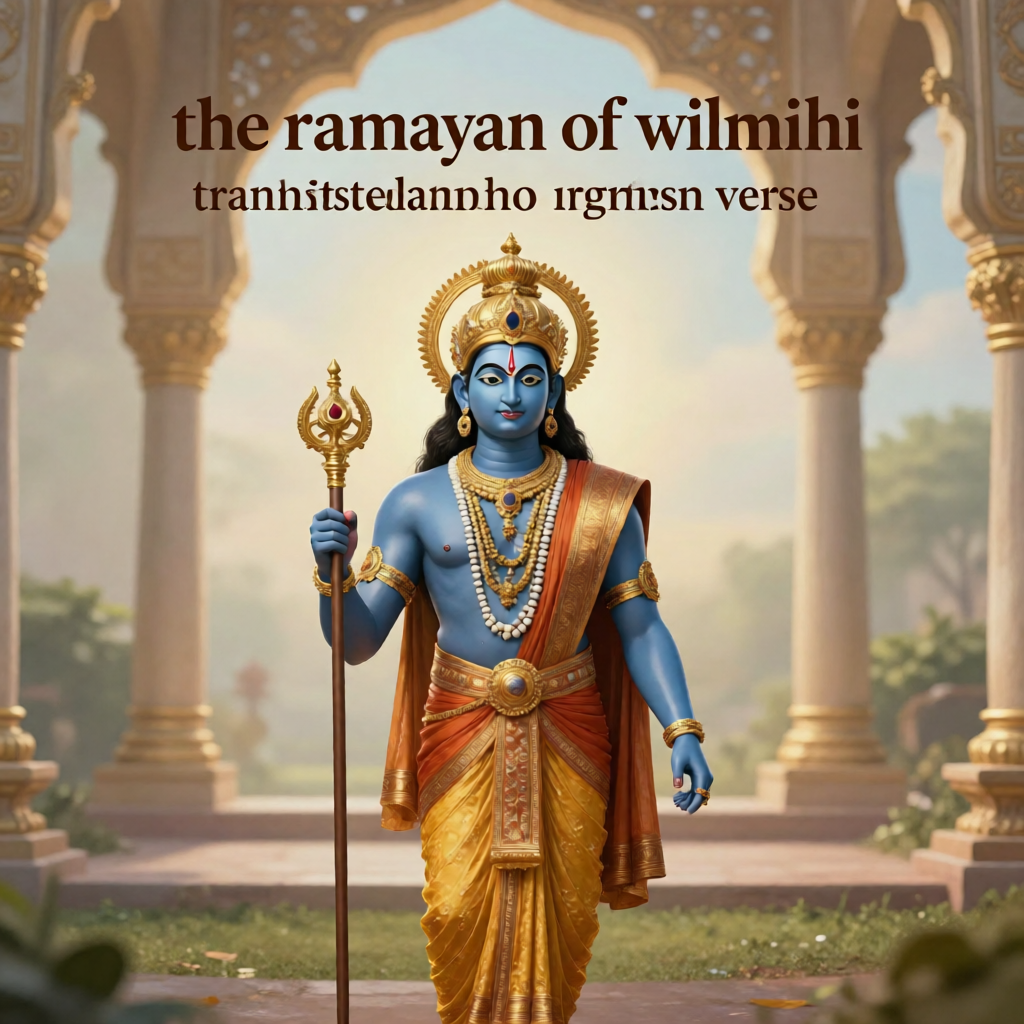
A Study Guide to the Rámáyan of Válmíki
The Shape of the Sacred Verse
The Rámáyan unfolds across six great movements, each carrying its own emotional weather yet threaded together by the steady pulse of dharma, longing, and divine purpose. Translated into English verse from the original Sanskrit, the epic preserves its original cadence of śloka—balanced, rhythmic lines where meaning moves like water between mirrored banks. The translation, drawing from the Northern Recension and supported by Gorresio’s Italian work and Schlegel’s Latin scholarship, retains the ceremonial weight of each canto even as it speaks to modern readers in accessible language.
Book I: The Opening of Worlds
The Bāla Kāṇḍa establishes the cosmic frame through the sage Nārad, who appears to set the narrative in motion, and Brahmā, who confirms the divine plan. King Daśaratha’s longing for an heir summons the great sacrifice presided over by the hermit Ṛṣyaśṛṅga, whose origins unfold in luminous detail. The conception of the four princes, Rāma, Lakṣmaṇa, Bharata, and Śatrughna, each carrying portions of Viṣṇu’s essence, births the human instrument of cosmic justice. The sage Viśvāmitra arrives seeking the young prince’s aid against fiends disrupting sacred rites, and Rāma’s departure for the forest marks his first steps toward destiny.
The forest journey with Viśvāmitra becomes a passage of awakening. Rāma slays the demoness Tādakā and receives a vast arsenal of celestial weapons, each pledging itself to his service. The destruction of the demon Ṿatāpi and the breaking of Śiva’s bow to win Sītā’s hand crown this movement of heroic testing. The four princes marry the four daughters of King Janak, and the radiant bridal procession returns to Ayodhyā, where Rāma dwells beside Sītā as Viṣṇu beside Lakṣmī.
Book II: The Weight of Exile
The Ayodhyā Kāṇḍa opens with an aged king, sensing mortality’s approach, convening his people to install Rāma as Regent Heir. Four cantos gather ceremonial grandeur as the kingdom prepares for consecration. Yet the machinery of fate is already turning: the hunchbacked Mantharā poisons Queen Kaikeyī’s mind, awakening ambition and resentment. In the chamber of wrath, Kaikeyī demands two ancient boons, Rāma’s fourteen-year exile and Bharata’s coronation, binding the king to his own oath.
The summons becomes a sentence. Rāma accepts exile with serene resolve, embodying the ideal of filial obedience even as his father collapses in grief. Sītā refuses separation, her speech ringing with wifely devotion: “The moon shall leave its own sweet light ere she ceases to cleave to duty.” Lakṣmaṇa, consumed by protective rage, is calmed by Rāma’s measured counsel. The three don hermit’s bark and depart Ayodhyā through a city plunged into mourning, its people crying out that the hero now walks humbly with only Lakṣmaṇa and Sītā for company.
The journey southward traces a geography of sorrow and spiritual deepening. At Prayāga, the sage Bharadvāja receives them with otherworldly hospitality. Crossing the Yamunā and Ganges, they settle at Chitrakūṭa, where Rāma finds consolation in nature’s beauty. Yet grief pursues them. King Daśaratha dies of sorrow, his heart breaking with memories of a long-buried crime, a hermit’s son slain by his arrow in youth, and the curse that foretold this very death. The message reaches Bharata, who returns to Ayodhyā consumed by anguish, renounces the throne, and sets out to find his exiled brother. Their reunion at Chitrakūṭa becomes one of the epic’s most moving scenes, ending with Rāma placing his golden sandals in Bharata’s keeping as symbols of royal authority. Bharata dwells at Nandigrāma as a hermit, ruling only in the sandals’ name until Rāma’s return.
Book III: The Forest’s Dangers
The Araṇyakāṇḍa opens with the three exiles welcomed by ascetic sages whose hermitages dot the Daṇḍaka forest. The golden deer that captivates Sītā becomes the instrument of Mārīcha’s ruse, luring Rāma away while the demon king Rāvaṇa, disguised as a mendicant, seizes the unprotected Sītā. The vulture king Jaṭāyu dies defending her, his dying words revealing the abductor’s identity. Rāma’s anguish pours forth in a sustained lament as he roams the forests calling to trees, plants, and animals for news of his beloved. The demoness Śūrpaṇakhā’s infatuation and mutilation provokes her brother Khara, whose army of fourteen thousand giants Rāma annihilates single-handedly. The conflict escalates as Rāvaṇa, roused by his sister’s pleas, sets in motion the abduction that will shape the rest of the epic.
Book IV: Alliance and Search
The Kiṣkindhā Kāṇḍa transforms grief into action. At Pampā’s banks, Rāma pours out his anguish to Lakṣmaṇa, who counsels resolution over despair. The brothers encounter the Vānar (forest-dwelling) prince Sugrīva, exiled by his brother Bali, and a sacred fire witnesses their oath of friendship. Rāma slays Bali from hiding, his arrow guided by the brothers’ indistinguishable forms, and Sugrīva ascends the throne of Kiṣkindhā. The monsoon season brings enforced waiting, tested by Sugrīva’s neglect of his pledge, before the great search begins. Vānar armies fan out to the four cardinal directions, led toward the southern sea by Hanumān, son of the Wind God, whose boundless might was earned when the infant tried to seize the sun and received Indra’s thunderbolt on his jaw.
The search party’s deadline expires without finding Sītā. The aged vulture Sampāti, brother of the slain Jaṭāyu, reveals he witnessed Rāvaṇa carry a weeping woman south to Lankā. Hanumān volunteers to leap the hundred-league ocean. The journey tests him with the rising mountain Maināka, the sea-goddess Surasā demanding he enter her mouth, and the shadow-grabbing demoness Sinhikā. Triumphant, Hanumān lands in Lankā and begins his search through the demon city’s palaces and gardens.
Book V: The Finding
The Sundara Kāṇḍa centers on Hanumān’s discovery of Sītā in the Aśoka grove of Lankā. He witnesses Rāvaṇa’s wooing and Sītā’s fierce rejection, her voice ringing with devotion to a husband she has not abandoned in spirit. The demoness Trijatā, visited by prophetic dreams, counsels kindness toward the captive queen. Hanumān reveals himself, presents Rāma’s ring, and receives from Sītā a gem from her hair and a cherished memory of Chitrakūṭa as tokens for Rāma. The Vānar hero then provokes the demon forces, allowing himself to be captured so he may deliver Rāma’s ultimatum face to face. When Rāvaṇa orders his tail set ablaze, Hanumān uses the fire to burn Lankā before leaping back across the sea to deliver Sītā’s tidings to the grief-stricken prince.
Book VI: The War’s Resolution
The Yuddha Kāṇḍa opens with the Vānar host’s march to the southern coast. Rāma threatens to dry the ocean with his arrows until the sea-god yields, and the engineer Nala constructs a bridge of floating stones. Omens multiply as the army crosses, and the besiegers establish themselves before Lankā’s golden walls. Vibhīṣaṇa, Rāvaṇa’s righteous brother, defects to Rāma’s cause and provides intelligence on the demon king’s strengths. The great war unfolds across a vast theater of carnage and single combat, with champions falling on both sides.
The narrative’s heart lies in Rāma’s defeat of Rāvaṇa. Armed with Brahmā’s weapon and mounted on Indra’s celestial chariot, Rāma brings down the ten-headed tyrant. Yet the resolution carries unexpected pain. Rāma commands Sītā to undergo a trial by fire to prove her purity before the assembled armies. She enters the flames invoking Agni as witness, and the fire-god himself emerges bearing her unharmed, radiant as the morning. The gods descend to reveal Rāma’s true identity as Nārāyaṇ, Viṣṇu himself, and Sītā as Lakṣmī, his eternal consort.
Themes Woven Through the Verse
Dharma suffuses every action, the sacred duty that binds king and exile alike, demanding obedience even when obedience brings suffering. Exile transforms from punishment into spiritual deepening, a stripping away of royal comfort to reveal the true substance of character. Devotion appears in multiple forms: Rāma’s filial obedience, Sītā’s wifely steadfastness, Lakṣmaṇa’s fraternal loyalty, Bharata’s selfless guardianship, and Hanumān’s unwavering service. The forest serves as both sanctuary and testing ground, its beauty and dangers mirroring the inner landscape of grief and growth.
Imagery and Aesthetic Power
The verse moves between two registers: the ceremonial grandeur of royal courts, with their golden thrones, jeweled ornaments, and elaborate sacrifices, and the wild beauty of forest exile, where lotuses glorify the flood, koïls wake love in every creature, and the moon pours tranquil light over the hermitage. The translation preserves the original’s similes drawn from nature: faces compared to lotuses, armies to thunderclouds, grief to an ocean fed by fresh floods. The golden deer that captivates Sītā, the burning of Lankā by Hanumān’s flaming tail, and the return chariot soaring through the sky, all function as both narrative events and symbolic transformations.
Mood and Emotional Architecture
The epic builds emotional complexity through its patient accumulation. Joy prepares the way for grief; victory carries the seeds of loss. The coronation that opens Book II gives way to exile’s devastation. Rāma’s triumph over Rāvaṇa brings not simple celebration but the painful test of Sītā’s fidelity. The homecoming to Ayodhyā, with the four brothers reunited, Sītá restored, and the golden age of ten thousand years proclaimed, carries the weight of all that preceded it. The final cantos move toward Rāma’s apotheosis at the Sarayū, where he enters the glory of Viṣṇu, leaving behind a mortal world forever changed by his presence.
Reading This Verse Translation
The translator’s preface notes that some passages, particularly those concerning Umā and certain cantos on Kārtikeya, have been omitted as unsuited to modern taste, with reference to Schlegel’s Latin version for completeness. The verse aims to preserve the original’s “cheerful spirit of heroic times” while remaining accessible. Readers approaching this translation will find themselves drawn into a world where the sacred and the human interpenetrate, where every tree may shelter a spirit, every river carry a goddess, and every choice reverberate across three worlds. The Rámáyan in English verse becomes not merely a story from a distant past but a living meditation on duty, love, loss, and the paths by which mortals touch the divine.