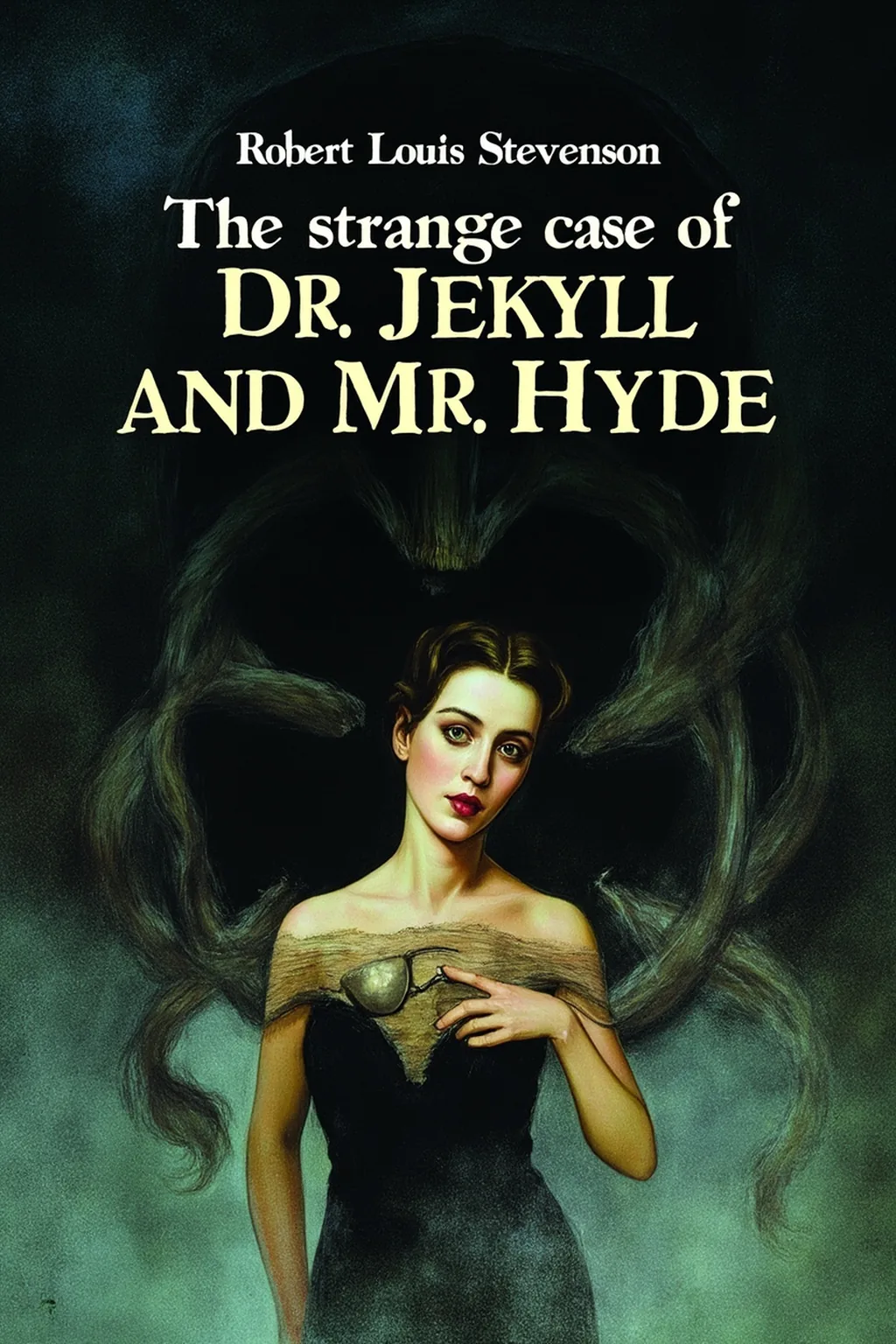
The strange case of Dr. Jekyll and Mr. Hyde
The strange case of Dr. Jekyll and Mr. Hyde by Stevenson, Robert Louis unfolds through 9 chapters. Part 1 of *The Strange Case of Dr. Jekyll and Mr. Hyde* introduces readers to the mysterious Edward Hyde through the eyes of Mr. Utterson, a fastidious lawyer. The narrative opens with a Sunday stroll between Utterson and his distant cousin Richard Enfield, who recounts a disturbing incident involving a sinister small man who callously trampled a child in the street. This encounter leads to a discussion of a mysterious door in a grim building, which Enfield dubs "Black Mail House." The chapter establishes the dark, atmospheric tone that will define the entire novella and plants the seed of Utterson's growing concern about his friend Dr. Jekyll's connection to the loathsome Hyde. This chapter follows Mr. Utterson's investigation into the mysterious Mr. Hyde and his growing concern for his old friend Dr. Jekyll. The narrative traces Utterson's sleepless night worrying about Hyde, his subsequent stakeout of Hyde's door, his face-to-face encounter with Hyde, his inquiry at Jekyll's house, and finally a tense conversation with Jekyll himself at a dinner party. This section covers Dr. Jekyll's request to Mr. Utterson regarding Edward Hyde, the murder of Sir Danvers Carew, and the discovery of a mysterious letter linked to Hyde's disappearance.
The Strange Case of Dr. Jekyll and Mr. Hyde
Part 1 of *The Strange Case of Dr. Jekyll and Mr. Hyde* introduces readers to the mysterious Edward Hyde through the eyes of Mr. Utterson, a fastidious lawyer. The narrative opens with a Sunday stroll between Utterson and his distant cousin Richard Enfield, who recounts a disturbing incident involving a sinister small man who callously trampled a child in the street. This encounter leads to a discussion of a mysterious door in a grim building, which Enfield dubs "Black Mail House." The chapter establishes the dark, atmospheric tone that will define the entire novella and plants the seed of Utterson's growing concern about his friend Dr. Jekyll's connection to the loathsome Hyde.
Story of the Door
Mr. Utterson and Richard Enfield take their habitual Sunday walk through a prosperous London quarter, where their path leads past a sinister side street. Enfield points out a decaying building with a blistered, neglected door bearing no bell or knocker. He reveals this structure is connected to a troubling story from his past: one winter night he witnessed a small, deformed man brutally trample a young girl and then coolly continue on his way. When Enfield and the child's family confronted the culprit, they forced him to pay compensation—but were disturbed by his ugliness and the doctor's obvious desire to kill him. The man produced a cheque signed by a highly respectable, celebrated figure, leading Enfield to suspect blackmail. Despite their mutual unease, neither man investigated further, adhering to Enfield's rule about avoiding questions in "Queer Street." When Utterson presses for the man's name, Enfield reveals it is Hyde, describing him as somehow deformed and detestable, though he cannot pinpoint exactly why.
Search for Mr. Hyde
After their walk, Mr. Utterson returns home in low spirits. Following his Sunday routine, he abandons his usual theological reading and instead enters his business room to examine Dr. Jekyll's last will and testament. The document, which he has long found offensive, stipulates that upon Jekyll's death or unexplained absence exceeding three months, all possessions shall pass to Edward Hyde. The will troubles Utterson both as a lawyer who values sanity and order, and as a friend who fears Jekyll has fallen into disgrace. Having previously known only Hyde's name, Utterson now connects it to the hateful attributes described by Enfield—the image of a fiend emerges from the mist. Determined to learn more, Utterson sets out toward Cavendish Square, reasoning that Dr. Lanyon, Jekyll's fellow physician, may hold the answers to this troubling mystery.
Part 2
This chapter follows Mr. Utterson's investigation into the mysterious Mr. Hyde and his growing concern for his old friend Dr. Jekyll. The narrative traces Utterson's sleepless night worrying about Hyde, his subsequent stakeout of Hyde's door, his face-to-face encounter with Hyde, his inquiry at Jekyll's house, and finally a tense conversation with Jekyll himself at a dinner party.
Utterson Visits Dr. Lanyon
The lawyer visits his old friend Dr. Lanyon, who welcomes him warmly. After pleasantries, Utterson asks if Lanyon knows anything about Hyde. Lanyon denies ever hearing the name and reveals he has had no contact with Jekyll for over ten years due to scientific disagreements. Lanyon describes Jekyll as having "gone wrong, wrong in mind" and dismisses Jekyll's recent ideas as "unscientific balderdash." Utterson is relieved that the friends' rift concerns only science, not something more serious.
Utterson's Sleepless Night
Utterson returns home and spends a troubled night unable to sleep. His imagination conjures vivid scenes of Hyde trampling a child in the street and of Hyde appearing at Jekyll's bedside to command him. Though Hyde haunts his dreams, the figure has no distinguishable face, which intensifies Utterson's desire to see Hyde in person. He believes that once he sees Hyde's face, the mystery surrounding Jekyll's connection to this man—and the strange clause in Jekyll's will—will become clear.
Utterson Stakes Out the Door
Determined to find Hyde, Utterson begins surveillance of the mysterious door in the by-street. He visits at various times—mornings, noon, and nights—patiently waiting for Hyde to appear. He resolves to become "Mr. Seek" to Hyde's assumed identity.
The Encounter with Mr. Hyde
On a frosty, quiet night, Utterson finally spots someone approaching the door. He steps out and touches the man's shoulder, identifying him as Mr. Hyde. Hyde startles but quickly composes himself. Utterson asks to enter Jekyll's house but learns Jekyll is out. Hyde then asks how Utterson recognized him, and when Utterson mentions common friends, Hyde becomes agitated, particularly at the mention of Jekyll's name. Hyde unexpectedly provides his Soho address and then quickly enters the house, leaving Utterson standing alone.
Utterson Inquires at Jekyll's House
Utterson proceeds to Jekyll's elegant home and speaks with the butler Poole. When told Jekyll is absent, Utterson mentions seeing Hyde enter through the dissecting room. Poole confirms Hyde has a key and that all servants have orders to obey him, though Hyde never dines there and uses the laboratory entrance. Utterson departs with a heavy heart, concerned for his old friend.
Utterson's Walk Home and Reflections
Walking home, Utterson reflects on Jekyll's past indiscretions, fearing old sins are now returning to haunt him. He imagines Hyde has his own dark secrets and worries that Hyde may grow impatient to inherit under the will's strange provisions. Utterson resolves to help Jekyll if his friend will allow it.
Dr. Jekyll Was Quite at Ease
Two weeks later at a dinner party, Utterson remains behind to speak with Jekyll privately. When Utterson mentions the will and then Hyde, Jekyll's face pales and he declares the matter closed. Jekyll insists Utterson doesn't understand his "very strange position" and cannot help. Utterson offers his trust and support, begging Jekyll to confide in him.
Part 3
This section covers Dr. Jekyll's request to Mr. Utterson regarding Edward Hyde, the murder of Sir Danvers Carew, and the discovery of a mysterious letter linked to Hyde's disappearance.
Dr. Jekyll's Promise to Utterson
Dr. Jekyll expresses gratitude to Mr. Utterson for his loyalty, assuring him he can be rid of Mr. Hyde whenever he chooses. Jekyll claims to take a great interest in Hyde despite Utterson's evident dislike of the man. He extracts a promise from Utterson: should anything happen to Jekyll, Utterson must advocate for Hyde and ensure he receives fair treatment. Utterson agrees reluctantly, making clear he does not promise to like Hyde, only to help him.
The Carew Murder Case
Nearly a year later, Sir Danvers Carew—an elderly, well-respected gentleman—is brutally murdered in a lane near the river. A maid witnesses the attack from her window. She describes how Hyde approaches Carew with apparent hostility, then beats him to death with a heavy cane, continuing to trample and strike the body even after the old man falls. The cane breaks under the assault. When Utterson examines the evidence at the police station, he recognizes the broken stick as one he long ago gave to Jekyll. The murdered man is identified as Sir Danvers Carew, one of Utterson's clients. Police and Utterson travel to Hyde's Soho address, only to find the rooms ransacked—papers burned in the hearth, drawers emptied. The landlady reveals Hyde had fled after returning briefly in the night. Inspector Newcomen discovers a surviving portion of a cheque book and learns several thousand pounds remain in Hyde's bank account, evidence the murderer fled in panic. Despite extensive efforts, Hyde cannot be found; witnesses describe only an unexpressed deformity and varied physical details, making identification difficult.
Incident of the Letter
Utterson visits Jekyll's laboratory later that afternoon. Jekyll appears deathly ill and greets Utterson with a changed voice. Utterson confronts him about Carew's murder, reminding Jekyll that both were his clients. Jekyll swears solemnly he will never see Hyde again, claiming Hyde is safe and will not be heard from. Jekyll mentions receiving a letter from Hyde and asks Utterson to advise whether to show it to police. The letter, written in Hyde's distinctive hand, assures Jekyll he need not fear for his safety, as he has means of escape. Jekyll burned the envelope before thinking, but the note was hand-delivered. Utterson notes the letter reflects better on their relationship than he expected, though he questions why Jekyll agreed to Hyde controlling the terms of his will—a detail that nearly cost Jekyll his life, as Hyde likely intended murder. Jekyll accepts this narrow escape as a profound lesson. Before leaving, Utterson asks Poole about a delivered letter, but Poole reports only circulars arrived by post, raising questions about who actually delivered Hyde's message.
Part 4
This section continues the narrative following the murder of Sir Danvers Carew, as Mr. Utterson grapples with concerns about his client's reputation and the mysterious Mr. Hyde's involvement.
The Handwriting Comparison
Utterson invites his head clerk Mr. Guest to dinner and shares a mysterious document written by Mr. Hyde. Guest, a handwriting expert, examines the document and notices an odd hand. When a note from Dr. Jekyll arrives during their meeting, Guest spontaneously compares the two writings and discovers they are strikingly similar in many points, differing only in slope. Utterson immediately understands the implications and locks Jekyll's note away in his safe, horrified at the thought that "Henry Jekyll forge for a murderer!"
Incident of Dr. Lanyon
Following Hyde's disappearance, Dr. Jekyll appears to recover and resumes his former life among friends. However, within weeks, Jekyll begins refusing visitors and secluding himself again. Utterson visits Dr. Lanyon and is shocked to find him severely deteriorated—both physically aged and harboring some deep terror. Lanyon declares himself doomed and refuses to discuss Jekyll, claiming he will never recover from a shock he received. Within a fortnight, Lanyon dies, leaving Utterson a sealed envelope marked not to be opened until Jekyll's death or disappearance, deepening the mystery surrounding the doctor.
Incident at the Window
Utterson and Enfield pass by the familiar by-street on a Sunday and stop to observe Jekyll's door. They notice the middle window of the house is open, and Utterson calls out to Jekyll, who appears sad and disconsolate. When Utterson invites him to join them outside, Jekyll refuses, explaining the place is not fit for visitors. Suddenly, Jekyll's expression transforms to one of abject terror, and he thrusts the window down. The two men flee in horror, exchanging only a brief, somber acknowledgment of what they witnessed.
The Last Night
One evening, Poole arrives at Utterson's home in a state of agitation. He reveals he has been afraid for about a week because Dr. Jekyll has again shut himself away in the cabinet over the laboratory, and something is clearly wrong. Utterson encourages him to speak plainly about his fears, prompting Poole to finally confess his mounting dread.
Part 5
This segment of the narrative follows the tense, urgent confrontation that unravels the central mystery of Dr. Jekyll’s disappearance, as Poole travels to summon Mr. Utterson to the Jekyll household on a deserted, stormy March night, leading to a forced entry into Jekyll’s locked cabinet.
Poole's Distressed Arrival and Hint of Foul Play
Poole arrives at Utterson’s home visibly distraught, avoids eye contact, leaves his glass of wine untasted, and hints that foul play has occurred at Dr. Jekyll’s house, begging Utterson to come see for himself. Utterson agrees immediately, and is struck by the overwhelming relief Poole shows at his acceptance.
The Stormy Journey Through Deserted London
The pair travel on a wild, cold March night with a howling wind and thin, tilted moon, through eerily empty London streets Utterson has never seen so deserted, heightening his sharp, unshakable sense of impending calamity. They arrive at the Jekyll square, where wind and lashing trees whip around the garden railing, and Poole is drenched in sweat from terror rather than exertion.
The Huddled, Terrified Servants in the Hall
When they enter the Jekyll house, the hall is brightly lit with a high fire, and all the household servants are huddled together like sheep around the hearth, paralyzed with fear. The housemaid weeps hysterically and the cook rushes to greet Utterson as a savior, and the servants make no protest when Poole reprimands them for their irregular, fearful behavior.
Poole Demonstrates the Changed Voice from the Cabinet
Poole leads Utterson to the laboratory adjacent to the house, has him stand quietly out of sight, then knocks on the red baize cabinet door and calls out that Mr. Utterson is requesting to visit. The voice from inside complains it cannot see anyone, and Utterson confirms the voice is drastically altered from Dr. Jekyll’s usual tone.
Poole's Murder Accusation and the Mysterious Drug Orders
Back in the kitchen, Poole insists the voice was not his master’s, claiming Dr. Jekyll was murdered eight days prior after a cry of God’s name was heard from the house, and that the person inside the cabinet is an imposter. He produces a crumpled, agitated handwritten order note from the imposter demanding a specific rare drug from chemists, which he has been chasing all week, as further proof something is deeply wrong.
Poole's Encounter with the Masked Figure Among the Crates
Poole reveals he snuck into the laboratory theatre earlier and saw a masked, dwarf-like figure rummaging among crates, who cried out and fled to the cabinet when spotted, an encounter that confirmed to him the person inside is not Dr. Jekyll.
Utterson's Rational Explanation vs. Poole's Certainty
Utterson offers a rational explanation: Dr. Jekyll is suffering from a painful, disfiguring illness that has altered his voice, driven him to wear a mask, and made him desperate for a specific drug, accounting for all the strange events. Poole rejects this, insisting the figure he saw was not Jekyll, was a dwarf, and that he knows his master’s voice and appearance after 20 years of service, and is certain murder has been committed.
The Decision to Break Down the Cabinet Door
Utterson accepts he has a duty to investigate, and decides he must break into the cabinet to get answers. Poole agrees, and they arm themselves: Utterson takes a heavy kitchen poker, and Poole retrieves an axe from the theatre, before they send a footman and kitchen boy to guard the laboratory door to prevent the imposter from escaping.
Identifying Hyde and Arming for Confrontation
While preparing, Utterson presses Poole on the identity of the masked figure, and Poole confirms it matches Mr. Hyde’s size, quick movements, and the chilling, unsettling presence he felt when meeting Hyde previously. Utterson concludes Hyde has murdered Jekyll and is hiding in the cabinet, vowing vengeance for the crime.
Waiting in the Theatre and Listening to the Pacing Footsteps
The pair wait in the dark laboratory theatre, listening to the soft, swinging, light footsteps pacing back and forth inside the cabinet all night, broken only by pauses when new drug supplies arrive. Poole reveals he once heard the figure weeping like a woman or lost soul, and Utterson confirms the footsteps are nothing like Dr. Jekyll’s heavy, creaking tread.
The Assault on the Cabinet
When their 10 minute waiting period ends, Utterson calls out to the occupant, who pleads for mercy, and Utterson recognizes the voice as Hyde’s. He orders Poole to break down the door, and after five heavy axe blows that shatter the tough wood and excellent fittings, the locked door falls inward onto the carpet.
Part 6
This chapter centers on the discovery of Edward Hyde's body, the subsequent search for Dr. Jekyll throughout his building, the examination of Jekyll's cabinet and its contents, and the beginning of Dr. Lanyon's narrative describing his involvement in Jekyll's mysterious affairs.
Discovery of Hyde's Body in the Cabinet
The search party enters Jekyll's cabinet to find an unsettling tableau of domestic normalcy—a good fire, kettle singing, and tea things set out—yet in the middle of the room lies the contorted body of Edward Hyde. He is dressed in clothes far too large for him, doctor's-sized garments that hang loosely on his diminished frame. Though the cords of his face still twitch with a semblance of life, Utterson recognizes the crushed phial in his hand and the strong smell of kernels filling the air, concluding that Hyde has taken his own life. With Hyde's fate sealed, Utterson declares that the search must now turn to finding the body of Dr. Jekyll himself.
Search of the Building for Jekyll
The investigators thoroughly explore Jekyll's premises, which consist primarily of the surgical theatre occupying the ground storey, the cabinet forming an upper storey, a connecting corridor, a second flight of stairs, several dark closets, and a spacious cellar. Each closet proves empty, their dust-covered doors indicating long disuse. The cellar is filled with old lumber from Jekyll's predecessor, sealed for years by cobwebs. Despite their efforts, no trace of Henry Jekyll—living or dead—is found anywhere in the building.
Examination of the Cabinet Contents and Curious Discoveries
Returning to the cabinet, the men examine its contents more carefully. On one table, they discover traces of chemical work: measured heaps of white salt on glass saucers, suggesting interrupted experiments. Poole recognizes the substance as the same drug he frequently procured for Jekyll. Near the fire, the easy-chair sits ready with tea prepared, sugar already in the cup, creating an oddly domestic scene. Several books rest on a shelf, including one lying open beside the tea things—a pious work Jekyll had often praised, now annotated in his own hand with startling blasphemies. They also examine a cheval-glass mirror, which Utterson notes has "seen some strange things." The mirror is angled to reveal only the rosy glow on the roof and the fire's reflections, but both Utterson and Poole seem disturbed by this ordinary piece of furniture.
Jekyll's Revised Will and Final Letter to Utterson
On Jekyll's business table, Utterson discovers a large envelope bearing his own name in the doctor's hand. Within it lies a will identical in form to the one he had previously returned six months earlier—a document designed to serve as testament in case of death and deed of gift in case of disappearance—but with one crucial difference: instead of naming Edward Hyde as beneficiary, Utterson reads his own name, Gabriel John Utterson. Amazed that Hyde had not destroyed this document despite being displaced from his inheritance, Utterson turns to the next paper: a brief note in Jekyll's hand, dated that very day, confirming Jekyll was alive mere hours before. The note, addressed "My dear Utterson," explains that when the document reaches him, Jekyll will have disappeared under circumstances he cannot foresee. Jekyll instructs Utterson to read the narrative prepared by Dr. Lanyon, followed by his own confession. A third enclosure—a sealed packet—goes into Utterson's pocket. Utterson determines to study these documents at home but promises to return before midnight to involve the police.
Dr. Lanyon's Narrative Begins: Receipt of Jekyll's Desperate Letter
The chapter transitions to Dr. Lanyon's first-person account, beginning four days prior on January ninth when Lanyon received a registered envelope from his colleague Henry Jekyll. The letter, dated December tenth, appeals to their long friendship while making an extraordinary request. Jekyll writes that his life, honour, and reason are all at stake, and he begs Lanyon to postpone all other engagements, travel immediately to his house by cab, and force entry to his cabinet with the assistance of Poole and a locksmith. Jekyll specifies that Lanyon must unlock the glazed press marked "E," retrieve the fourth drawer from the top (or third from the bottom), and carry it back to Cavendish Square. The drawer should contain some powders, a phial, and a paper book. Then, at midnight, Lanyon must admit a messenger who will present himself in Jekyll's name and deliver the drawer to him. Jekyll warns that neglecting either task could result in his death or the "shipwreck of his reason."
Lanyon Retrieves the Drawer from Jekyll's Cabinet
Despite suspecting Jekyll of insanity, Lanyon feels bound to comply with the request. He drives to Jekyll's house, where Poole awaits with a locksmith and carpenter. The tradespeople approach the door to Dr. Denman's former surgical theatre—the most convenient entry point to Jekyll's cabinet. The door proves extremely strong with an excellent lock; the carpenter anticipates great difficulty and significant damage if forced. After two hours of labor, the locksmith finally opens the door. Lanyon locates press "E" and extracts the specified drawer, which he has filled with straw and tied in a sheet before returning to Cavendish Square with the mysterious contents.
Examination of the Drawer's Contents
In the privacy of his own home, Lanyon examines the drawer's contents with scientific scrutiny. The powders appear to be privately manufactured by Jekyll, composed of what seems to be a simple white crystalline salt, lacking the precision of a dispensing chemist. The phial, about half full of blood-red liquor, proves highly pungent and seems to contain phosphorus and some volatile ether. The paper book is an ordinary version book recording dates spanning many years, but the entries ceased abruptly nearly a year ago. Occasional brief remarks appear—typically single words like "double" repeated several times, and once, early in the record, the notation "total failure!!!" While the contents intrigue him, Lanyon remains unconvinced of their significance, dismissing them as the failed experiments of a possibly unstable colleague. Convinced Jekyll suffers from cerebral disease, Lanyon dismisses his servants to bed but loads a revolver for self-defence.
Arrival of Jekyll's Mysterious Messenger
At precisely midnight, a soft knock sounds at Lanyon's door. When Lanyon answers, he finds a small man crouching against the portico pillars. The visitor confirms through a constrained gesture that he has come from Dr. Jekyll, then enters with a searching backward glance toward the darkness—unsettled by a nearby policeman with his lantern lit. Following the man into the consulting room, Lanyon keeps his hand ready on his weapon. He has never seen this visitor before, yet is struck by the man's small stature, shocking facial expression, and peculiar combination of muscular activity with apparent constitutional weakness. Most disturbing is an odd, subjective disturbance caused by the visitor's proximity—a sensation resembling incipient rigour accompanied by a marked sinking of the pulse. Lanyon attributes this initially to personal distaste but later recognizes its deeper significance.
Lanyon's Witness of Transformation and Jekyll's Full Statement
Lanyon witnesses the transformation of Hyde back into Jekyll, and Jekyll's complete confession follows. The chapter reveals the terrible secret connecting Jekyll and Hyde while documenting Lanyon's psychological destruction and Jekyll's philosophical exploration of dual nature.
The Visitor's Disgusting Appearance and Urgent Demand
The Visitor's Disgusting Appearance and Urgent Demand Lanyon describes his visitor as striking him with "disgustful curiosity" from the first moment of entrance. The man is dressed in clothes enormously too large—trousers hanging and rolled up, coat waist below his haunches, collar sprawling on shoulders—yet this ludicrous appearance moves Lanyon not to laughter but to recognition of something "abnormal and misbegotten." His impatience is extreme, crying "Have you got it? Have you got it?" and even laying hands upon Lanyon's arm to shake him, causing Lanyon to feel "a certain icy pang along my blood."
Lanyon Yields the Drawer to the Agitated Visitor
Lanyon Yields the Drawer to the Agitated Visitor The visitor (Hyde) explains he comes at Dr. Jekyll's instance on business of some moment. He pauses, putting hand to his throat and wrestling against approaching hysteria, and mentions "a drawer." Taking pity on Hyde's suspense and his own growing curiosity, Lanyon points to the drawer lying on the floor behind a table, still covered with a sheet. Hyde springs to it, then pauses with hand upon his heart; Lanyon hears his teeth grate with convulsive jaw action, and his face is so ghastly that Lanyon grows alarmed for both his life and reason. Hyde turns a "dreadful smile," plucks away the sheet, and at sight of the contents utters "one loud sob of such immense relief."
The Mixing of the Tincture and the Choice Offered
The Mixing of the Tincture and the Choice Offered Hyde requests a graduated glass, which Lanyon provides. Hyde measures out "a few minims of the red tincture" and adds one of the powders. The mixture transforms through stages: beginning reddish, then brightening and effervescing with audible bubbling and small fumes of vapour, suddenly ceasing to change to dark purple, which fades slowly to a watery green. Hyde watches with keen eye, smiles, and sets down the glass. He offers Lanyon a choice: be wise and leave, or allow the experiment to proceed with promises of new knowledge and fame, warning that his sight "shall be blasted by a prodigy to stagger the unbelief of Satan." Lanyon, having gone too far in inexplicable services, declares he must see the end.
Hyde Drinks and Transforms into Jekyll Before Lanyon
Hyde Drinks and Transforms into Jekyll Before Lanyon Hyde declares "Lanyon, you remember your vows," and challenges him about denying transcendental medicine and deriding superiors. He puts the glass to his lips and drinks at one gulp. A cry follows; he reels, staggers, clutches at the table with injected eyes and gasping mouth. His face becomes suddenly black, features seem to melt and alter, and he appears to swell. Lanyon springs to his feet and leaps back against the wall, arms raised in terror. Before his eyes stands Henry Jekyll—"pale and shaken, and half fainting, and groping before him with his hands, like a man restored from death."
Lanyon's Shattered Nerves and the Revelation of Hyde's Identity
Lanyon's Shattered Nerves and the Revelation of Hyde's Identity Lanyon declares he cannot set on paper what Jekyll told him that hour; his soul sickened at what he saw and heard. His life is "shaken to its roots," sleep has left him, and "deadliest terror" sits beside him constantly. He feels his days are numbered yet "shall die incredulous." The moral turpitude Jekyll unveiled, even confessed with tears of penitence, cannot be remembered without horror. He reveals to Utterson that the creature who visited him was, on Jekyll's own confession, Hyde—the murderer of Carew, hunted throughout the land.
Henry Jekyll's Full Statement of the Case
Henry Jekyll's Full Statement of the Case Jekyll begins his confession, explaining how he came to be both Jekyll and Hyde through scientific experimentation aimed at separating the dual nature of man.
Jekyll's Endowments and the Origins of His Duplicity
Jekyll's Endowments and the Origins of His Duplicity Born to a large fortune with excellent parts, inclined to industry and fond of the respect of wise and good men, Jekyll appeared destined for an honorable future. His worst fault was "a certain impatient gaiety of disposition" that he concealed from public view, creating a "profound duplicity of life." Rather than any particular degradation, it was the "exacting nature of my aspirations" that severed his nature more deeply than most men, dividing good and ill within him.
The Discovery of Man's Dual Nature
The Discovery of Man's Dual Nature Jekyll explains he was "no more myself when I laid aside restraint and plunged in shame, than when I laboured at the furtherance of knowledge." His scientific studies, directed wholly toward the mystic and transcendental, shed light on the "consciousness of the perennial war among my members." He drew nearer to the truth that "man is not truly one, but truly two"—possibly even a "polity of multifarious, incongruous and independent denizens." He learned to dwell with pleasure on the thought of separating these elements: the unjust going free while the just walked upright without exposure to extraneous evil.
Scientific Studies Toward the Separation of Good and Evil
Scientific Studies Toward the Separation of Good and Evil Jekyll began to perceive "the trembling immateriality, the mistlike transience, of this seemingly so solid body in which we walk attired." Certain agents could "shake and pluck back that fleshly vestment, even as a wind might toss the curtains of a pavilion." He declines to elaborate deeply on the scientific branch of his discoveries, noting that attempts to cast off life's burdens return with more awful pressure, and his discoveries were incomplete.
The Compounding of the Drug and the First Experiment
The Compounding of the Drug and the First Experiment Jekyll recognized his natural body from "the mere aura and effulgence of certain of the powers that made up my spirit" and managed to compound a drug by which these powers would be dethroned and a second form substituted. He hesitated long, knowing he risked death—for any drug controlling identity might "utterly blot out that immaterial tabernacle." The temptation of singular discovery overcame alarm. He prepared his tincture, purchased a large quantity of a particular salt from wholesale chemists as the required ingredient, and late one accursed night compounded the elements and drank off the potion.
The Sensations and Awakening as Edward Hyde
The Sensations and Awakening as Edward Hyde "The most racking pangs succeeded: a grinding in the bones, deadly nausea, and a horror of the spirit." These agonies swiftly subsided, and Jekyll came to himself as if "out of a great sickness." He felt younger, lighter, happier in body but conscious of "a heady recklessness," "disordered sensual images," and "an unknown but not an innocent freedom of the soul." He knew himself to be "more wicked, tenfold more wicked, sold a slave to my original evil"—and the thought braced and delighted him like wine. He stretched out his hands and was suddenly aware he had "lost in stature."
The Appearance and Nature of Edward Hyde
The Appearance and Nature of Edward Hyde Jekyll theorizes that his evil side, being less robust and less developed than the good, and having been "much less exercised and much less exhausted," resulted in Edward Hyde being smaller, slighter, and younger than Jekyll. Evil left "an imprint of deformity and decay" upon Hyde's body, yet Jekyll felt no repugnance at this reflection—"This, too, was myself." Hyde was "pure evil," alone in mankind, and all human beings who met him felt "a visible misgiving of the flesh" because they are commingled of good and evil while Hyde was purely evil.
The Successful Return to the Form of Henry Jekyll
The Successful Return to the Form of Henry Jekyll Jekyll lingered only a moment at the mirror before attempting the conclusive experiment—returning to his original form. Hurrying back to his cabinet, he prepared and drank the cup again, suffered the pangs of dissolution once more, and came to himself "with the character, the stature and the face of Henry Jekyll."
Jekyll's Full Confession
This chapter presents Dr. Jekyll's complete account of how he created Edward Hyde, the circumstances that led to Sir Danvers Carew's murder, and his subsequent imprisonment within his own conscience. Jekyll describes his discovery as a fatal crossroads where a noble spirit might have produced an angel, but his dormant virtue and alert evil instead produced Hyde—a being wholly inclined toward worse.
The Origin of Edward Hyde
Jekyll reveals that his drug possessed no discriminating moral action; it merely unlocked the prisonhouse of his disposition, releasing whatever dwelled within. At the crucial moment, his virtue slumbered while his evil, kept awake by ambition, was swift to seize the occasion. The drug was neither diabolical nor divine—it simply freed what already existed within him. From that moment, Jekyll possessed two characters and two appearances, one wholly evil and the other the same incongruous Henry Jekyll whose reformation he had already learned to despair.
Establishing the Double Life
Despite his scientific ambitions, Jekyll remained unwilling to conquer his aversion to the dryness of scholarly life, occasionally desiring merriment and undignified pleasures. His new power tempted him in this direction, leading him to slavery. He prepared meticulously—obtaining and furnishing a house in Soho where Hyde could be tracked by police, engaging a silent and unscrupulous housekeeper, announcing to his servants that Hyde would have full liberty at his house, and drafting a will ensuring no pecuniary loss if anything befell Jekyll. He even visited his second character in person to parry mishaps.
Hyde's Escalating Depravity
The pleasures Jekyll sought in his disguise began undignified but soon turned monstrous in Hyde's hands. Jekyll discovered that this familiar summoned from his own soul was inherently malign and villainous—every act and thought centered on self, drinking pleasure with bestial avidity from any degree of torture. Jekyll stood aghast at Hyde's acts, but the situation seemed apart from ordinary laws and insidiously relaxed conscience's grasp. Jekyll convinced himself that Hyde alone was guilty, his own conscience slumbered, and he woke to unimpaired good qualities, even hastening to undo Hyde's evil when possible.
The Child Incident
Jekyll mentions an act of cruelty to a child that aroused a passer-by's anger—recognizing this person later as the reader's kinsman. Joined by a doctor and the child's family, moments arose when Jekyll feared for his life. To pacify their just resentment, Hyde had to appear personally and pay with a cheque drawn in Jekyll's name. This danger was eliminated by opening another bank account in Hyde's own name, with Jekyll providing a backward-sloped signature that Hyde could use independently.
The Involuntary Transformation
Two months before the murder, Jekyll experienced a terrifying reversal of his previous experience. After returning late from an adventure, he woke in his bedroom in the square but sensed he was not where he seemed to be—that he was in the little room in Soho in Hyde's body. When his eyes fell upon his hand, he saw Hyde's: lean, corded, knuckly, dusky pale, shaded with dark hair—though he had gone to bed Henry Jekyll. Rushing to the mirror confirmed his horror. With drugs in a distant cabinet, servants already awake, and no way to conceal his altered stature, Jekyll escaped only because servants were accustomed to Hyde's comings and goings. Ten minutes later, back in his own shape, he sat with darkened brow at breakfast.
The Growing Imbalance
This inexplicable incident spelled out Jekyll's judgment like the Babylonian finger on the wall. His projected nature had been much exercised, and Hyde's body seemed to have grown in stature with a more generous tide of blood. Jekyll began to spy danger that the balance of his nature might be permanently overthrown, voluntary change forfeited, and Hyde's character become irrevocably his. The drug's effects had become unreliable—early failures forced him to double doses, once even to treble at risk of death. Whereas initially the difficulty was throwing off Jekyll's body, it had lately transferred to the other side. Jekyll was slowly losing hold of his original self.
The Choice Between Natures
Jekyll recognized he must choose between his two natures. Jekyll (composite) shared in Hyde's pleasures with sensitive apprehension or greedy gusto, but Hyde was indifferent to Jekyll—merely remembering him as a mountain bandit remembers a cavern. Choosing Jekyll meant dying to long-secret appetites; choosing Hyde meant dying to a thousand interests and becoming forever despised and friendless. While Jekyll would suffer smartingly in abstinence, Hyde would be unconscious of what he had lost. The inducements were as old as mankind, and Jekyll chose the better part—yet was found wanting in strength to keep to it.
The Failed Reform and Relapse
Jekyll chose the elderly doctor with honest hopes, bidding farewell to Hyde's liberty, comparative youth, light step, and secret pleasures. Yet he retained unconscious reservations—the Soho house and Hyde's clothes remained. For two months he maintained severe virtue, enjoying an approving conscience. But time eroded alarm's freshness; conscience's praises became routine; Hyde's throes and longings tortured him. In an hour of moral weakness, Jekyll again swallowed the transforming draught. His devil, long caged, emerged roaring. Even taking the draught, Jekyll felt a more unbridled, furious propensity to ill—the very quality that ensured to be tempted was to fall.
The Murder of Sir Danvers
The moment of relapse stirred in Jekyll's soul a tempest of impatience while confronting his victim. No morally sane man could have committed that crime upon so pitiful a provocation, yet Hyde struck in the spirit of a sick child breaking a plaything. Hell's spirit awakened, delighting in the mauling of the unresisting body until terror finally struck. Jekyll fled the scene, glorying and trembling, then ran to Soho to destroy his papers. Before the transformation's pangs finished tearing him, Jekyll had already fallen upon his knees with streaming tears of gratitude and remorse. The veil of self-indulgence was rent; he saw his life entire and could have screamed aloud.
Remorse and Confinement to Jekyll
As remorse's acuteness died away, joy succeeded. The problem of conduct was solved—Hyde was impossible, Jekyll confined to his better existence regardless of will. He rejoiced to embrace natural life's restrictions and locked the door, grinding the key under his heel. The next day brought news that the murder had not been overlooked, Hyde's guilt patent to the world. Jekyll was glad to have his better impulses guarded by the terrors of the scaffold. Jekyll was now his city of refuge—let Hyde peep out an instant, and all men's hands would be raised to take and slay him.
Henry Jekyll's Full Statement of the Case, Part 9
Chapter 9: Henry Jekyll's Full Statement of the Case, Part 9** Jekyll narrates the final phase of his descent, describing his relapse into evil, the catastrophic failure of his potion, and the tragic conclusion that severs him permanently from his identity as Jekyll.
Jekyll's Relapse into Sin
Jekyll's Relapse into Sin** Following his initial transformation and subsequent reformation, Jekyll commits himself to a life of virtuous conduct, laboring earnestly to relieve suffering and finding genuine contentment in doing good. However, this period of moral rectitude proves temporary. As the initial fervor of his penitence diminishes, the darker aspects of his nature reassert themselves, drawing him back toward transgression. His relapse occurs not through any deliberate intention to resurrect Hyde, but rather through a gradual weakening of his moral resistance, leading him to "trifle with [his] conscience" as an ordinary sinner would, until he succumbs entirely to temptation.
The Sudden Transformation
The Sudden Transformation** On a clear January day in Regent's Park, Jekyll sits basking in the sunshine, his conscience temporarily dormant, when a sudden and overwhelming nausea seizes him. Within moments, the transformation occurs—the clothing becomes loose on his shrunken frame, and he recognizes the familiar corded, hairy hand of Edward Hyde. The change is swift and complete; the respectable, beloved Jekyll vanishes, replaced by Hyde, now hunted and houseless, a known murderer facing the gallows. The transformation represents a complete and catastrophic reversal of fortune, shattering whatever security Jekyll had believed he possessed.
Hyde's Resolve to Reach Lanyon
Hyde's Resolve to Reach Lanyon** Stripped of his usual resources and trapped in his monstrous form, Hyde faces an urgent problem: his drugs remain locked in Jekyll's laboratory, inaccessible through the front door without risking capture. Recognizing the impossibility of entering his own home, Hyde determines to enlist Dr. Lanyon, remembering that his own handwriting remains unchanged across both personalities. This realization illuminates the path forward—he will write letters to Lanyon and to his servant Poole, commanding them to retrieve the necessary materials from Jekyll's cabinet, enabling him to restore himself to human form.
The Hotel in Portland Street and the Nocturnal Journey
The Hotel in Portland Street and the Nocturnal Journey** Dressed in ill-fitting clothes that render his appearance comical yet tragic, Hyde commandeers a hansom to a hotel in Portland Street. His demeanor is so terrifying that the servants obey his every command without exchanging glances, providing him with writing materials in a private room. There he composes his crucial letters to Lanyon and Poole, sending them by registered post to ensure their delivery. Throughout the day, he sits beside the fire, consuming his own fears, and when night falls, he roams the streets in a closed cab, driven by terror and hatred. The encounter with a woman offering boxes of lights—in which he strikes her—demonstrates the volatile violence now consuming him. Finally, abandoning the cab when the driver grows suspicious, Hyde continues on foot, skulking through deserted streets, counting the minutes until midnight.
Awakening at Lanyon's House
Awakening at Lanyon's House** Jekyll recovers consciousness at Lanyon's residence, shaken by his friend's horror at the transformation but recognizing it as merely a fraction of the self-loathing now consuming him. His terror has shifted from the gallows to the horrifying reality of being Hyde. He receives Lanyon's condemnation in a dreamlike state and returns home in similar fashion, collapsing into bed. Despite nightmares, he sleeps deeply and wakes the next morning weakened but refreshed, still hating and fearing the brute within, yet grateful to be home with access to his drugs.
Uncontrollable Transformations and Mutual Hatred
Uncontrollable Transformations and Mutual Hatred** From this point onward, Jekyll requires increasing quantities of the potion to maintain his human form, with transformations occurring at all hours, especially during sleep. The premonitory shudder precedes each change, and Jekyll becomes physically and mentally exhausted, consumed entirely by horror at his other self. Meanwhile, Hyde's powers grow as Jekyll weakens. The mutual hatred between them intensifies: Jekyll, having witnessed Hyde's full deformity, views him as something "hellish" and "inorganic"—a lifeless thing usurping life's functions. Hyde, forced into subordination, resents Jekyll's decline and plays malicious tricks: scrawling blasphemies in Jekyll's handwriting, burning letters, and destroying his father's portrait. Hyde's remarkable love of life and fear of execution compel him to remain subordinate, yet his spite remains a constant threat.
The Ineffective Potion
The Ineffective Potion** Jekyll's supply of the salt compound, unrenewed since his first experiment, begins to diminish. Upon mixing a fresh draught, the expected transformation occurs but proves ineffective—the potion lacks its former power. Despite London's thorough search, no proper supply can be found. Jekyll concludes that his original salt contained an unknown impurity that had been essential to the mixture's efficacy. With this final resource exhausted, he faces the impending doom of remaining permanently trapped in Hyde's form.
The Final Words of Henry Jekyll
The Final Words of Henry Jekyll** Writing under the influence of the last remaining powder, Jekyll knows this represents his final opportunity to think his own thoughts or see his own face. He must complete the narrative quickly, for if Hyde interrupts him mid-writing, the manuscript will be destroyed. Jekyll reflects on how Hyde's selfishness and focus on the present moment may preserve the document after sufficient time has elapsed. As the moment of final transformation approaches, he sits either trembling and weeping or pacing in terrified anticipation. Whether Hyde will face the scaffold or find courage to release himself remains unknown, but Jekyll expresses indifference, for his true death comes now. With this, he seals his confession and brings the life of Henry Jekyll to its end.