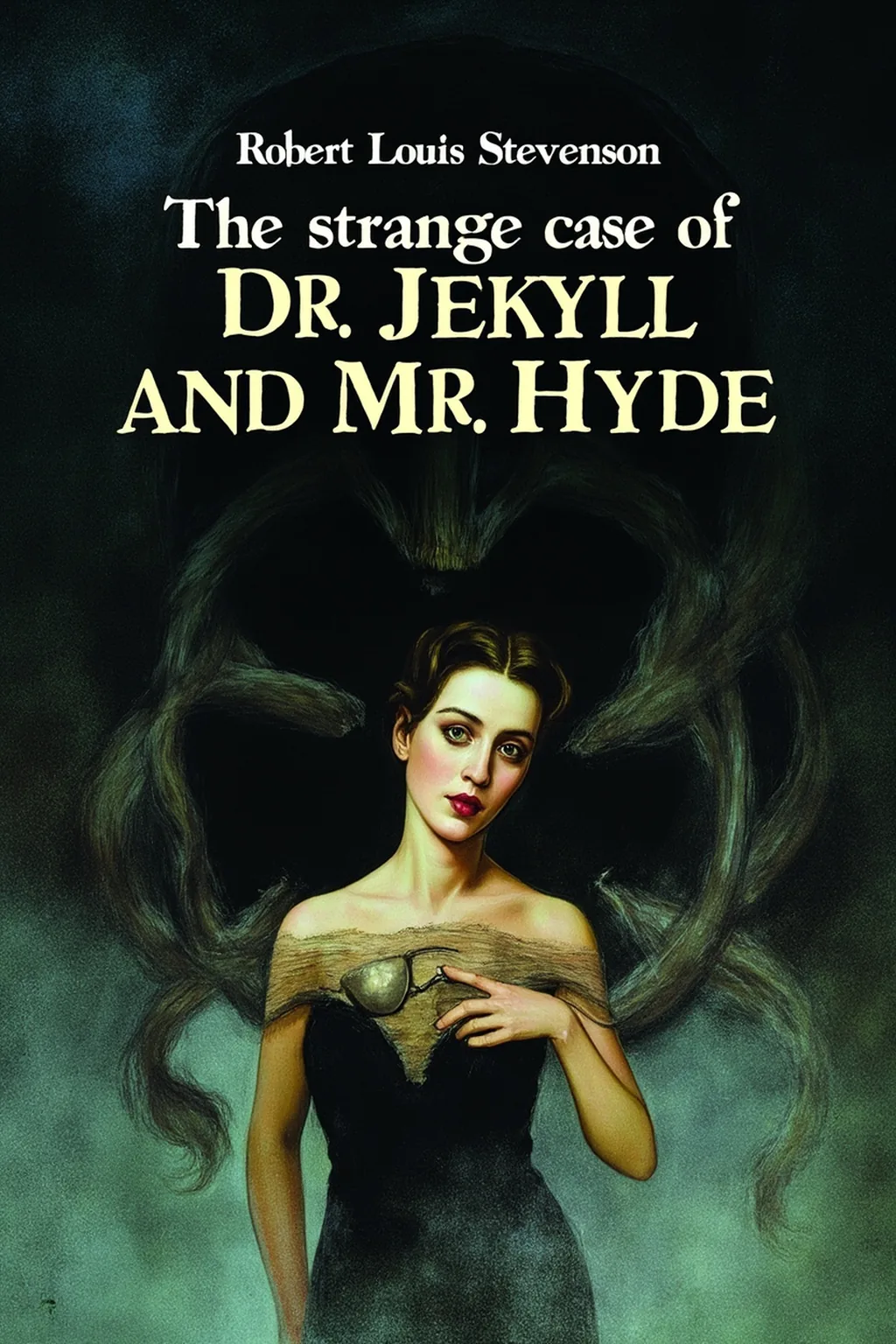
Chapter 1: Part 1
Mr. Utterson the lawyer was a man of a rugged countenance that was never lighted by a smile; cold, scanty and embarrassed in discourse; backward in sentiment; lean, long, dusty, dreary and yet somehow lovable. At friendly meetings, and when the wine was to his taste, something eminently human beaconed from his eye; something indeed which never found its way into his talk, but which spoke not only in these silent symbols of the after-dinner face, but more often and loudly in the acts of his life. He was austere with himself; drank gin when he was alone, to mortify a taste for vintages; and though he enjoyed the theatre, h
Two doors from one corner, on the left hand going east the line was broken by the entry of a court; and just at that point a certain sinister block of building thrust forward its gable on the street. It was two storeys high; showed no window, nothing but a door on the lower storey and a blind forehead of discoloured wall on the upper; and bore in every feature, the marks of prolonged and sordid negligence. The door, which was equipped with neither bell nor knocker, was blistered and distained. Tramps slouched into the rece
Read interpretation
Introduces the sinister, neglected door that serves as the physical threshold to Dr. Jekyll’s secret life and Mr. Hyde’s domain.
“Well, it was this way,” returned Mr. Enfield: “I was coming home from some place at the end of the world, about three o’clock of a black winter morning, and my way lay through a part of town where there was literally nothing to be seen but lamps. Street after street and all the folks asleep—street after street, all lighted up as if for a procession and all as empty as a church—till at last I got into that state of mind when a man listens and listens and begins to long for the sight of a policeman. All at once, I saw two figures: one a little man who was stumping along eastward at a good walk, and the other a girl of maybe eight or ten who was running as hard as she was able down a cross street. Well, sir, the two ran into one another naturally enough at the corner; and then came the horrible part of the thing; for the man trampled calmly over the
Read interpretation
Recounts the horrific incident where Hyde tramples a child, emphasizing his inhuman calm, the visceral loathing he inspires, and the subsequent blackmail payment involving the sinister door.
“He is not easy to describe. There is something wrong with his appearance; something displeasing, something down-right detestable. I never saw a man I so disliked, and yet I scarce know why. He must be deformed somewhere; he gives a strong feeling of deformity, although I couldn’t specify the point. He’s an extraordinary looking man, and yet I really can name nothin
Read interpretation
Captures the elusive, detestable quality of Hyde’s appearance, conveying a sense of deformity that cannot be specifically pinpointed.
That evening Mr. Utterson came home to his bachelor house in sombre spirits and sat down to dinner without relish. It was his custom of a Sunday, when this meal was over, to sit close by the fire, a volume of some dry divinity on his reading desk, until the clock of the neighbouring church rang out the hour of twelve, when he would go soberly and gratefully to bed. On this night however, as soon as the cloth was taken away, he took up a candle and went into his business room. There he opened his safe, took from the most private part of it a document endorsed on the envelope as Dr. Jekyll’s Will and sat down with a clouded brow to study its contents. The will was holograph, for Mr. Utterson though he took charge of it now that it was made, had refused to lend the least assistance in the making of it; it provided
Read interpretation
Utterson reviews Dr. Jekyll’s will, revealing the disturbing bequest to Edward Hyde and the clause regarding unexplained absence, transforming the document from a curiosity to a source of fear.
Chapter 2: Part 2
“We had,” was the reply. “But it is more than ten years since Henry Jekyll became too fanciful for me. He began to go wrong, wrong in mind; and though of course I continue to take an interest in him for old sake’s sake, as they say, I see and I have seen devilish little of the man. Such unscientific balderdash,” added
Read interpretation
Lanyon reveals the depth of his estrangement from Jekyll, citing Jekyll’s ‘unscientific balderdash’ as the cause, foreshadowing the dark nature of Jekyll’s experiments.
Six o’clock struck on the bells of the church that was so conveniently near to Mr. Utterson’s dwelling, and still he was digging at the problem. Hitherto it had touched him on the intellectual side alone; but now his imagination also was engaged, or rather enslaved; and as he lay and tossed in the gross darkness of the night and the curtained room, Mr. Enfield’s tale went by before his mind in a scroll of lighted pictures. He would be aware of the great field of lamps of a nocturnal city; then of the figure of a man walking swiftly; then of a child running from the doctor’s; and then these met, and that human Juggernaut trod the
Read interpretation
Utterson is tormented by nightmares of Hyde, visualizing him as a demonic force invading Jekyll’s home, which drives his obsessive need to see Hyde’s face.
Mr. Hyde appeared to hesitate, and then, as if upon some sudden reflection, fronted about with an air of defiance; and the pair stared at each other pretty f
Read interpretation
The tense confrontation where Hyde finally shows his face, allowing Utterson to recognize him in the future, marking a pivotal moment in the investigation.
The lawyer stood awhile when Mr. Hyde had left him, the picture of disquietude. Then he began slowly to mount the street, pausing every step or two and putting his hand to his brow like a man in mental perplexity. The problem he was thus debating as he walked, was one of a class that is rarely solved. Mr. Hyde was pale and dwarfish, he gave an impression of deformity without any nameable malformation, he had a displeasing smile, he had borne himself to the lawyer with a sort of murderous mixture of timidity and boldness, and he spoke with a husky, whispering
Read interpretation
Utterson reflects on the visceral, spiritual disgust Hyde inspires, famously identifying ‘Satan’s signature’ upon Hyde’s face and linking it to his old friend Jekyll.
“Yes, sir, he does indeed,” said Poole. “We have all orders to ob
Read interpretation
Poole confirms the household’s strange obligation to obey Hyde, heightening the mystery of Hyde’s power over Jekyll’s domestic sphere.
And the lawyer set out homeward with a very heavy heart. “Poor Harry Jekyll,” he thought, “my mind misgives me he is in deep waters! He was wild when he was young; a long while ago to be sure; but in the law of God, there is no statute of limitations. Ay, it must be that; the ghost of some old sin, the cancer of some concealed disgrace: punishment coming, pede claudo, years after memory has forgotten and self-love condoned the fault.” And th
Read interpretation
Utterson walks home haunted by the suspicion that Hyde is blackmailing Jekyll for an ancient sin, fearing that Hyde’s impatience to inherit might endanger Jekyll’s life.
The large handsome face of Dr. Jekyll grew pale to the very lips, and there came a blackness about his eyes. “I do not care to hear more,” said he. “This is a matter I thou
Read interpretation
Jekyll’s physical reaction to the mention of Hyde—growing pale with blackness about his eyes—betrays his terror and refusal to discuss the matter.
“It can make no change. You do not understand my position,” returned the doctor, with a certain incoherency of manner. “I am painfully situated, Utterson; my position is a very strange—a very strange one. It is one of those affairs that cannot be
Read interpretation
Jekyll admits his position is strange and painful, insisting that it is an affair that ‘cannot be mended by talking,’ shutting down Utterson’s offer of help.
Chapter 3: Part 3
“My good Utterson,” said the doctor, “this is very good of you, this is downright good of you, and I cannot find words to thank you in. I believe you fully; I would trust you before any man alive, ay, before myself, if I could make the choice; but indeed it isn’t what you fancy; it is not as bad as that; and just to put your good heart at rest, I will tell you one thing: the moment I choose, I can be rid of Mr. Hyd
Read interpretation
Jekyll’s desperate attempt to reassure Utterson about his control over Hyde, claiming he can be rid of him at any moment, which sets up the tragic irony of the chapter.
“I don’t ask that,” pleaded Jekyll, laying his hand upon the other’s arm; “I only ask for justice; I only ask you to help him for my sake, when I am no
Read interpretation
Jekyll’s strange compulsion to protect Hyde, asking Utterson to secure his rights even after death, highlighting the duality of his feelings.
h the maid’s window overlooked, was brilliantly lit by the full moon. It seems she was romantically given, for she sat down upon her box, which stood immediately under the window, and fell into a dream of musing. Never (she used to say, with streaming tears, w
Read interpretation
The maid’s vivid description of the murder, capturing Hyde’s sudden transformation into an ‘ape-like fury’ and the brutal violence of the act.
Mr. Utterson had already quailed at the name of Hyde; but when the stick was laid before him, he could doubt no longer; broken and battered as it was, he recognised it for o
Read interpretation
The critical discovery that the murder weapon is Jekyll’s cane, physically linking the respectable doctor to the horrific crime.
It was by this time about nine in the morning, and the first fog of the season. A great chocolate-coloured pall lowered over heaven, but the wind was continually charging and routing these embattled vapours; so that as the cab crawled from street to street, Mr. Utterson beheld a marvelous number of degrees and hues of twilight; for here it would be dark like the back-end of evening; and there would be a glow of a rich, lurid brown, like the light of some strange conflagration; and here, for a moment, the fog would be quite broken up, and a ha
Read interpretation
Atmospheric description of the journey through the fog to Hyde’s quarters, symbolizing the nightmare and moral obscuration surrounding the case.
In the whole extent of the house, which but for the old woman remained otherwise empty, Mr. Hyde had only used a couple of rooms; but these were furnished with luxury and good taste. A closet was filled with wine; the plate was of silver, the napery elegant; a good picture hung upon the walls, a gift (as Utterson supposed) from Henry Jekyll, who was much of a connoisseur; and the carpets were of many plies and agreeable in colour. At this moment, however, the rooms bore every mark of having been recently and hurriedly ransacked; clo
Read interpretation
The discovery of Hyde’s ransacked rooms and the burnt cheque book, confirming his flight and the panic following the murder.
“Utterson, I swear to God,” cried the doctor, “I swear to God I will never set eyes on him again. I bind my honour to you that I am done with him in this world. It is all at an end. And indeed he does not want my help; you do not know him as I do; he is safe, he is qu
Read interpretation
Jekyll’s feverish denial and claim that he is ‘done with him,’ attempting to distance himself from Hyde while appearing deathly sick.
The letter was written in an odd, upright hand and signed “Edward Hyde”: and it signified, briefly enough, that the writer’s benefactor, Dr. Jekyll, whom he had long so unworthily repaid for a thousand generosities, need labour under no alarm for his safety, as he had means of escape on which he placed a sure
Read interpretation
The introduction of the letter from Hyde, which claims safety and escape, raising Utterson’s suspicions about its origin.
On his way out, the lawyer stopped and had a word or two with Poole. “By the bye,” said he, “there was a letter handed in to-day: what was the messenger like?” But Poole was positive nothing had come except by post; “and only cir
Read interpretation
The final revelation that no messenger delivered the letter, implying forgery and deepening the mystery of Jekyll’s involvement.
Chapter 4: Part 4
“Well, sir,” returned the clerk, “there’s a rather singular resemblance; the two hands are in many points identical: only differently sl
Read interpretation
The clerk’s observation that the handwriting of Hyde’s letter and Jekyll’s invitation are identical, revealing the forgery.
But no sooner was Mr. Utterson alone that night, than he locked the note into his safe, where it reposed from that
Read interpretation
Utterson’s horrified realization that Jekyll has forged a letter for a murderer, confirming his complicity.
But Lanyon’s face changed, and he held up a trembling hand. “I wish to see or hear no more of Dr. Jekyll,” he said in a loud, unsteady voice. “I am quite done with that person; and I beg that you w
Read interpretation
Lanyon’s terrified rejection of Jekyll, regarding him as dead and refusing to hear his name mentioned.
As soon as he got home, Utterson sat down and wrote to Jekyll, complaining of his exclusion from the house, and asking the cause of this unhappy break with Lanyon; and the next day brought him a long answer, often very pathetically worded, and sometimes darkly mysterious in drift. The quarrel with Lanyon was incurable. “I do not blame our old friend,” Jekyll wrote, “but I share his view that we must never meet. I mean from henceforth to lead a life of extreme seclusion; you must not be surprised, nor must you doubt my friendship, if my door is often shut
Read interpretation
Jekyll’s letter explaining his need for extreme seclusion and the unnamed punishment and danger he has brought upon himself.
A week afterwards Dr. Lanyon took to his bed, and in something less than a fortnight he was dead. The night after the funeral, at which he had been sadly affected, Utterson locked the door of his business room, and sitting there by the light of a melancholy candle, drew out and set before him an envelope addressed by the hand and sealed with the seal of his dead friend. “PRIVATE: for the hands of G. J. Utterson ALONE, and in case of his predecease to be destroyed unread,” so it was emphatically superscribed; and the lawyer dreaded to behold the contents. “I have buried one friend to-day,” he thought: “what if this shoul
Read interpretation
The discovery of Lanyon’s sealed packet, which is only to be opened upon Jekyll’s death or disappearance, heightening the suspense.
The court was very cool and a little damp, and full of premature twilight, although the sky, high up overhead, was still bright with sunset. The middle one of the three windows was half-way open
Read interpretation
The sighting of Jekyll looking like a disconsolate prisoner at the window, emphasizing his isolation and sadness.
“That is just what I was about to venture to propose,” returned the doctor with a smile. But the words were hardly uttered, before the smile was struck out of his face and succeeded by an expression of such abject terror and despair, as froze the very blood of the two gentlemen below. They saw it but for a gli
Read interpretation
The sudden transformation of Jekyll’s expression into abject terror, causing him to slam the window shut in panic.
“You know the doctor’s ways, sir,” replied Poole, “and how he shuts himself up. Well, he’s shut up again in the cabinet; and I don’t like it, sir—I wish I may die if I like it. Mr. Utterson
Read interpretation
Poole’s arrival and confession of fear regarding the doctor’s behavior, signaling the beginning of the final crisis.
Chapter 5: Part 5
The man’s appearance amply bore out his words; his manner was altered for the worse; and except for the moment when he had first annou
Read interpretation
Opening image of Poole’s terror—untasted wine, averted gaze—establishes the chapter’s dread and signals that something is profoundly wrong at Jekyll’s house.
It was a wild, cold, seasonable night of March, with a pale moon, lying on her back as though the wind had tilted her, and flying wrack of the most diaphanous and lawny texture. The wind made talking difficult, and flecked the blood into the face. It seemed to have swept the streets unusually b
Read interpretation
Atmospheric masterpiece: the wild night mirrors Utterson’s inner turmoil and foreshadows calamity. The deserted streets and crushing anticipation create unbearable tension.
The hall, when they entered it, was brightly lighted up; the fire was built high; and about the hearth the whol
Read interpretation
The servants huddled ‘like a flock of sheep’ is a powerful image of collective terror, showing how fear has infected the entire household.
“Changed? Well, yes, I think so,” said the butler. “Have I been twenty years in this man’s house, to be deceived about his voice? No, sir; master’s made away with; he was made away with eight days ago, when we heard him cry out upon the name of God; and who’s in there instead of him, and _wh
Read interpretation
Poole’s accusation of murder—‘master’s made away with’—is the chapter’s central revelation, delivered with the conviction of twenty years’ service.
ure and quite useless for his present purpose. I
Read interpretation
The desperate scrawled plea ‘For God’s sake… find me some of the old’ reveals Jekyll’s agonizing dependence on the transforming drug.
there he was at the far end of the room digging among the crates. He looked up when I came in, gave a kind of cry, and whipped ups
Read interpretation
Poole’s sighting of the masked figure—‘why had he a mask upon his face?’ and ‘cry out like a rat’—is viscerally horrifying and confirms the impostor theory.
“Quite so, sir,” returned Poole. “Well, when that masked thing like a monkey jumped from among the chemicals and whipped into the cabinet, it went down my spine like ice. O, I know it’s not evidence, Mr. Utterson; I’m book-lear
Read interpretation
Poole’s visceral identification of Hyde—‘that masked thing like a monkey’—captures the creature’s grotesque, inhuman quality and the servant’s bone-deep certainty.
“So it will walk all day, sir,” whispered Poole; “ay, and the better part of the night. Only when a new sample comes from the chemist, there’s a bit of a break. Ah, it’s an ill consci
Read interpretation
The ceaseless pacing footsteps and Poole’s observation about ‘an ill conscience’ create an unforgettable image of guilt and torment.
“Weeping like a woman or a lost soul,” said the butler. “I came away with that upon my heart, that I could
Read interpretation
The weeping ‘like a woman or a lost soul’ is one of the chapter’s most haunting images—suggesting Jekyll’s trapped consciousness suffering within Hyde’s body.
“Utterson,” said the voice, “for God’s sake, have mer
Read interpretation
Hyde’s desperate plea for mercy is the climactic revelation—the voice confirms the impostor’s identity and marks the point of no return.
Poole swung the axe over his shoulder; the blow shook the building, and the red baize door leaped against the lock and hinges. A dismal screech, as of mere animal terror, rang from the cabinet. Up went the axe again, and again the panels crashed and the frame bounded; four times the blow fell; but the wood was tough and the fittings w
Read interpretation
The violent assault on the cabinet door, the ‘dismal screech, as of mere animal terror,’ and the final breach deliver the chapter’s explosive climax.
Chapter 6: Part 6
The besiegers, appalled by their own riot and the stillness that had succeeded, stood back a little and peered in. There lay the cabinet before their eyes in the quiet lamplight, a good fire glowing and chattering on the hearth, the kettle singing its thin strain, a drawer or two open, papers neatly set forth on the business table, and nearer the fire, the things laid out for
Read interpretation
The eerie domestic tranquility—fire glowing, kettle singing, tea laid out—creates a horrifying contrast with the violence of the forced entry and the body that lies within.
Right in the middle there lay the body of a man sorely contorted and still twitching. They drew near on tiptoe, turned it on its back and beheld the face of Edward Hyde. He was dressed in clothes far too large for him, clothes of the doctor’s bigness; the cords of his face still moved with a semblance of life, but life was quite gone; and by t
Read interpretation
Hyde’s corpse in Jekyll’s oversized clothes, the crushed phial, the smell of poison—a grotesque image of self-destruction and stolen identity.
“We have come too late,” he said sternly, “whether to save or punish. Hyde is gone to his account; and it only remains for us to find the
Read interpretation
Utterson’s grim verdict—too late for salvation or punishment—marks the irreversible turn: the mystery has become tragedy.
“Ay,” continued Utterson, “and the fractures, too, are rusty.” The two men looked at each other with a scare. “This is beyond me, Poole,” said
Read interpretation
The broken key with rusted fractures is a crucial clue—impossible, inexplicable, and deeply unsettling to both men.
This brought them to the fireside, where the easy-chair was drawn cosily up, and the tea things stood ready to the sitter’s elbow, the very sugar in the cup. There were several books on a shelf; one lay beside the tea things open, and Utterson
Read interpretation
The pious book annotated with blasphemies is a devastating image of Jekyll’s divided soul—faith and sacrilege in the same hand.
“And surely none stranger than itself,” echoed the lawyer in the same tones. “For what did Jekyll”—he caught himself up at the word with a start, and then conquering the weakness—“what could Je
Read interpretation
Utterson’s slip—‘Jekyll’ when he means Hyde—reveals his dawning comprehension that the two are somehow the same.
Next they turned to the business table. On the desk, among the neat array of papers, a large envelope was uppermost, and bore, in the doctor’s hand, the name of Mr. Utterson. The lawyer unsealed it, and several enclosures fell to the floor. The first was a will, drawn in the same eccentric terms as the one which he had returned six months before, to serve as a testament in case of death and as a deed of gif
Read interpretation
The changed will—Hyde’s name replaced by Utterson’s—is inexplicable: why would Hyde spare the document that disinherited him?
“My dear Utterson,—When this shall fall into your hands, I shall have disappeared, under what circumstances I have not the penetration to foresee, but my instinct and all the circumstances of my nameless situation tell me that the end is sure and must be early. Go then, and first read the narra
Read interpretation
Jekyll’s farewell letter points toward the full revelation: read Lanyon’s narrative, then the confession that will explain everything.
“Dear Lanyon,—You are one of my oldest friends; and although we may have differed at times on scientific questions, I cannot remember, at least on my side, any break in our affection. There was never a day when, if you had said to me, ‘Jekyll, my life, my honour, my reason, depend upon you,’ I would not have sacrificed my le
Read interpretation
Jekyll’s desperate appeal—‘my life, my honour, my reason, are all at your mercy’—reveals the extremity of his terror and dependence on Lanyon.
“Confident as I am that you will not trifle with this appeal, my heart sinks and my hand trembles at the bare thought of such a possibility. Think of me at this hour, in a strange place, labouring under a blackness of distress that no fancy can exaggerate, and yet well aware that, if you will b
Read interpretation
Jekyll’s description of his ‘blackness of distress that no fancy can exaggerate’ conveys the psychological torture of his condition.
“P.S.—I had already sealed this up when a fresh terror struck upon my soul. It is possible that the post-office may fail me, and this letter not come into your hands until to-morrow morning. In that case, dear Lanyon, do my errand when it shall be most convenient for you in the course of the day; and once more expect my messenger at midnight. It may then already be too late; and i
Read interpretation
The postscript’s fresh terror and warning that a missed night means ‘the last of Henry Jekyll’ underscores the precariousness of his existence.
Here I proceeded to examine its contents. The powders were neatly enough made up, but not with the nicety of the dispensing chemist; so that it was plain they were of Jekyll’s private manufacture; and when I opened one of the wrappers I found what seemed to me a simple crystalline salt of a white colour. The phial, to which I next turned my attention, might have been about half full of a blood-red liquor, which was highly pungent to the sense of smell and seemed to me to contain phosphorus and some volatile ether. At the other ingredients I could make no guess. The book was
Read interpretation
Lanyon’s examination of the drawer—the white salt, blood-red phial, the record of experiments ending in ‘total failure’—builds scientific dread.
These particulars struck me, I confess, disagreeably; and as I followed him into the bright light of the consulting room, I kept my hand ready on my weapon. Here, at last, I had a chance of clearly seeing him. I had never set eyes on him before, so much was certain. He was small, as I have said; I was struck besides with the shocking expression of his face, with his remarkable combination of great muscular activity and great apparent debility of constitution, and—last but not least—with the odd, subjective disturbance caused
Read interpretation
Lanyon’s visceral reaction to Hyde—physical disturbance, sinking pulse, something deeper than hatred—captures the creature’s essential wrongness.
Chapter 7: Part 7
d up to keep them from the ground, the waist of the coat below his haunches, and the collar sprawling wide upon his shoulders. Strange to relate, this ludicrous accoutrement was far from moving me to laughter. Rather, as there was something abnormal and misbegott
Read interpretation
Lanyon’s instinctive horror at Hyde’s essence—the clothes that should be laughable instead reinforce the sense of something fundamentally wrong. This captures the visceral wrongness Hyde evokes in all who encounter him.
Will you be wise? will you be guided? will you suffer me to take this glass in my hand and to go forth from your house without further parley? or has the greed of curiosity too much command of you? Think before you answer, for it shall be done as you decide. As you decide, you shall be left as you were before, and neither richer nor wiser, unless the sense of service rendered to a man in mortal distre
Read interpretation
Hyde’s Faustian offer to Lanyon—the choice between safe ignorance and forbidden knowledge that will ‘blast’ his sight. The pivotal moment where curiosity condemns Lanyon to destruction.
He put the glass to his lips and drank at one gulp. A cry followed; he reeled, staggered, clutched at the table and held on, staring with injected eyes, gasping with open mouth; and as I looked there came, I thought, a change—he seemed to swell—his face became suddenly black and the features s
Read interpretation
The climactic transformation—Hyde drinks and Lanyon watches him swell, blacken, and melt into another form. The novel’s most visually horrific moment, rendered with visceral immediacy.
“O God!” I screamed, and “O God!” again and again; for there before my eyes—pale and shaken, and half fainting, and groping before him with his hands, like a man restored from death—there stood
Read interpretation
Lanyon’s cry of terror as Jekyll stands before him ‘like a man restored from death.’ The revelation’s emotional apex—the friend returned from the impossible.
What he told me in the next hour, I cannot bring my mind to set on paper. I saw what I saw, I heard what I heard, and my soul sickened at it; and yet now when that sight has faded from my eyes, I ask myself if I believe it, and I cannot answer. My life is shaken to its roots; sleep has left me; the deadliest terror sits by me at all hours of the day and night; and I feel that my days are numbered, and that I must die; and yet I shall die incredulous. As for the
Read interpretation
Lanyon’s shattered testimony—his soul sickened, sleep abandoned, deadly terror his constant companion. The cost of forbidden knowledge: he shall die incredulous, unable to believe what he witnessed.
gularities as I was guilty of; but from the high views that I had set before me, I regarded and hid them with an almost morbid sense of shame. It was thus rather the exacting nature of my aspirations than a
Read interpretation
Jekyll’s central thesis: man is ‘not truly one, but truly two.’ The philosophical foundation of the entire narrative—human nature as irreconcilably divided.
rately on that hard law of life, which lies at the root of religion and is one of the most plentiful springs of distress. Though so profound a double-dealer, I was in no sense a hypocrite; both sides of me were in dead earnest; I was no more myself when I laid aside restraint and plunge
Read interpretation
Jekyll’s daydream of separation—if good and evil could be housed separately, life would be relieved of the unbearable. The fatal allure of the experiment’s promise.
e trembling immateriality, the mistlike transience, of this seemingly so solid body in which we walk attired. Certain agents I found to
Read interpretation
Jekyll’s perception of the body’s ‘trembling immateriality’—the flesh as mere vestment that can be shaken off. The mystical science behind the transformation.
The most racking pangs succeeded: a grinding in the bones, deadly nausea, and a horror of the spirit that cannot be exceeded at the hour of birth or death. Then these agonies began swiftly to subside, and I came to myself as if out of a great sickness. There was something strange in my sensations, something indescribably new and, from its very novelty, incredibly sweet. I felt youn
Read interpretation
The first transformation’s sensations—grinding agony followed by ‘a solution of the bonds of obligation.’ Jekyll’s horrified delight in feeling ‘tenfold more wicked.’ The seduction of evil’s freedom.
n Henry Jekyll. Even as good shone upon the countenance of the one, evil was written broadly and plainly on the face of the other. Evil besides (which I must still believe to be the letha
Read interpretation
Jekyll’s recognition of Hyde in the mirror—‘This, too, was myself.’ The divided self accepts its darker half as ‘more express and single’ than the compromised original.
the glass, I was conscious of no repugnance, rather of a leap of welcome. This, too, was myself. I
Read interpretation
The devastating moral conclusion: Hyde alone among mankind is ‘pure evil.’ All others are commingled; only he is unmixed darkness.
Chapter 8: Part 8
these agonies of death and birth, I had come forth an angel instead of a fiend. The d
Read interpretation
The central metaphor of the drug as neutral agent, merely unlocking what already exists within—Jekyll’s fatal insight that his own nature, not the potion, created Hyde.
ug had no discriminating action; it was neither diabolical nor divine; it but s
Read interpretation
The moral diagnosis: virtue slept while evil was alert and ambitious—the psychological truth beneath the supernatural transformation.
Men have before hired bravos to transact their crimes
Read interpretation
A dark innovation: Jekyll pioneered using a double not for crime but for pleasure—his corruption runs deeper than mere transgression.
respectability, and in a moment, like a schoolboy, strip off these lendings and spring headlong into the sea of liberty. But for me, in my impenetrable mantle, the safety was complete. Think of it—I did not even exist! Let me but escape into my laboratory door, g
Read interpretation
The terrible privilege of the double life: Hyde can commit any act, then vanish like breath on a mirror, leaving respectable Jekyll to laugh at suspicion. The image of erasure is chilling.
e excursions, I was often plunged into a kind of wonder at my vicarious depravity. This familiar that I called out of my own soul, and sent forth alone to do
Read interpretation
Hyde’s essential nature: pure malignancy, drinking pleasure from torture, relentless as stone. Jekyll’s horror at his own creation is palpable.
akeful moments, my eyes fell upon my hand. Now the hand of Henry Jekyll (as you have often remarked) was professional in shape and size; it was larg
Read interpretation
The moment of involuntary transformation—Jekyll wakes to find Hyde’s hand on his own bedclothes. The physical detail is visceral, the terror absolute.
e sight that met my eyes, my blood was cha
Read interpretation
The reversal that signals doom: Jekyll went to bed himself and awoke as Hyde. Control has shifted irrevocably.
bliged on more than one occasion to double, and once, with infinite risk of death, to treble the amount; and these rare uncertainties had cast h
Read interpretation
The diagnosis of his condition: slowly losing hold of his original and better self, becoming incorporated with his worse. The language of possession and absorption.
cast in my lot with Jekyll, was to die to those appetites which I had long secretly indulged and had of late begun to pamper. To cast it in with Hyde, was to d
Read interpretation
The impossible choice: Jekyll must die to his appetites or die to everything that makes life worth living. Hyde would not even feel the loss—consciousness itself is at stake.
e unbridled, a more furious propensit
Read interpretation
The most famous line from this chapter: Hyde’s long suppression has made him more violent, more furious. The caged devil image is unforgettable.
Instantly the spirit of hell awoke in me and raged. With a transport of glee, I mauled the unresisting body,
Read interpretation
The murder itself: Hyde’s transport of glee as he mauls an unresisting victim, tasting delight from every blow. The horror is in the pleasure.
e tearing him, before Henry Jekyll, with streaming tears of gratitude and remorse, had fallen upon his knees an
Read interpretation
The final renunciation: Jekyll locks the door and grinds the key under his heel. A gesture of absolute rejection—though we know it cannot hold.
I think I was glad to know it; I think I was glad to have my better impulses thus bu
Read interpretation
The terrible refuge: Jekyll is now trapped in his better self because Hyde would be hanged. Safety through terror, not virtue.
Chapter 9: Part 9
ubsequent penitence, but not yet moved to begin. After all, I reflected, I was like my neighbours; and then I smiled, comparing myself with other men, comparing my active good-will with the lazy cruelty of their neglect. And at the
Read interpretation
The pivotal moment of involuntary transformation—Jekyll’s pride triggers his doom. The contrast between respectability and hunted murderer, achieved in a single instant, encapsulates the novel’s tragic arc.
red his fury with a great effort of the will; composed his two important letters, one
Read interpretation
A crucial linguistic rupture: Jekyll can no longer say ‘I’ of Hyde. The separation of identities collapses even as their moral opposition sharpens to pure fear and hatred.
longer the fear of the gallows, it was the ho
Read interpretation
The transformation of Jekyll’s fear—from external punishment to internal horror—marks his final psychological shift. Hyde is no longer a disguise but an abomination.
ccupied by one thought: the horror of my other self. But when I slept, or when the virtue of the medicine wore off, I would leap almost without transition (for the
Read interpretation
Among the most visceral prose in Stevenson: Hyde rendered as inorganic, hellish matter that nonetheless lives and sins. The body horror carries profound theological weight.
angs of transformation grew daily less marked) into the possession of a fancy brimming with images of terror, a soul boiling with causeless hatre
Read interpretation
The intimacy of damnation—Hyde knit closer than a wife, caged in Jekyll’s flesh, struggling to be born. The image of internal imprisonment and usurpation is unforgettable.
m the action of his ape-like spite. And indeed the doom that is closing on us both has already ch
Read interpretation
Jekyll’s final acceptance of death. The philosophical resignation—‘what is to follow concerns another than myself’—completes his separation from Hyde.
nged and crushed him. Half an hour from now, when I shall again and forever reindue th
Read interpretation
The closing sentence of Jekyll’s confession and of the novel’s tragic arc. The act of sealing becomes a self-administered funeral rite.
Read interpretation
Establishes Mr. Utterson’s character as austere yet tolerant, defining his ‘Cain’s heresy’ philosophy and his role as the last reputable influence for downgoing men.