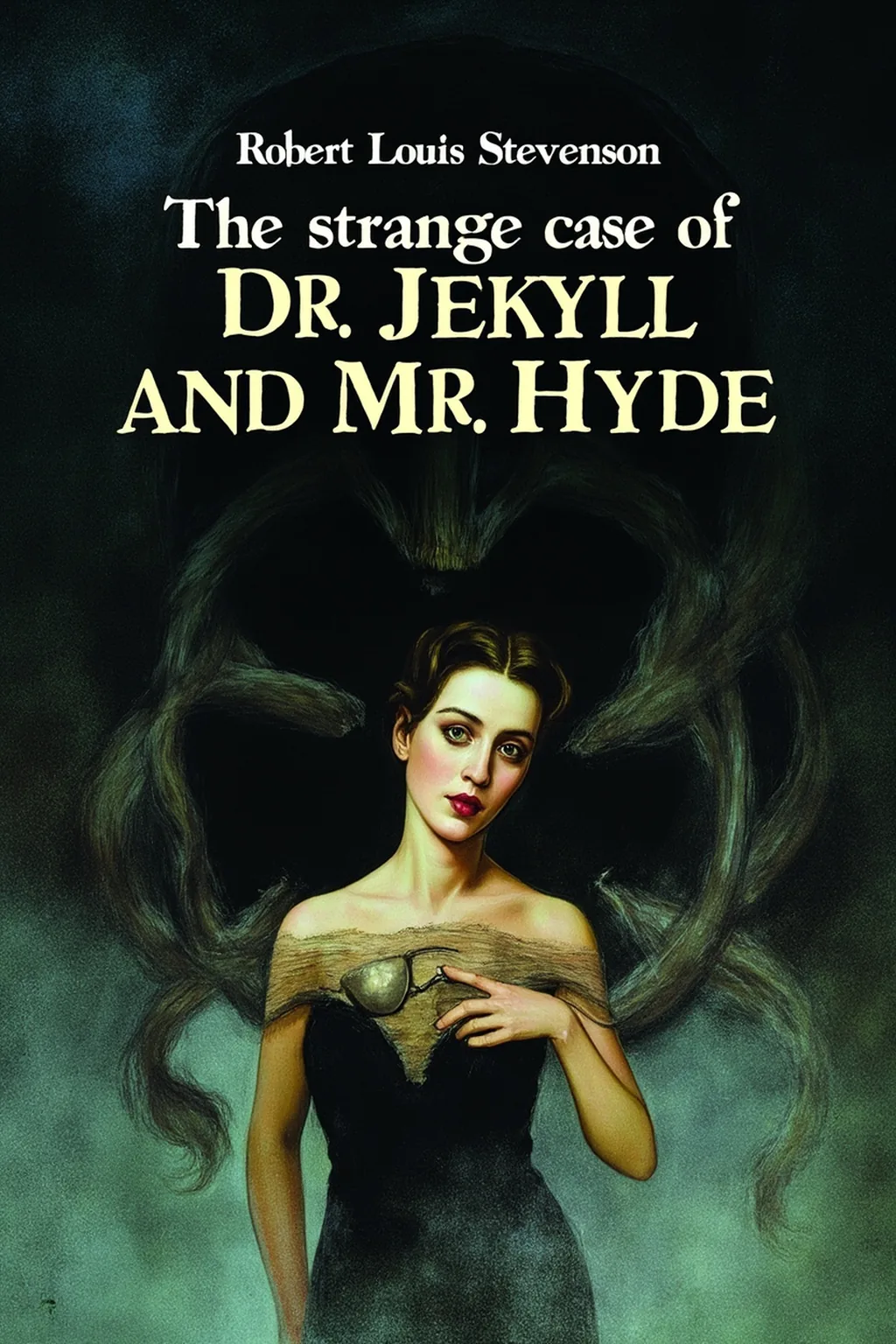
Part 4
The murder of Sir Danvers Carew echoed through London, and Mr. Utterson walked the fog-draped streets with heavier fears than the newsboys’ cries could justify. That was the funeral oration of one friend and client, and Utterson could not help fearing lest the good name of another—Dr. Henry Jekyll—be sucked down in the eddy of the scandal. The letter he carried troubled him the more: it had come by the laboratory door, possibly been written in Jekyll’s own cabinet, and must be handled with greater caution.
That evening, Utterson sat by his hearth with Mr. Guest, his trusted head clerk, a bottle of particular old wine between them. There was no man from whom Utterson kept fewer secrets than Guest; and Guest, being a great student of handwriting, would consider a viewing of the letter natural and obliging.
“This is a sad business about Sir Danvers,” Utterson began.
“I should like to hear your views on that. I have a document here in his handwriting—a murderer’s autograph.”
Guest’s eyes brightened, and he studied the letter with passion. “Not mad, sir; but it is an odd hand.”
Just then a servant entered with a note.
“Is that from Dr. Jekyll, sir? I thought I knew the writing,” Guest inquired.
“Only an invitation to dinner. Why? Do you want to see it?”
The clerk laid the two sheets alongside and sedulously compared them. “Thank you, sir; it is a very interesting autograph.”
Utterson struggled with himself. “Why did you compare them, Guest?”
“Well, sir, there is a rather singular resemblance. The two hands are in many points identical: only differently sloped.”
“Rather quaint,” said Utterson.
“I wouldn’t speak of this note, you know.”
“No, sir. I understand.”
But no sooner was Utterson alone that night than he locked the Hyde letter in his safe. “What!” he thought. “Henry Jekyll forge for a murderer!” And his blood ran cold in his veins.
Incident of Dr. Lanyon
Time ran on; Mr. Hyde had vanished as completely as though he had never existed, though tales of his cruelty and vile life came to light. Gradually, Utterson began to recover from the hotness of his alarm. The death of Sir Danvers was, in his way of thinking, more than paid for by the disappearance of Mr. Hyde. A new life began for Dr. Jekyll: he emerged from seclusion, renewed old relations, became once more the familiar guest. He was busy, much in the open air, doing good; his face seemed to open and brighten with some inward consciousness of service. For more than two months the doctor was at peace.
Then came the change. On the 8th of January, Utterson dined at the doctor’s with a small party; Lanyon was there, and the host looked from one to the other as in the old days when the three had been inseparable. But on the 12th, and again on the 14th, the door was shut against the lawyer. “The doctor is confined to the house,” Poole said, “and sees no one.” On the 15th, Utterson tried again and was refused. After two months of seeing his friend almost daily, the return of solitude weighed upon his spirits. The sixth night he betook himself to Dr. Lanyon’s.
There at least he was not denied admittance; but he was shocked at the change in the doctor’s appearance. The rosy man had grown pale, his flesh had fallen away, he was visibly balder and older. Yet it was less these tokens of physical decay than a look in the eye and quality of manner that arrested the lawyer’s notice—a deep-seated terror of the mind. When Utterson remarked on his ill looks, Lanyon declared himself a doomed man with a strange firmness.
“I have had a shock,” he said, “and I shall never recover. It is a question of weeks.”
“Jekyll is ill, too. Have you seen him?”
Lanyon’s face changed, and he held up a trembling hand. “I wish to see or hear no more of Dr. Jekyll. I am quite done with that person; and I beg that you will spare me any allusion to one whom I regard as dead.”
“Some day, Utterson, after I am dead, you may perhaps come to learn the right and wrong of this. I cannot tell you. And in the meantime, if you can sit and talk with me of other things, for God’s sake, stay and do so; but if you cannot keep clear of this accursed topic, then in God’s name go, for I cannot bear it.”
As soon as he got home, Utterson wrote to Jekyll, asking the cause of this unhappy break. The next day brought a long answer, often pathetically worded, and darkly mysterious in drift. “I do not blame our old friend,” Jekyll wrote, “but I share his view that we must never meet. I mean from henceforth to lead a life of extreme seclusion. I have brought on myself a punishment and a danger that I cannot name. If I am the chief of sinners, I am the chief of sufferers also. I could not think that this earth contained a place for sufferings and terrors so unmanning; and you can do but one thing, Utterson, to lighten this destiny, and that is to respect my silence.”
A week afterward Dr. Lanyon took to his bed, and in something less than a fortnight he was dead. The night after the funeral, Utterson sat in his business room by a melancholy candle, and drew out an envelope addressed by the hand and sealed with the seal of his dead friend: “PRIVATE: for the hands of G. J. Utterson ALONE, and in case of his predecease to be destroyed unread.” He condemned the dread as a disloyalty, and broke the seal. Within was another enclosure, likewise sealed, marked “not to be opened till the death or disappearance of Dr. Henry Jekyll.”
Yes, it was disappearance; here again, as in the mad will he had long ago returned to its author, the idea of a disappearance and the name of Henry Jekyll stood bracketed. Written by Lanyon’s hand, what should it mean? Curiosity urged him to dive at once to the bottom of the mystery; but professional honour and faith to his dead friend were stringent obligations, and the packet slept in the inmost corner of his private safe. From that day forth, Utterson desired the society of his surviving friend with less eagerness. Poole had no pleasant news to communicate: the doctor now more than ever confined himself to the cabinet, where he would sometimes even sleep; he was out of spirits, had grown very silent, did not read.
Incident at the Window
It chanced on Sunday, when Utterson was on his usual walk with Enfield, that their way lay once again through the by-street, and both stopped to gaze on the door.
“Well,” said Enfield, “that story’s at an end at least. We shall never see more of Mr. Hyde.”
“Did I ever tell you that I once saw him, and shared your feeling of repulsion?”
The original text of this work is in the public domain. This page offers a compressed quick-read summary for educational purposes.