“She was the most beautiful child I had ever seen, and I afterwards wondered that”
“This, I recognise, is from the head-master, and the head-master’s an awful bore. Read him, please; deal with him; but mind you don’t report. Not a word. I’m off!”
Read interpretation
The employer’s dismissive scrawl—“Read him, please; deal with him”—establishes immediately the abdication of adult responsibility that leaves the governess isolated at Bly. His instruction to conceal the letter’s contents from everyone, including herself, creates a sealed secret that corrodes her from within. The casual “I’m off!” that follows encapsulates his complete withdrawal from involvement, turning what might have been a manageable crisis into a burden she must bear alone. James demonstrates how authority can impose obligations while simultaneously withdrawing the support that would make them dischargeable.
“It would have been impossible to carry a bad name with a greater sweetness of innocence, and by the time I had got back to Bly with him I remained merely bewildered—so far, that is, as I was not outraged—by the sense of the horrible letter locked up in my room.”
Read interpretation
The dissonance between Miles’s apparent innocence and the accusations sealed in that letter produces in the governess a “bewilderment” that oscillates between outrage and mere confusion. James captures how the gap between surface and substance—between the boy’s “sweetness of innocence” and the “bad name” he apparently carries—generates a peculiar form of moral vertigo. The governess’s refusal to open the letter until the last possible moment before sleep suggests her intuitive understanding that such knowledge, once admitted, cannot be unknown, and that its presence in her room marks Bly itself as a place where secrets fester.
“She was there, she was there!” The governess’s cry at the lake—“Miss Jessel stood before us on the opposite bank”—crystallizes the moment when her private vision becomes a claimed public truth. The repetition (“She was there, she was there!”) conveys the desperate need for verification, for another set of eyes to confirm what her own insistently report. That Mrs. Grose sees nothing shatters any hope of shared understanding, transforming the governess’s testimony from revelation into isolated delusion. James dramatizes the epistemological crisis of any encounter with the supernatural: how does one prove a seeing when others cannot see? The accusation leveled at Flora—that she too saw but conceals—suggests that the children, not the governess, may possess the true sight, creating a perverse inversion of innocence and perception.
Read interpretation
“Their more than earthly beauty, their absolutely unnatural goodness. It’s a game,” I went on; “it’s a policy and a fraud!”
Read interpretation
This eruption of suspicion marks the governess’s complete psychological transformation from admiration to mistrust. The very qualities that first enchanted her—the children’s “more than earthly beauty” and “absolutely unnatural goodness”—now appear as calculated performance. The double negation (“more than earthly… absolutely unnatural”) reveals her logic: true innocence would not need to appear so perfect; the perfection itself becomes evidence of deception. James shows how obsession corrupts perception: the same traits that signified grace now signify fraud, and the interpretive framework has shifted entirely toward surveillance and suspicion.
“She won’t—she’ll never speak to me again.” And Mrs. Grose: “Ah, Miss, it isn’t a matter on which I can push her! Yet it isn’t either, I must say, as if I much needed to. It has made her, every inch of her, quite old.”
Read interpretation
Flora’s transformation from adorable child to resentful accuser horrifies the governess more than any ghost. The child’s “grand manner”—her dignified rejection of imputation on her “truthfulness and… respectability”—marks the collapse of their relationship into adversarial performance. James locates the uncanny not in spectral appearances but in this precocious adulthood: an eight-year-old who “every inch of her, quite old” suggests that corruption, like perception, has inverted the natural order, aging the innocent while the governess remains trapped in her feverish uncertainty.
“Well, I think I’m glad Bly agrees with me!” He was admirably shut in or shut out, and I took it in with a throb of hope. Wasn’t he looking, through the haunted pane, for something he couldn’t see?—and wasn’t it the first time in the whole business that he had known such a lapse?
Read interpretation
With Flora and Mrs. Grose departed, the governess finally witnesses in Miles “the first time” he has shown uncertainty—“a lapse” in his usual composure. His turn toward the window suggests seeking what he cannot find, and this reversal of their positions—from watched to watcher, from knowing to ignorant—fills her with hope. James constructs a scene of inverted power dynamics: the child who had always seemed “shut in” to secrets now appears “shut out” from them. The governess’s anticipation that this vulnerability might lead to confession reveals her belief that exposure, not concealment, is the path to salvation.
“Yes—I took it.” At this, with a moan of joy, I enfolded, I drew him close.
Read interpretation
Miles’s simple confession—admitting he stole and read the governess’s letter—provokes not anger but relief. The “moan of joy” that greets this admission reveals how completely her imagination had constructed catastrophe from mere silence. James presents the confession as almost erotic embrace, the governess drawing the child “close” in triumph. Yet this moment of apparent victory precedes the final confrontation with Quint at the window, suggesting that the relief of “knowing” may be itself an illusion, and that the real danger approaches precisely when vigilance relaxes.
“The house is a vision of beauty, and you’re simply worthy of the house.”
Read interpretation
Mrs. Gracedew’s declaration to Chivers establishes the aesthetic dimension that will govern “Covering End,” where beauty functions as both spiritual value and material currency. Her comparison of the old servant to Rembrandt’s “Good and Faithful Servant” elevates domestic fidelity to the status of high art while simultaneously making Chivers himself a piece of heritage to be preserved—or acquired. James introduces from the first lines of the second novella the theme of preservation: what is owed to the past, and what price will strangers pay for access to inherited beauty?
“I don’t think I am really as crushable as you.”
Read interpretation
This exchange between Mrs. Gracedew and Captain Yule establishes the witty resistance that will characterize their interactions. When Yule suggests all are “crushable by the right thing,” she turns his assertion into epistemological question: do we ever know which force will crush us? Her insistence that she is “never crushed” positions her as immune to the social pressures bearing upon every other character—Yule’s debts, Cora’s arranged marriage, Prodmore’s schemes. James constructs Mrs. Gracedew as a figure for aesthetic judgment itself: unattached, ungovernable, finding freedom in appreciation rather than acquisition.
“I’m here for an act of salvation—I’m here to avert a sacrifice!”
Read interpretation
Mrs. Gracedew’s declaration of purpose articulates the novella’s central conflict: the house faces sale, perhaps destruction, and she has come to prevent this loss. The language of sacrifice—religious and antiquarian—elevates property to sacred trust. Her plea to Yule that beauty must be actively preserved rather than passively abandoned (“you must have beauty in your life”) positions aesthetic commitment as moral obligation. James presents conservation as a form of faith: the believer acts not from calculation but from devotion to what the ages have wrought.
“Seventy thousand, then!” And Prodmore accepted as if he had closed with a duchess.
Read interpretation
Mrs. Gracedew’s agreement to pay the inflated price completes her acquisition of the estate, though the narrative frames this transaction in terms of romantic rather than commercial triumph. Prodmore accepts “as if he had closed with a duchess”—his dignity restored by the sum, her nobility confirmed by the willingness to pay it. James ironizes both parties: she has paid far more than the property is worth, yet the exchange elevates them both into a kind of aristocratics of possession. The house passes from debt-ridden Yule to wealthy American widow, completing a transatlantic circuit of cultural inheritance.
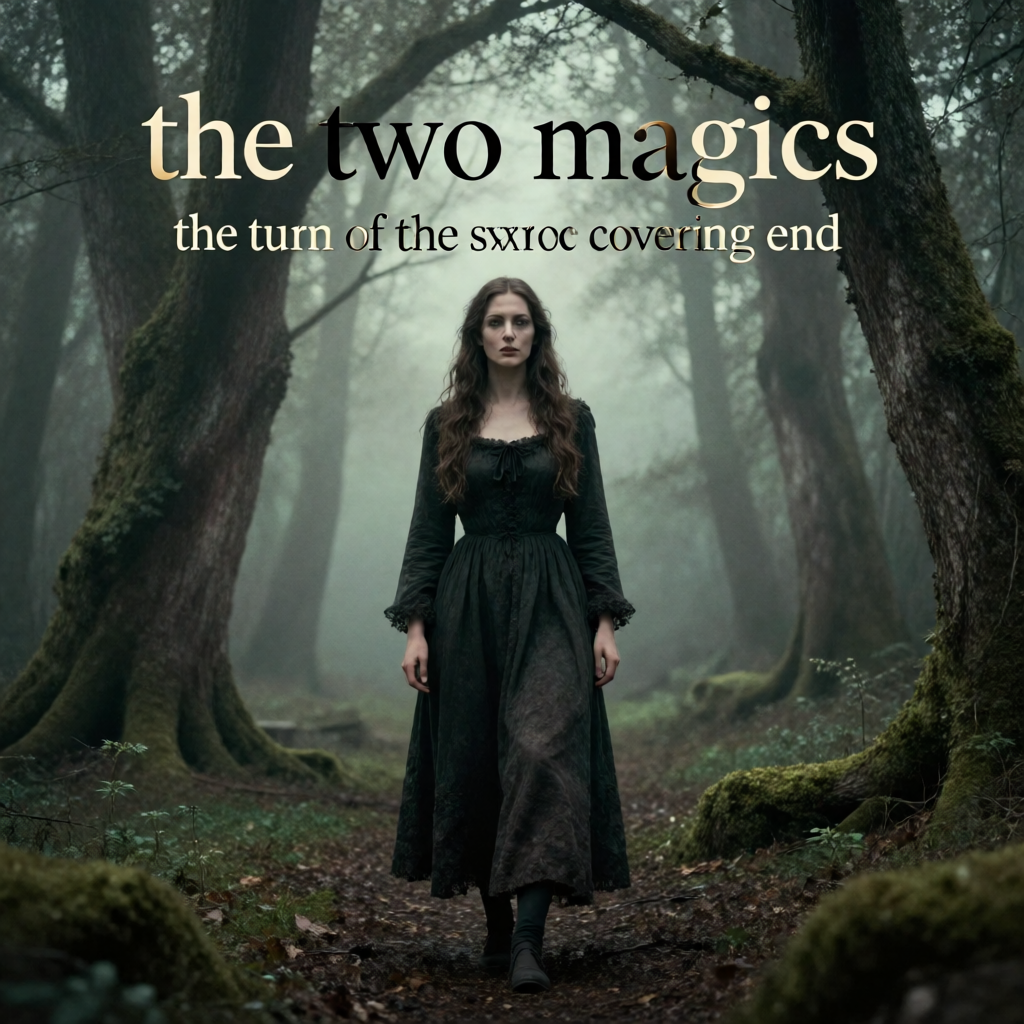
The two novellas collected in The Two Magics present opposed solutions to the problem of what we owe to the past. In “The Turn of the Screw,” the governess’s obsessive preservation of the children’s innocence leads to tragedy: her refusal to trust, to share her visions, or to release them from surveillance destroys rather than protects them. In “Covering End,” Mrs. Gracedew’s passionate preservation of the old house saves it for inheritance—yet only by paying a ransom that her own judgment would call grotesque. James seems to suggest that preservation always demands sacrifice, whether of money, peace, or life, and that the question of what deserves such devotion admits no easy answer.
Read interpretation
This fragment—cut off mid-thought, as if overwhelmed by the fact itself—captures the governess’s immediate surrender to Flora’s appearance, establishing from the opening pages how profoundly sight and aesthetic response will govern her entire testimony. The sentence’s incompleteness mimics the experience of being struck dumb by beauty, while “wondered” suggests subsequent reflection that only deepens the impression. James here introduces the narrator’s tendency to process the world through extraordinary intensity of perception, a faculty that will prove her downfall when it extends to perceiving what others cannot see.