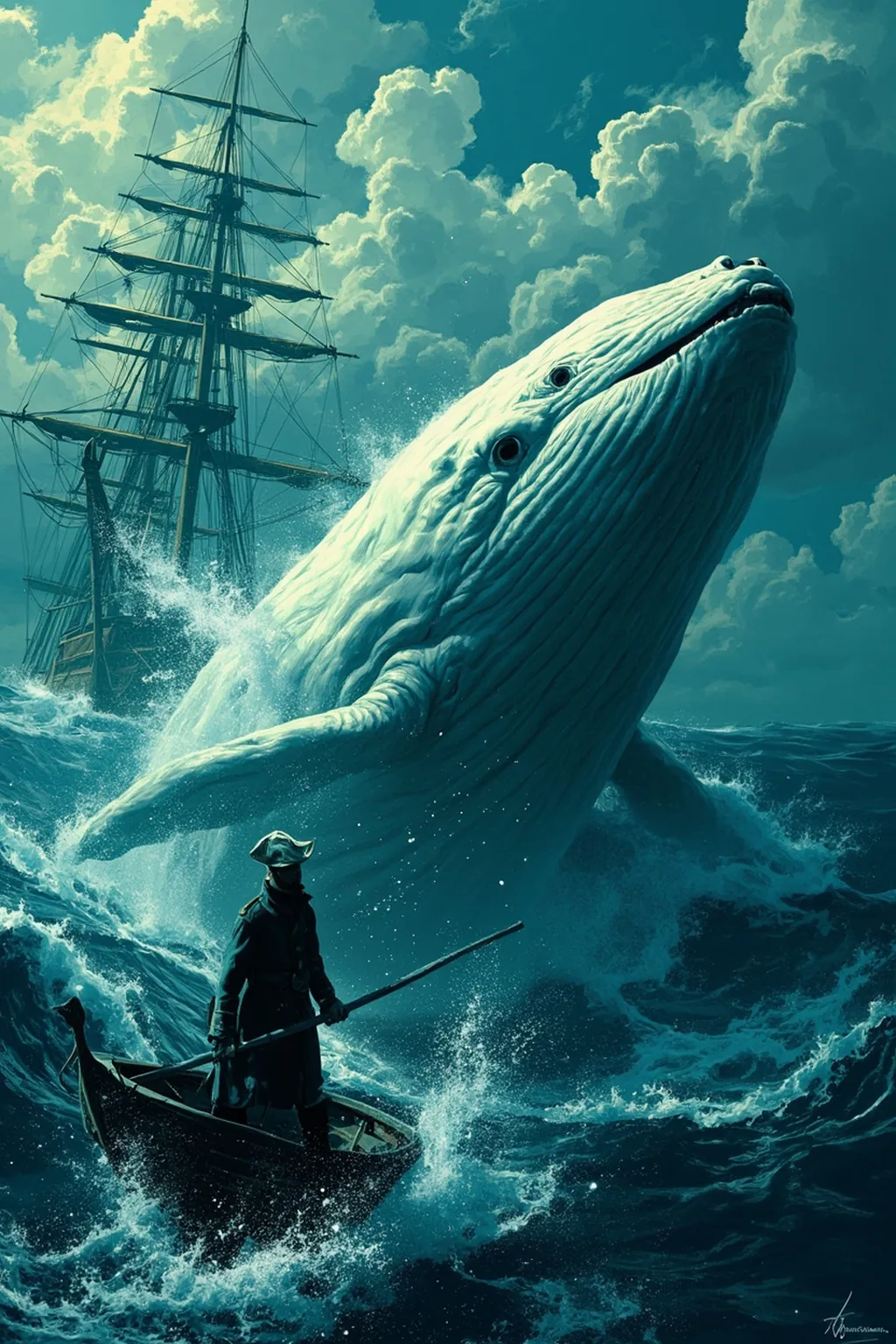
Steelkilt Confronts the Captain at Sea
On the fourth day of his sail to Tahiti, the captain encounters Steelkilt and his group in a large war canoe. Steelkilt hails the captain, threatens to sink his boat if he does not heave to, forces the captain to hand over his pistol, and makes him swear an oath to beach his boat on a nearby island and remain there for six days before continuing to Tahiti.
Steelkilt Escapes to Tahiti
After forcing the captain to take the oath, Steelkilt swims back to his canoe, sails to Tahiti, and boards two French ships about to depart for France, escaping any potential legal retribution from his former captain.
Captain Returns to His Whaling Ship
Ten days after the French ships sail, the captain arrives in Tahiti, enlists a small number of Tahitians with seafaring experience, charters a native schooner, returns to the Town-Ho, finds the ship secure, and resumes his whaling cruise.
The Story’s Truth Is Questioned
After finishing his account, the narrator is asked by Don Sebastian and the other listeners if the story of the Town-Ho is factually true, and if he received it from an unquestionable source, as they find the tale extremely extraordinary.
Oath Sworn on the Holy Evangelists
To prove the veracity of his story, the narrator requests a copy of the Holy Evangelists. When a priest brings the text, the narrator swears an oath on the holy book that his account of the Town-Ho’s events is true in substance, stating he was present on the ship, knew the crew, and had spoken with Steelkilt after Radney’s death.
KAPITEL 55. Of the Monstrous Pictures of Whales.
The narrator announces his intention to paint an accurate portrait of the whale as seen by whalemen alongside their ships, but first critiques the many imaginary portraits that have deceived landsmen. He proposes to “set the world right” by demonstrating that existing pictures of whales are all wrong. The chapter explores various historical and artistic depictions of whales, revealing consistent anatomical and representational errors.
Introduction to Whale Portraiture
Moby-Dick introduces this chapter by announcing that the narrator will paint an accurate picture of the whale from firsthand experience aboard a whale-ship. However, he first feels compelled to address the “curious imaginary portraits” that have fooled the public. The chapter systematically critiques whale depictions across ancient sculptures, Renaissance paintings, scientific illustrations, and popular culture, exposing how even supposedly authoritative sources have produced monstrous inaccuracies.
Ancient Sculptural Origins
The narrator traces the “primal source of all pictorial delusions” to ancient Hindoo, Egyptian, and Grecian sculptures. He notes that these civilizations drew dolphins with chain-armor scales and helmeted heads—a great deal of artistic license. This pattern of creative embellishment has continued in popular whale pictures and scientific presentations alike, establishing a tradition of creative interpretation over accuracy that persists to the present day.
Elephanta Pagoda Whale
The narrator identifies the most ancient extant whale portrait in the cavern-pagoda of Elephanta, India. The Brahmins claim all human professions were prefigured in these ancient sculptures, including whaling. The Hindu whale appears in a depiction of Vishnu’s incarnation as the Matse Avatar—a half-man, half-whale form showing only the tail. The narrator criticizes this tail as “all wrong,” resembling the tapering tail of an anaconda rather than the broad, majestic flukes of a true whale.
Christian Artistic Depictions
The narrator examines Christian paintings of the whale, finding them equally inaccurate. Guido’s depiction of Perseus rescuing Andromeda from the sea-monster fails to capture the whale’s true form. Hogarth’s “Perseus Descending” is no better, with his monster exhibiting “huge corpulence” that barely disturbs the water’s surface. The creature has a “howdah on its back” and a distended mouth resembling “the Traitors’ Gate” of the Tower of London. The narrator finds these artistic renditions as unsuccessful as the ancient Hindu sculptures.
Biblical and Literary Whales
The narrator critiques biblical and literary depictions, including Jonah’s whale in old Bible prints and old primers. He discusses the “book-binder’s whale” that decorates book spines—a serpentine creature wrapping around anchors, derived from figures on antique vases. This dolphin-like whale was introduced by an Italian publisher during the Renaissance, reflecting the era’s belief that dolphins were a species of Leviathan. He also notes curious whale depictions in book vignettes, such as those in the title-page of the original “Advancement of Learning.”
The original text of this work is in the public domain. This page focuses on a guided summary article, reading notes, selected quotes, and visual learning materials for educational purposes.