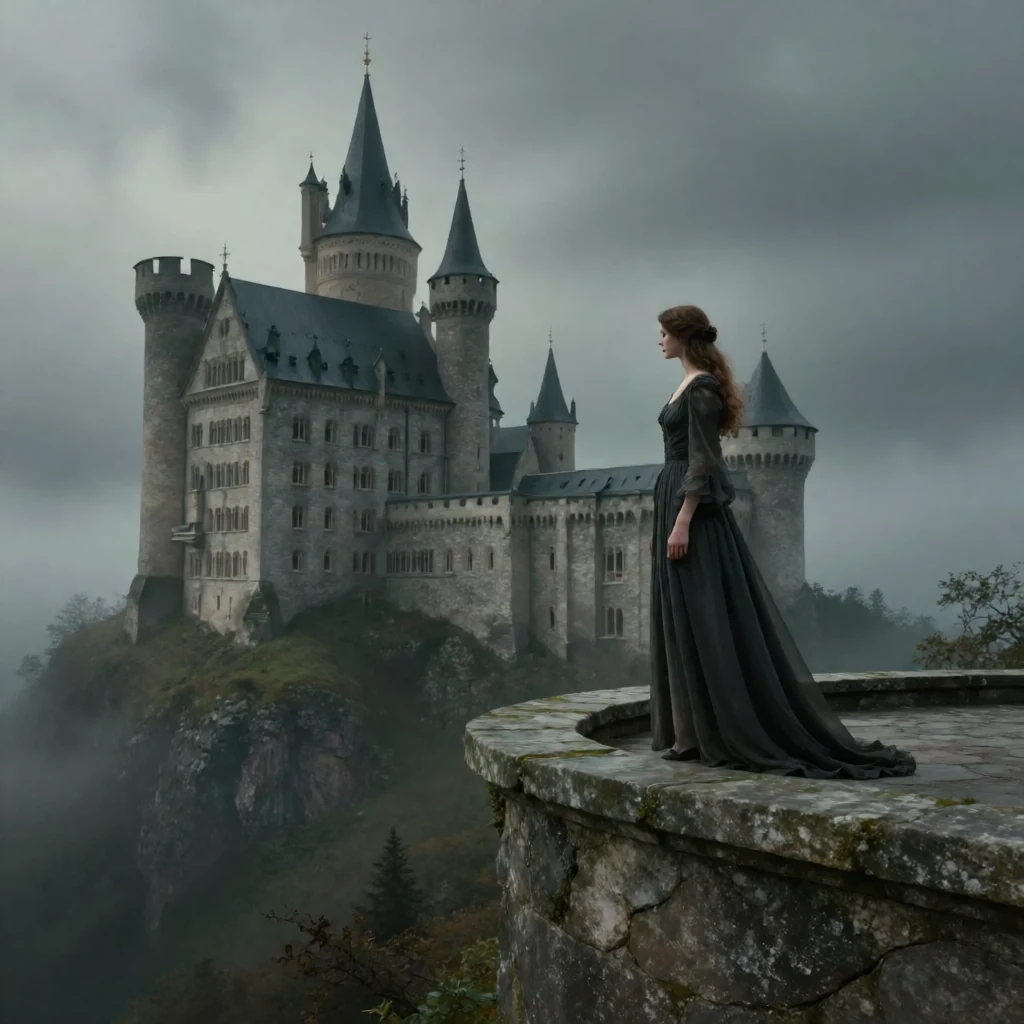
Emily’s Adriatic Chamber
Emily’s chamber is spacious, desolate, and lofty, matching the rest of the palace, with high latticed windows opening out toward the Adriatic. The initial view prompts gloomy thoughts, but the sight of the Adriatic soon brings lighter, airy images, including the sea-nymph she had previously daydreamed about. To avoid serious, somber reflections, she focuses on her whimsical ideas, and spends the remainder of the hour composing the poem The Sea-Nymph.
The Sea-Nymph
This section presents the full text of Emily’s poem The Sea-Nymph, which outlines the life and responsibilities of a sea nymph: guiding river waters through Neptune’s waves to bless the earth’s inmost shores, dancing with fellow nymphs on flowery riverbanks at eve, residing in coral bowers and crystal undersea courts lined with sparry columns and shifting-hued domes, using her enchanting music to comfort sorrowful sailors and guide lost, storm-tossed vessels to safety, and serving Neptune by watching over the seas during storms until the tempest passes.
CHAPITRE III.
Chapter III opens with an epigraph from Julius Cæsar describing a Stoic, impassive man, then introduces Montoni as a Venetian host whose intense personality, gaming addiction, and carefully selected circle of intimates dominate the social world surrounding Emily and Madame Montoni. The chapter traces a sequence of evening entertainments—dinner, gondola excursions, a casino supper, an operatic outing—and uses these gatherings to contrast the various characters’ temperaments, to advance Count Morano’s romantic interest in Emily, and to deepen Emily’s longing for her native country.
Prefatory Quote on a Stoic, Dispassionate Man
The chapter begins with a prefatory quotation attributed to Julius Cæsar, describing a man who is a keen observer of human conduct, who delights in no plays and hearkens to no music, who seldom smiles, and whose smiles seem to mock his own spirit for being moved at all. Such a man, the passage concludes, is never at heart’s ease while he beholds a greater than himself, establishing the Stoic, dispassionate type that the chapter’s central figure, Montoni, will come to embody.
Montoni’s Personality, Gaming Habit, and Inner Circle
Montoni returns home many hours after dawn, his soul unsusceptible to light pleasures and finding its chief enjoyments in the energies of passion and the tempests of life. Without a strong object of interest, life itself feels like sleep to him, and he has substituted the artificial passion of gaming, which he now pursues with ardour. He spends the night playing with Cavigni and a party of young men of money, vice, and inferior talents, whom he despises and uses merely as instruments of his purposes. Among his distinguished intimates are Signors Bertolini, Orsino, and Verezzi: Bertolini is gay, extravagant, generous, and brave; Orsino is reserved, haughty, cruel, cunning, and Montoni’s chief favourite; Verezzi is talented but volatile, fickle, and selfish. Also present at the dinner are Count Morano, a Venetian nobleman, and Signora Livona, a lady of supposed distinguished merit whom Montoni has introduced to his wife.
Madame Montoni’s Ill Grace at the Dinner Party
Madame Montoni receives the compliments of Montoni’s male friends with ill grace, disliking them as her husband’s companions, hating them for keeping him abroad till late, and envying their hold upon him. Only Count Morano’s rank procures him any distinction from her. Her sullenness of countenance, her ostentatious dress, and her failure to adopt the Venetian habit stand in striking contrast to the beauty, modesty, sweetness, and simplicity of Emily, who observes the party with more attention than pleasure. The beauty and fascinating manners of Signora Livona, however, win Emily’s involuntary regard and stir up long-slumbering feelings of affection.
Evening Gondola Ride and Count Morano’s Musical Performance
In the cool of evening the party embarks in Montoni’s gondola and rows out upon the sea, where the red glow of sunset still lingers and the dark sky begins to twinkle with stars. Emily gives herself up to pensive emotions as the smoothness of the water, its reflected heavens, and the distant music of waves and instruments raise her feelings to enthusiasm. The memory of St. Aubert and Valancourt comes upon her, and tears gather in her eyes, so that the moonbeams falling upon her partly veiled countenance give her the contour of a Madona with the sensibility of a Magdalen. Count Morano, sitting beside her, seizes a lute and sings with exquisite taste a rondeau of tender sadness addressed to her, after which Emily sings a melancholy air of her native province, is overcome by its associations, recovers herself with a gay song, and finally passes the lute to Signora Livona, whose Italian-accented performance concludes a session of canzonettes sung in chorus with lutes and other instruments.
The original text of this work is in the public domain. This page focuses on a guided summary article, reading notes, selected quotes, and visual learning materials for educational purposes.