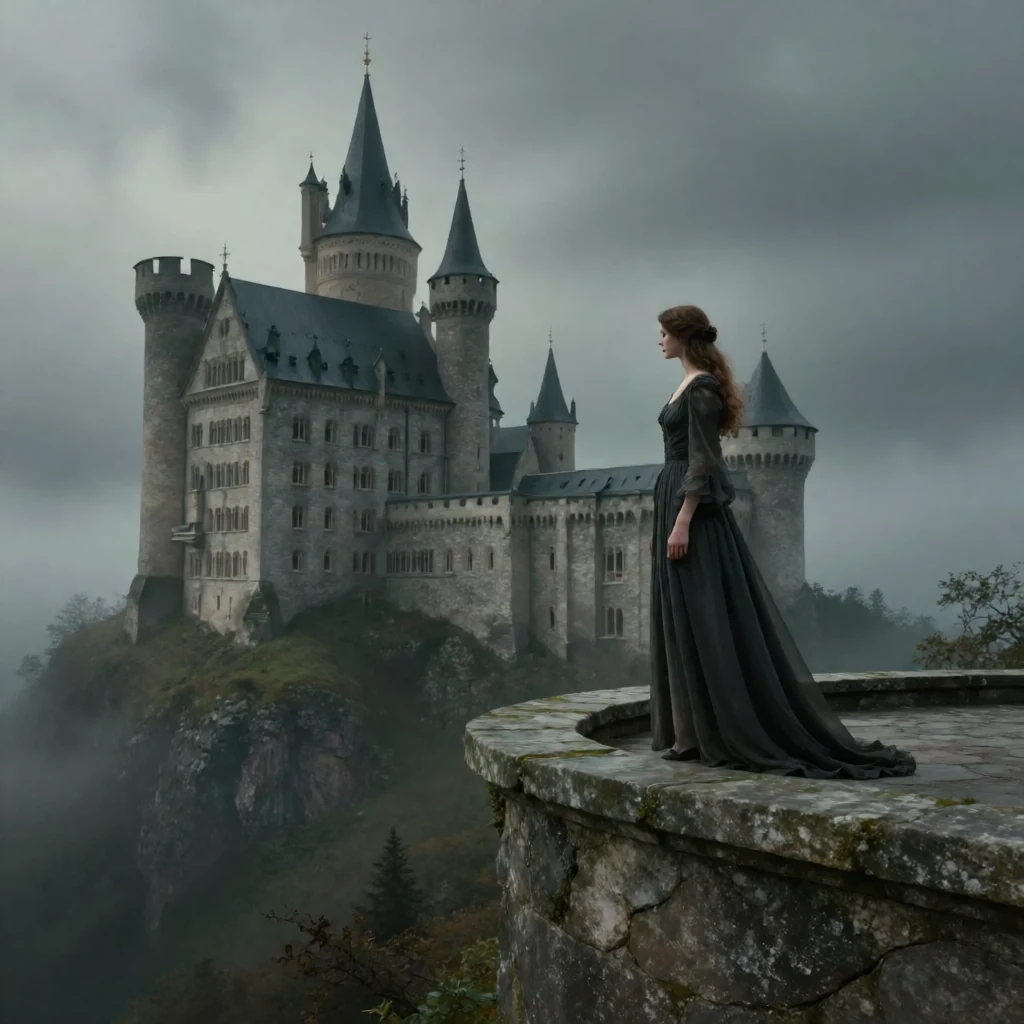
Emily’s Reflective Barge Journey to Miarenti
On the day of departure, Montoni delays leaving Venice until evening to avoid the heat, and the family embarks on a barge for the Brenta River. Emily sits alone near the stern, watching Venice fade from view as the vessel moves, and falls into melancholy reverie. She recalls the ancient grandeur of Troy from the Iliad, contrasts it with the site’s current ruined, silent state, and composes stanzas about a camel driver named Hamet who is saved from a Tartar robber by a kind shepherd. As they approach the Italian coast, she notes the purple hills, orange and cypress groves, and grand Palladian villas lining the river. When twilight falls, she remembers happy evenings stargazing with her father at La Vallée, mourns his loss, and feels a superstitious dread that she will never see Valancourt again, viewing Montoni and Morano’s demands as a threat to that separation.
Montoni Confronts Emily Over the Quesnel Letter
After midnight, Montoni rouses Emily from her reverie to confront her in the cabin, where Madame Montoni sits with a resentful expression. Montoni demands to know if she will persist in denying knowledge of the subject of his letter to Quesnel. Emily replies that she had hoped his recent silence meant he was convinced of his error, but Montoni dismisses this as impossible, stating he might as reasonably expect a woman to be sincere as expect her to convince him of error, making clear his conduct regarding the letter was deliberate design, not mistake. Humiliated and distressed by the exchange, Emily returns to the deck to escape the conversation.
Arrival at the Quesnel Villa
As the barge glides up the Brenta under moonlight, Emily spots a villa she recognizes as belonging to Madame Quesnel’s relative. The vessel stops at a flight of marble steps leading to a lawn, where Montoni’s servant announces their arrival. They find Mons. and Madame Quesnel and a small group of friends seated in the portico, enjoying the cool night air with fruits and ices, while servants perform a simple serenade on the riverbank. After formal greetings, the group moves to an adjoining white marble hall with a cupola roof supported by columns, porticos overlooking the gardens and river, a central cooling fountain, and fragrant air from surrounding orangeries, lit by Etruscan lamps and soft moonlight.
CHAPITRE III.
Chapter III takes place at the portico and gardens of an Italian villa along the Brenta, where two couples—M. Quesnel and his wife, Montoni and Emily—pass a morning in conversation and sightseeing. The chapter begins with a confrontation in which Quesnel’s vain boasting meets Montoni’s contemptuous silence, after which the ladies trade flattering descriptions of countries distant from where they currently sit. As dawn breaks over the Italian mountains and market boats glide down the Brenta toward Venice, the party strolls through gardens filled with cypresses, cedars, and orange groves. Emily, whose thoughts are often drawn to the absent Valancourt, lingers behind to contemplate the sublime landscape with its ruined villas and distant purple peaks before the group retires indoors to escape the rising sun.
Quesnel’s Boasts and Montoni’s Silence
In the portico, Mons. Quesnel draws Montoni aside to boast of his new acquisitions and to offer an affected pity for Montoni’s recent disappointments. Montoni, whose pride and sharp discernment allow him to see through the hollow flattery to the “frivolous malignity” beneath, listens in contemptuous silence. The standoff holds until Quesnel mentions Emily by name, at which point the two men leave the portico and walk together into the gardens.
Memories of France
Left behind, Emily continues to attend to Madame Quesnel, who speaks fondly of France, her native country. Emily listens with the faint, lingering hope that Valancourt’s name will also be mentioned, but it never comes. Madame Quesnel proves herself equally capable of praising whatever country she is not currently in: she had raved about Italy while in France and now, sitting amid Italian delights, extols France instead, trying to impress her auditors with descriptions of places they have never seen. So taken is she by these distant fancies that she fails to notice the fine climate, fragrant orangeries, and luxuries surrounding her.
The original text of this work is in the public domain. This page focuses on a guided summary article, reading notes, selected quotes, and visual learning materials for educational purposes.