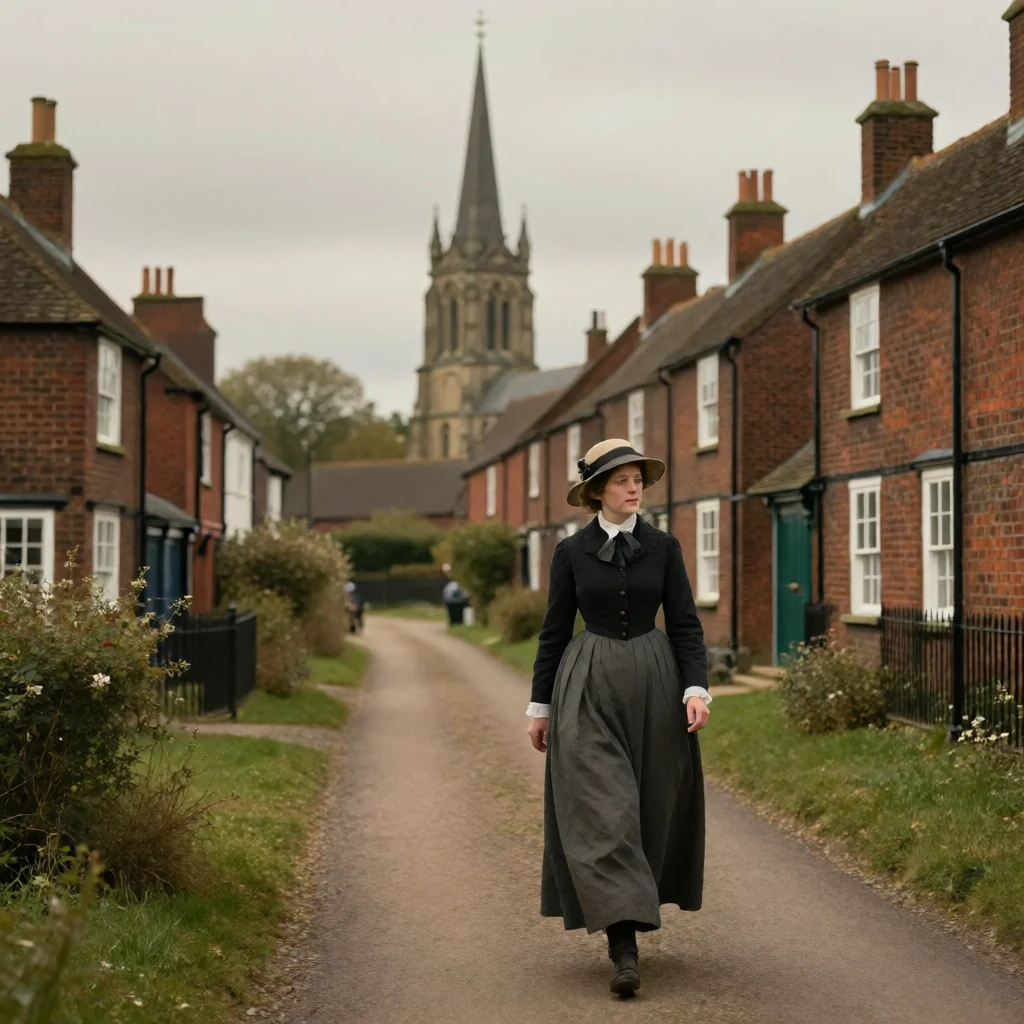
Celia Notes Sir James’s Misplaced Romantic Hope
Celia observes Sir James’s mistaken belief that Dorothea returns his romantic interest, recognizing that Dorothea is focused solely on her reform project rather than him. She privately suspects Dorothea would not reject a proposal from Sir James if it allowed her to fully implement her ideas, though she finds his misplaced hope uncomfortable. Celia avoids voicing her criticisms directly to Dorothea, instead using subtle, indirect comments to temper Dorothea’s rhapsodic mood about the plans and Sir James when safe opportunities arise, and remains baffled by the loud, unrefined singing of well-bred people.
Dorothea is Impressed by Mr. Casaubon’s Character
Mr. Casaubon makes a morning visit to the Brooke household, and is invited to return for an overnight stay the following week. Over three subsequent conversations, Dorothea confirms her initial positive impression of him: she admires his deep intellectual knowledge, his genuine, unpretentious manner that avoids trivial small talk, and his respectful engagement with her thoughts and devotional feelings, seeing him as a source of guidance, sympathy, and intellectual companionship. The only notable disappointment is his complete lack of interest in her cottage reform plans, as he steers conversations toward obscure topics like ancient Egyptian housing to deflect from her ideas.
Dorothea is Disappointed by Casaubon’s Cottage Indifference
After Mr. Casaubon leaves, Dorothea feels agitated by his indifference to her reform work, and debates whether to argue the merits of her project with him by pointing to varying climate needs and the wickedness of pagan despots who failed to provide adequate housing. She ultimately decides it would be presumptuous to demand his attention to a topic she sees as a suitable leisure pursuit for women, rather than a serious scholarly concern, and feels ashamed of her own urge to push the topic with him. She also briefly wonders if Casaubon’s visits are motivated by a desire to spend time with her uncle Mr. Brooke, rather than her own company.
Dorothea Advances Cottage Plans and Questions Her Motives
Dorothea’s mild disappointment with Casaubon makes her even more appreciative of Sir James’s eagerness to support the cottage project: he visits frequently, engages practically with the project’s logistics, and follows her ideas docilely. She proposes building two new cottages to relocate two tenant families, allowing their old substandard cabins to be demolished and rebuilt on the same sites, and Sir James readily agrees to the plan. As she moves forward with the project, Dorothea also grapples with quiet self-doubt, questioning whether she is overstating the importance of her reform work and indulging in self-satisfaction about her efforts, while also reading widely on related topics to better hold her own in conversations with Mr. Casaubon.
Chapter IV
Chapter IV centers on Dorothea Brooke’s turbulent reaction to two competing romantic prospects: the assumed courtship of Sir James Chettam, revealed by her sister Celia during a carriage ride, and the formal marriage proposal from scholar Mr. Casaubon, delivered by their uncle Mr. Brooke upon their return to Tipton Grange. The chapter tracks Dorothea’s distress at the idea of marrying Sir James, her relief at finding scholarly solace in Casaubon’s pamphlets, and her immediate, enthusiastic acceptance of Casaubon’s proposal, concluding with Mr. Brooke’s private bemusement at his niece’s unexpected romantic choice.
Epigraph
The chapter opens with a two-line epigraph exchanged between two gentlemen, framing its core tension between personal agency and external constraint: the first speaker claims that people forge their own fetters through their own deeds, while the second counters that the wider world supplies the iron for those self-made chains, setting up the social and personal pressures that will shape Dorothea’s decisions in the chapter.
Celia Confronts Dorothea About Sir James’s Intentions
During a carriage ride home from inspecting Sir James Chettam’s new cottage building site with her sister Celia, Dorothea dismisses Sir James as a potential suitor, insisting he only views her as a future sister-in-law. Celia pushes back, revealing household gossip confirming that Sir James intends to propose to Dorothea, a revelation that devastates Dorothea, who has no romantic feelings for him. Dorothea declares she will withdraw from the cottage project to avoid misleading Sir James, and storms out of the carriage pale and red-eyed after Celia criticizes her lofty, impractical ideals.
The original text of this work is in the public domain. This page offers a compressed quick-read summary for educational purposes.