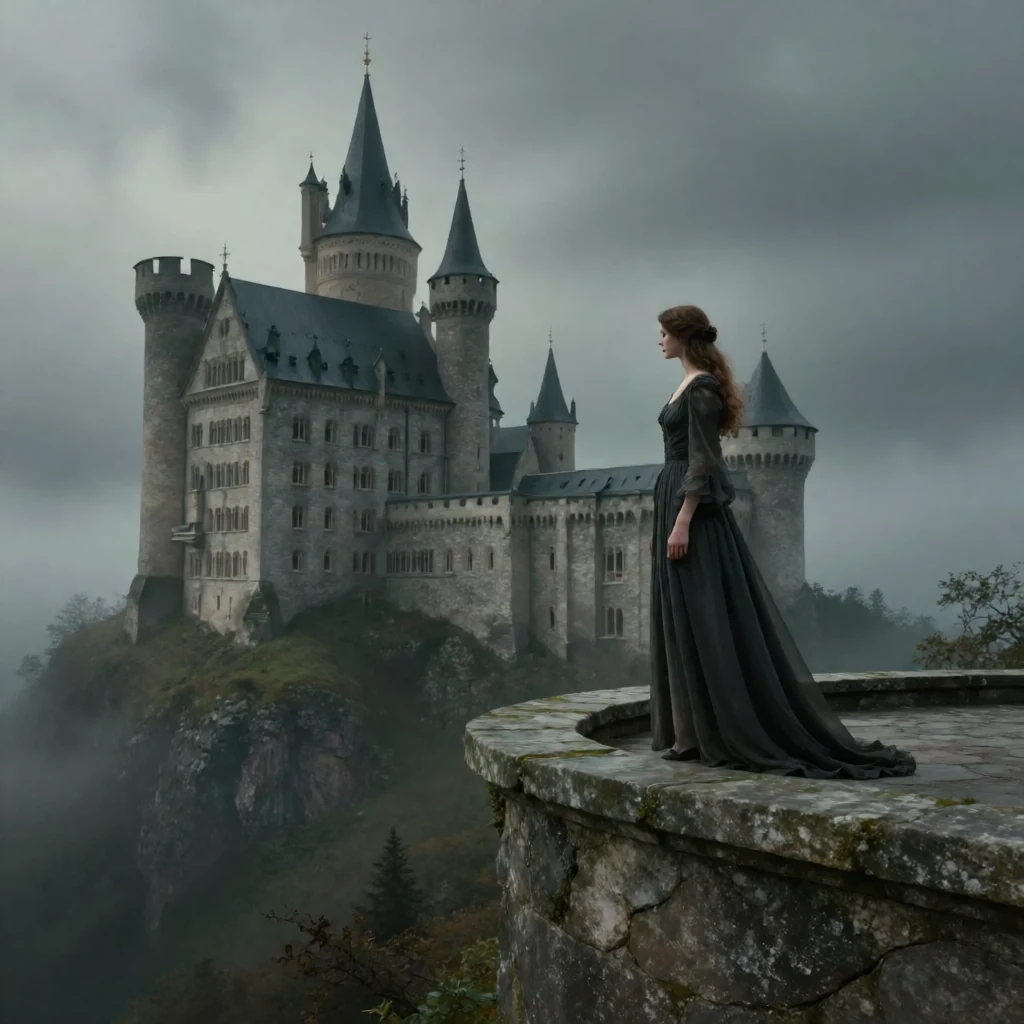
Emily’s Evening Resolve to Destroy Her Father’s Manuscripts
Emily spends a melancholy evening reviewing all that has transpired since last seeing Valancourt, while her father’s death returns vivid in her memory. She particularly recalls his earnest command that she destroy his manuscript papers, and is horrified to realize she has not yet fulfilled this duty. She determines that another day shall not pass in such neglect.
CHAPTER X
Chapter X opens with a Macbeth epigraph, then moves into two interwoven episodes: Emily’s private ordeal in St. Aubert’s chamber as she burns his mysterious papers and discovers an enigmatic miniature, followed by Valancourt’s arrival at the château and his halting declaration of love on the terrace overlooking the Garonne.
Macbeth Epigraph
The chapter is prefaced with a brief quotation from Shakespeare’s Macbeth: “Can such things be, / And overcome us like a summer’s cloud, / Without our special wonder?” The epigraph signals the chapter’s preoccupation with appearances that overwhelm the mind, foreshadowing Emily’s susceptibility to illusion and wonder.
Emily Burns St. Aubert’s Papers
On the morning after her father’s death, Emily orders a fire lit in St. Aubert’s chamber and goes there to burn the papers he entrusted to her. She fastens the door against interruption, and as she enters the closet where the papers are concealed she is struck by an unusual awe, trembling before she even touches the board. The chamber, the great chair in the corner, and the table where she last saw her father sitting over the papers on the eve of his departure all combine to weigh upon her.
Emily’s Superstitious Closet Visions
Months of solitary grief and melancholy brooding have left Emily’s nerves so enfeebled that she has become subject to “thick-coming fancies” and momentary delusions. Twice in the closet, her disturbed imagination conjures the countenance of her dead father in the obscure arm-chair, and the second time the illusion is strong enough to send her rushing into the chamber, where she nearly faints. Reason soon returns, and she reproaches herself for allowing such weakness to interrupt an act of solemn duty.
Emily Destroys the Tempting Papers
Recalling St. Aubert’s instructions, Emily locates the loose board, presses the marked line, and reveals a bundle of papers, some scattered sheets, and a purse of louis. Unthinkingly she begins to read the loose papers and is roused only by a sentence of dreadful import, which fills her with terror and curiosity. She longs to read further and momentarily questions whether her promise to burn the papers should stand, but her conscience reasserts itself: she has given a solemn promise and must obey. She commits the papers to the flames, watching them consume while shuddering at the irrecoverable loss.
Emily Finds the Mysterious Miniature
After the fire, Emily remembers the purse; at the bottom she finds a small packet wrapped in paper, which unfolds into an ivory case containing the miniature of a beautiful lady. The portrait shows uncommon beauty, an expression of sweetness touched with sorrow and resignation, and Emily cannot identify the sitter, though St. Aubert’s manner when speaking of the Marchioness of Villeroi makes her wonder if it is that lady’s likeness. St. Aubert gave no instructions about the picture, so she feels justified in keeping it, gazing on it with sensations of love and pity.
Valancourt Arrives for Farewell
Still musing on the miniature, Emily is roused by the garden gate closing and sees Valancourt crossing toward the château. Her spirits, already shaken by the morning’s trials, leave her unprepared for company, and she pauses in the chamber to collect herself. When she meets him in the parlour she is struck by the change in his air and countenance since they parted at Rousillon, though his habitual dejection briefly lifts at the sight of her; he has come, he says, to take the farewell she permitted.
Valancourt Declares His Love
They walk down to the terrace, where Valancourt admires the river scenery and begins to describe the Garonne from its source in the wild Pyrenees, where it rushes through the Vallée d’Aran before turning toward Toulouse and the Bay of Biscay. Talk of the Pyrenean landscapes stirs in Emily the memory of her father, whose image seems to inhabit every scene Valancourt describes. Conversation falters as grief overtakes them, and Valancourt, watching the plane-tree she loved with St. Aubert, can no longer contain himself: he declares the scene lovely, announces that he is about to leave, perhaps forever, and ventures to call his admiration of her goodness by the name of love.
The original text of this work is in the public domain. This page focuses on a guided summary article, reading notes, selected quotes, and visual learning materials for educational purposes.