Across the Apennines
Montoni chooses to travel by carriage across the country toward the Apennines rather than embark on the Brenta. His manner toward Emily is unusually severe, confirming her suspicion that the journey is meant to break her resistance and force her marriage to Count Morano in secret. Though the countryside is beautiful, Emily is too absorbed in thoughts of Valancourt and in dread of what awaits her to take pleasure in it; she can only occasionally smile at Annette’s naïve remarks about the scenery.
The Mountain Vista
As the travelers climb into the Apennines, the road winds between massive pine-forests that wall out the view and lend a solemn gloom to the journey. At length the drivers halt at a little plain, and a magnificent prospect opens below: an amphitheatre of mountains, the Italian campagna with its cities and rivers, and the Adriatic on the far horizon, into which the Po and the Brenta pour their waters. Emily, forgetting her sorrows for a moment, gazes long on the splendour of the world she is leaving, weeping for Valancourt, who is all she values in it.
Through the Pine Forests
The journey resumes through narrowing passes and towering pines, where the road winds steeply over crags and precipices. The scene shifts continually: barren rocks with flashing cataracts alternate with narrow pastoral vales where goats browse and shepherd’s cabins stand beside clear streams. Although wild and romantic, the Apennine landscape moves Emily less profoundly than the Alps once did; she is often elevated but seldom struck with the same indescribable awe. Toward nightfall the road descends into a deep valley ringed by inaccessible mountains, and a vista opens toward the Apennines’ darkest heights.
First Sight of Udolpho
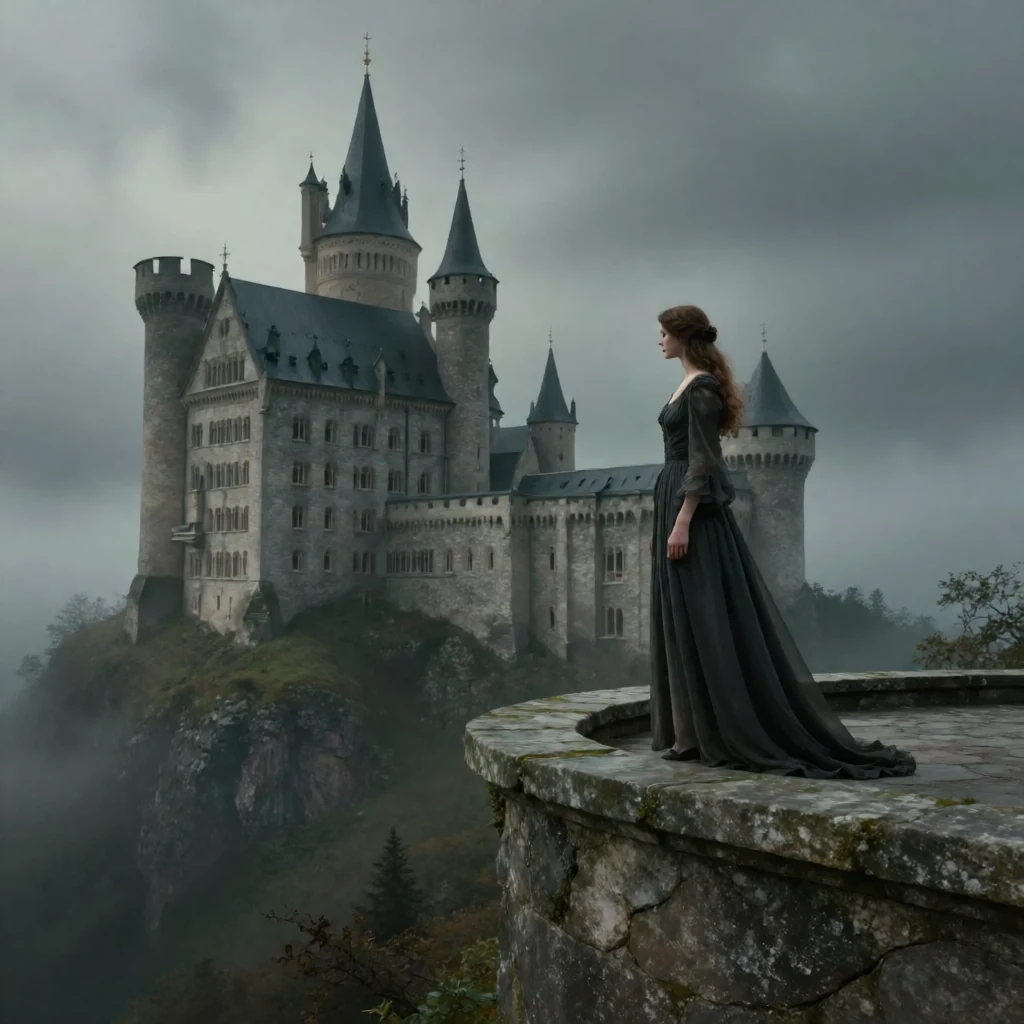
As the sun sinks behind the descending mountains, its rays break through an opening in the cliffs and fall on the towers and battlements of a castle that crowns a precipice above. Montoni, silent for hours, at last speaks: “There is Udolpho.” Emily gazes with melancholy awe at the gothic mass of dark grey stone. The light fades from its walls, leaving a deepening purple tint; the towers grow more sombre as twilight thickens, and the castle seems to stand the gloomy sovereign of the scene. The carriages then ascend into the dark woods that surround the fortress.
Arrival at the Castle Gates
The tall, shadowy woods around Udolpho fill Emily’s mind with images of banditti. When the carriages emerge on a heathy rock before the gates, the deep tone of the portal bell struck to announce their arrival sharpens her fear. In the dim evening she can make out only the heavy outline of the ramparts and the gigantic gateway, defended by round towers crowned with overhanging turrets, from whose crumbling stones long grass and wild plants wave in place of banners. Beyond the walls all is lost in obscurity, and she waits in dread until footsteps and bolts announce that the gates are being opened.
Entering the Courts
The wheels roll heavily beneath the portcullis, and Emily feels she is entering a prison. The first court is gloomy; a second gate admits them to a still wilder courtyard, grass-grown, with lofty walls overgrown in briony, moss, and nightshade, and embattled towers rising above. The desolation conjures up thoughts of long-suffering and murder, and an unaccountable conviction of horror seizes her. She has time to notice little more before they pass on into the castle, for the suddenness of Montoni’s journey has prevented any preparation for their reception.
The Gothic Hall
Within, a servant with a lamp leads them into an extensive gothic hall, where partial gleams on the pillars and pointed arches only deepen the surrounding gloom. A tripod lamp hanging from the lofty vault is hastily lit, revealing the rich fret-work of the roof, a corridor to the upper apartments, and a painted window stretching nearly from floor to ceiling. Crossing the foot of the marble staircase and passing through an ante-room, they enter a spacious apartment whose walls of black larch-wood from the neighbouring mountains are almost indistinguishable from the darkness. Montoni calls for more light, and, when Madame Montoni complains of the cold mountain air, orders that wood be brought for a fire.
The original text of this work is in the public domain. This page focuses on a guided summary article, reading notes, selected quotes, and visual learning materials for educational purposes.