Annette’s Gossip
Annette appears, and her gossip brings relief: among the arrivals are Signor Cavigni and Signor Verezzi, but not Count Morano. Annette chatters at length about the arrival of Christian faces in the dismal castle, the merry times ahead, and especially about Ludovico—Cavigni’s handsome young lacquey whose songs about “Charly-magne” and the Blackamoors she had once listened to beneath her lattice in Venice. Emily, amused and wearied by Annette’s loquacity, teases her gently about her secret.
The Haunted Chamber
Emily questions Annette about the noises and sights in her chamber the previous night. When Emily mentions that the door had been left open and found fastened in the morning, Annette turns pale at the suggestion of a ghost who can draw bolts. Annette refuses to elaborate on the chamber’s haunted reputation, hurrying away without waiting for Emily’s reply. Emily, her heart lightened by the certainty that Morano has not arrived, can smile at the superstitious terror that has seized her companion.
Emily’s Books and Drawing
Having failed to obtain another chamber from Montoni, Emily resolves to endure her situation. She unpacks her books—her sweet delight and soothing resource—and arranges her small library on a high chest. Taking out her drawing utensils, she is briefly pleased by the thought of sketching the sublime scenes from her windows, but checks herself, remembering how often such intentions have been thwarted. Attempting to read, she finds her attention wandering, and at length throws aside the book.
The Veiled Picture
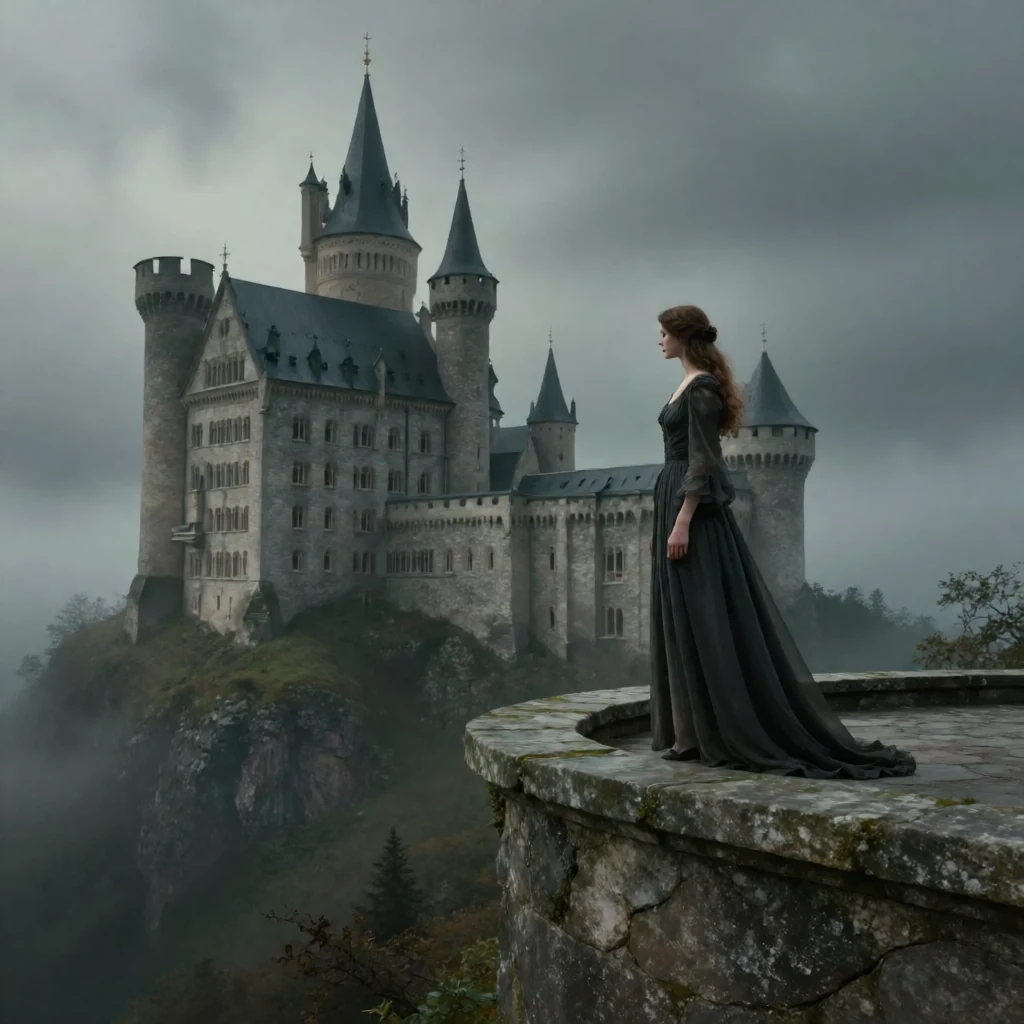
Seeking further distraction, Emily determines to explore the castle’s adjoining chambers. As she walks through the obscure, desolate rooms—where no footsteps may have passed for years—she recalls the history of the former possessor and remembers the veiled picture that had attracted her curiosity the previous night. Resolving to examine it, she passes through the chambers that lead to it, somewhat agitated by the mystery surrounding it. Yet this is a sublime terror, one that, as it expands the mind and elevates expectation, leads her by a kind of fascination to seek even the object from which she appears to shrink.
CHAPTER VI
Emily, summoned to a chamber, lifts the black veil from what she believes to be a painting but discovers something so horrifying that she drops senseless to the floor; upon recovering, she debates telling her aunt but ultimately resolves to keep the terrible secret, fearing the indiscretion of Madame Montoni in Montoni’s household. Later, while walking on the ramparts, Emily and her aunt observe a long procession of armed soldiers winding through the valley, identified by Cavigni as a legion of condottieri marching toward Modena, and Montoni explains the trumpet signals that confirm the troops are not hostile. That evening, the troubled Madame Montoni weeps alone in her dressing-room while Emily retreats to her own gloomy chamber, where she questions Annette about who may have entered her apartment the previous night, only to learn that no one in the castle admits knowledge of the matter and that Annette herself was deterred from investigating the veiled picture by a locked door.
The Veil Lifted
Emily approaches the chamber door with faltering steps, pausing before she enters. She moves toward a large picture frame in a dark corner and timidly lifts the veil, but immediately drops it upon discovering that what lay behind was no picture at all. Overcome by the shock, she falls senseless to the floor before she can leave the room.
Emily’s Silence
On recovering, Emily nearly faints again at the memory of what she saw and barely manages to return to her own chamber. She considers telling Madame Montoni, weighing the relief of sharing her burden against the fear of dangerous consequences, and ultimately resolves upon a profound silence. In her aunt’s company she steels herself to appear composed. Downstairs at dinner she forces herself to converse and even to look cheerful, despite the horror that keeps rushing back into her mind whenever her eyes meet Montoni’s.
The original text of this work is in the public domain. This page focuses on a guided summary article, reading notes, selected quotes, and visual learning materials for educational purposes.