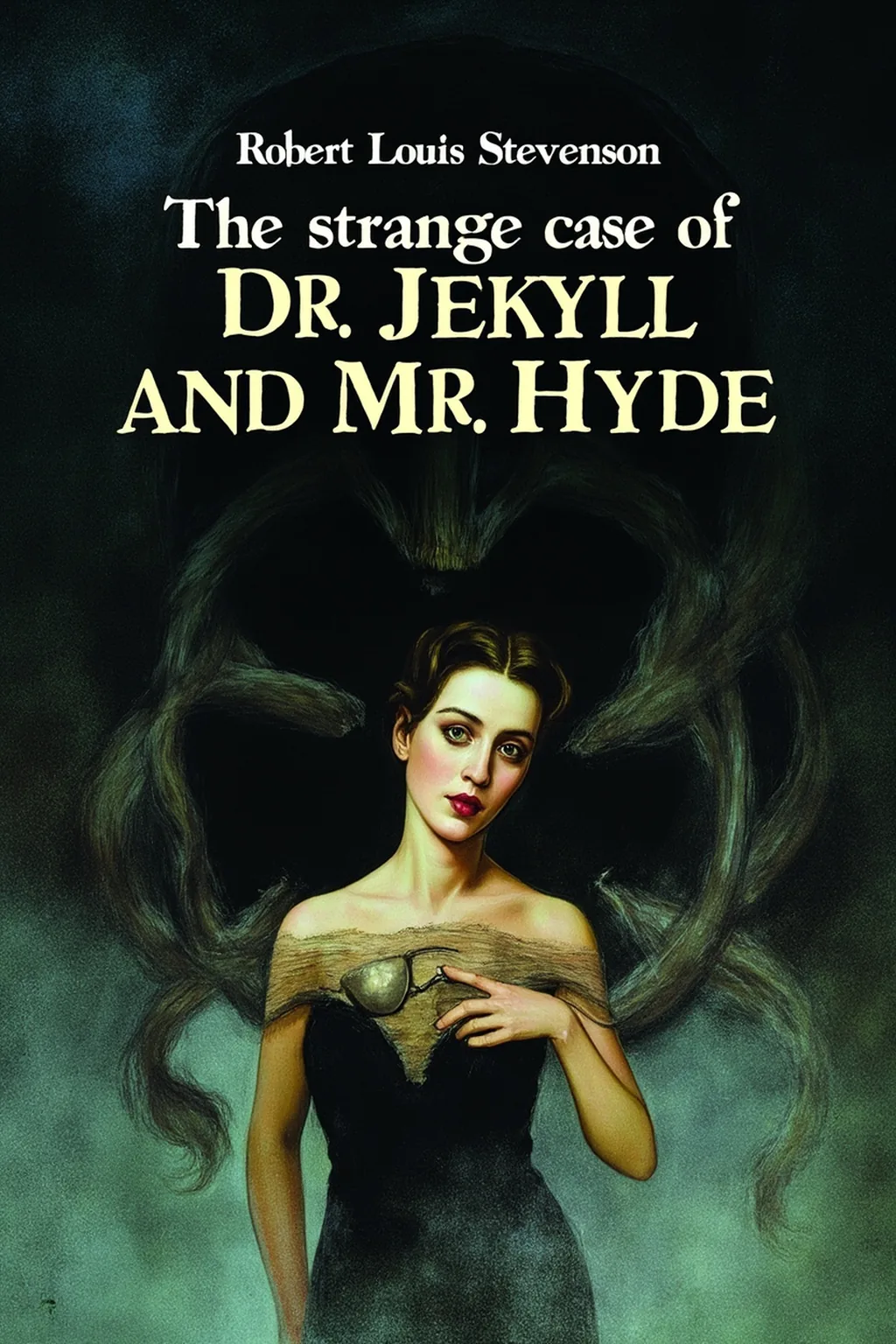
He had been born to a large fortune, blessed with excellent parts, inclined to industry, and fond of the respect of his fellow men. Yet from the earliest days, a fault had lurked within him: an impatient gaiety of disposition, which, while it had made the happiness of others, he found hard to reconcile with the grave countenance he wished to present to the world. So it was that he concealed his pleasures, and by the time he reached years of reflection, he found himself already committed to a profound duplicity of life. It was not the degradation of his faults but the exacting nature of his aspirations that had severed in him those provinces of good and ill which divide the dual nature of man.
His scientific studies, which had turned wholly toward the mystic and transcendental, shed a strong light upon this consciousness of perpetual civil war within him. He drew steadily nearer to a truth that would prove his doom: that man is not truly one, but truly two. He conceived of it, he confessed, as a polity of multifarious, incongruous and independent denizens. From the nature of his own life, he had advanced in one direction only. It was on the moral side, and in his own person, that he learned to recognize the thorough and primitive duality of man.
If each of these natures could be housed in separate identities, he told himself, life would be relieved of all that was unbearable. The unjust might go his way, delivered from the aspirations and remorse of his more upright twin; and the just could walk steadfastly on his upward path. The curse of mankind was that these incongruous elements were bound together in the agonized womb of a single consciousness.
A side light began to shine upon the subject from his laboratory table. He perceived, more deeply than it had ever been stated, the trembling immateriality of the seemingly solid body. Certain agents, he found, had the power to shake and pluck back that fleshly vestment, even as a wind tosses the curtains of a pavilion. He would not enter deeply into the scientific branch of his confession, for two reasons: first, because he had learned that the doom and burthen of our life is bound forever on man’s shoulders, and when one attempts to cast it off, it but returns with more awful pressure; and second, because his discoveries were incomplete. Enough that he had managed to compound a drug by which the higher powers of his spirit could be dethroned and a second form substituted—none the less natural because it bore the stamp of the lower elements in his soul.
He hesitated long before putting the theory to the test. He knew he risked death; any drug that so potently controlled the very fortress of identity might, by the least overdose, blot out the immaterial tabernacle it was meant only to change. But the temptation of a discovery so singular and profound at last overcame his alarm. Late one accursed night, he compounded the elements, watched them boil and smoke together in the glass, and with a strong glow of courage, drank off the potion.
The most racking pangs succeeded: a grinding in the bones, deadly nausea, and a horror of the spirit that cannot be exceeded at the hour of birth or death. Then the agonies began swiftly to subside. There was something strange in his sensations, something indescribably new and, from its very novelty, incredibly sweet. He felt younger, lighter, happier in body; within, he was conscious of a heady recklessness, a current of disordered sensual images, a solution of the bonds of obligation, an unknown but not innocent freedom of the soul. He knew himself, at the first breath of this new life, to be more wicked, tenfold more wicked, sold a slave to his original evil; and the thought, in that moment, braced and delighted him like wine. He stretched out his hands, exulting—and in the act, was suddenly aware that he had lost in stature.
There was no mirror at that date in his room; that which now stood beside him as he wrote had been brought there later for the very purpose of these transformations. The night was far gone, but he determined, flushed with hope and triumph, to venture in his new shape as far as his bedroom. He stole through the corridors, a stranger in his own house; and coming to his room, he saw for the first time the appearance of Edward Hyde.
He could here speak only by theory. The evil side of his nature, to which he had now transferred the stamping efficacy, was less robust and less developed than the good he had deposed. Edward Hyde was therefore much smaller, slighter, and younger than Henry Jekyll. As good shone upon the countenance of the one, evil was written broadly and plainly on the face of the other. Evil had left on that body an imprint of deformity and decay. And yet when he looked upon that ugly idol in the glass, he was conscious of no repugnance, but rather of a leap of welcome. This, too, was himself. It seemed natural and human. In his eyes it bore a livelier image of the spirit, more express and single, than the imperfect and divided countenance he had been accustomed to call mine.
He lingered but a moment at the mirror: the second and conclusive experiment had yet to be attempted. It remained to be seen if he had lost his identity beyond redemption, and must flee before daylight from a house that was no longer his. Hurrying back to his cabinet, he once more prepared and drank the cup, once more suffered the pangs of dissolution, and came to himself once more with the character, the stature, and the face of Henry Jekyll.
And here, for the moment, the confession paused.
The original text of this work is in the public domain. This page focuses on a guided summary article, reading notes, selected quotes, and visual learning materials for educational purposes.