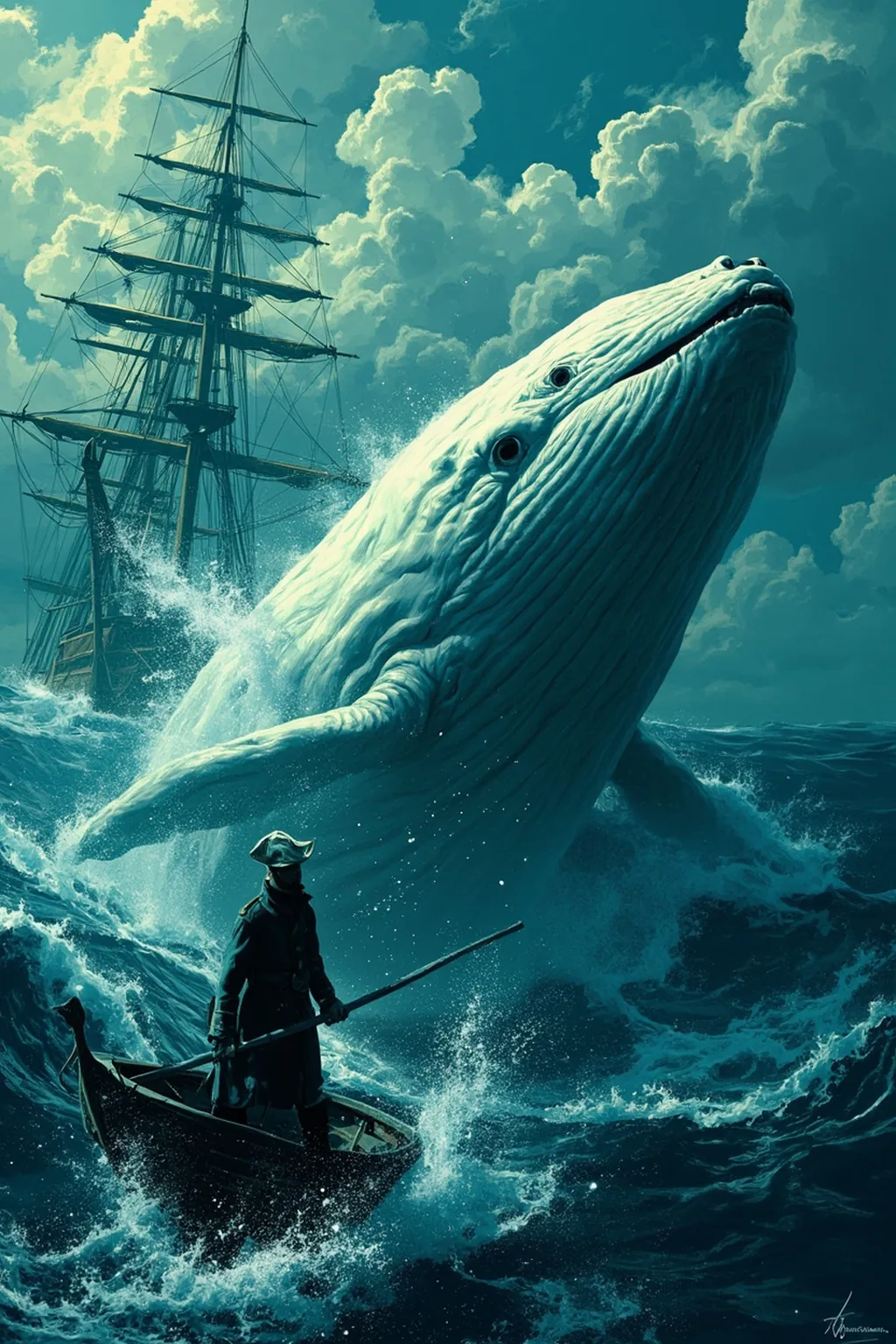
The Challenge of Sperm Whale Beheading
The beheading of the Sperm Whale represents a remarkable scientific anatomical achievement that experienced whale surgeons justifiably take great pride in. The procedure presents extraordinary challenges: the whale possesses no proper neck, as its head and body join at the thickest part of the creature. The surgeon must operate from above, with eight to ten feet separating himself from his subject, which remains largely hidden within a discolored, rolling, and often tumultuous sea. Under these difficult circumstances, he must cut many feet deep into the flesh, navigating by feel alone without any visual confirmation of the ever-contracting wound. He must skillfully avoid adjacent, forbidden anatomical areas and precisely divide the spine at a critical point near its insertion into the skull. The reader is invited to marvel at Stubb’s boast that he could behead a sperm whale in merely ten minutes.
Hoisting the Decapitated Whale Head
Once severed, the whale’s head is dropped astern and held in place by a cable while the body is stripped. If the whale is small, the head can subsequently be hoisted onto the deck for deliberate disposal. However, with a fully grown leviathan, this proves impossible, as the sperm whale’s head constitutes nearly one-third of its entire bulk. Suspending such an enormous burden, even using the immense tackles of a whaler, would be as futile as attempting to weigh a Dutch barn on jewellers’ scales. In the case of the Pequod, after decapitation and stripping the body, the head was hoisted against the ship’s side at approximately mid-level, remaining partly submerged and buoyed by its native element. The strained vessel leaned steeply from the enormous downward pull of the lower mast-head, with every yard-arm on that side projecting like a crane over the waves. That blood-dripping head hung at the Pequod’s waist like the giant Holofernes from the girdle of Judith.
Ahab’s Address to the Sphynx-Like Whale Head
With the task completed at noon, the seamen descended below for their dinner, leaving the deck deserted in profound silence. An intense copper calm, resembling a universal yellow lotus, increasingly unfolded its noiseless leaves upon the sea. Shortly thereafter, Ahab emerged alone from his cabin, took several turns on the quarter-deck, paused to gaze over the side, then slowly made his way into the main-chains. He retrieved Stubb’s long spade—still remaining after the whale’s decapitation—drove it into the lower part of the half-suspended mass, and positioned its other end crutch-wise under one arm. Leaning over the head with attentively fixed eyes, Ahab confronted what appeared as a black, hooded head. In the midst of such intense calm, it resembled the Sphynx in the desert. Addressing it reverently, Ahab demanded that this vast and venerable head reveal its secret. He acknowledged that though garnished with no beard, it appeared hoary with mosses in places, and declared that of all divers, this head had descended the deepest. He spoke of how that head had moved amid the world’s foundations, witnessed unrecorded names and navies rusting, untold hopes and anchors rotting, and the frigate earth ballasted with countless drowned bones in its murderous hold. Ahab declared that the head had been the most familiar home in that awful water-land, had ventured where bell or diver never went, had slept beside countless sailors while sleepless mothers would surrender their lives merely to lie beside them. He recounted how the head had witnessed locked lovers leap from their flaming ship, heart to heart sinking beneath the exulting wave, true to each other when heaven seemed false. He described how it saw a murdered mate thrown by pirates from a midnight deck, falling for hours into the deeper midnight of the insatiate maw while his murderers sailed on unharmed. Concluding his tirade, Ahab exclaimed that the head had seen enough to split the planets and make an infidel of Abraham, yet not one syllable had it spoken.
The ‘Sail Ho!’ Sighting
The contemplative scene was broken by a triumphant cry from the main-mast-head: “Sail ho!” Ahab responded with unexpected warmth, declaring the cry cheering upon the deadly calm and suggesting it might convert a better man. Upon learning the vessel was three points on the starboard bow and approaching with its breeze, Ahab’s whole demeanor shifted as thunder-clouds seemed to sweep aside from his brow. He expressed hope that St. Paul might arrive that way to bring breezes to his windless situation, and reflected on how far beyond utterance the linked analogies of Nature and the soul of man extended—not the smallest atom stirs or lives in matter but has its cunning duplicate in mind.
The original text of this work is in the public domain. This page focuses on a guided summary article, reading notes, selected quotes, and visual learning materials for educational purposes.