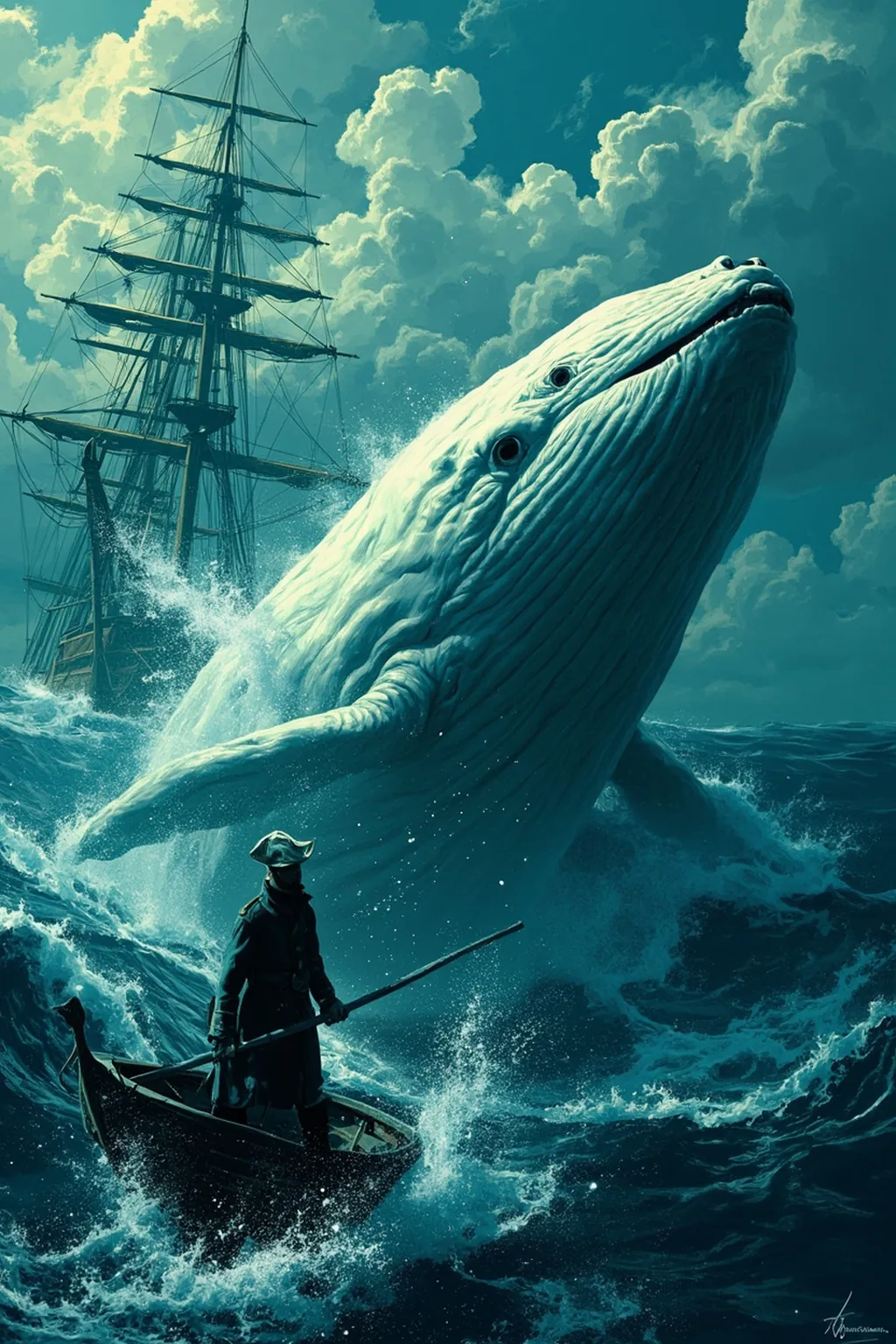
Ahab Calls for White Whale Sightings
Mid-conversation, Ahab shouts to the ship’s masthead lookouts to stay alert, announces whales are nearby, and orders them to shout at the top of their lungs if they spot a white whale.
Stubb Reacts to Ahab’s Announcement
Stubb remarks to Flask that Ahab’s sudden focus on the white whale signals he has something bloody on his mind, warns Flask to stand ready for trouble, and notes that Ahab is walking toward their position.
第三十二章 Cetology.
The chapter opens with an invitation to embark on a deep exploration of whale knowledge. The narrator acknowledges that before the Pequod’s hull can roll alongside the barnacled leviathan, there is a matter essential to understanding the leviathanic revelations to come. He aims to provide a systematized exhibition of the whale in his broad genera, warning that this is no easy task, for it amounts to classifying the constituents of a chaos.
Opening Preamble: Purpose of Cetological Study
The narrator declares his intention to present to the audience a systematized exhibition of the whale across his broad genera. He recognizes the difficulty of this endeavor, noting that he will draw upon the best and latest authorities while acknowledging that no branch of zoology is more involved than cetology.
Challenges of Cetological Classification
The chapter presents a chorus of authoritative voices attesting to the difficulty of whale classification. Captain Scoresby from 1820 states that no branch of zoology is so much involved as cetology. Surgeon Beale from 1839 observes that utter confusion exists among the historians of the sperm whale. Even the great lights of zoology and anatomy—Cuvier, John Hunter, and Lesson—speak of whales in terms of unfitness for research, impenetrable veils covering knowledge, and fields strewn with thorns that torture naturalists.
The original text of this work is in the public domain. This page focuses on a guided summary article, reading notes, selected quotes, and visual learning materials for educational purposes.