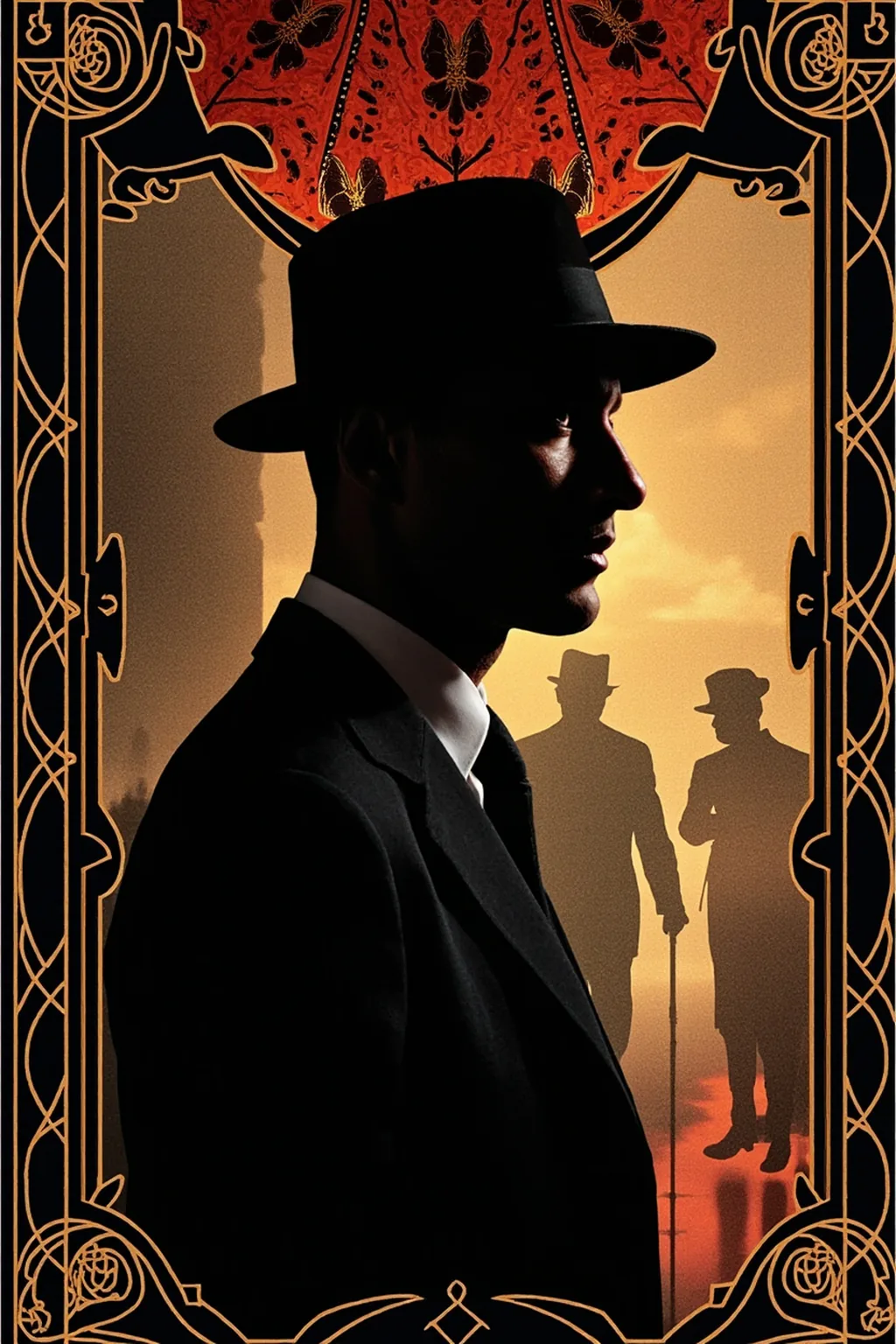
VIII
I couldn’t sleep a wink that night, the foghorn on the Sound groaning without pause, tossing between half-real nightmares and the sharp, ugly truth of Myrtle’s death. As dawn began to grey the sky, I heard a taxi pull up Gatsby’s drive, and I threw on my clothes in a hurry, heart pounding with the need to warn him before it was too late.
His front door was still hanging open when I crossed the lawn, and he was slouched against a hall table, heavy with exhaustion and defeat. “Nothing happened,” he said, voice thin as paper. “I waited, and around four she came to the window, stood there a minute, then turned out the light.”
The house felt impossibly vast that night, dark and stale, like it hadn’t been aired in weeks. We groped through the cavernous rooms for cigarettes, pushing aside heavy curtains like pavilions, fumbling for light switches, until I stumbled over the keys of a dusty piano with a wet, echoing splash. The humidor on a side table held only two dry, stale smokes; we threw open the French windows of the drawing room and sat on the step, smoking into the dark.
“You need to get out of here,” I told him. “They’ll trace your car soon enough.”
“Go now, old sport?” He shook his head, unmovable. He couldn’t leave Daisy, not until he knew what she was going to choose, not when the last thread of hope he’d clung to for five years was still in his grasp.
That night, with his dream already shattered by Tom’s cruel exposure of his fabricated past, Gatsby told me everything, no more secrets left to guard. He told me of Dan Cody, the first man who’d ever taken him in, the ghost of the life he’d built before he was Jay Gatsby. But mostly he talked about Daisy.
She was the first “nice” girl he’d ever known, a bright, unreachable thing from the world of wealth he’d only ever watched from the outside, separated by “indiscernible barbed wire.” He’d first come to her house with other officers from Camp Taylor, awed by the soft mystery of her home, the sense of fresh, living romance that hung in the air, not the musty, stored-up love of the poorer world he knew. He’d known he had no right to her, that he was a penniless nobody in a uniform that could be stripped from him at any moment, but he’d taken her anyway, one still October night, lying to her about his background to give her the security she craved. He’d meant to take what he could and leave, but the moment he kissed her curious, lovely mouth, he was hooked, committed to chasing a grail he’d never be able to hold.
He told me of their last afternoon before he shipped out, sitting with her in his arms for hours, the fire crackling, her cheeks flushed with a cold, the quiet weight of their impending parting hanging over them. He told me of the war, of his quick rise to captain, then major, of being stuck at Oxford when the armistice was signed, of Daisy’s letters growing more distant as she moved back into her world of orchestras and parties and half a dozen suitors. By the time he got home, she was married to Tom Buchanan, secure in his money and his solid, unthinking bulk. He’d spent his last army pay on a miserable week in Louisville after the wedding, walking the streets where they’d once strolled, sitting on the train as it pulled away, staring after the city that had held her, convinced he’d lost the best, freshest part of his life forever.
Dawn broke fully while we talked, turning the sky grey-gold, the air crisp with autumn. Gatsby still insisted Daisy loved him, that Tom had scared her into confusion the day before, that she’d only said she loved Tom because she was frightened. I had to catch my train, missed two before I could wrench myself away, and as I walked down the steps I called back to him, across the lawn: “They’re a rotten crowd. You’re worth the whole damn bunch put together.” He nodded politely, then broke into that bright, understanding smile, the one that made him look like he’d been waiting his whole life to hear someone say it, his gorgeous pink suit a flash of colour against the white steps of the house he’d built for her. I shook his hand, called a final goodbye, and walked away, not knowing I’d never see him alive again.
In the city, I tried to focus on stock listings, then fell asleep at my desk, only to wake to Jordan’s call. Her voice was harsh, stripped of the cool, fresh lilt I knew, sharp with annoyance. She’d left Daisy’s house, was heading to Southampton that afternoon, accused me of being unkind to her the night before. I tried to brush her off, said I couldn’t meet her, and when she pushed, I cut her off cold. I knew then we were done, that there was nothing left to say between us. I hung up the phone, then immediately dialled Gatsby’s number, only to get a busy signal. I tried four times, until the operator told me the line was held open for a long distance call from Detroit. I circled the 3:50 train on my timetable, a cold weight in my chest, and waited.
Back at the Wilson garage after Myrtle’s death, the crowd outside had thinned by dawn, leaving only Michaelis and a handful of men with George Wilson, who rocked back and forth on the couch, unmoored with grief. Around three in the morning, Wilson grew quiet, started muttering about the yellow car that had killed his wife, said he had a way of finding out who owned it. He blurted out that Myrtle had come home two months prior with a bruised face and swollen nose—proof of the domestic abuse he’d long ignored—then broke down crying, yelling “Oh, my God!” over and over. Michaelis found a new braided silver dog leash in Wilson’s desk, which Wilson said he’d found wrapped in tissue paper on Myrtle’s bureau, certain it was proof of her affair. Wilson stared out the window at the looming Doctor T. J. Eckleburg billboard, murmuring that God saw everything, that he’d told Myrtle she couldn’t fool God, no matter how hard she tried. When Michaelis left at dawn to sleep, Wilson was gone.
His movements were traced after that: he walked to Port Roosevelt, then to Gad’s Hill, bought a coffee and a sandwich he didn’t eat, spent three hours unaccounted for—likely asking garages about the yellow car, though no garage owner ever came forward to confirm it—before he turned up in West Egg at 2:30 that afternoon, asking for Gatsby’s house. By then, he knew exactly who he was looking for.
At two that afternoon, Gatsby had put on his bathing suit, told the butler to bring any phone messages to him at the pool. He’d stopped at the garage to pick up the pneumatic mattress that had made his summer parties fun, and told his driver not to take the open car—the one with the broken front fender, the one that had struck Myrtle—out under any circumstances. He carried the mattress to the pool alone, the sun warm on his back, waiting for a call that would never come. The butler waited until four o’clock, then gave up. Gatsby had known, I think, that no call was coming. He’d let go of the dream that had driven him for years, the green light at the end of Daisy’s dock that had always receded just out of reach.
The shots came not long after. When I arrived, driven by a dread I couldn’t name, we found Gatsby’s body floating in the pool, the pneumatic mattress bobbing nearby with a thin red circle staining the water. A short distance away, in the grass, lay George Wilson, the revolver still loose in his hand. The two men who had orbited Daisy Buchanan’s carelessness were both dead, their lives smashed apart by the same rich, indifferent woman who’d never even bothered to send a message to the man who’d loved her more than anything in the world.
The original text of this work is in the public domain. This page offers a compressed quick-read summary for educational purposes.