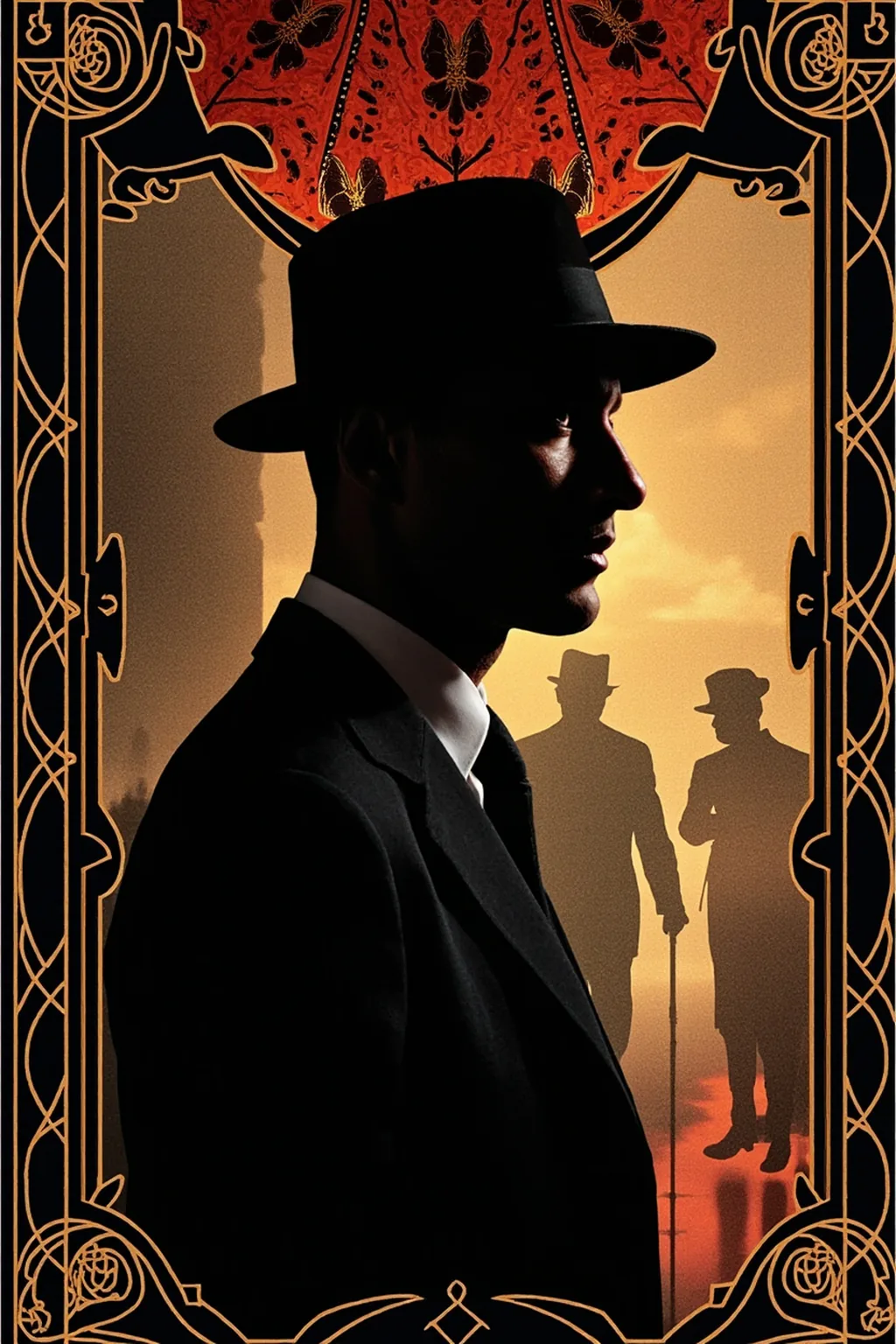
“Then wear the gold hat, if that will move her;
If you can bounce high, bounce for her too,
Till she cry ‘Lover, gold-hatted, high-bouncing lover,
I must have you!’”
“Whenever you feel like criticizing anyone,” he told me, “just remember that all the people in this world haven’t had the advantages that you’ve had.”
Read interpretation
Nick Carraway recounts his father’s wisdom, which becomes the philosophical foundation for the narrator’s approach to the morally compromising characters he encounters. This advice reveals Nick’s Midwestern rootedness in principles of tolerance and moral humility, yet Fitzgerald immediately signals its inadequacy—reserving judgment is “a matter of infinite hope,” but one that has a limit. The tension between Nick’s inherited philosophy and the corrupting world of East Egg will test this tolerant disposition repeatedly throughout the novel.
“Reserving judgements is a matter of infinite hope.”
Read interpretation
This refinement of his father’s advice introduces a paradox at the heart of Nick’s character: his tolerance is neither passive nor naive but actively hopeful, rooted in faith that people might prove better than they appear. Fitzgerald uses this admission to position Nick as a fitting chronicler for Gatsby’s story, where hope itself becomes both the characters’ driving force and their tragic vulnerability.
“Only Gatsby, the man who gives his name to this book, was exempt from my reaction—Gatsby, who represented everything for which I have an unaffected scorn.”
Read interpretation
Nick’s declaration that Gatsby alone escapes his habitual reserve immediately elevates the mysterious neighbor above ordinary moral categories. Yet Fitzgerald complicates this reverence by having Nick denounce Gatsby’s values as “contemptible” even as he remains inexplicably drawn to him. This paradox—simultaneous scorn and fascination—defines the narrator’s complicated relationship with the novel’s titular figure and invites readers to share in his unresolved ambivalence.
“This is a valley of ashes—a fantastic farm where ashes grow like wheat into ridges and hills and grotesque gardens; where ashes take the forms of houses and chimneys and rising smoke and, finally, with a transcendent effort, of ash-grey men, who move dimly and already crumbling through the powdery air.”
Read interpretation
The Valley of Ashes between West Egg and New York serves as the novel’s moral and spiritual wasteland, a “fantastic” landscape where industrial waste has replaced natural growth. Fitzgerald’s repeated use of ash imagery—heavily textured throughout this passage—transforms the terrain into something simultaneously organic and horrifying, as if humanity itself is decomposing into grey powder. The “ash-grey men” who “move dimly and already crumbling” prefigure the spiritual disintegration of characters like George Wilson, trapped in this “solemn dumping ground” between the wealth of the coasts.
“The eyes of Doctor T. J. Eckleburg are blue and gigantic—their retinas are one yard high. They look out of no face, but, instead, from a pair of enormous yellow spectacles which pass over a nonexistent nose.”
Read interpretation
The monumental, faceless eyes of Doctor T.J. Eckleburg emerge as the novel’s most haunting symbol of absent judgment. Fitzgerald traces the billboard’s origin to an oculist who installed it to attract patients, then “sank down himself into eternal blindness, or forgot them and moved away”—a wry commentary on the impermanence of commercial enterprise. The eyes that now “brood on over the solemn dumping ground” represent a watching presence that sees everything yet judges nothing, a God-like observer rendered impotent by its own artificiality. George Wilson will later interpret these eyes as divine witness, revealing how desperate grief transforms meaningless symbols into desperate meaning.
“There was music from my neighbour’s house through the summer nights. In his blue gardens men and girls came and went like moths among the whisperings and the champagne and the stars.”
Read interpretation
The opening of Chapter Three establishes Gatsby’s estate as a perpetual celebration, a world of summer festivity where guests “came and went like moths.” Fitzgerald’s imagery of moths drawn to flame suggests both attraction and danger, while the “whisperings and champagne and stars” evokes a fairy-tale atmosphere of enchantment. The blue gardens and perpetual entertainment signal Gatsby’s attempt to construct an alternative reality—a stage upon which his reunion with Daisy might be achieved.
“Every Friday five crates of oranges and lemons arrived from a fruiterer in New York—every Monday these same oranges and lemons left his back door in a pyramid of pulpless halves.”
Read interpretation
The mechanical juicing of hundreds of oranges each weekend exemplifies the industrial scale of Gatsby’s hospitality, transforming natural abundance into mechanical process. Fitzgerald’s precise accounting—“pyramid of pulpless halves”—emphasizes the relentless consumption and waste underlying the glittering surface of wealth, a motif that will culminate in the novel’s tragic denouement. The fruit that arrives fresh and leaves exhausted mirrors Gatsby himself, whose “extraordinary gift for hope” will be similarly depleted by summer’s end.
“The bar is in full swing, and floating rounds of cocktails permeate the garden outside…”
Read interpretation
The bar in full swing and cocktails “permeating” the garden suggest both sensory abundance and moral diffusion, as alcohol loosens social inhibitions and enables the careless cruelties that characterize Gatsby’s gatherings. The orchestra’s arrival—“no thin five-piece affair, but a whole pitful of oboes and trombones and saxophones and viols and cornets and piccolos”—announces the party as theatrical production, performance elevated to art. Every element of Gatsby’s hospitality functions as spectacle, designed to impress and overwhelm rather than genuinely connect.
“He’s a bootlegger,” said the young ladies, moving somewhere between his cocktails and his flowers. “One time he killed a man who had found out that he was nephew to Von Hindenburg and second cousin to the devil.”
Read interpretation
The gossip circulating about Gatsby mixes criminal accusation with supernatural speculation, creating a mythology that renders him simultaneously menacing and fascinating. The casual juxtaposition of bootlegging with murder and devilish ancestry reveals how completely Gatsby has become a blank screen upon which others project their desires and fears. The young ladies deliver these wild rumors “between his cocktails and his flowers,” treating dark speculation as light entertainment, while the conflicting accounts—“He was a German spy, though some say he was an American”—demonstrate how thoroughly Gatsby’s true origins have been obscured by invention.
“I wrote down on the empty spaces of a timetable the names of those who came to Gatsby’s house that summer. It is an old timetable now, disintegrating at its folds…”
Read interpretation
Nick’s documentation of Gatsby’s guests transforms the novel into archival record, with the physical deterioration of his timetable mirroring the moral disintegration he witnessed. The roster of names from East Egg, West Egg, and theatrical New York—spanning social registers from senators to divorcées to the mysteriously wealthy—constitutes a census of complicity. These guests “paid him the subtle tribute of knowing nothing whatever about him,” suggesting that ignorance itself becomes a form of tribute, a collective agreement to maintain the fiction of Gatsby’s mysterious success.
“When I came home to West Egg that night I was afraid for a moment that my house was on fire. Two o’clock and the whole corner of the peninsula was blazing with light…”
Read interpretation
The midnight illumination of Gatsby’s mansion signals both his insomnia and his obsessive preparation for the reunion with Daisy that Nick has agreed to arrange. Fitzgerald’s metaphor of fire—at once threatening and illuminating—prefigures the destructive forces that Gatsby’s passion will unleash. The light that “fell unreal on the shrubbery and made thin elongating glints upon the roadside wires” suggests a house on the verge of becoming unstuck from reality, its owner equally suspended between hope and desperation.
“We both looked down at the grass—there was a sharp line where my ragged lawn ended and the darker, well-kept expanse of his began.”
Read interpretation
The boundary between Nick’s modest cottage and Gatsby’s mansionliteralizes the novel’s class distinctions, with the “sharp line” marking the division between old and new wealth, authenticity and ostentation. Nick’s “ragged lawn” contrasts with Gatsby’s “darker, well-kept expanse,” suggesting that whatever Gatsby cultivates grows in deeper, more shadowed soil. This moment of shared observation establishes Nick’s complicity in Gatsby’s scheme—he will become the grass that separates two worlds, facilitating the crossing that may destroy them both.
“Why, I thought—why, look here, old sport, you don’t make much money, do you?”
Read interpretation
Gatsby’s awkward attempt to offer Nick a business opportunity—his “business,” it becomes clear, is connected to the bootlegging operations run through Meyer Wolfsheim—reveals the transactional logic underlying even his friendships. His request that Nick invite Daisy to tea, despite his vast wealth and elaborate estate, exposes how thoroughly his emotional need has incapacitated his practical judgment. Gatsby cannot simply buy what he wants; he must construct elaborate circumstances in which Daisy might choose him freely, a romantic idealism that borders on delusion.
“Just why these inventions were a source of satisfaction to James Gatz of North Dakota, isn’t easy to say.”
Read interpretation
Fitzgerald’s direct revelation of Gatsby’s birth name—“James Gatz—that was really, or at least legally, his name”—dismantles the mythology built around the novel’s protagonist. The shift from third-person omniscience (“Just why these inventions were”) to first-person observation (“isn’t easy to say”) creates a brief moment of authorial hesitation, as if Fitzgerald himself cannot fully explain the gap between self-invention and authentic identity. James Gatz of North Dakota remains a figure of mystery even as his secrets are exposed.
“He was a son of God—a phrase which, if it means anything, means just that—and he must be about His Father’s business, the service of a vast, vulgar, and meretricious beauty.”
Read interpretation
This Platonic conception of Gatsby’s selfhood positions his transformation as quasi-religious vocation, a calling to “His Father’s business” that elevates mere material success into sacred purpose. Yet Fitzgerald immediately qualifies this grandeur with “vulgar, and meretricious beauty”—the very qualities that distinguish Gatsby’s aesthetic from the genuine article. The tension between divine aspiration and tawdry execution defines Gatsby’s tragedy: he invents the ideal self at seventeen and remains “faithful to it” throughout his life, never recognizing that his dream has been corrupted by the pursuit itself.
“It was when curiosity about Gatsby was at its highest that the lights in his house failed to go on one Saturday night—and, as obscurely as it had begun, his career as Trimalchio was over.”
Read interpretation
Fitzgerald explicitly invokes Petronius’s Satyricon, comparing Gatsby to Trimalchio, the freed slave whose vulgar wealth and elaborate feasts defined the Roman novel’s satirical target. Just as Trimalchio’s parties masked servile origins behind grotesque ostentation, Gatsby’s entertainments have concealed his connection to Meyer Wolfsheim’s criminal enterprises. The extinguishing of his lights marks not merely the end of parties but the collapse of the entire fiction upon which his identity—and his hope of reclaiming Daisy—rested.
“I wanted somebody who wouldn’t gossip. Daisy comes over quite often—in the afternoons.”
Read interpretation
Gatsby’s dismissal of his original servants and replacement with Wolfsheim’s people transforms his estate from social venue to clandestine operation. The admission that Daisy visits “quite often—in the afternoons” reveals how completely his life has reorganized around her, every domestic arrangement subordinated to maintaining their secret. Fitzgerald’s image of the “whole caravansary” falling “in like a card house at the disapproval in her eyes” suggests that Gatsby’s entire world is fragile as architecture, dependent on the approval of a woman who may never fully commit to him.
“The next day was broiling, almost the last, certainly the warmest, of the summer.”
Read interpretation
The oppressive heat of the day that will culminate in tragedy operates as both physical condition and emotional metaphor, reducing characters to sweating discomfort while intensifying the psychological pressure building toward confrontation. Fitzgerald’s insistence that this is “almost the last” and “certainly the warmest” of the summer positions the scene as climactic in multiple senses—the temperature that will break, the season nearing its end, Gatsby’s hopes approaching their final dissolution.
“I couldn’t sleep all night; a foghorn was groaning incessantly on the Sound, and I tossed half-sick between grotesque reality and savage, frightening dreams.”
Read interpretation
The foghorn that Nick hears through his sleepless night introduces the Sound as an acoustic boundary between worlds, its “groaning” voice foreshadowing the mourning to come. His state “between grotesque reality and savage, frightening dreams” captures the disorientation that will characterize the novel’s tragic aftermath, when distinguishing between what happened and what was imagined becomes impossible. The night’s chaos has transformed Nick into a figure haunted by the violence he has witnessed and the friendships he could not save.
“At first I was surprised and confused; then, as he lay in his house and didn’t move or breathe or speak, hour upon hour, it grew upon me that I was responsible, because no one else was interested—interested, I mean, with that intense personal interest to which everyone has some vague right at the end.”
Read interpretation
Nick’s sense of responsibility for Gatsby crystallizes around the image of the corpse lying silent in his house, “hour upon hour,” awaiting recognition from a world that has abandoned him. His insistence that “no one else was interested” captures the moral poverty of Gatsby’s associates, whose attendance at parties never constituted genuine connection. The admission that everyone possesses some “vague right” to others’ interest at the moment of death suggests that living relationships demand more than death ever requires of witnesses.
“But she and Tom had gone away early that afternoon, and taken baggage with them.”
Read interpretation
The Buchanan’s departure with “baggage”—plural, loaded, prepared—reveals a planned abandonment rather than hasty flight. Daisy and Tom leave without forwarding address, choosing absence over accountability, comfort over conscience. Fitzgerald’s spare reporting of this abandonment—“Left no address?” “No.”—emphasizes the silence that replaces connection, the way the powerful escape consequences while those left behind bear the weight of what happened. Nick’s instinctive call to Daisy, “without hesitation,” makes his failure to reach her all the more devastating, a hope extinguished before it could be tested.
Read interpretation
This dedication, attributed to Thomas Parke d’Invilliers, Fitzgerald’s poetic pseudonym, establishes the novel’s central preoccupation with romantic pursuit and the unattainable ideal. The “gold-hatted, high-bouncing lover” who must captivate through movement and vitality foreshadows Jay Gatsby’s desperate, energetic quest to reclaim Daisy Buchanan, setting the tone for a narrative built on longing and performance.