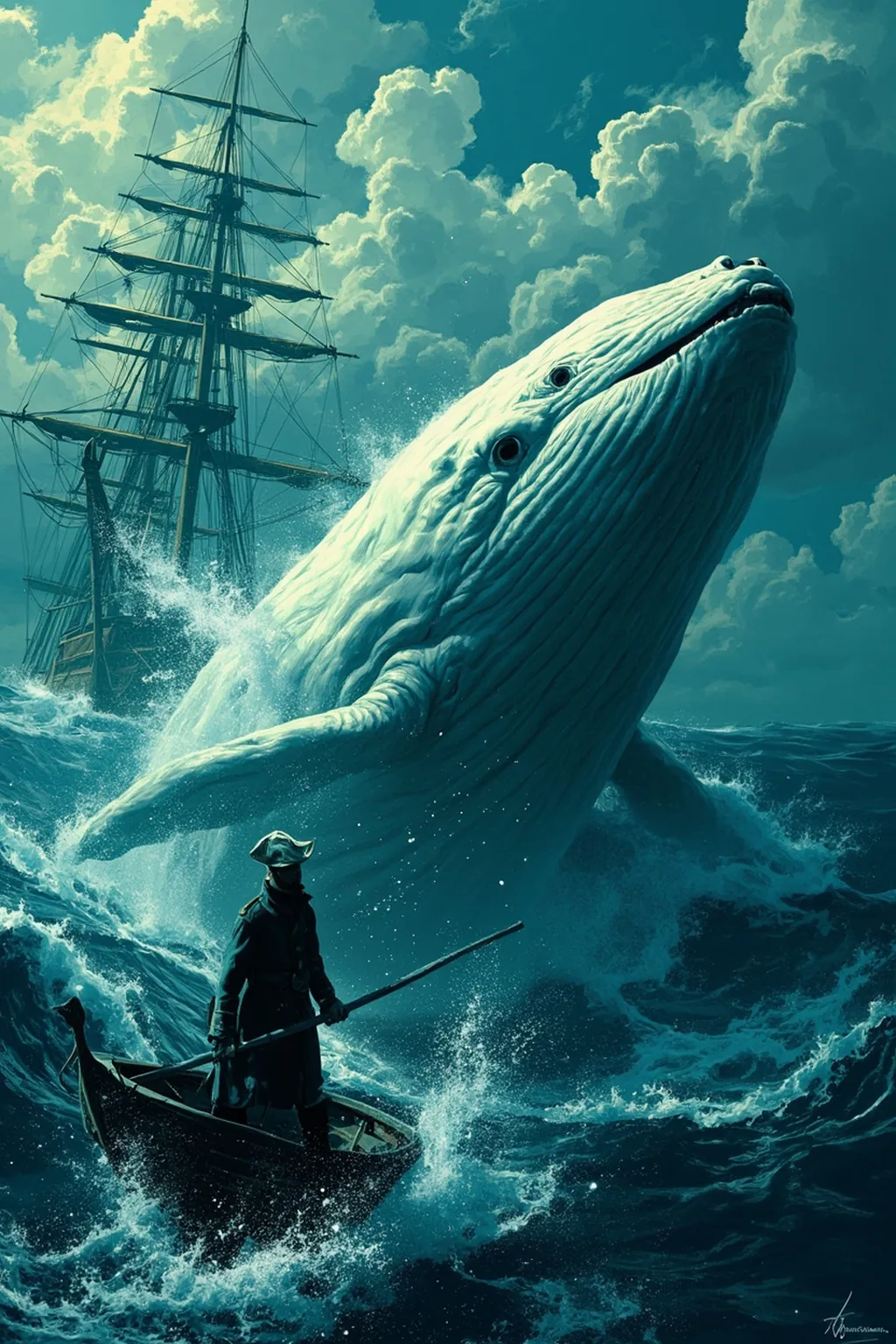
Pequod Harpooneers
The three harpooneers of the Pequod are introduced as squires to the mates. Queequeg, already known to the reader, serves as squire to chief mate Starbuck. Tashtego, an unmixed Indian from Gay Head, Martha’s Vineyard, serves as Stubb’s squire. He is described as having long, lean, sable hair, high cheek bones, and black eyes that are Oriental in largeness but Antarctic in expression. Once a hunter of New England moose, he now hunts whales, his harpoon replacing his ancestors’ arrows. The third harpooneer is Daggoo, a gigantic, coal-black man with a lion-like tread, who serves as squire to little Flask. Despite his imposing six-foot-five frame, Daggoo retains all his barbaric virtues, moving about the decks “erect as a giraffe” in deliberate contrast to Flask’s short, square appearance.
Crew Demographics
The chapter notes that while nearly all officers in the American whale fishery are American-born, not one in two common seamen are. This pattern is compared to the American army, military and merchant navies, and canal and railroad engineering forces, where “native Americans liberally provides the brains, the rest of the world as generously supplying the muscles.” Many whaling seamen come from the Azores, where Nantucket whalers stop to augment crews. Similarly, Greenland whalers recruit from the Shetland Islands. The chapter memorably describes the crew as “Isolatoes”—sailors who do not acknowledge the common continent of men, each living on a separate continent of his own. Together, they form a diverse delegation, described as an “Anacharsis Clootz deputation from all the isles of the sea, and all the ends of the earth.”
Foreshadowing of Little Pip
The chapter concludes with a brief but poignant reference to Little Pip, described as a “Black Little Pip” and an “Alabama boy.” The text cryptically states “he never did—oh, no! he went before,” foreshadowing his fate. He is said to be found “beating his tambourine” on the grim Pequod’s forecastle, prelusive of “the eternal time” when he will be called to “the great quarter-deck on high” to “strike in with angels.” The passage suggests a duality to Pip’s character: “Called a coward here, hailed a hero there!” This brief mention establishes Pip as a significant figure whose eventual destiny the narrative will return to.
KAPITEL 28. Ahab.
This chapter marks the first introduction of Captain Ahab in Moby-Dick, following the Pequod’s departure from Nantucket. The narrator describes Ahab’s initial seclusion aboard the ship, during which the three mates command vicariously on his behalf. The chapter progresses through the narrator’s growing unease, the dramatic reveal of Ahab’s physical appearance—his livid scar, ivory prosthetic leg, and characteristic pivot-hole posture—through his gradual emergence onto the deck as warmer weather arrives. The chapter establishes Ahab as a commanding, mysterious figure whose presence dominates the ship despite his initial withdrawal.
Ahab’s Initial Seclusion and the Ship’s Vicarious Command Structure
For several days after leaving Nantucket, Captain Ahab remains hidden below deck, unseen by most of the crew. The three mates—Starbuck, Stubb, and Flask—relieve each other regularly at the watches and appear to command the ship, issuing orders that prove to be sudden and peremptory. Yet these officers clearly recognize that they command only vicariously; their “supreme lord and dictator” remains in the cabin retreat, unseen by any eyes not permitted to penetrate that sacred space. The narrator observes that though the harpooneers and crew are far more barbaric and motley than any merchant-ship company he has previously known, he attributes this wildness to the fierce uniqueness of the whaling vocation rather than any cause for alarm. By tacit consent, little or no allusion is made to the captain’s condition or whereabouts, and the ship maintains its progress southward, leaving the merciless winter behind as it sails through increasingly warmer waters.
Narrator’s Unease Mitigated by Competent Ship’s Officers
The narrator experiences a vague disquietude regarding the unknown captain, which becomes intensified by the recurring memory of Elijah’s diabolical incoherences. Despite these apprehensions, he finds reassurance in the aspect of the three chief officers—the mates—who are calculated to allay his misgivings and induce confidence. These three Americans—a Nantucketer, a Vineyarder, and a Cape man—represent the best possible sea-officers in their different ways. The narrator acknowledges that it would be against all warrantry to cherish emotions of anxiety, given the competent leadership visible in the mates’ conduct and the nature of the whaling profession itself.
The original text of this work is in the public domain. This page focuses on a guided summary article, reading notes, selected quotes, and visual learning materials for educational purposes.