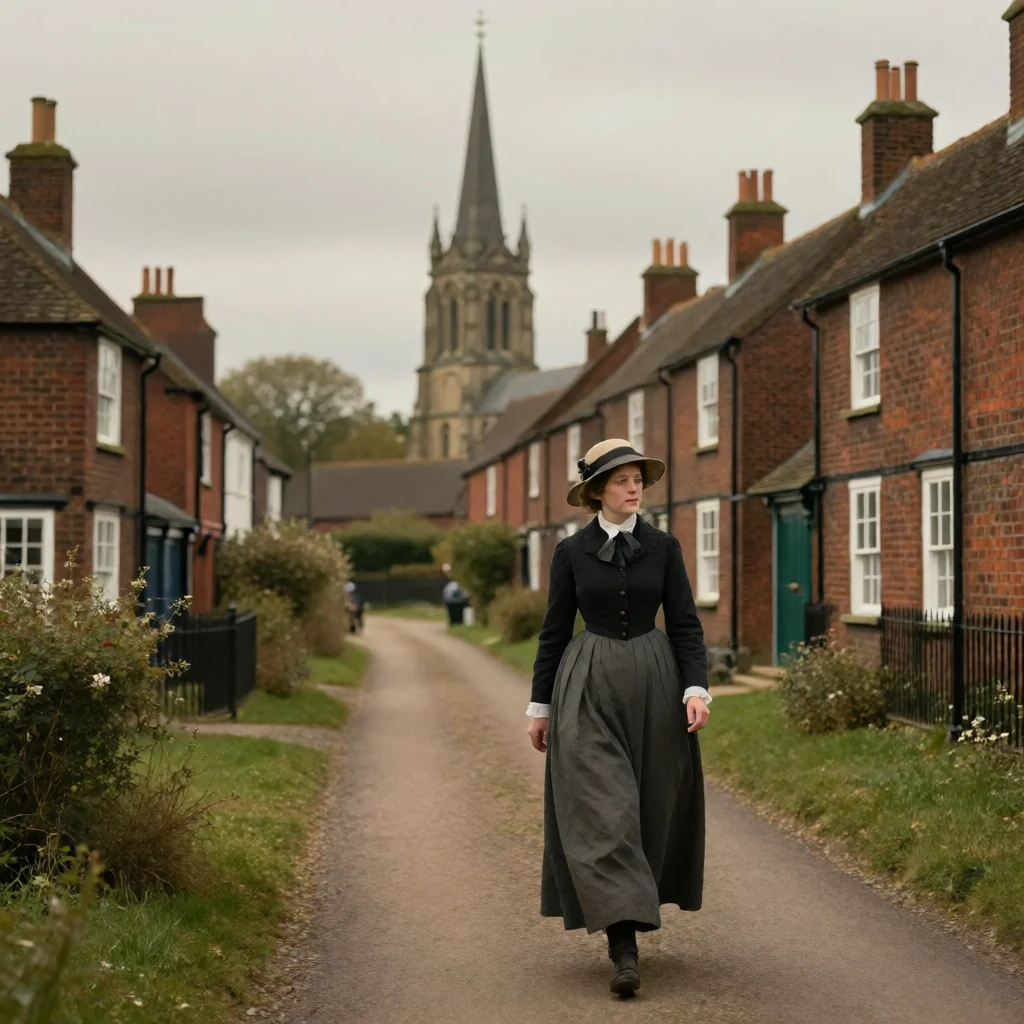
Farebrother Drawing Room Family Introduction
Three ladies receive Lydgate in the drawing room: Mrs. Farebrother, the Vicar’s white-haired mother, befrilled and kerchiefed with dainty cleanliness, upright, quick-eyed, and still under seventy; her sister Miss Noble, a tiny old lady of meeker aspect with more worn and mended attire; and Miss Winifred Farebrother, the Vicar’s elder sister, well-looking but “nipped and subdued as single women are apt to be who spend their lives in uninterrupted subjection to their elders.” Lydgate had expected books and natural history collections, not this quaint group. The Vicar appears milder and more silent at home, with his mother dominating conversation.
Mrs. Farebrother’s Views on Morality and Social Change
Mrs. Farebrother welcomes Lydgate with lively formality and informs him her household rarely needs medical aid because her children were raised to wear flannel and avoid overeating. She dismisses Lydgate’s plea for those with unhealthy ancestors as “dangerous,” insisting Nature is just—if descendants are bad, they deserve their fate. The Vicar jokes that his mother “objects to metaphysics.” Mrs. Farebrother champions traditional morality, lamenting that in her youth, Church people shared the same opinions and the catechism was sufficient. Now one is “liable to be contradicted” even when speaking from the Prayer-book. She derides new theological ideas as “mixed stuffs that will neither wash nor wear” and worries clergymen may no longer be gentlemen. When the conversation turns to Tyke, another clergyman, Mrs. Farebrother’s sharpness blunts momentarily in maternal confidence.
Farebrother Family Banter and Self-Deprecation
Mrs. Farebrother declares her son will “compare with any preacher in this kingdom.” The Vicar slyly suggests his mother is partial, then asks what “Tyke’s mother says about him.” Miss Winifred reports that Mr. Tyke told Griffin and his wife they would receive no more coals if they came to hear Farebrother preach. Mrs. Farebrother lays down her knitting with pointed significance. The Vicar calmly responds that they are not his parishioners and his sermons are not worth coals to them. His mother protests that he “always undervalues himself” and warns he risks “undervaluing the God who made him.” When the Vicar suggests taking Lydgate to his study, all three ladies remonstrate—he should not be hurried away, there is nothing in the study but “pickled vermin” and drawers full of blue-bottles and moths. A game at cribbage would be better. Lydgate reflects that he wonders the Vicar has not “taught them better.”
Camden Farebrother’s Natural History Study Tour
In the study, as bare as the ladies implied, the Vicar explains his mother is unused to visitors interested in his hobbies. He offers Lydgate his pipe—he smokes despite his profession, pleasing “the devil” by maintaining the habit. Lydgate explains his heavier constitution would lead to idleness. The Vicar shows his collection of insects, particularly orthoptera, claiming an “exhaustive study” of the district’s entomology with both fauna and flora work ongoing. He opens drawers showing specimens, but Lydgate fixates on a glass jar containing “a lovely anencephalous monster.” The Vicar envies Lydgate’s lack of such “spiritual tobacco”—hobbies filling void time—and describes imaginary learned treatises on biblical entomology. Lydgate examines the drawers despite the Vicar’s self-deprecating laughter. The Vicar agrees to part with the monster in exchange for sea-mice specimens and Robert Brown’s work on pollen. Lydgate suggests making one’s value felt so people must “put up with you whether you flatter them or not,” and the Vicar agrees but warns one must “keep yourself independent”—few can do so, as either one slips into uselessness or “wears the harness” of social obligation. Lydgate determined to avoid “harness” by staying away from London with its “empty bigwiggism and obstructive trickery.”
Conversation on Trawley and Medical Reform Ideals
The Vicar reveals he corresponds with Trawley, who shared Lydgate’s Paris apartment, and knows more about Lydgate than Lydgate knows about him. Lydgate has lost track of Trawley, who was “hot on French social systems” and talked of founding a Pythagorean community in the American Backwoods. The Vicar reports Trawley is now practising at a German bath and has married a rich patient. Lydgate recalls his own position that the medical profession’s “fault was in the men” who “truckle to lies and folly,” advocating a “disinfecting apparatus within” rather than preaching against humbug. The Vicar notes Lydgate’s scheme is more difficult than the Pythagorean community—one must contend with “all those descendants of the original Adam” in society. He reflects he has paid “twelve or thirteen years more” for knowledge of difficulties.
The original text of this work is in the public domain. This page focuses on a guided summary article, reading notes, selected quotes, and visual learning materials for educational purposes.