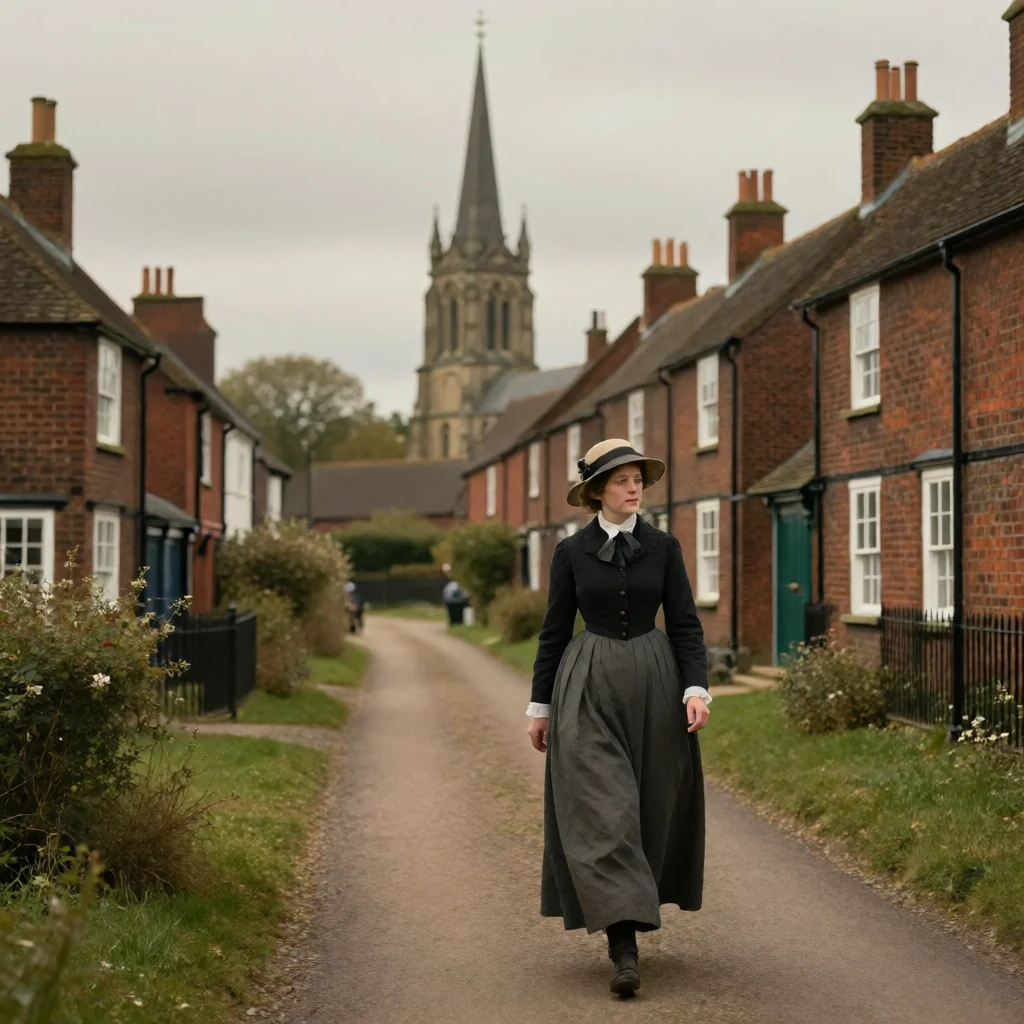
The Garth Household and Mrs. Garth
Fred rides to the Garth home, a rambling half-timbered former farmhouse outside the town with an orchard, knowing and loving every corner of it. The chapter then describes Mrs. Garth at length: a curly-haired, square-faced, handsome woman who once served as a governess, she is practical, self-controlled, and earnest about education, teaching her children grammar and the story of Cincinnatus in the kitchen while making pies. The passage sketches her dignified frugality, her disciplined household, her indulgence toward male failings contrasted with rigorous standards for her own sex, and her maternal fondness for Fred that makes his coming failure all the harder to bear. When Fred arrives, Caleb is out, so Mrs. Garth keeps him company in the kitchen until Caleb returns.
Fred’s Confession to the Garths
In the parlor, Caleb arrives, and Fred bursts out with the plain fact: he cannot meet the bill and offers only the fifty pounds he has brought. Caleb quietly reveals to his astonished wife that he had put his name to a bill for Fred for one hundred and sixty pounds because Fred had been confident he could meet it. Mrs. Garth’s face changes beneath a still surface, and she fixes her eyes on Fred, asking whether he has asked his father for the rest of the money and been refused. Fred, biting his lip, admits he knows asking would be useless and that he would not wish to mention Mr. Garth’s name in the matter, leaving the chapter on the tense threshold of Mrs. Garth’s judgment.
CHAPITRE XXIV.
CHAPTER XXIV. presents a domestic crisis in the Garth household as Caleb reveals to his wife Susan that he has been drawn into Fred Vincy’s debts. The chapter moves from the immediate financial reckoning through Fred’s confession and departure, the Garths’ reflections on his character, the practical arrangements for repayment, their speculation about Mary Garth’s feelings for Fred, and finally to a meditative passage on Caleb’s vocational philosophy.
Caleb and Mrs. Garth Discuss Fred’s Debt Crisis
Caleb and Mrs. Garth Discuss Fred’s Debt Crisis Caleb opens the chapter by admitting that the debt of a hundred and ten pounds has arrived at an unfortunate moment, with Christmas approaching and his finances strained. He tells Susan he will need every farthing in the bank, comparing his situation to a tailor cutting with short measure. Susan takes in the news gravely, offering the ninety-two pounds she has saved for their son Alfred’s apprenticeship premium.
Fred Confesses Fault and Expresses Remorse
Fred Confesses Fault and Expresses Remorse Fred stammers that he will ultimately pay the debt, but Mrs. Garth sharply notes that boys cannot be apprenticed “ultimately.” Fred then recounts his failed attempt to raise the money, including the bad luck with a horse that went lame after he had paid out thirty pounds. Overcome with emotion at the kindness shown him by the Garths, he hurries out of the room, conscious of his own inadequacy.
Mrs. Garth Voices Disappointment in Fred Vincy
Mrs. Garth Voices Disappointment in Fred Vincy After Fred’s departure, Mrs. Garth states plainly that she is disappointed in him, confessing she had not believed he would sink so low as to draw Caleb into his debts. She acknowledges his extravagance but condemns his lack of consideration for friends who could least afford to lose. Caleb readily admits his own foolishness in endorsing the bills, and Susan, though severe, tells him he should not have kept such troubles from her, just as he conceals burst buttons.
Caleb and Mrs. Garth Arrange Debt Repayment
Caleb and Mrs. Garth Arrange Debt Repayment Susan instructs Caleb on the sacrifices required: Alfred must be taught by his father rather than apprenticed, and Caleb must curb his habit of working without pay. She sends him to ride over to Mary to ask what money she has saved. Caleb, leaning forward with his fingertips pressed together, laments the interruption to his work and wishes the troublesome bill were at Hanover.
The original text of this work is in the public domain. This page focuses on a guided summary article, reading notes, selected quotes, and visual learning materials for educational purposes.