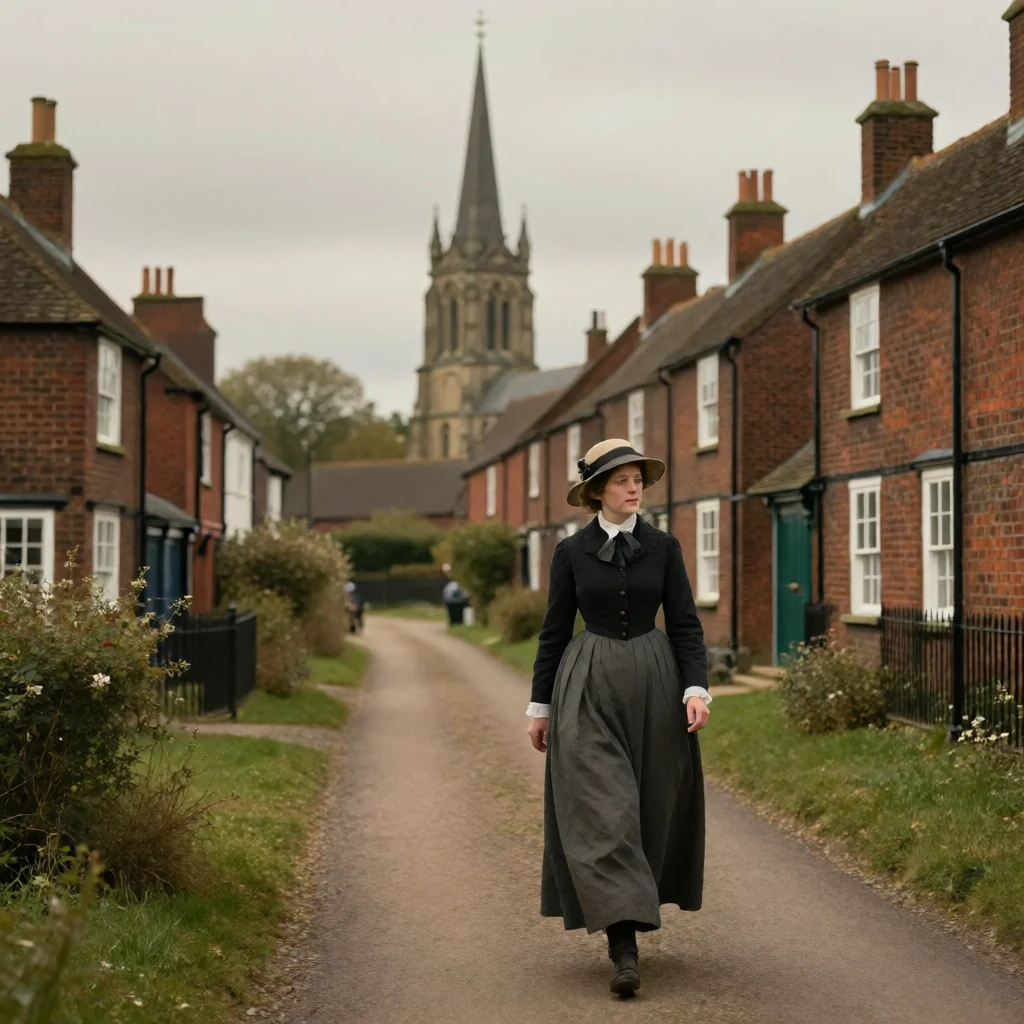
Assessing the Bay
Fred is subtle, not telling his friends outright that he has come to Houndsley to sell his horse; he hopes instead to draw out their genuine opinion of its value. Bambridge, never a gratuitous flatterer, declares the unfortunate bay to be a roarer of the worst degree, comparing it unfavorably even to Pegwell’s old roan, telling his famous “wind-instruments” joke. When Fred points out the contradiction in Bambridge’s statements, Bambridge simply admits, “I said a lie, then.” When Fred turns to Horrock for confirmation of the horse’s clean trot, Horrock offers only the “complete neutrality” of a great master’s portrait. Fred eventually concludes that both Bambridge’s depreciation and Horrock’s silence actually indicate that they think better of the horse than they choose to say.
The Dappled Gray Hunter
That evening, before the fair has properly begun, Fred sees what he believes is a favorable opening. A young farmer, acquainted with Bambridge, arrives at the Red Lion wanting to part with his hunter, Diamond, in favor of a useful hack—being about to marry and give up hunting. Diamond is stabled at a friend’s premises, accessible through a grim back street. Fred, not fortified by brandy as his companions are, finds his hope of finding the right horse exhilarating enough to make him willing to revisit the stable first thing in the morning. He notes that the dappled gray would suit Lord Medlicote’s man, who is on the look-out for just such a horse, and observes that Bambridge has let slip, when the farmer was absent, that he had seen worse horses go for eighty pounds.
Fred’s Speculative Bargain
Fred reasons that the farmer paused over his broken-winded steed long enough to suggest he might take it with twenty-five pounds in addition as the equivalent of Diamond. In that case, selling Diamond for at least eighty pounds would leave Fred fifty-five pounds in pocket and bring him to within twenty-five pounds of meeting his bill, with only that small deficit temporarily thrown on Mr. Garth. Fred reflects that even if both Bambridge and Horrock had dissuaded him, he would have read their motives as something other than concern for a young fellow’s interest—“deep hands” holding something else. He accepts that in matters of horses, distrust is one’s only clew, but argues that scepticism can never be wholly applied, since life requires belief and action. Before the fair has well set in, he secures the dappled gray in exchange for his old horse and thirty pounds—only five pounds more than he had expected to give.
The Journey Home
A little worried and wearied, perhaps from the mental debate, Fred decides not to wait for the further gayeties of the horse-fair. He sets out alone on his fourteen-mile journey, intending to take it quietly and keep his horse fresh.
CHAPITRE XXIV.
In Chapter XXIV of Middlemarch, Fred Vincy suffers a financial disaster when his horse Diamond kicks violently in the stable, nearly killing the groom and laming itself, destroying the eighty-pound investment he hoped to sell to Lord Medlicote’s man. With only fifty pounds to his name and a bill for one hundred and sixty pounds due in five days, Fred resolves to confess the truth to Caleb Garth and ride to Mary at Stone Court afterward. The chapter then introduces the Garth household and culminates in Fred’s confession to the Garths about the unpaid bill.
Fred’s Diamond Horse Mishap
Fred Vincy’s spirits collapse when his horse Diamond, in which he had invested eighty pounds as a potential sale to Lord Medlicote’s man, suddenly kicks viciously in the stable, nearly kills the groom, and lams itself badly by catching its leg in an overhanging rope. With only fifty pounds remaining and no prospect of obtaining more, Fred faces the imminent presentation of a one hundred and sixty pound bill in five days, leaving him utterly downcast and stripped of his usual resilience.
Fred’s Resolve to Confess His Debt
Recognizing that his father would angrily refuse to rescue Mr. Garth from what he would see as enabling extravagance and deceit, Fred decides to go directly to Mr. Garth with the fifty pounds, at least securing that sum out of his own hands. He takes his father’s nag with the intention of confessing everything to Mary at Stone Court afterward, knowing that his conscience has been sharpened by his love for her. Fred reflects that his sense of rectitude is held in place largely by Mary’s expectations of what is admirable in character, and that he cannot bring himself to defer this unpleasant task as he usually would.
The original text of this work is in the public domain. This page focuses on a guided summary article, reading notes, selected quotes, and visual learning materials for educational purposes.