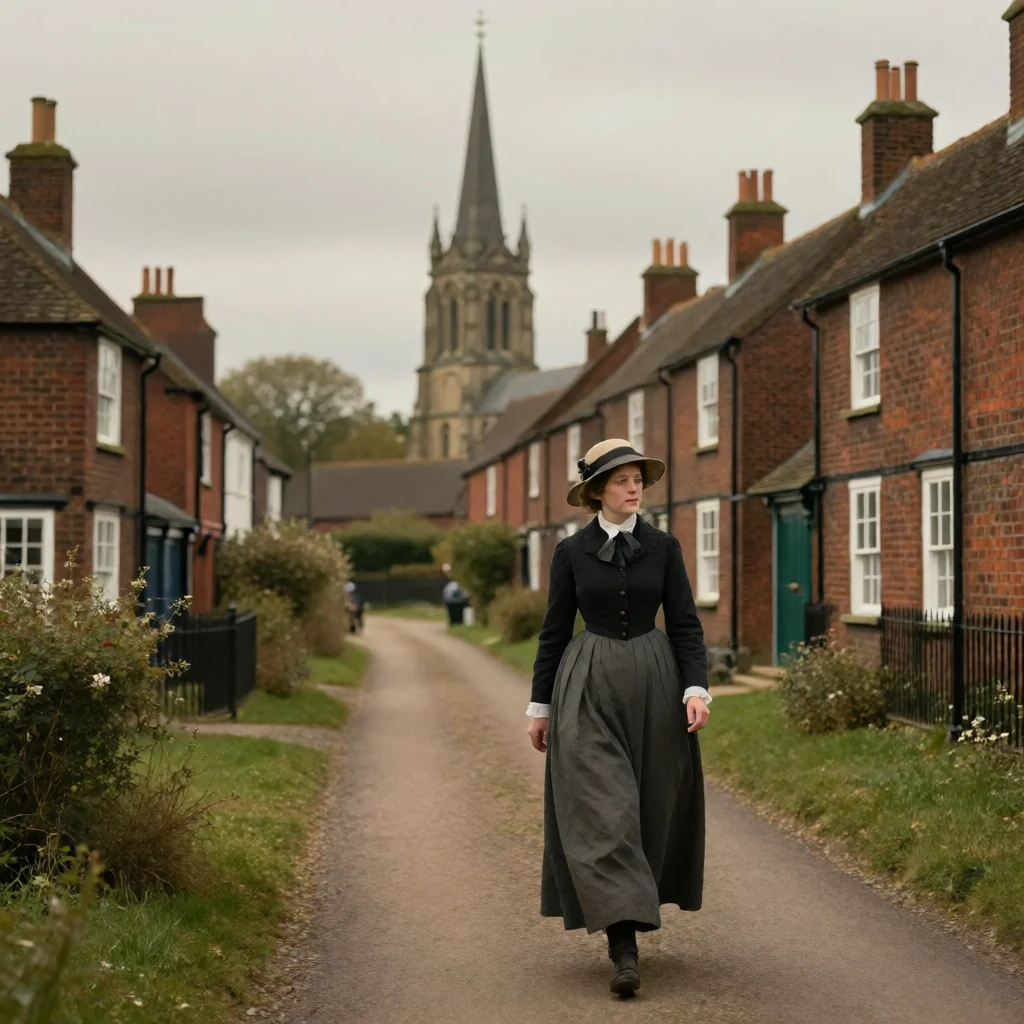
Mysterious Mourner Rigg’s Entrance
The morning’s ordinary currents of conjecture are disturbed by the arrival of a strange mourner, described by Mrs. Cadwallader as frog-faced: a man about two or three and thirty with prominent eyes, thin-lipped downward-curved mouth, and sleekly brushed hair, whose batrachian unchangeableness of expression marks him as a new legatee whose presence raises new uncertainty among the mourners.
Caleb Garth’s Non-Covetous Inquiry
Caleb Garth, having little expectation and less cupidity, is interested only in verifying his own guesses about the stranger, and his calm half-smiling observation contrasts with the alarm or scorn visible in other faces as Joshua Rigg enters the wainscoted parlor to await the reading of the will.
Mrs. Waule and Trumbull’s Confidential Exchange
Mrs. Waule, finding vacant seats between herself and Mr. Trumbull, moves next to the auctioneer and in confidential woolly whispers probes him about what her poor brother has done; Trumbull screens his secrets with professional discretion, but Mrs. Waule finds some relief in suggesting that those who have made sure of their good luck may yet be disappointed, while her sister Martha observes that nobody knows what was on Peter’s mind.
Fred Vincy’s Suppressed Laughter
Fred Vincy, having overheard Mr. Jonah suggesting something about a “love-child,” struggles to suppress inappropriate laughter at the stranger’s batrachian face, until Mary Garth cleverly rescues him by asking him to change seats, allowing him to retreat into a shadowy corner to compose himself.
Lawyer Standish Arrives with Wills
The lawyer Mr. Standish enters with Solomon and Jonah, believing he knows thoroughly well who will be pleased and disappointed; he behaves with the same deep-voiced off-hand civility to everyone, discussing the hay-crop and the Duke of Clarence, while the brothers maintain thoroughly neutral gravity.
Revelation of Multiple Featherstone Wills
Mr. Standish reveals that he holds a will executed on August 9, 1825, but has discovered a subsequent instrument dated July 20, 1826, and a codicil dated March 1, 1828, explaining that he will begin by reading the earlier will as the deceased did not destroy it.
Mary Garth’s Secret Role in Second Will
Mary Garth feels the most throbbing excitement because she knows that it was she who virtually determined the production of this second will on that final night, a secret known to no other soul present.
First Will’s Modest Bequests Read
The first will’s modest bequests—two hundred pounds each to brothers and sisters, one hundred to nephews and nieces, and to Mrs. Vincy and Rosamond, with Mr. Trumbull receiving a gold-headed cane and fifty pounds—inspire disgust and indignation among the family, who feel affronted by such offensive dribbling to persons not present and problematical low connections, totaling about three thousand pounds while the fate of the rest remains mysterious.
Fred Vincy’s Ten Thousand Pound Bequest
The expectation that the “much” would fall to Fred Vincy is confirmed when ten thousand pounds in specified investments are bequeathed to him, causing him to bite his lips to avoid smiling and Mrs. Vincy to feel herself the happiest of women with the prospect of possible revocation shrinking from sight.
Joshua Rigg Named Residuary Legatee
The remainder of the personal property and all the land are left to Joshua Rigg as residuary legatee and sole executor, who is also to take the name Featherstone, prompting a shudder-like rustling around the room as everyone stares afresh at the unmoved Mr. Rigg.
Second Will’s Almshouses Bequest
The second will, which Mary Garth knows is not the final wishes, revokes everything except legacies to the low persons and leaves the Lowick parish land, stock, and household furniture to Joshua Rigg, with the residue devoted to erecting and endowing almshouses for old men called Featherstone’s Alms-Houses, the testator declaring he wished to please God Almighty.
Family Reactions to Final Will
The reactions diverge sharply: Mr. Vincy protests that the last will was void since Featherstone was not in his right mind; Mr. Trumbull calls the will eccentric while professing himself above mercenary considerations; Caleb Garth observes that there is nothing surprising in it and wishes there were no such thing as a will, his response highlighting the contrast between acquisitive rage and philosophical detachment among the disappointed mourners.
The original text of this work is in the public domain. This page focuses on a guided summary article, reading notes, selected quotes, and visual learning materials for educational purposes.