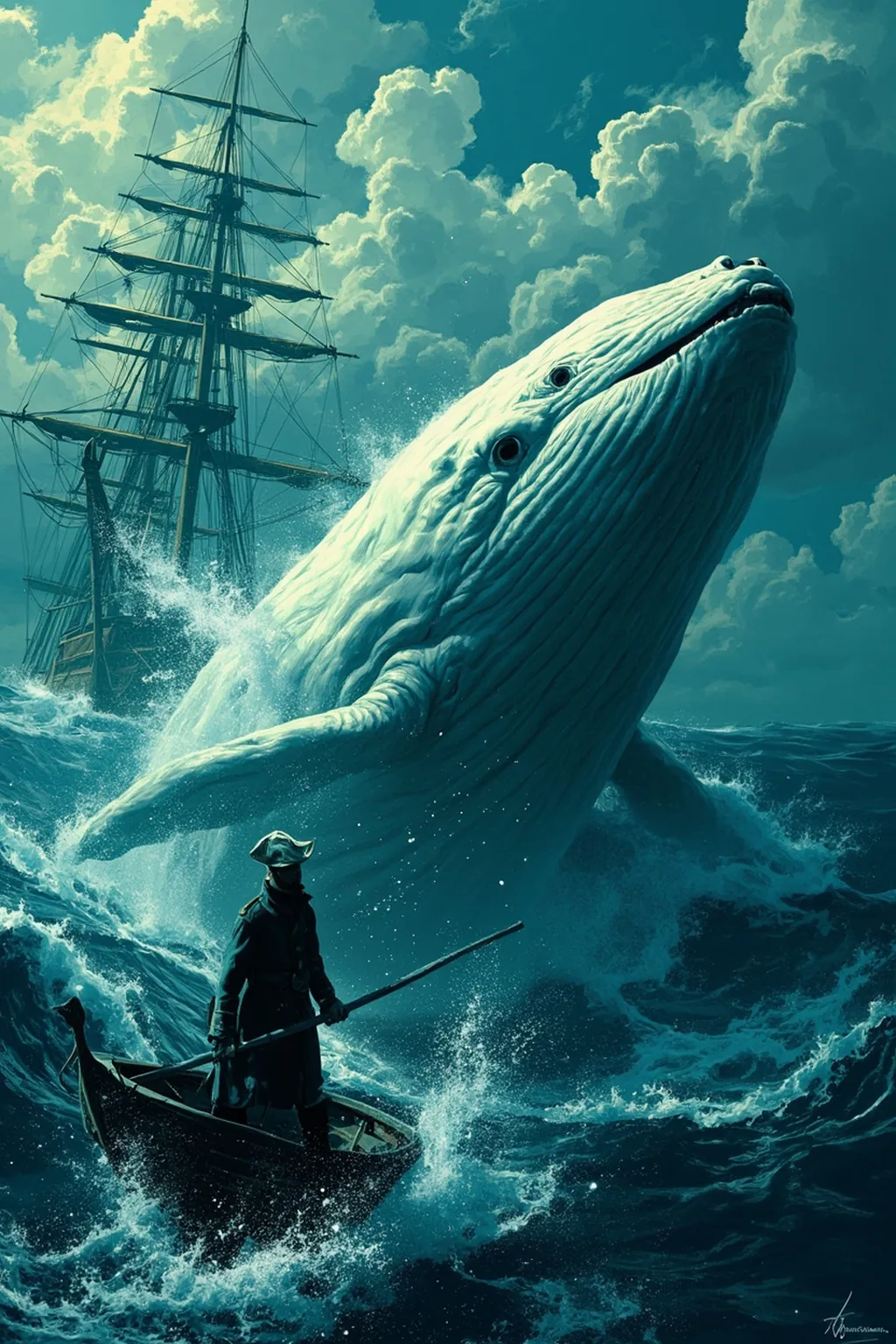
Ahab retrieves his ivory stool and pipe, lights it at the binnacle lamp, and sits smoking on the deck’s weather side.
Following Stubb’s departure, Ahab remains on deck, leaning over the bulwarks. He summons a sailor from the watch and sends him below to retrieve both his ivory stool and his pipe. He then lights the pipe using the binnacle lamp and plants the stool on the weather side of the deck, where he sits to smoke. This action establishes Ahab’s particular routines and his ease with summoning crew members to serve his personal needs, revealing the authority he wields over his men.
Ahab is compared to Norse sea kings who sat on narwhal tusk thrones, framed as a lord of Leviathans.
The narrator draws a striking comparison between Ahab and the sea-loving Danish kings of old Norse tradition, whose thrones were allegedly made from narwhal tusks. When observing Ahab seated on his ivory stool—a tripod of bones resembling the legendary narwhale thrones—one cannot help but think of the royalty such a seat symbolizes. The text explicitly identifies Ahab as a Khan of the plank, a king of the sea, and a great lord of Leviathans. This comparison elevates Ahab’s stature, associating him with legendary maritime sovereignty and positioning him as a monarchic figure commanding not merely men but the greatest creatures of the deep.
Ahab soliloquizes that the pipe no longer soothes him, rejects it as unsuitable for his troubled state, and vows to smoke no more.
After smoking for several moments, thick vapor repeatedly blows back into Ahab’s face. He breaks into soliloquy, withdrawing the pipe and declaring that smoking no longer soothes him. He addresses the pipe directly, musing that if its charm has departed, his situation must be dire indeed. Ahab reflects that he has been unconsciously toiling rather than pleasuring, and that he has been smoking to windward throughout in nervous whiffs, as if like a dying whale, his final jets are the strongest and fullest of trouble. He questions what business he has with a pipe meant for sereneness and mild white vapors, not for someone like himself with torn iron-grey locks and a troubled spirit. Concluding his introspection, he declares he will smoke no more.
The original text of this work is in the public domain. This page focuses on a guided summary article, reading notes, selected quotes, and visual learning materials for educational purposes.