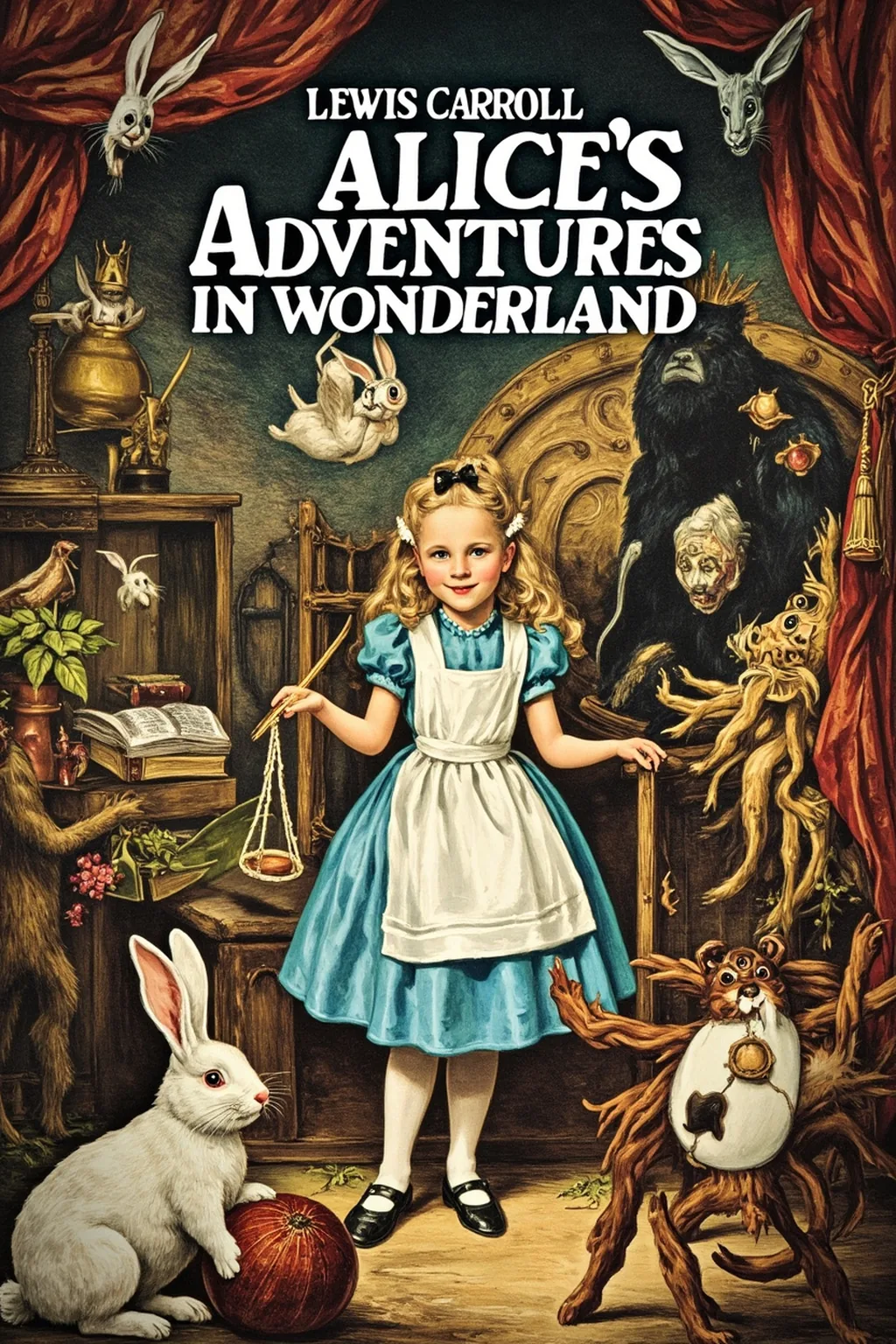
CHAPTER V. Advice from a Caterpillar
This chapter begins with Alice’s encounter with the Caterpillar, who questions her identity in a sleepy, demanding voice. The confusing exchange establishes Alice’s disoriented state after her many size changes that day.
Initial Identity and Poem Exchange
The Caterpillar repeatedly asks “Who are you?” causing Alice confusion about her own identity. When she cannot explain herself clearly, the Caterpillar instructs her to recite a poem. Alice attempts “How doth the little busy bee” but it comes out incorrectly, so the Caterpillar demands she recite “You are old, Father William” instead. Alice recites this poem but makes errors throughout, prompting the Caterpillar to declare it “wrong from beginning to end.”
Size Discussion and Mushroom Guidance
The conversation shifts to Alice’s size, with the Caterpillar asking what size she wants to be. Alice expresses a wish to be “a little larger” since three inches is a “wretched height,” angering the Caterpillar, who is exactly three inches tall. After Alice pleads that she is not used to this height, the Caterpillar smokes its hookah and finally offers crucial guidance: “One side will make you grow taller, and the other side will make you grow shorter” regarding the mushroom before crawling away.
Mushroom Transformation and Pigeon Confrontation
Alice examines the perfectly round mushroom, stretches her arms around it, and breaks off pieces from each side. Upon nibbling the right-hand piece, she feels a violent blow under her chin as she begins shrinking rapidly. She quickly eats from the left-hand piece to counteract this, but overshoots and shrinks so much that her neck extends enormously while her shoulders and hands become unlocatable. Her serpentine neck draws the attention of an angry Pigeon, who accuses her of being a serpent trying to steal its eggs. Alice protests that she is a little girl, but the Pigeon remains unconvinced, arguing that little girls do not have such necks. The confrontation ends with the Pigeon dismissing Alice, who remains entangled among tree branches with her elongated neck.
Size Restoration and House Discovery
Remembering she still holds the mushroom pieces, Alice carefully alternates between nibbling each piece, growing taller and shorter until she successfully returns to her normal height. Finding this sensation strange after so long, she begins contemplating how to reach “that beautiful garden.” She then discovers an open clearing containing a little house about four feet high. Realizing her current size would frighten whoever lives there, she nibbles the right-hand mushroom piece again to shrink down to nine inches before approaching.
Pig and Pepper
Alice approaches a curious house in the woods where two footmen in livery—one resembling a fish and the other a frog—exchange an invitation from the Queen to the Duchess for a croquet game. The footmen bow so deeply their curls become entangled, causing Alice to laugh and retreat into the woods. When she peeks out again, the Frog-Footman sits alone near the door, staring stupidly upward.
Footmen Exchange Queen’s Croquet Invitation
The Fish-Footman produces a large letter from under his arm and hands it to the Frog-Footman, who repeats the message with solemn ceremony, slightly altering the word order: “From the Queen. An invitation for the Duchess to play croquet.” Both footmen bow low, their powdered curls tangling together. Alice finds their formality absurd, retreating into the woods to contain her laughter before approaching the door.
Frog-Footman Obstructs Entry to Duchess’s House
When Alice knocks, the Frog-Footman offers nonsensical reasons why knocking is useless: they stand on the same side of the door, and the noise inside prevents anyone from hearing her. A plate suddenly flies from the house and breaks against a tree, barely missing his nose, yet he continues as though nothing happened. He declares he will sit there for days, and when Alice asks how to enter, he responds cryptically that she should question whether she will get in “at all.” Frustrated, Alice opens the door and enters anyway, leaving him to sit on.
The original text of this work is in the public domain. This page offers a compressed quick-read summary for educational purposes.