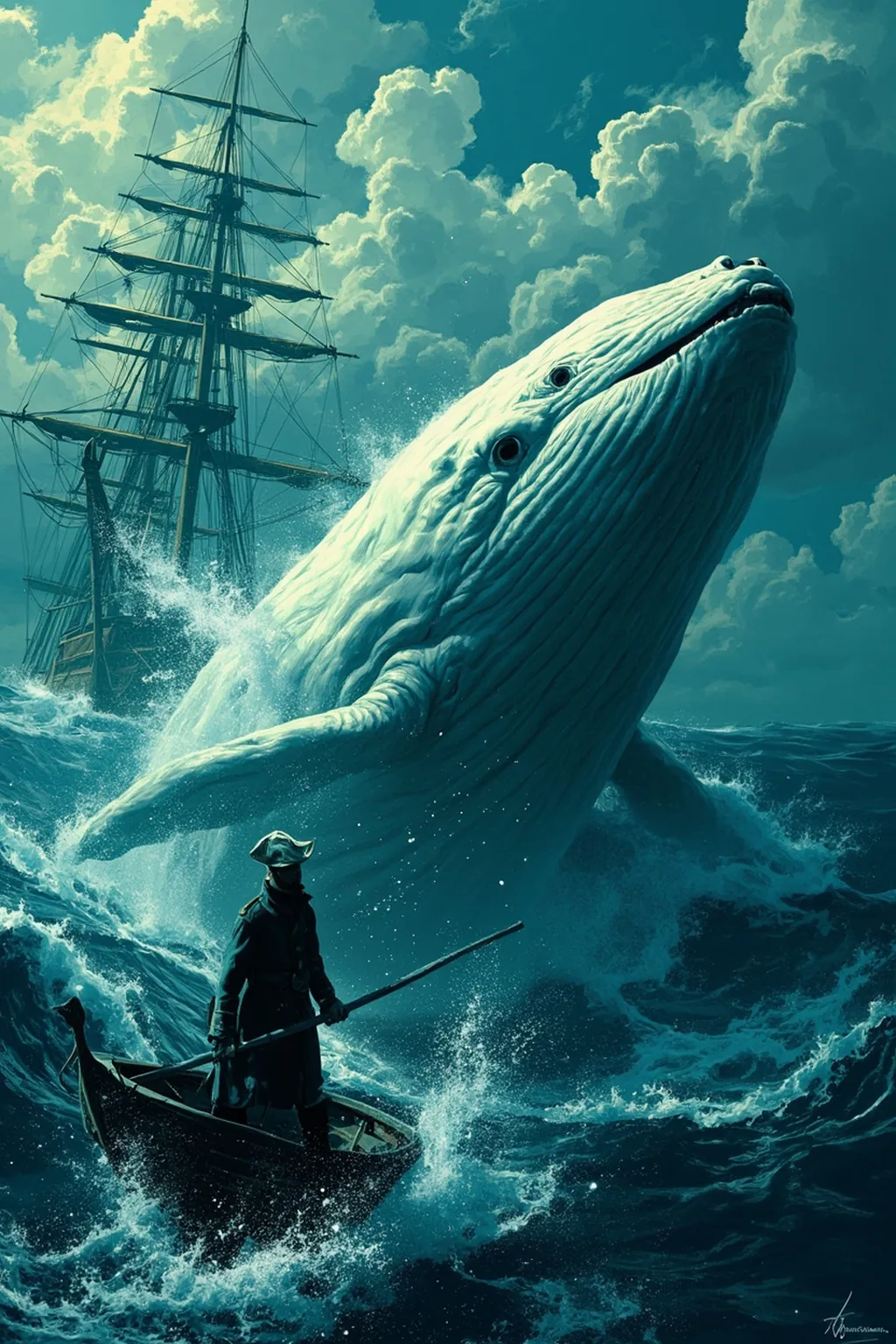
Ishmael Meets Captain Peleg
Ishmael Meets Captain Peleg Inside the queer wigwam-like tent, Ishmael finds an elderly seaman of authority, who is brown, brawny, and rolled up in blue Quaker-style pilot-cloth, with a fine net-work of wrinkles around his eyes from years of sailing hard gales and always looking to windward. Ishmael asks if this is the Captain of the Pequod. The man, Captain Peleg, demands to know what Ishmael wants. When Ishmael says he is thinking of shipping, Peleg questions him sharply—mocking his lack of whaling experience, sneering at the merchant service, and accusing him with half-humorous innuendo of being a pirate, a murderer of officers, and a stove-boat Nantucketer. Peleg reveals his insular, Quaker Nantucketer prejudice, distrustful of all aliens not from Cape Cod or the Vineyard. Peleg then quizzes Ishmael on his reasons for going a-whaling and tests his nerve, demanding to know if he would be the man to pitch a harpoon down a live whale’s throat and then jump after it. When Ishmael equivocates, Peleg sends him to the weather bow to report what he sees. Ishmael, determined, reports only water and monotonous horizon, and a possible squall. Peleg, in a strange challenge about whether the world can be seen from where one stands, presses him further. Ishmael, although staggered, stands firm in his resolve to go a-whaling, declares the Pequod as good a ship as any and the best, and expresses his determination to ship. Peleg, seeing him so decided, agrees to sign him on and leads the way below deck to the cabin to complete the paperwork.
Introduction to Captain Bildad
Introduction to Captain Bildad In the cabin, Ishmael finds Captain Bildad seated on the transom—a most uncommon and surprising figure. Along with Captain Peleg, Bildad is one of the largest owners of the Pequod; the remaining shares are held by a crowd of old annuitants, widows, fatherless children, and chancery wards, each owning only the value of a timber head, a foot of plank, or a couple of nails. Nantucketers commonly invest their money in whaling vessels as others invest in approved state stocks. Like Peleg, Bildad is a Quaker, the island of Nantucket having been originally settled by that sect, and its inhabitants still retain many Quaker peculiarities, though sometimes modified by alien and heterogeneous influences—some of these Quakers being the most sanguinary of sailors and whale-hunters, the so-called “fighting Quakers.” From a childhood steeped in the stately thee-and-thou Quaker idiom, combined with the audacious adventure of their whaling lives, these men develop bold and complex characters worthy of a Scandinavian sea-king or a poetical Pagan Roman, and when united with great natural force and a ponderous heart, shaped by long night-watches in remote waters, they produce a singular and tragically great type—a “mighty pageant creature, formed for noble tragedies.” Although such men may have a “half wilful overruling morbidness,” truly great men are made great through a certain morbidness, and all mortal greatness is but disease. Unlike Peleg, who cared nothing for serious things and deemed them trifles, Bildad was raised in the strictest sect of Nantucket Quakerism, and even after an ocean life and voyages round the Horn, not one jot of his Quakerism was altered. Yet despite his conscientious refusal to bear arms against land invaders, he himself had illimitably invaded the Atlantic and Pacific; and though a sworn foe to human bloodshed, he had in his straight-bodied coat spilled tuns of leviathan gore. How he reconciled these contradictions in his contemplative old age is unknown, but he seems to have concluded that a man’s religion is one thing and the practical world quite another. The world pays dividends. Bildad’s career was one of relentless progress: from cabin-boy in the drabbest clothes, to harpooneer in a broad shad-bellied waistcoat, to boat-header, chief-mate, captain, and finally ship owner. At the age of sixty, he wholly retired from active life to spend his remaining days quietly receiving his well-earned income. He carries a reputation, however, as an incorrigible old hunks and a hard task-master in his sea-going days. He never swore at his men, but worked them cruelly hard. As a chief-mate, his drab-colored eye staring at a sailor would make him nervous until he could clutch a hammer or marling-spike and go to work like mad. Indolence and idleness perished before him. His own person, gaunt and beardless with only a soft economical nap on his chin, was the embodiment of his utilitarian character.
The original text of this work is in the public domain. This page focuses on a guided summary article, reading notes, selected quotes, and visual learning materials for educational purposes.