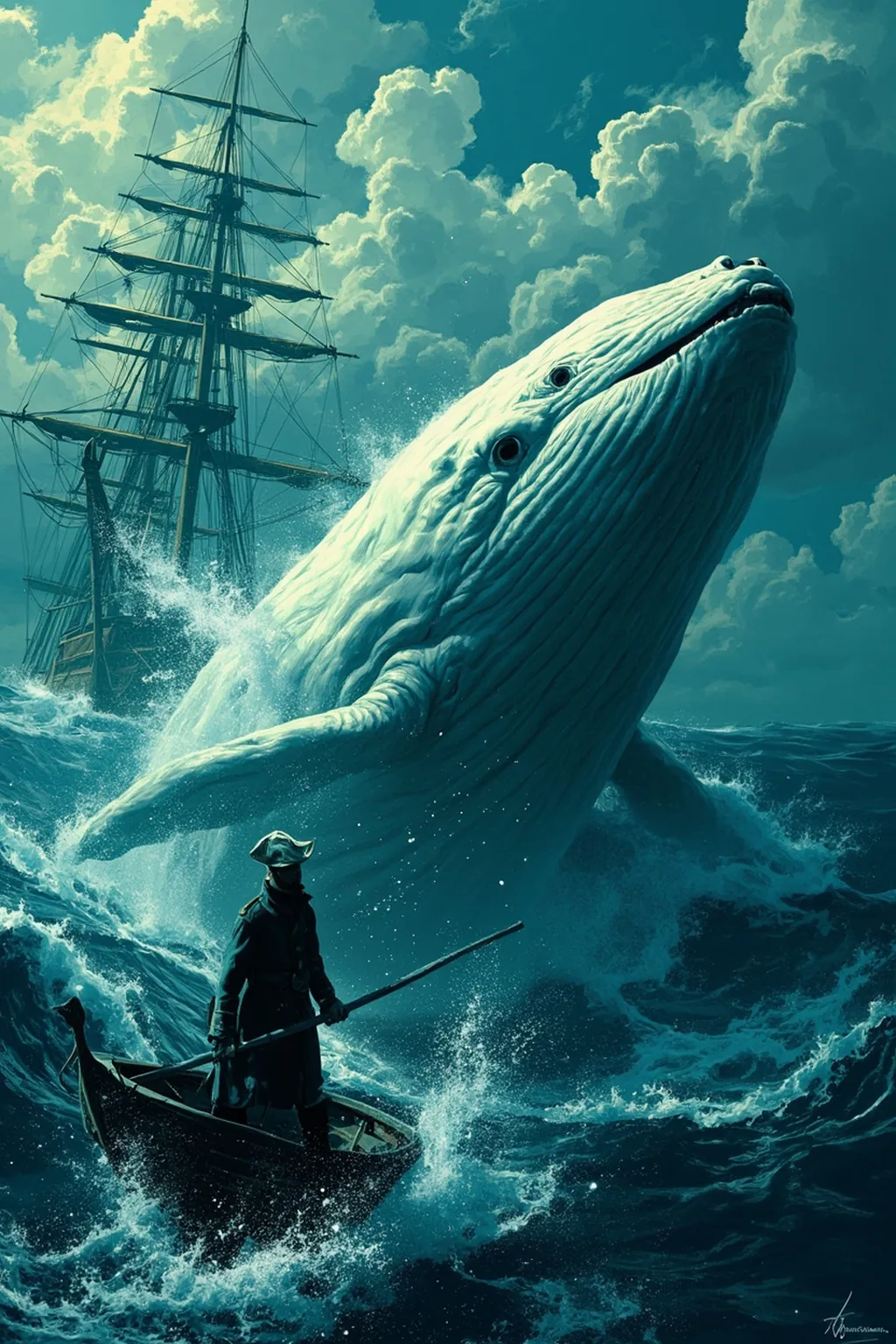
The Pasteboard Masks
When Starbuck objects that he came to hunt whales, not his commander’s vengeance, and questions what profit his vengeance will yield in the Nantucket market, Ahab dismisses monetary concerns. He explains that all visible objects are but pasteboard masks, and in each living act, some unknown but reasoning thing puts forth the mouldings of its features from behind the unreasoning mask. He compares himself to a prisoner who must thrust through the wall to reach outside, declaring the white whale is that wall shoved near him. He explains that what he chiefly hates is the inscrutable thing’s inscrutable malice sinewing the whale’s strength, whether the whale is agent or principal. He claims he would strike the sun if it insulted him, invoking a kind of fair play where jealousy presides over all creations. He tells Starbuck that what is said in heat, that thing unsays itself, and apologizes for the intensity of his words. He argues that the crew is with him in this matter, citing Stubb’s laughter and a Chilean seaman’s snorting approval. When Starbuck remains silent, Ahab interprets this as tacit acquiescence, whispering aside that Starbuck now is his and cannot oppose him without rebellion.
The Grog Ritual
Ahab calls for the great measure of grog. After receiving the brimming pewter, he orders the harpooneers to produce their weapons. He ranges them before him near the capstan with harpoons in hand, while his three mates stand at his side with lances and the rest of the crew forms a circle. He searches the faces of every man, comparing their wild eyes to prairie wolves meeting their leader’s eye before rushing on a bison. He commands them to drink and pass the heavy flagon, emphasizing short draughts and long swallows as the hot rum “spiralizes” through them and “forks out at the serpent-snapping eye.” He refills the pewter and addresses his “braves,” explaining he has mustered them to revive a noble custom of his fisherman fathers.
The Harpoon Pledge
Ahab orders the mates to cross their lances full before him, then grasps the three radiating lances at their crossed center while twitching them nervously, attempting through some nameless interior volition to shock them with the same fiery emotion accumulated within him. The three mates quail before his strong, sustained, mystic aspect—Stubb and Flask look sideways while Starbuck’s honest eye falls downright. Ahab appoints the three mates as cupbearers to the three harpooneers, invoking the Pope washing beggars’ feet with his tiara. The harpooneers silently obey and stand with the detached iron parts of their harpoons, barbs up. Ahab fills the harpoon sockets with the grog, comparing it to a murderous chalice. He commands the harpooneers to drink and swear, addressing them as men who man the deathful whaleboat’s bow: “Death to Moby Dick! God hunt us all, if we do not hunt Moby Dick to his death!” The long barbed steel goblets are lifted, and to cries and maledictions against the white whale, the spirits are quaffed down with a hiss. Starbuck pales, turns, and shivers.
The Dispersal
The replenished pewter goes the rounds once more among the frantic crew. Ahab waves his free hand, and they all disperse. He retires within his cabin. The narrative reflects on the admonitions and warnings that failed to stay when they came—perhaps predictions rather than warnings—and notes that with little external to constrain us, the innermost necessities in our being drive us on.
KAPITEL 37. Sunset.
This brief chapter presents a single dramatic scene: Ahab alone in the stern cabin, gazing through the windows as the sun sets. The chapter consists almost entirely of Ahab’s extended monologue, revealing his tortured inner state and defiant philosophy.
Ahab Alone at the Stern Cabin Window
Ahab sits in solitude, his attention fixed on the ocean beyond the stern windows. He speaks of the white, turbid wake trailing behind his vessel—pale waters and paler cheeks wherever he sails. With characteristic contempt, he dismisses the envious billows that swell to whelm his track, insisting he will pass first. The imagery establishes Ahab as a figure moving through the world leaving a trail of devastation in his wake.
The original text of this work is in the public domain. This page focuses on a guided summary article, reading notes, selected quotes, and visual learning materials for educational purposes.