Indigenous Settlement Legend
The chapter presents a traditional story explaining how the island was first settled by Native Americans. According to the legend, an eagle once swooped down upon the New England coast and carried off an infant Indian in its talons. The parents watched with loud lament as their child was borne out of sight over the wide waters, and they resolved to follow in the same direction. After a perilous passage in their canoes, they discovered the island and found an empty ivory casket—the poor little Indian’s skeleton. This legend provides a mythological foundation for the island’s human history.
Maritime Livelihood Progression
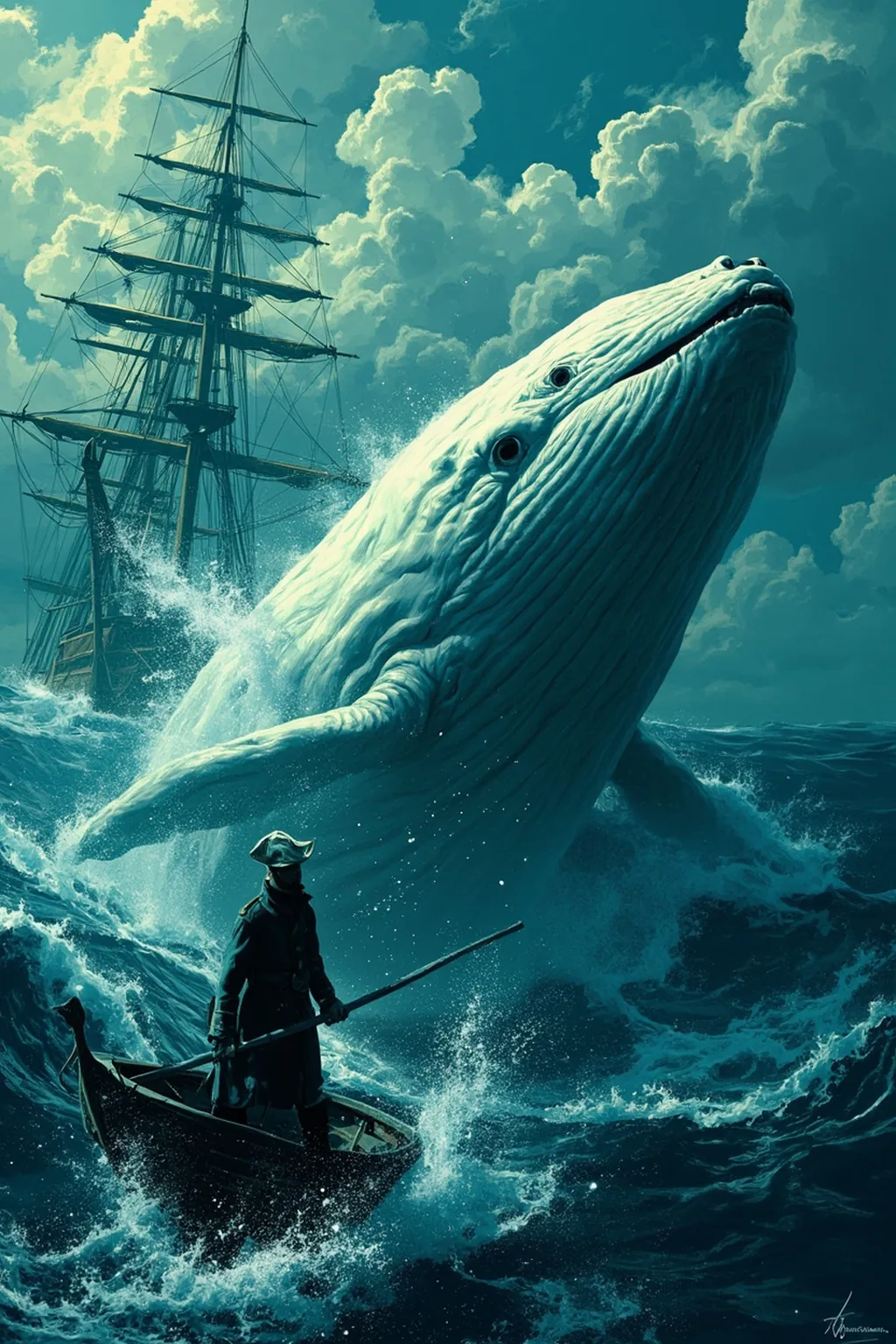
The narrative traces the evolution of Nantucket’s economy from modest beginnings to industrial-scale whaling. The inhabitants, born on a beach, naturally took to the sea for a livelihood. They began by catching crabs and quohogs in the sand, then grew bolder and waded out with nets for mackerel. With increasing experience, they pushed off in boats to capture cod. Eventually, they launched a navy of great ships to explore the watery world, creating an uninterrupted belt of circumnavigations, peeking in at Behring’s Straits, and declaring everlasting war against the mightiest animated mass that survived the flood—the monstrous and mountainous sperm whale. This progression illustrates how the Nantucketers developed from simple shore-based fishing to becoming masters of the whale fishery.
Nantucketers’ Sea-Dwelling Identity
The chapter celebrates the unique relationship between Nantucketers and the ocean. Described as naked sea hermits, they issued from their ant-hill in the sea to overrun and conquer the watery world like Alexanders, parceling out the Atlantic, Pacific, and Indian oceans among themselves. The narrator emphasizes that the sea belongs to the Nantucketer as empires belong to Emperors, with other seamen having only a right of way through it. Merchant ships are compared to extension bridges and armed ones to floating forts, while even pirates merely plunder other ships without drawing sustenance from the bottomless deep. The Nantucketer alone resides and riots on the sea, going down to it in ships as his special plantation. He lives on the sea as prairie cocks live in the prairie, hides among waves like chamois hunters climbing the Alps, and knows the land so little that upon returning, it smells like another world. Like the landless gull rocked to sleep between billows, the Nantucketer at nightfall furls his sails and rests while walruses and whales rush beneath his pillow.
CAPÍTULO 15. Chowder.
The chapter follows the narrator and Queequeg as they arrive late in the evening at Nantucket, seeking lodging and a meal. They have been directed to the Try Pots Inn by the landlord of the Spouter-Inn, who praised his cousin Hosea Hussey’s establishment and particularly recommended the house chowders.
Arrival and Directions to the Try Pots Inn
After the Moss anchors, the narrator and Queequeg go ashore too late for any business that day, needing only supper and a bed. Peter Coffin gave them complicated directions involving a yellow warehouse to keep on the starboard hand until they sighted a white church to larboard, then navigating a corner three points to starboard, and finally asking the first person they met. Queequeg disputes the original instructions, insisting the yellow warehouse—their first landmark—should be left on the larboard rather than starboard. The two wander in darkness, occasionally waking locals for directions, until they successfully locate the inn.
Try Pots Inn Sign and Narrator’s Unease
The inn’s sign features two enormous black wooden pots hung from the cross-trees of an old top-mast planted before the doorway. The narrator finds the structure ominously resembling a gallows with two horns, and he cannot help staring with a vague misgiving. His overactive imagination interprets the sign as foreboding death: the two horns seem meant for both him and Queequeg. He reflects on the series of ominous signs encountered since landing at the whaling port—the Coffin who runs his inn, the tombstones at the whalemen’s chapel—and now this gallows-like structure with its black pots, wondering if they hint at damnation.
The original text of this work is in the public domain. This page focuses on a guided summary article, reading notes, selected quotes, and visual learning materials for educational purposes.