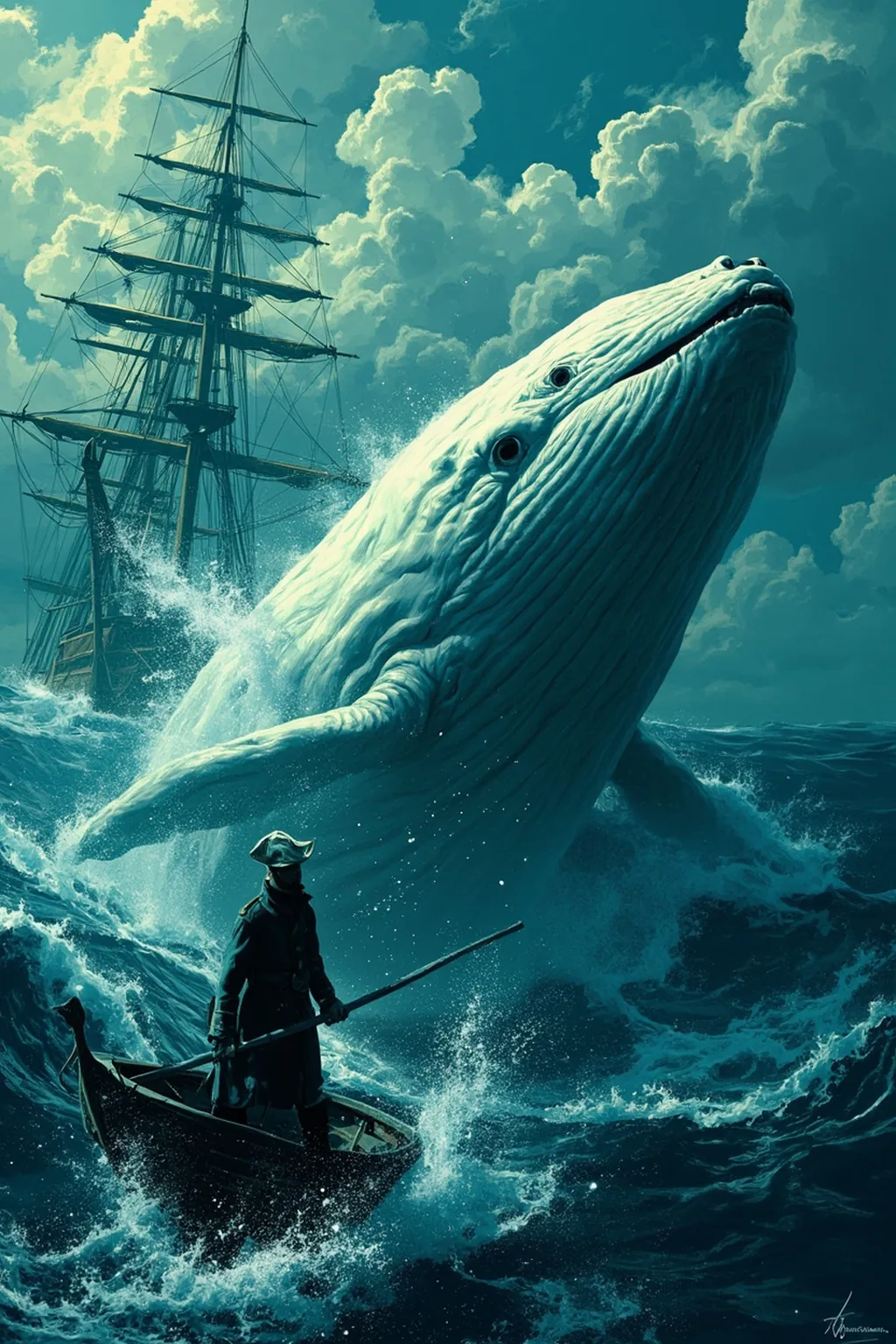
Southern Seas Solitude
While southern whale-fishers lack the crow’s-nest comfort of Arctic whalers, the narrator suggests this disadvantage is offset by the serenity of tropical seas. He describes his leisurely ascent up the rigging, pausing in the top to chat with Queequeg, then climbing further to rest his leg over the topsail yard for a preliminary survey before reaching his ultimate destination at the mast-head.
The Dreamy Lookout
The narrator makes a frank admission: he kept “but sorry guard” at the mast-head. With “the problem of the universe revolving” in his mind at such a thought-engendering altitude, he could not take seriously the standing orders to watch for whales. He reflects on how the dreamy young philosophers often found aboard whaling ships become lost in reverie, merging with the infinite sea. They begin to see the ocean as “the visible image of that deep, blue, bottomless soul, pervading mankind and nature.” Strange fins and gliding forms become “the embodiment of those elusive thoughts that only people the soul by continually flitting through it.” In this enchanted state, one’s spirit “ebbs away to whence it came” and becomes “diffused through time and space,” like Cranmer’s “sprinkled Pantheistic ashes.”
Warning to Ship-Owners
The narrator admonishes Nantucket ship-owners to beware of enlisting “any lad with lean brow and hollow eye” given to unseasonable meditativeness—those who carry Plato’s philosophy rather than practical navigation (Bowditch’s manual) in their heads. These “sunken-eyed young Platonists” will tow the ship “ten wakes round the world, and never make you one pint of sperm the richer.” The narrator observes that the whale-fishery has become “an asylum for many romantic, melancholy, and absent-minded young men” seeking sentiment “in tar and blubber.” These Childe Harold-like figures perch upon mast-heads and ejaculate romantic poetry about the ocean, yet captains’ reprimands about their lack of interest go unheeded. The dreamy look-outs explain their failure to spot whales through a philosophical short-sightedness—“what use, then, to strain the visual nerve?”—having left their opera-glasses at home.
The Pantheist’s Peril
The narrator warns that while absorbed in this dreamy, pantheistic state, one exists only through the rocking life of the ship, borrowed from the sea, which itself borrows from “the inscrutable tides of God.” Yet this dreamy state carries mortal danger: any movement or slip of the hand, any loss of one’s grip, brings “your identity comes back in horror” as one hovers “over Descartian vortices.” Perhaps at mid-day in fair weather, a half-throttled shriek accompanies the drop through “that transparent air into the summer sea,” never to rise again. The narrator concludes with urgent admonition: “Heed it well, ye Pantheists!”
CAPÍTULO 36. The Quarter-Deck.
This chapter depicts one of the most pivotal scenes in Moby-Dick, as Captain Ahab summons the entire crew to the quarter-deck to reveal his singular obsession with hunting the white whale and binds them to his vendetta through ritual and gold. The chapter moves from Ahab’s brooding entrance through his interrogation of the crew, his revelation of Moby Dick’s identity, his philosophical defense of vengeance, and culminates in an oath-taking ceremony that seals the ship’s fate. Through Ahab’s magnetic leadership and the crew’s eager complicity, Melville explores themes of obsession, fate, free will, and the dangerous dynamics of collective purpose.
The Quarter-Deck
Ahab ascends from his cabin after breakfast, resuming his habitual morning routine of pacing the deck—similar to how country gentlemen walk in their gardens after meals. He walks with the steady stride of a sea captain, his movements now charged with an intensity that signals the weight of his inner thoughts. Stubb comments to Flask that something significant is developing within Ahab, suggesting the “chick” of his purpose is about to break from its shell. Throughout the day, Ahab alternates between isolation in his cabin and pacing the deck, his face bearing the expression of someone on the verge of a storm.
The Ivory Stride
Ahab’s familiar footsteps have worn permanent dents into the deck planks, so thoroughly has he walked these boards. His pace leaves marks like geological stones, evidence of his constant movement. More significantly, his face shows the marks of his one unsleeping thought—his relentless obsession with the white whale—that has shaped every feature and movement. The dents in the deck deepen as his nervous step that morning leaves a more pronounced mark than usual, indicating that something is coming to a head.
The original text of this work is in the public domain. This page focuses on a guided summary article, reading notes, selected quotes, and visual learning materials for educational purposes.