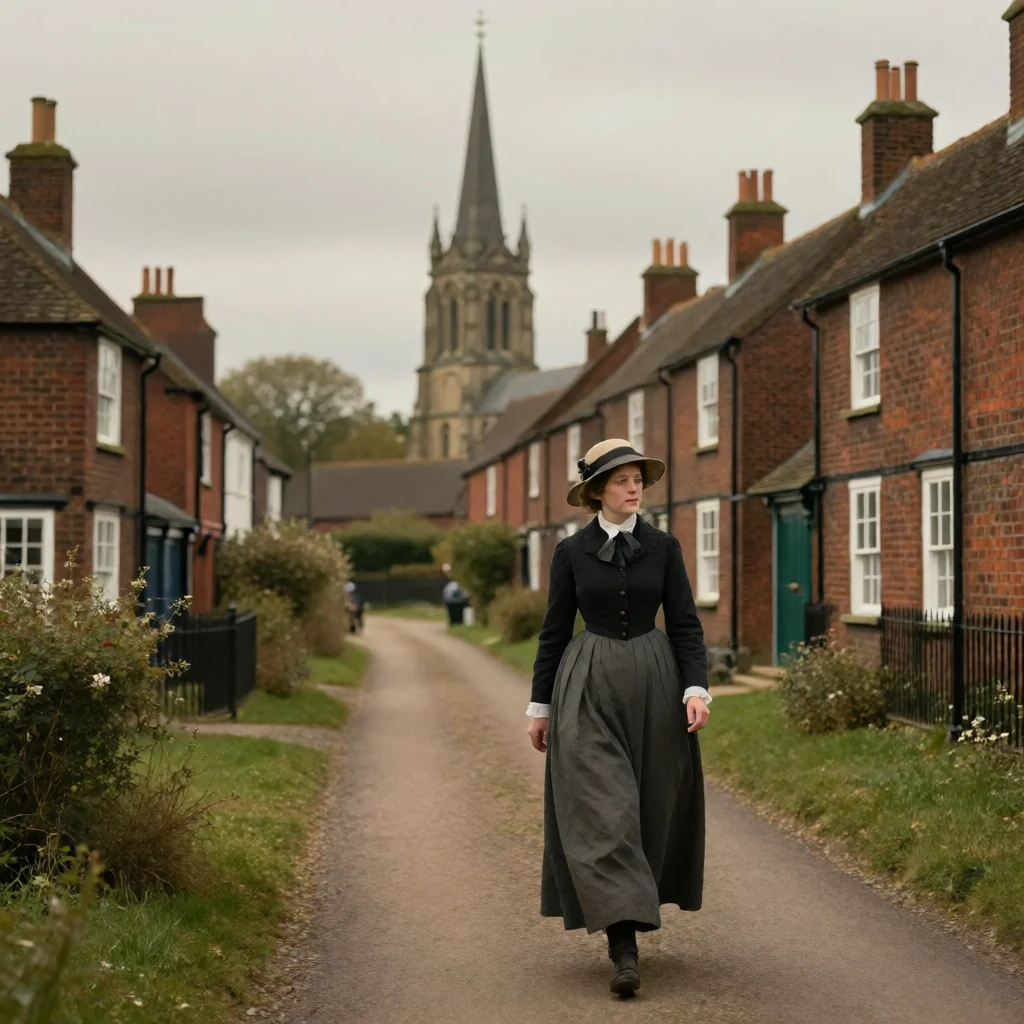
Courtship Illusions vs. Marital Reality
The narrator observes that a fellow-mortal known only through the brief imaginative weeks of courtship may, when seen in married companionship, be disclosed as something better or worse than preconceived, but will certainly not appear altogether the same. During courtship everything is regarded as provisional, and the smallest sample of virtue is taken to guarantee delightful stores that broad leisure will reveal, but once the door-sill of marriage is crossed, expectation concentrates on the present and one discovers oneself exploring an enclosed basin rather than an open sea.
Mr. Casaubon’s Emotionally Distant Academic Demeanor
When Mr. Casaubon asks whether this or that sight interests her and offers to stay, it seems to Dorothea as if going or staying were alike dreary. His measured, official answers about Raphael’s frescos at the Farnesina—spoken like a clergyman reading according to the rubric—do not help to justify the glories of the Eternal City. Eliot observes that there is hardly any contact more depressing to a young ardent creature than a mind in which years full of knowledge seem to have issued in a blank absence of interest or sympathy.
Dorothea’s Growing Disillusionment with Her Husband
Dorothea is gradually ceasing to expect with her former delightful confidence that she should see any wide opening where she followed her husband. Poor Mr. Casaubon himself is lost among small closets and winding stairs, and in agitated dimness about the Cabeiri or other mythologists’ parallels, easily loses sight of any prompting purpose. With his taper stuck before him he has forgotten the absence of windows, and in bitter manuscript remarks on other men’s notions about solar deities, he has become indifferent to the sunlight, his characteristics fixed and unchangeable as bone.
Strained Pre-Departure Breakfast Exchange
At a strained breakfast before their departure, Dorothea tries to shake off what she inwardly calls her selfishness and turns a face of cheerful attention to her husband. Mr. Casaubon, blinking and swaying his head, pronounces a little speech conscious of Rome as one of the most striking sights of Europe, recalls his own first visit after the fall of Napoleon, and proposes the emendation “See Rome as a bride, and live henceforth as a happy wife.” Dorothea, trying to keep her mind fixed on what most affects her husband, responds that she hopes he is thoroughly satisfied with their stay so far as his studies are concerned.
CHAPITRE XX.
This chapter tracks the interactions of newlywed Dorothea and Mr. Casaubon during their wedding trip in Rome, opening with Casaubon sharing updates on his expanded annotation work, Dorothea’s earnest but misinterpreted request that he publish his long-planned scholarly book, the eruption of their first mutual anger at one another, their stiff, awkward outing to the Vatican in the wake of the fight, and Dorothea’s quiet, pensive reflection on her ideals amid the unexpected strain of their early marriage.
Casaubon Discusses Annotation Work and Dorothea’s Influence
Mr. Casaubon tells Dorothea that his annotation work has expanded further than he initially anticipated, with numerous unplanned subjects requiring his attention. He notes that while the work is laborious even with his amanuensis’s help, Dorothea’s presence has successfully prevented him from overextending his study hours to the point of mental exhaustion that was a constant risk during his solitary life.
Dorothea Urges Casaubon to Publish His Research
Dorothea expresses hope that she will be far more useful to Casaubon once they settle at Lowick, and earnestly urges him to move past compiling rows of notes to write and publish the book that will make his vast scholarly knowledge accessible to the wider world. She offers to assist with any part of the process, from taking dictation to copying and extracting materials, and ends her appeal with a quiet sob and tears of earnest frustration.
Casaubon’s Irritated Defense of His Scholarly Process
Casaubon reacts to Dorothea’s request with sharp, unusual irritation, delivering an impassioned defense of his slow, scrupulous scholarly process. He frames impatient demands for quick, public output as the unfair criticism of ignorant, unqualified onlookers who cannot comprehend the depth of work required for his research, and misreads Dorothea’s earnest desire to support him as the judgment of the shallow, unsympathetic world that has always surrounded his work. This is the first time Dorothea has seen him visibly angry, with a quick flush coloring his face.
The original text of this work is in the public domain. This page focuses on a guided summary article, reading notes, selected quotes, and visual learning materials for educational purposes.