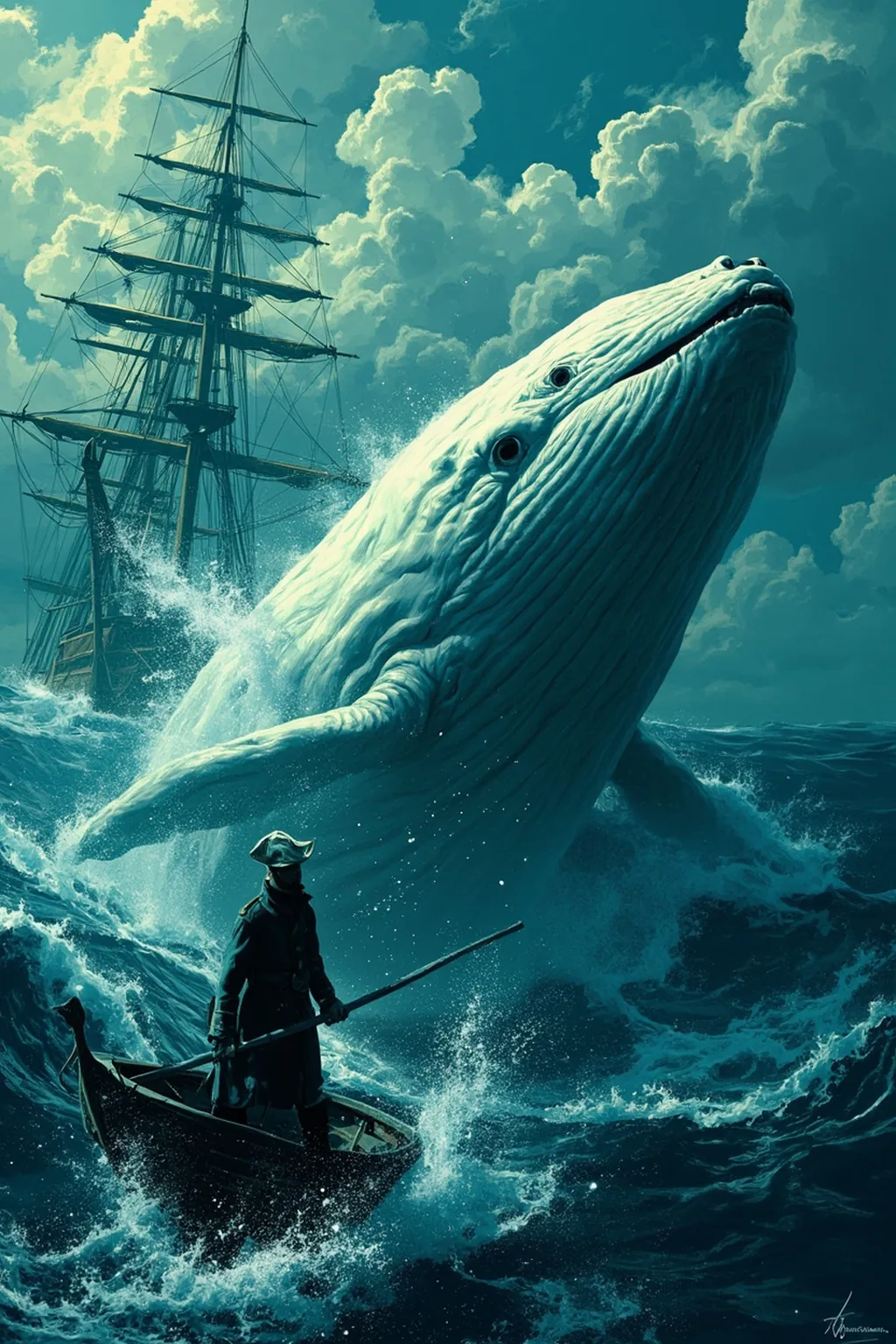
Pitchpoling
Faced with an accelerating whale that cannot be overtaken, the crew must rely on the advanced technique of pitchpoling to strike with the lance from a moving boat at a great distance.
The Pitchpoling Maneuver
Pitchpoling is the art of accurately throwing a long lance from a violently rocking and jerking boat under extreme headway. The lance, made of light pine and spanning ten to twelve feet, is attached to a long rope called a warp so it can be retrieved after the throw.
Lance vs Harpoon
Although a harpoon can be pitchpoled, it is rarely done because it is heavier and shorter than the lance, making it less effective for the distance and accuracy required. Typically, a harpoon must first be planted to anchor the whale before pitchpoling can occur.
Stubb’s Dexterity
Stubb is singled out as the perfect candidate for pitchpoling due to his characteristic humor, deliberate coolness, and equanimity, which allow him to remain steady in the most dire emergencies.
The Juggler Analogy
Before throwing the weapon, Stubb balances the long lance vertically on his palm, fifteen feet high. The image of him poised in the tossing bow, holding the spear aloft, is likened to a juggler balancing a staff on his chin.
The Strike
With a swift, nameless impulse, Stubb hurls the lance in a superb, lofty arch. The bright steel flies across the foaming distance and strikes the vital spot of the whale, causing it to spout red blood.
Stubb’s Exclamation
Reacting to the fatal blow, Stubb cries out boisterously, joking that he has “driven the spigot out” of the whale, and declares that today all fountains must run wine, wishing he had whiskey to catch in the spout.
The Whale’s Death
Stubb continues to throw the lance repeatedly, each time retrieving it like a greyhound. The whale enters its final flurry, and as the tow-line slackens, the boat drops back, allowing the crew to stand by and silently watch the monster die.
CAPÍTULO 85. The Fountain.
This chapter examines a millennia-old puzzle: despite six thousand years of whales spouting across the seas and centuries of hunters watching them up close, it remains uncertain whether whale spouts are truly water or merely vapor.
Millennia-Long Whale Spout Mystery
For over six thousand years, whales have been spouting and “sprinkling the gardens of the deep,” yet despite thousands of hunters observing the fountain of the whale at close range, the fundamental question of whether these spoutings are water or vapor remains unresolved as of December 1851. The author calls this a noteworthy paradox.
Whale Respiratory Anatomy and Surfacing Necessity
Unlike fish that breathe dissolved air through their gills and can live indefinitely underwater, whales possess lungs like humans and must inhale disengaged air from the open atmosphere, requiring periodic visits to the surface. The sperm whale cannot breathe through its mouth, which lies buried at least eight feet beneath the surface, and its windpipe has no connection to its mouth. The whale breathes exclusively through its spiracle on top of the head.
Whale Extended Breath-Holding Capacity
While humans must breathe every two or three heartbeats, sperm whales breathe only about one-seventh of their time. Whales possess a complex labyrinth of vermicelli-like vessels between their ribs and along the spine that store oxygenated blood when at the surface, allowing them to remain submerged for an hour or more at depths of a thousand fathoms without drawing a single breath. This functions like a camel’s stored water supply for desert crossing.
Sperm Whale Consistent Spouting Patterns
When unmolested, sperm whales surface for exactly uniform periods and complete exactly the same number of breaths each time—say, seventy breaths over eleven minutes. If disturbed before finishing their quota, the whale will dodge back up to complete the full number of breaths before finally descending for good. This methodical behavior reveals the whale is systematically replenishing its air reservoir before deep dives, and this necessity to surface exposes the whale to all the fatal hazards of the chase.
The original text of this work is in the public domain. This page focuses on a guided summary article, reading notes, selected quotes, and visual learning materials for educational purposes.