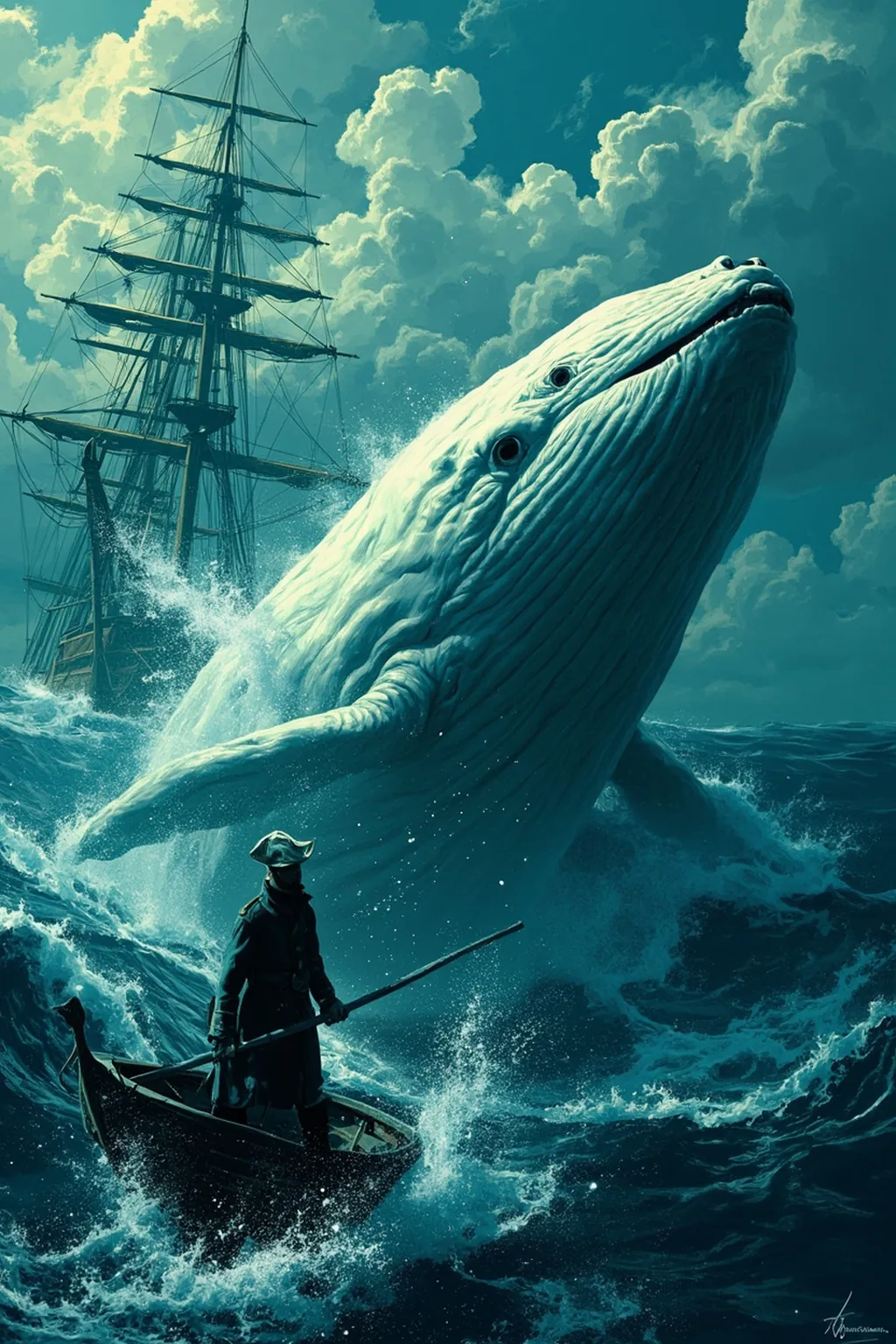
Queequeg’s Gifts, Shared Worship, and the Honeymoon Chat
After supper and an additional chat and smoke, the pair returns to their room. Queequeg gives Ishmael his embalmed head as a gift, then pulls thirty dollars in silver from his enormous tobacco wallet, splits it into two equal piles, and pushes one pile to Ishmael, pouring the coins into his pockets when Ishmael tries to protest. He then prepares for his evening idol worship, and invites Ishmael to join; Ishmael reasons that true worship is doing the will of God, which means treating one’s fellow man as one wishes to be treated, so he agrees to participate in Queequeg’s ritual. After the worship, they undress and get into bed, where they share intimate, confidential conversation late into the night like a newly married couple on their honeymoon.
CAPÍTULO 11. Nightgown.
The chapter depicts an intimate scene between the narrator and Queequeg in bed together, transitioning from dozing to full wakefulness. The two men lie sociably, with Queequeg occasionally throwing his tattooed legs over the narrator’s and then drawing them back. The narrator reflects on the nature of comfort and contrast, noting that true bodily warmth requires some part of you to be cold. The chapter concludes with Queequeg beginning to recount his native island origins while they share a pipe by lamplight.
Bedside Warmth and the Philosophy of Contrasting Comfort
The narrator argues that nothing exists in itself and can only be understood through contrast. True comfort requires some discomfort—specifically, being slightly chilled in one area to fully appreciate warmth elsewhere. He criticizes the wealthy for having fire in their bedrooms, claiming it undermines genuine coziness. The narrator describes the ideal scenario as lying in bed with only a blanket between oneself and the cold air, comparing it to being “the one warm spark in the heart of an arctic crystal.” The men sit crouching together with knees drawn up, noses bending over them like warming-pans.
Lighting the Lamp and Shared Pipe Comfort
Upon opening his eyes after deliberately keeping them closed to preserve the snugness of bed, the narrator experiences a “disagreeable revulsion” at the coarse outer darkness. Although he had previously resisted Queequeg smoking in bed, his prejudices have softened through their growing friendship. Now he welcomes Queequeg’s pipe, appreciating the “condensed confidential comfortableness of sharing a pipe and a blanket with a real friend.” They pass the Tomahawk pipe between them while wrapped in shaggy jackets, creating a blue canopy of smoke illuminated by the newly lit lamp.
Queequeg Begins Recounting His Island Origins
The narrator suspects the undulating smoke tester may have stirred Queequeg’s memories, prompting him to speak of his native island. Eager to hear his history, the narrator requests that Queequeg continue his tale. Though the narrator admits he initially struggled to comprehend much of Queequeg’s broken English, later familiarity with his speech patterns allows him to later reconstruct and present the story.
CAPÍTULO 12. Biographical.
This chapter provides the narrator’s biographical account of Queequeg, his harpooneer, chronicling the man’s noble origins on a remote island and his journey toward the Western world. The chapter explores themes of cultural exchange, disillusionment with civilization, and the deep friendship forming between the narrator and his exotic shipmate.
Queequeg’s Island Origins and Noble Lineage
Queequeg hails from the island of Rokovoko, an unmapped place that exists “not down in any map; true places never are.” Born the son of a High Chief and King, with an uncle who was a High Priest and aunts married to unconquerable warriors, Queequeg possesses excellent royal blood in his veins. However, his lineage is noted to include a cannibal propensity that was nurtured during his untutored youth. From childhood—described as a “new-hatched savage running wild about his native woodlands in a grass clout” followed by nibbling goats—Queequeg harbored an ambitious desire to see more of Christendom beyond merely observing passing whalers.
Journey to Join the Sag Harbor Whaling Ship
When a Sag Harbor ship visited his father’s bay, Queequeg sought passage to Christian lands. Despite his father’s royal influence, the ship rejected him due to having its full complement of seamen. Undeterred, Queequeg made a bold vow: he paddled his canoe alone to a distant strait where the ship would have to pass upon leaving. There he hid among mangrove thickets with his canoe prow seaward, and when the vessel glided by, he darted out, capsized and sank his own canoe, climbed the chains, threw himself upon the deck, and grappled a ring-bolt—swearing not to let go even if cut to pieces. After the captain threatened him with a cutlass, he relented at the sight of Queequeg’s desperate dauntlessness.
The original text of this work is in the public domain. This page focuses on a guided summary article, reading notes, selected quotes, and visual learning materials for educational purposes.