Spotting the Goney (Albatross) Off the Crozetts
Southeast of the Cape, off the distant Crozettes—a prime cruising ground for Right Whalemen—the lookout spots another vessel, the Goney (Albatross). From the narrator’s elevated position at the fore-mast-head, a clear view emerges of a sight remarkable to anyone new to distant ocean fisheries: a whaler at sea, long absent from home. This encounter presents the familiar yet haunting scene of a fellow whaling vessel plying the remote waters.
Weathered Albatross Whaler Description
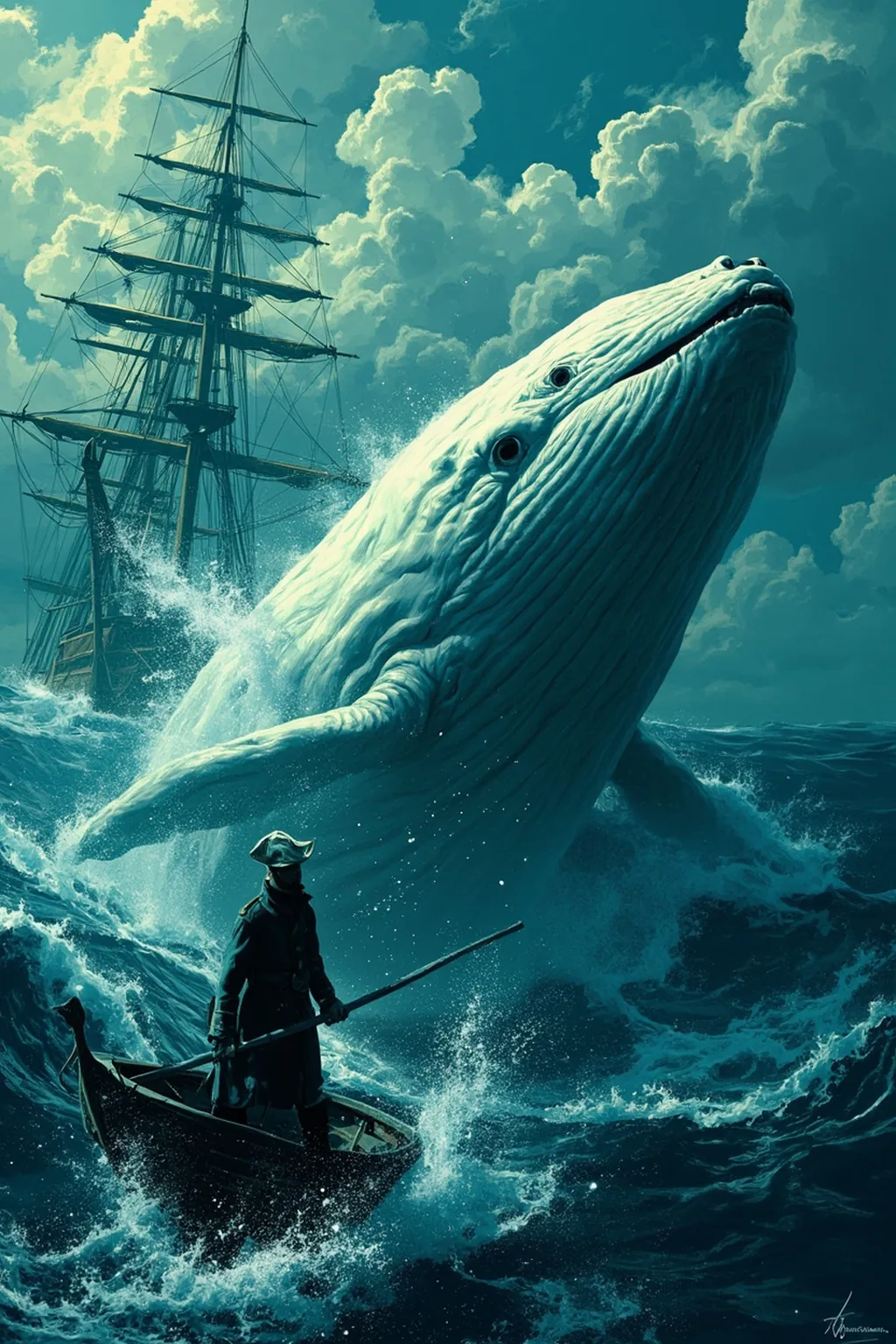
The Goney presents a spectral appearance, bleached and weathered as if the waves themselves had acted as fullers. Her hull resembles the skeleton of a stranded walrus, traced with long channels of reddened rust. Her spars and rigging appear as thick branches furred over with hoar-frost. Only her lower sails are set. The three look-outs at her mast-heads, with their long beards, seem clad in beast skins—their garments torn and patched from nearly four years of continuous cruising. They stand in iron hoops nailed to the mast, swaying over the fathomless sea, presenting a wild and weathered sight.
Silent Encounter With the Distant Whaler
The two ships glide close under each other’s stern, bringing the six men in the air so near that they might almost leap from one vessel’s mast-heads to another’s. Yet despite this proximity, the forlorn-looking fishermen on the Goney mildly eye the Pequod’s crew without exchanging a single word. Even as the quarter-deck hail from below is being heard, the strange vessel’s crew remains completely silent.
Pequod’s Hail for the White Whale
The Pequod initiates contact with the traditional maritime hail: “Ship ahoy! Have ye seen the White Whale?” This direct question about Moby Dick represents the Pequod’s singular mission, seeking any information about the white whale that has consumed Ahab’s obsession.
Ahab’s Trumpet Falls Into the Sea
As the strange captain leans over the pallid bulwarks and moves to answer, his trumpet falls from his hand into the sea. The rising wind prevents him from making himself heard without this device. Despite his efforts, he cannot communicate, and his ship continues to increase the distance between the vessels. The seamen of the Pequod silently note this ominous incident occurring at the mere mention of the White Whale’s name, interpreting it as a significant sign.
Ahab Hails the Nantucketer Stranger
Taking advantage of his windward position, Ahab seizes his own trumpet. Recognizing by her appearance that the stranger vessel is a Nantucketer bound for home, he delivers his own hail: announcing the Pequod as bound round the world and instructing that all future letters be addressed to the Pacific Ocean, with instructions to redirect correspondence to this location should he not return within three years.
Shoals of Fish Flee to the Stranger Vessel
As the two wakes cross, small harmless fish that had been placidly swimming alongside the Pequod suddenly dart away with shuddering fins. They range themselves fore and aft along the stranger’s flanks, departing from Ahab’s vessel. While Ahab must have witnessed similar occurrences during his continual voyagings, to his monomaniacal mind, even the veriest trifles carry deep and capricious meanings.
Ahab’s Somber Murmur and Helm Command
Gazing over into the water at the departing fish, Ahab murmurs “Swim away from me, do ye?” The tone of this remark conveys more deep, helpless sadness than the insane old man has ever before displayed. Then, returning to command mode, he cries out to the steersman in his old lion voice, ordering the helm brought up to keep the ship on its course round the world.
Reflection on Circumnavigation Perils
The command to sail round the world evokes complex feelings. While the phrase inspires proud emotions, the narrator questions where such circumnavigation ultimately leads—only through numberless perils back to the very point of departure, where those left behind were all the time secure and before us. Were the world an endless plain with new discoveries awaiting eastward exploration, there would be genuine promise. However, in pursuit of far mysteries or the demon phantom swimming before all human hearts, chasing such goals over this round globe either leads seekers through barren mazes or leaves them whelmed midway.
The original text of this work is in the public domain. This page focuses on a guided summary article, reading notes, selected quotes, and visual learning materials for educational purposes.