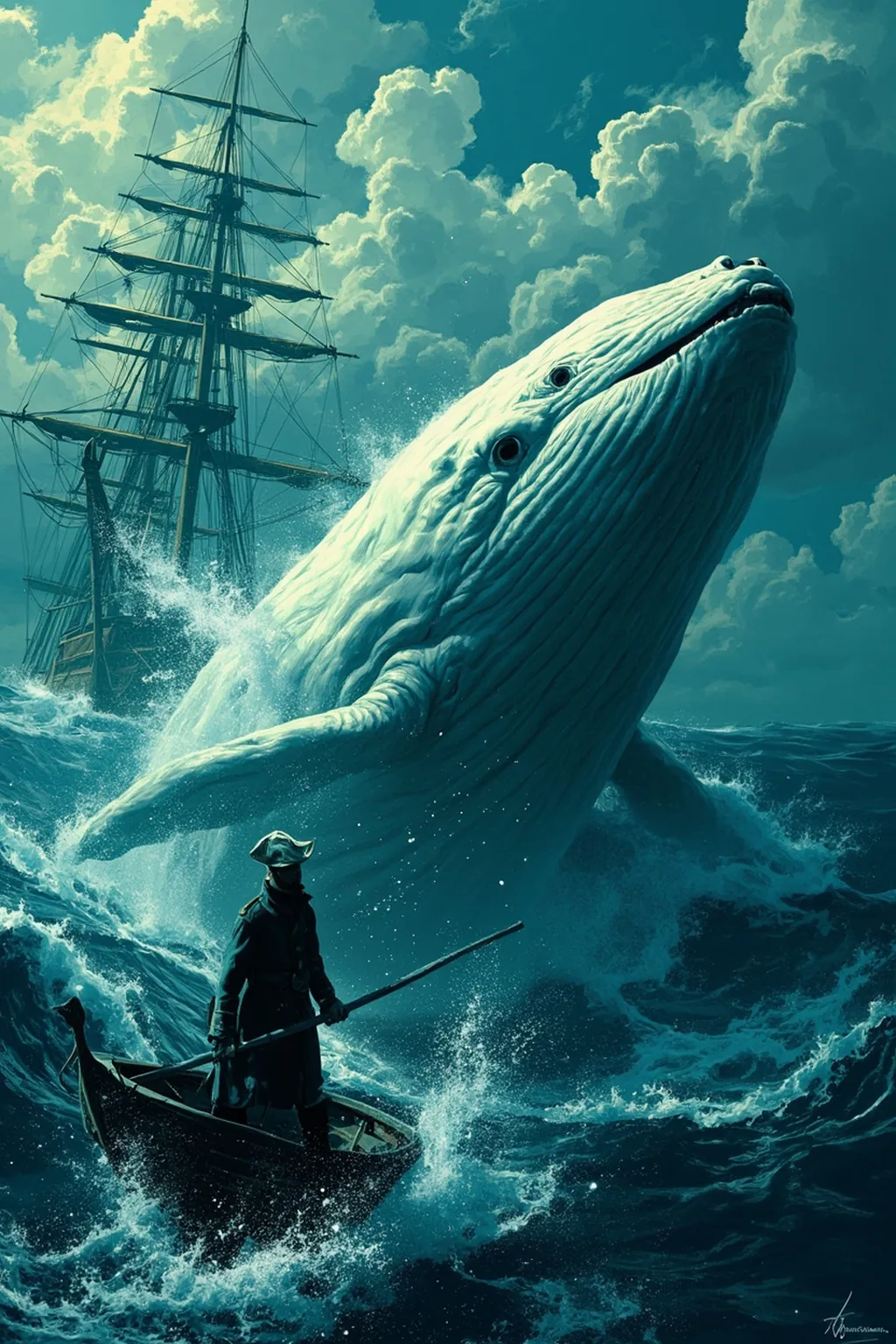
Starbuck Reacts to the Giant Squid Sighting
As the creature disappears again with a low sucking sound, Starbuck still gazes at the agitated waters where it sank. With a wild voice he exclaims, “Almost rather had I seen Moby Dick and fought him, than to have seen thee, thou white ghost!” When Flask asks what it was, Starbuck identifies it as the great live squid, which few whale-ships ever beheld and returned to tell of.
Crew Identifies Creature as Rare Giant Squid
The crew confirms Starbuck’s identification of the creature as the rare giant squid that few whale-ships have ever beheld and lived to tell of. This extraordinary sighting represents one of the most unusual encounters possible in the sperm whale fishery.
Ahab Silently Returns to the Pequod
Upon identifying the creature, Ahab says nothing. He turns his boat and sails back to the vessel, with the rest of the boats following silently.
Sperm Whalemen’s Superstitions Surrounding Squid Sightings
The source text explains that whatever superstitions sperm whalemen in general connect with the sight of this object, certain it is that the unusualness of such a glimpse has gone far to invest it with portentousness. So rarely is it beheld that, though one and all declare it to be the largest animated thing in the ocean, very few have any but the most vague ideas concerning its true nature and form.
Belief Squid Is Sperm Whales’ Primary Food
Sailors believe the giant squid furnishes the sperm whale’s only food. Though other species of whales find their food above water and may be seen by man in the act of feeding, the spermaceti whale obtains his whole food in unknown zones below the surface. Only by inference can anyone tell of what precisely that food consists. At times, when closely pursued, the sperm whale will disgorge what are supposed to be the detached arms of the squid—some exceeding twenty and thirty feet in length. Sailors fancy that the monster to which these arms belonged ordinarily clings by them to the bed of the ocean, and that the sperm whale, unlike other species, is supplied with teeth in order to attack and tear it.
Giant Squid Compared to Bishop Pontoppidan’s Kraken
There seems some ground to imagine that the great Kraken of Bishop Pontoppodan may ultimately resolve itself into Squid. The manner in which the Bishop describes it—as alternately rising and sinking, along with other particulars he narrates—corresponds in many ways to the giant squid. However, the source notes that much abatement is necessary regarding the incredible bulk the Bishop assigns to it.
Naturalists Classify Giant Squid as Cuttlefish
By some naturalists who have vaguely heard rumors of the mysterious creature, it is included among the class of cuttle-fish. To which, indeed, in certain external respects it would seem to belong—but only as the Anak (giant) of the tribe.
CAPÍTULO 60. The Line.
The chapter introduces the whale-line as a magical and sometimes horrible element of the whaling scene, emphasizing its importance for understanding similar scenes throughout the work.
The Whale-Line
Originally, whale-lines were made from the best hemp, slightly treated with tar vapor rather than fully impregnated with it. Melville explains that while tar makes ordinary ropes more pliable and convenient for common ship use, it would make whale-lines too stiff for the required close coiling, and tar actually reduces rather than enhances the rope’s durability and strength.
Hemp and Tar
The tar treatment of whale-line differs from standard rope-making because the ordinary quantity of tar would overly stiffen the line. Furthermore, tar in general does not add to the rope’s durability or strength, despite giving it compactness and gloss.
Manilla Rope
In recent years, Manilla rope has almost entirely replaced hemp for whale-lines in American fisheries. While less durable than hemp, Manilla is stronger and far more soft and elastic. Melville notes an aesthetic dimension, describing Manilla as “a golden-haired Circassian to behold” compared to hemp’s dark, Indian appearance.
The original text of this work is in the public domain. This page focuses on a guided summary article, reading notes, selected quotes, and visual learning materials for educational purposes.