Macey’s Death
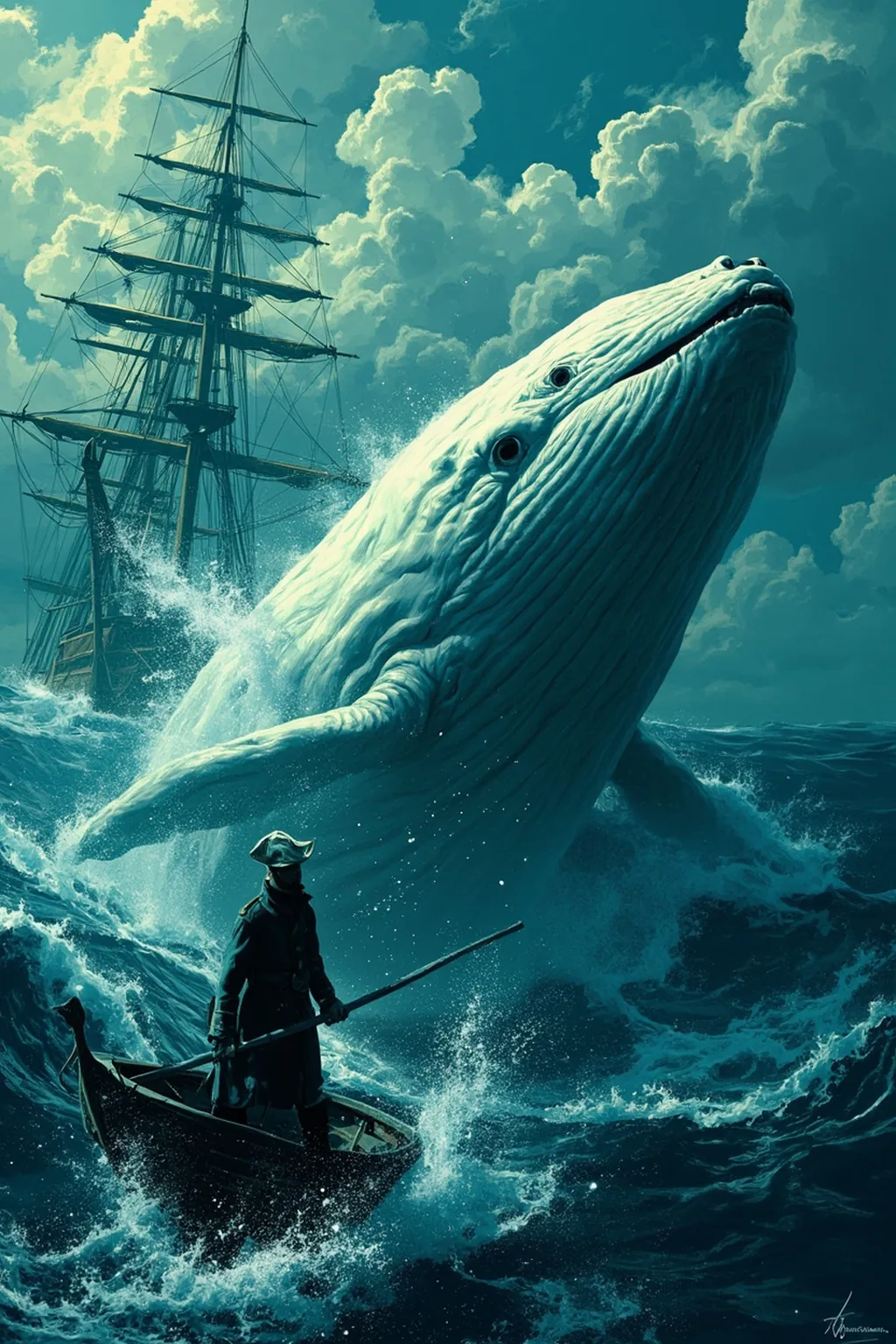
Jeroboam chief mate Macey, eager to hunt Moby Dick despite Gabriel’s repeated warnings, convinced five crew members to man a whale boat for the hunt. Gabriel took position on the main-royal masthead, hurling frantic prophecies of doom for attacking the whale he claimed was a divine incarnation. As Macey stood in the boat’s bow poised to throw his lance, Moby Dick surfaced suddenly, the broad white shadow of his body temporarily knocking the breath out of the oarsmen. The whale then struck Macey bodily, sending him flying through the air in a long arc before he fell into the sea 50 yards away and sank permanently. No part of the whale boat was damaged, nor were any of the oarsmen harmed, and when Macey’s body was later recovered, it bore no marks of violence— a type of fatal accident that is nearly as common as any other in the sperm whale fishery.
The Fatal Letter
After Mayhew finishes his story of Macey’s death, Ahab asks if he intends to hunt Moby Dick if the whale is sighted again, and Ahab confirms he will pursue the White Whale. Gabriel again leaps to his feet, warning Ahab he will meet the same blasphemous end as Macey. Ahab then remembers his letter bag, and asks Starbuck to check it for letters addressed to the Jeroboam’s crew. Starbuck finds a tattered, damp, mold-covered letter addressed to Mr. Harry Macey, the Jeroboam’s chief mate, which Ahab realizes is the very man Mayhew just told him was killed by Moby Dick. To avoid letting the Jeroboam’s boat come alongside the Pequod, Ahab has Starbuck attach the letter to the end of a cutting spade pole to hand it over at a distance, but as Ahab reaches the pole toward the boat, the Jeroboam’s oarsmen stop rowing so the boat drifts close enough for Gabriel to snatch the letter. Gabriel impales the letter on his boat knife and throws it back to the Pequod, where it falls at Ahab’s feet, before he shrieks at his crew to row away immediately.
Gabriel’s Defiance
When Ahab attempts to pass the letter intended for the deceased Macey to the Jeroboam’s boat via a pole to avoid close contact, Gabriel seizes the letter as soon as it comes within reach, impales it on his boat knife, and hurls it back onto the Pequod’s deck at Ahab’s feet. He then shrieks a warning to Ahab that he is headed for the same fate as Macey, before yelling at his crew to row away at full speed, sending the Jeroboam’s boat rapidly fleeing from the Pequod.
CAPÍTULO 72. The Monkey-Rope.
The narrator, acting as the bowsman, keeps his harpooneer Queequeg tethered to the ship by a monkey-rope during the perilous work of cutting‑in a whale, a rope that fastens to both men so that if one sinks the other will be dragged down with him. While Queequeg toils on the whale’s back amid rolling seas and circling sharks, the narrator jerks the rope to pull him clear of crushing between the whale and the hull, and two other sailors swing whale‑spades to keep the predators at bay. After the ordeal the steward offers Queequeg a cup of tepid ginger water, provoking an indignant protest from Stubb, who demands proper spirits for the harpooneer; the narrator then retrieves a flask of rum to replace the useless ginger.
The Cutting-In Scene
The chapter opens with a description of the chaotic and mobile nature of the cutting-in operation aboard a whaling vessel. The crew must constantly move about as different tasks require attention at various locations simultaneously. The narrative retraces earlier events, explaining how the blubber-hook gets inserted into the hole cut by the spades of the mates. This duty falls to Queequeg, who must descend onto the whale’s back for this specific purpose.
Queequeg on the Whale
The harpooneer often must remain on the whale throughout the entire flensing operation. The whale lies mostly submerged, with only the parts being worked on visible above water. Queequeg scrambles about ten feet below deck level, caught between the massive revolving carcass and the water. On this particular occasion, he wears Highland costume—shirt and socks—which the narrator finds unusually becoming.
The original text of this work is in the public domain. This page focuses on a guided summary article, reading notes, selected quotes, and visual learning materials for educational purposes.