The Line Burns
The line burns against Stubb’s hands as he holds it, resembling a sharp two-edged sword that the enemy constantly tries to wrench away. He must maintain his grip despite the searing pain as the whale runs with the line.
Wetting the Line
Stubb cries “Wet the line!” to the tub oarsman, who snatches off his hat and dashes seawater onto it. More turns are taken around the loggerhead until the line begins holding its place, with the boat now flying through the water like a shark with all fins.
Riding the Line
The vibrating line extends the entire length of the boat, tighter than a harpstring, giving the craft the appearance of having two keels—one cleaving water, the other the air. A continual cascade plays at the bows while a ceaseless whirling eddy forms in the wake. Even the slightest motion causes the cracking craft to cant over its gunwale into the sea. Tashtego crouches almost double at the steering oar to lower his center of gravity as they rush across the water.
Changing Places
Stubb and Tashtego change places—stem for stern—a staggering, precarious business in that rocking commotion. The maneuver requires careful coordination as the boat continues its violent pursuit of the whale.
Hauling In
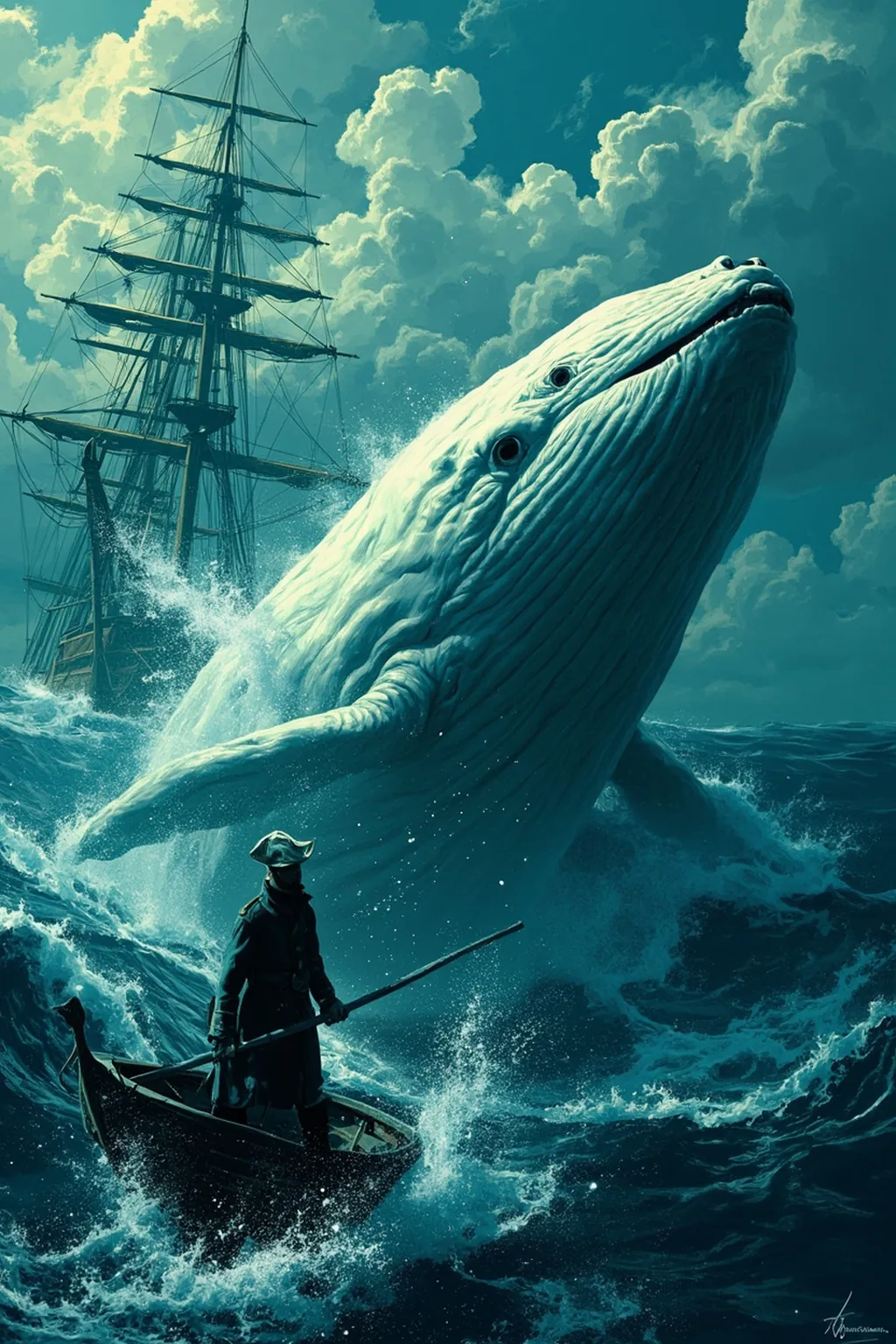
As the whale slackens his flight, Stubb cries “Haul in—haul in!” to the bowsman. All hands pull the boat up alongside the whale while it tows them along. Ranging up by the whale’s flank, Stubb firmly plants his knee in the cleat and darts harpoon after harpoon into the flying fish.
The Lance Thrusts
Red tide pours from the monster like brooks down a hill. The whale’s tormented body rolls not in brine but in blood, bubbling and seething for furlongs behind. The slanting sun plays upon this crimson pond, sending back reflection into every face so that all glow red like red men. Jet after jet of white smoke agonizingly shoots from the whale’s spiracle while Stubb vigorously hauls in upon his crooked lance and straightens it again and again against the gunwale, sending it into the whale repeatedly.
The Final Thrust
As the whale’s wrath wanes, Stubb cries “Pull up—close to!” and ranges the boat along the fish’s flank. Reaching far over the bow, Stubb slowly churns his long sharp lance into the fish, carefully churning and churning as if seeking to feel after some gold watch the whale might have swallowed. That gold watch proves to be the whale’s innermost life.
The Flurry
The monster starts from its trance into what whalers call a “flurry,” horribly wallowing in its blood and overwrapping itself in impenetrable, mad, boiling spray. The imperilled craft instantly drops astern and struggles blindly to escape from that phrensied twilight into the clear air of day.
The Death
The whale abates in its flurry and rolls out into view once more, surging from side to side with spasmodic, cracking, agonized respirations. Gush after gush of clotted red gore shoots into the frighted air, then falls dripping down the whale’s motionless flanks into the sea. The whale’s heart has burst.
Stubb’s Ashes
Daggoo announces “He’s dead, Mr. Stubb.” Stubb confirms “Both pipes smoked out!” and withdrawing his own pipe from his mouth, scatters the dead ashes over the water. For a moment he stands thoughtfully, eyeing the vast corpse he has made.
CHAPITRE 62. The Dart.
The chapter criticizes the standard whaling practice of requiring the harpooneer to perform the exhausting double duty of rowing vigorously while also being poised to throw his harpoon at a moment’s notice. Ishmael describes how the harpooneer must strain at the oar, shout loudly to inspire the crew, then suddenly pivot, drop his oar, and cast his heavy iron at the whale, often from a distance of twenty or thirty feet. The author argues that this system results in abysmal success rates, noting that out of fifty fair chances to dart, not more than five succeed, and that many harpooneers burst blood vessels, get cursed and demoted, or cause their ships to lose money. He contends that the headsman should remain stationary in the bows from beginning to end, darting both harpoon and lance without being expected to row, maintaining that exhaustion rather than the whale’s speed causes most failures in the fishery.
The original text of this work is in the public domain. This page focuses on a guided summary article, reading notes, selected quotes, and visual learning materials for educational purposes.