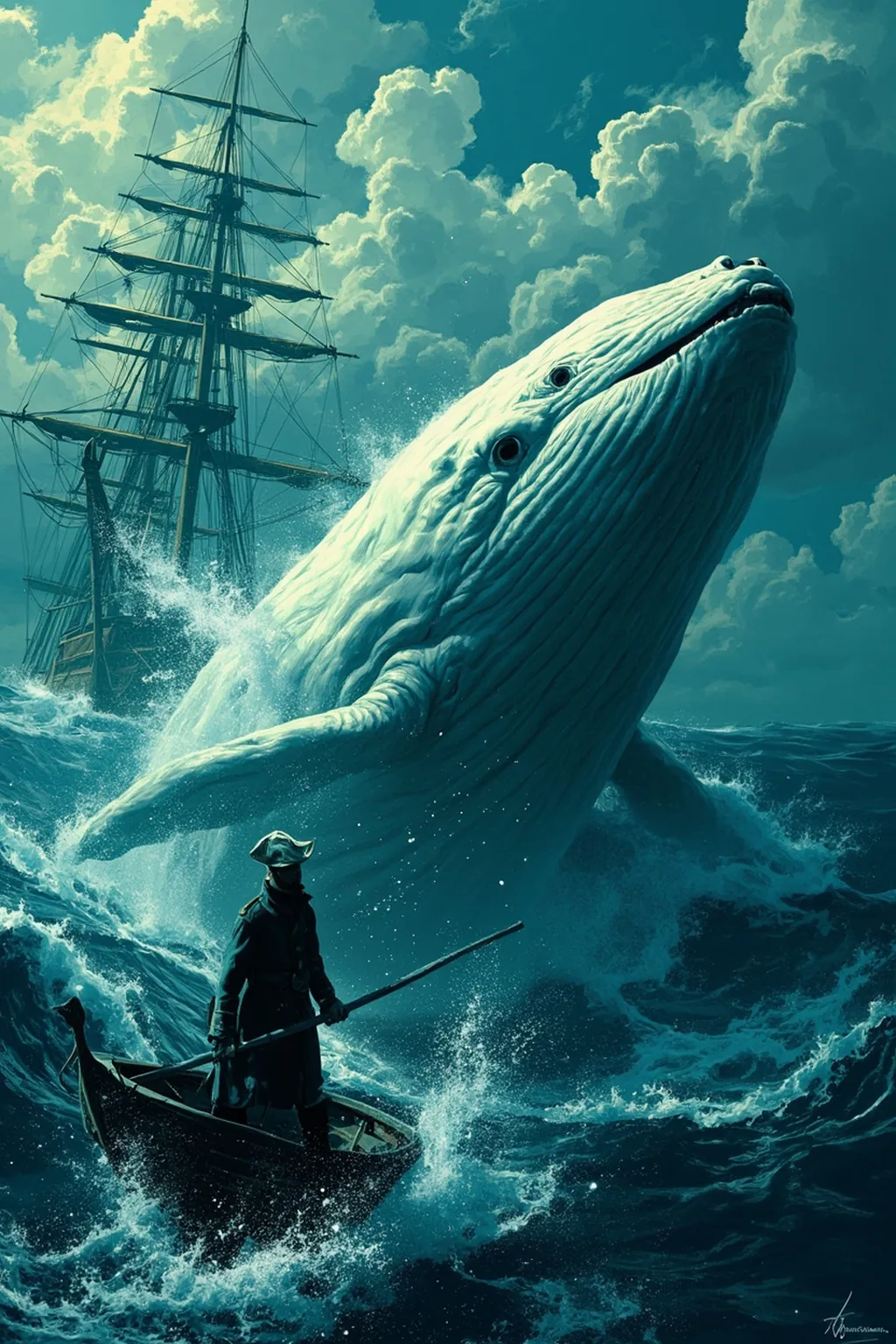
Queequeg Proves Harpoon Skill, Secures Crew Spot
Peleg interrupts the religious debate by dismissing concerns about paperwork, instead focusing on practical skill. He asks Queequeg if he has ever stood in the head of a whale-boat and struck a fish. Without speaking, Queequeg demonstrates his expertise by leaping onto the bulwarks, entering a whale-boat, and bracing himself with harpoon poised. He offers a vivid explanation: if one could see a small drop of tar on water, and that tar represented a whale’s eye, he could strike it dead. With that, he darts the harpoon across the ship’s decks, striking the distant tar spot with precision and removing it entirely. This extraordinary display convinces Peleg immediately. He calls to Bildad to fetch the ship’s papers, insisting they must secure “Hedgehog” (Queequeg) for one of their boats. Peleg offers Queequeg the exceptional “ninetieth lay”—a highly favorable profit-sharing arrangement never before offered to a harpooneer from Nantucket. Thus, Queequeg’s savage skill earns him a place among the crew, transcending the religious objections raised by Bildad.
Signing Ceremony, Captains’ Religious Dispute, and Bildad’s Departure
When preparations for signing the shipping documents begin, Peleg asks whether Queequeg can write his name. Rather than faltering, Queequeg confidently takes the pen and copies onto the paper an exact replica of the round figure tattooed on his arm—the “his mark” that gives the chapter its title, reading “Quohog. his X mark.” Meanwhile, the pious Bildad cannot resist one final attempt at conversion. He places a religious tract titled “The Latter Day Coming; or No Time to Lose” in Queequeg’s hands, grasping them earnestly while warning him to abandon his Pagan ways, spurn idols, and avoid the “fiery pit” of damnation. Peleg interjects sharply, declaring that “pious harpooneers never make good voyagers” because religious fear destroys the shark-like aggression necessary for whaling. He recounts how Nat Swaine, once the bravest whaler from Nantucket, became worthless after joining a church and fearing for his soul. Bildad responds by invoking the typhoon when the Pequod lost three masts while Peleg served as mate with Captain Ahab, asking how Peleg could have dismissed thoughts of Death and Judgment during such peril. Peleg counters that survival—not salvation—was his focus during the crisis. Unable to resolve this philosophical disagreement, Bildad silently buttons his coat and departs to oversee sailmakers mending a top-sail, leaving the captains’ dispute unresolved and highlighting the fundamental tension between religious devotion and the pragmatic courage required for the dangerous whaling trade.
CHAPITRE 19. The Prophet.
Queequeg and the narrator have just signed on to the whaling ship Pequod and are walking away from the vessel when they are stopped by a shabbily dressed, smallpox-scarred stranger who engages them in cryptic, ominous conversation about Captain Ahab and their upcoming voyage.
Initial Encounter with the Ragged Stranger
The stranger, clad in a faded jacket, patched trousers, and a tattered black handkerchief around his neck, with a face heavily pocked and scarred by smallpox, stops Queequeg and the narrator as they walk away from the Pequod. He asks them repeatedly if they have shipped on the vessel, pointing directly at the Pequod with a rigid, extended finger to emphasize his question.
Stranger Probes Knowledge of Captain Ahab
The stranger asks if the pair has met “Old Thunder,” the nickname he says old sailors use for Captain Ahab, and questions whether they have seen Ahab yet. When the narrator notes Ahab is currently ill but expected to recover soon, the stranger scoffs, claiming his own left arm will only heal when Ahab is fully recovered.
Stranger Shares Rumors of Ahab’s Past
The stranger demands to know what the pair have been told about Ahab, then lists obscure, dramatic rumors about the captain: a three-day illness off Cape Horn, a deadly fight with a Spaniard before an altar in Santa, spitting into a silver calabash, and the loss of his leg to a sperm whale on the last voyage per a prophecy. He notes most of these stories are not widely known outside of old sailor circles.
The original text of this work is in the public domain. This page focuses on a guided summary article, reading notes, selected quotes, and visual learning materials for educational purposes.