Repulsion of Unnatural Whiteness in Albino People
The narrator notes that whiteness loses its positive, glorious associations when applied to human albinos, whose all-over pale skin makes them an object of revulsion and shock even to their own family members, despite having no other physical deformities. This reaction, he argues, highlights the unnatural, unsettling quality of whiteness when stripped of its culturally sanctioned, familiar positive contexts.
Whiteness as a Marker of Supernatural Terror
The narrator points out that both natural forces and human malice use whiteness to signal and amplify terror: the “White Squall” of the Southern Seas takes its name from its pale, ghostly appearance, and the White Hoods of Ghent used white masks to amplify the horror of their violent rebellion when they murdered their bailiff in a public square, making their act feel even more supernatural and dreadful.
Pallor of Death and Spectral White Imagery
The narrator draws on common universal human experience to tie whiteness to supernatural terror: the pale pallor of a dead body is the most frightening feature of death, leading to the widespread tradition of white burial shrouds, and white is the color associated with ghosts, mist, and even the pale horse of the Fourth Horseman of the Apocalypse, the personification of death itself.
Inherent Dread of Whiteness Without Positive Associations
The narrator concludes that even when whiteness is stripped of all positive, familiar associations, it still carries an inherent, instinctive dread for the human soul, calling up a peculiar, unsettling apparition in the mind that cannot be explained by rational analysis of its usual symbolic meanings.
The Mariner’s Superstitious Fear of Milky Seas
The narrator uses the example of a sailor traveling through a midnight sea of milky white water to illustrate this instinctive dread: while the sailor would feel only sharp, rational alertness to hidden rocks near a foreign coast, the pale, uniform whiteness of the “milky sea” inspires a silent, superstitious terror that overwhelms him, far more frightening than the actual risk of shipwreck, even if he cannot consciously articulate that the whiteness itself is the source of his fear.
Contrasting Reactions to Snowy White Scenery
The narrator contrasts reactions to snowy white landscapes to show how context shapes the terror of whiteness: a Peruvian Indigenous person or a Western backwoodsman may view snow-covered mountains or prairies with relative indifference, seeing only desolate but familiar scenery, while a sailor in Antarctic waters sees a similarly blank white landscape of ice as a spectral, churchyard-like horror, full of looming, ghastly ice monuments and splintered crosses that seem to grin at him.
The Spooked New England Colt and Unnatural Whiteness
The narrator closes with the example of a young Vermont colt, raised far from any natural predators, who will panic and flee in terror if presented with the smell of a buffalo robe, even though he cannot see it and has no memory of bison or related dangers. This instinctive fear of an unfamiliar, wild scent tied to a white object, he argues, mirrors the broader, instinctive human dread of whiteness when it is divorced from familiar, positive contexts.
CHAPITRE 42. The Whiteness of the Whale.
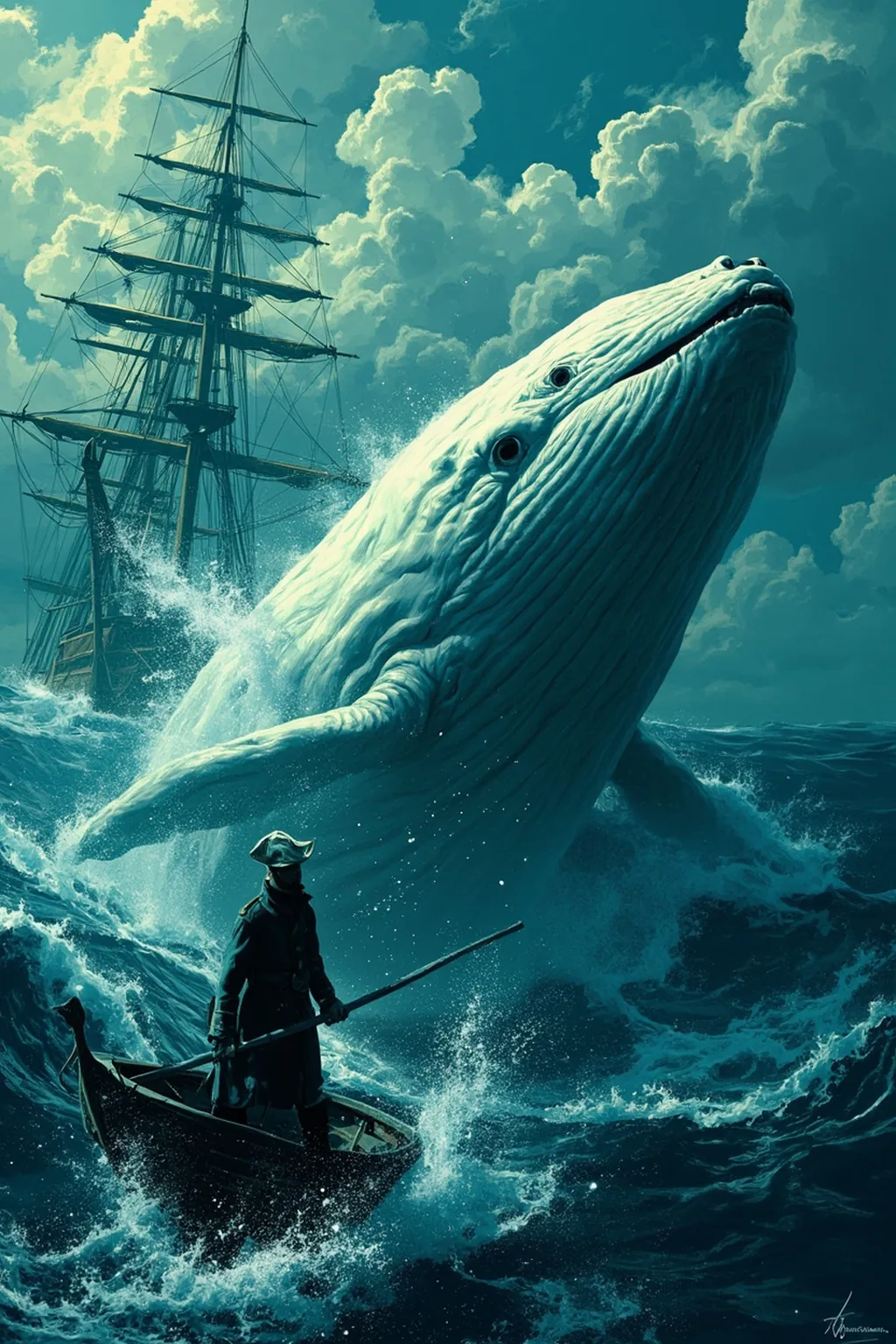
This chapter, titled The Whiteness of the Whale, explores the paradoxical, multifaceted power of whiteness, examining its dual role as a symbol of divine spirituality and a trigger for primal, cosmic terror, alongside its connections to animal instinct, the structure of visible and invisible existence, and the deceptive nature of earthly color.
Demonism Instinct in Bison and Prairie Foal
Even non-human animals carry an instinctual awareness of the “demonism” present in the world: bison herds driven by savage musk may trample young wild prairie foals that share their range, a dynamic Ishmael likens to the instinctual terror evoked by vast white natural landscapes such as milky seas, frost-covered mountains, and windrowed prairie snows.
Ishmael’s View of Natural Phenomena as Omens
Ishmael frames muted natural phenomena—including the rolling of milky seas, the rustle of mountain frosts, and the shifting of prairie snow drifts—as ominous, mystical signs that carry unspoken hints of nameless, unknown forces, much like the frightening presence of a buffalo robe is to a skittish colt, even if neither can fully grasp the nature of the unseen things they sense.
The original text of this work is in the public domain. This page focuses on a guided summary article, reading notes, selected quotes, and visual learning materials for educational purposes.